
If your BMI says one thing and your jeans say another, you are not imagining it. BMI was invented in 1832 as a population statistic, not a personal body composition metric. It does not know how much muscle you have, where you carry weight, or whether you spent the last six months building glutes through reformer pilates. The number still matters because doctors use it. The number still misleads because it cannot tell muscle from fat. This calculator gives you the BMI value, the WHO category, and a pilates-aware interpretation matched to your activity tier. The basic answer is yours immediately. No email required.
Pilates BMI Calculator
Enter your sex, weight, height, and pilates activity tier. The basic BMI plus a pilates-aware interpretation appears immediately. No email needed for the basic answer.
Your BMI
Body Mass Index
0.0
Category
Note: BMI is a population screening tool, not a personal verdict. Body composition matters more than BMI for pilates princesses, especially those building muscle through reformer or strength work.
Get Your Personalized BMI + Body Composition Plan
We will send you a personalized interpretation of your BMI in context of your pilates activity tier, a step-by-step waist-to-hip ratio guide, body fat percentage estimation guidance, a 12-week pilates progression that prioritizes body composition over scale weight, and an anti-scale-anxiety framework. Free, no spam, easy unsubscribe.
How the Pilates BMI Calculator Works
The formula is simple: BMI equals your weight in kilograms divided by your height in meters squared. The calculator handles the unit conversion automatically when you toggle between lbs and kg or between feet/inches and centimeters. The result rounds to one decimal place, which matches how most clinical BMI references are written.
The output has three layers. First, the BMI value itself. Second, the WHO category: Severely Underweight (under 16.0), Underweight (16.0 to 18.4), Healthy Weight (18.5 to 24.9), Higher Weight (25.0 to 29.9), or Significantly Higher Weight (30.0 and above). The brand-voice labels soften the WHO clinical terminology without misrepresenting the underlying ranges. Third, and this is what makes this tool different from the dozens of generic BMI calculators online: a pilates-aware interpretation that uses your activity tier to estimate whether your BMI is muscle-driven, fat-driven, or mixed.
The activity tier you select does not change the BMI value. It changes the interpretation. A 26.5 BMI for a Sedentary visitor and a 26.5 BMI for an Active pilates princess are the same number with very different meanings. The calculator surfaces that distinction explicitly rather than leaving the visitor to guess.
The 6 BMI Categories
The WHO categories are universally cited but worth understanding before you act on them. Below is each range with what it generally means and what the brand-voice softer label translates to.
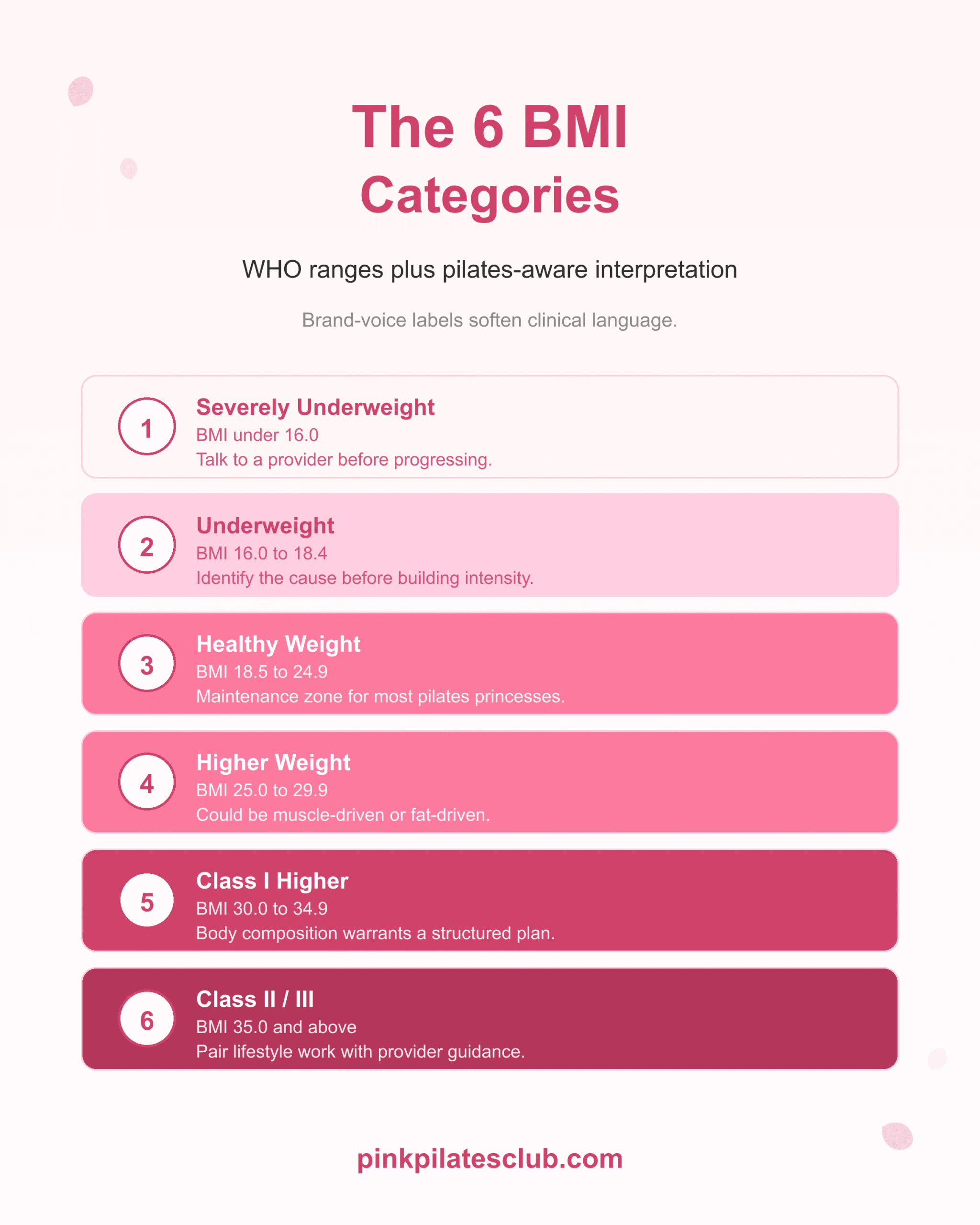
Severely Underweight (BMI under 16.0) and Underweight (BMI 16.0 to 18.4) both warrant a healthcare provider conversation before any structured pilates intensity progression. Underweight BMI can result from undereating, chronic stress, hormonal patterns, or medical conditions. Restorative pilates and gentle walking are fine; building intensity without identifying the cause is not. Healthy Weight (BMI 18.5 to 24.9) is the WHO-defined healthy range. Most pilates princesses who land here through consistent practice are in maintenance mode, with the goal being preservation through training and protein intake.
Higher Weight (BMI 25.0 to 29.9) is where the muscle-versus-fat distinction matters most. An Active pilates princess in this range likely has muscle-driven BMI; the number overstates fat mass. A Sedentary visitor in this range likely has fat-driven BMI; the number is more accurate. The activity tier input on the calculator surfaces this distinction directly. Significantly Higher Weight (BMI 30.0 and above, split into Class I 30.0-34.9 and Class II/III 35.0+) is where body composition shifts respond best to a structured plan that includes professional input. Pilates plus walking plus protein plus cortisol management can shift composition meaningfully but a BMI this high usually benefits from medical guidance alongside the lifestyle work.
Why BMI Is Limited for Pilates Princesses
BMI was designed in 1832 by Adolphe Quetelet as a population statistic for actuarial purposes. Insurance companies needed a quick way to estimate body composition across thousands of people without measuring each one. It was never meant to be a personal body composition metric. Below are the four reasons BMI specifically misleads pilates princesses.
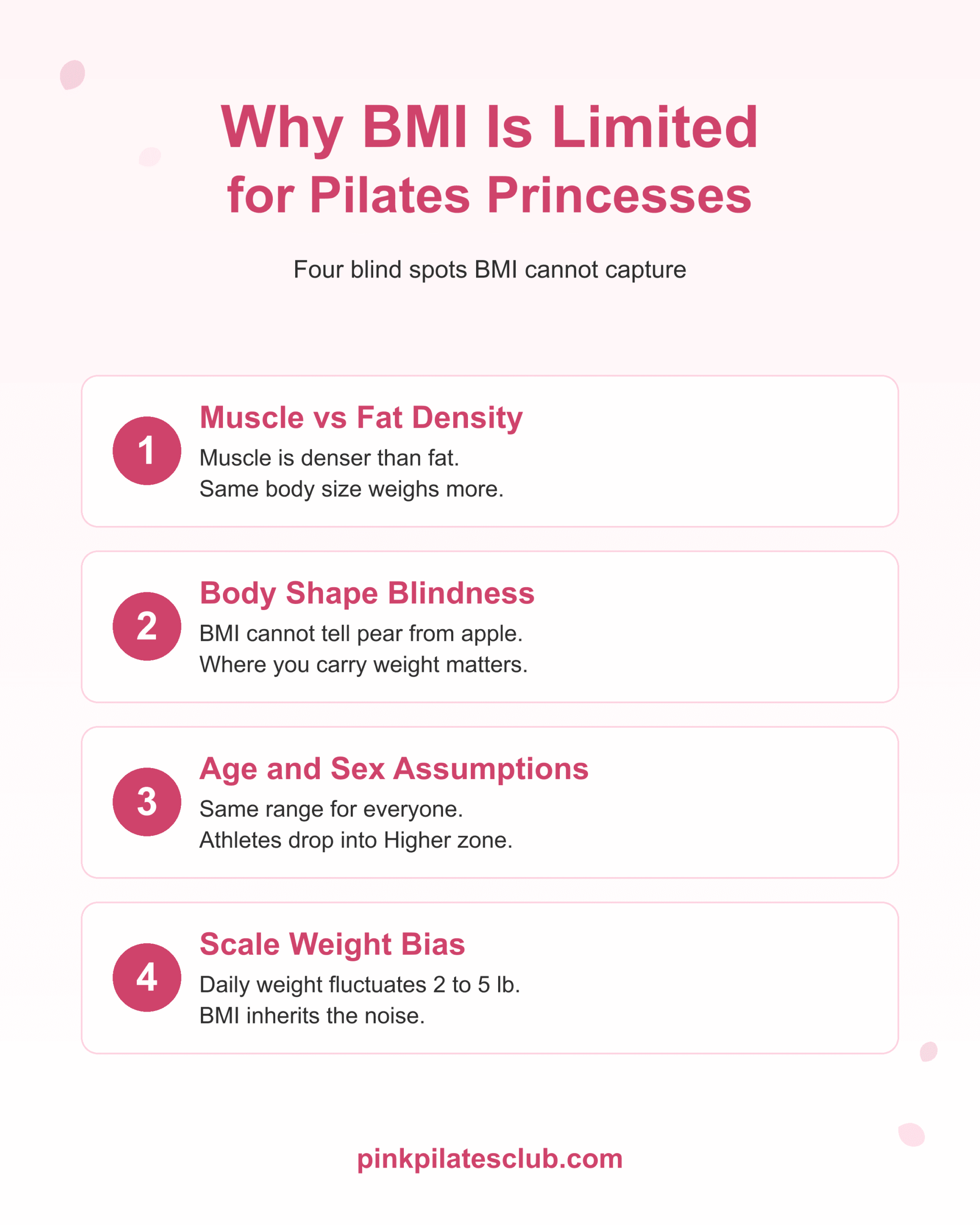
First, muscle versus fat density. Muscle is about 18 percent denser than fat. A pilates princess who has built glute, core, and arm muscle through reformer or wall pilates carries more weight at the same body size than a sedentary person of the same height. BMI cannot distinguish this; it sees the higher weight and labels her “Higher Weight” when her body fat percentage may be lower than someone in the “Healthy Weight” range. Second, body shape blindness. BMI does not know whether you carry weight in your hips and thighs (pear shape, lower metabolic risk) or your abdomen (apple shape, higher metabolic risk). The Waist-to-Hip Ratio Calculator covers this directly.
Third, age and sex assumptions. The WHO categories were derived from population averages and do not adjust for age, sex, or population subgroups. Women generally have higher healthy body fat ranges than men. Athletes generally have lower fat at the same BMI than sedentary individuals. Pilates princesses fall somewhere in the athletic category, which the WHO ranges do not anticipate. Fourth, scale weight bias. BMI uses scale weight, which fluctuates 2 to 5 pounds within a single day depending on hydration, glycogen storage, and digestion. A scale measurement at 6 a.m. on a Tuesday and a scale measurement at 8 p.m. on a Saturday produce meaningfully different BMI values for the same body composition.
Better Metrics to Pair with BMI
BMI is not useless. It is a starting point. The four metrics below give a more complete body composition picture for pilates princesses, and each one corrects a specific BMI blind spot.
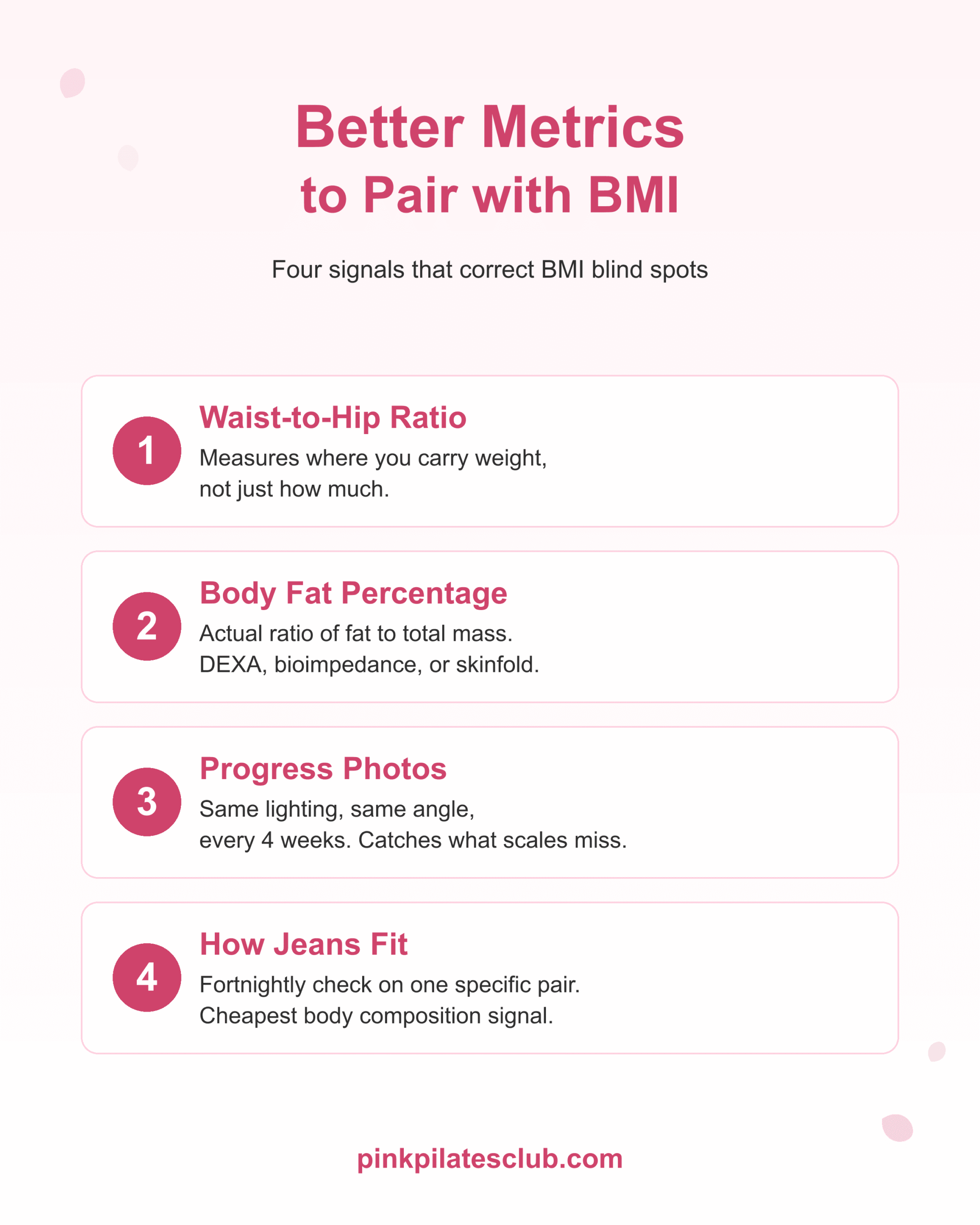
First, waist-to-hip ratio. The single most useful body composition metric for pilates princesses. Measures where you carry weight, not how much. Apple shape (high WHR) versus pear shape (low WHR) correlates with metabolic risk in ways BMI cannot capture. The Waist-to-Hip Ratio Calculator covers the math directly. Second, body fat percentage. The actual ratio of fat mass to total mass. Even a rough estimate via DEXA, bioimpedance, or skinfold calipers gives a far better composition picture than BMI alone. Most pilates princesses with a “Higher Weight” BMI but consistent reformer practice have body fat percentages in the healthy range, which BMI cannot show.
Third, progress photos. Same lighting, same angle, same time of day, every 4 weeks. Visible changes in body composition often appear in photos before they appear on the scale or in BMI. Fourth, the how-jeans-fit subjective check. The cheapest and most underrated body composition metric. A specific pair of jeans that you wear every two weeks tells you more about body composition trends than daily weighing does. Pilates princesses who replace daily weighing with a fortnightly jeans check report better consistency and lower scale anxiety. The brand philosophy supports this directly.
The 28-Day Flat Tummy Reset
Want a structured 4-week program that prioritizes body composition over BMI? The 28-Day Flat Tummy Reset stacks gentle deficit, intensity progression, and recovery balance so the body composition shifts compound across the month, regardless of what the BMI number does. Built for pilates princesses who care more about how their body looks and feels than what their scale says.
$89.97 · instant digital access
Frequently Asked Questions
Is BMI accurate for pilates princesses?
BMI is accurate as a population statistic and limited as a personal body composition metric. It cannot distinguish muscle from fat, where you carry weight, or your fitness level. For pilates princesses building muscle through reformer or wall work, BMI often overstates fat mass. Pair BMI with waist-to-hip ratio for a more useful picture.
What is a healthy BMI for women?
The WHO defines 18.5 to 24.9 as the healthy weight range for adults regardless of sex. Women generally have higher healthy body fat ranges than men, but BMI uses the same range for both. A BMI of 22 to 24 is the most common landing zone for active pilates princesses with consistent training and adequate protein intake.
Why does my BMI say overweight when I look fit?
Likely muscle-driven BMI. Pilates princesses training 3 to 5 sessions per week build glute, core, and arm muscle that BMI cannot distinguish from fat. Muscle is about 18 percent denser than fat, so the same body size weighs more for someone with more muscle. Use waist-to-hip ratio and progress photos to confirm; both correct this BMI limitation.
What is a better measure than BMI for pilates?
Waist-to-hip ratio is the single most useful upgrade. Body fat percentage (from DEXA, bioimpedance, or skinfold calipers) is more accurate but harder to access. Progress photos every 4 weeks and a fortnightly fit-check on a specific pair of jeans both correct BMI’s scale-weight bias without requiring any measurement at all.
Does building muscle through pilates raise BMI?
Yes, modestly. Most pilates princesses who go from sedentary to consistent practice gain 2 to 6 pounds of muscle over 6 to 12 months, which raises BMI by 0.4 to 1.2 points at the same height. The composition is healthier even though the BMI number rose. This is one of the strongest arguments for using waist-to-hip ratio and progress photos alongside BMI.
Should I worry about my BMI as a pilates princess?
Worry is the wrong frame. Use BMI as a screening signal, not a verdict. If your BMI is in the Healthy range, it is one positive signal among many. If your BMI is in the Higher Weight range, check whether it is muscle-driven or fat-driven before adjusting your practice. If your BMI is in Significantly Higher Weight or Underweight, talk to a healthcare provider rather than self-diagnosing through a calculator.
Your Next Step
You have your BMI, your category, and a pilates-aware interpretation that explains what the number likely means for your body composition. If you want a personalized BMI plus body composition plan, take the email plan offered above. If you are ready for a structured 4-week program that prioritizes body composition over the scale, the 28-Day Flat Tummy Reset is the next step. You do not need to chase a specific BMI number. You just need consistent practice and a clearer picture of what your body is actually doing.
Keep Reading
- the Pilates Calorie Burn Calculator for the per-session burn
- the Wall Pilates Calorie Burn Calculator for wall sessions
- our Pilates Weight Loss Calculator for pound projections
- the Pilates vs Yoga Calorie Comparison if you do both practices
- the Hormone Balance Quiz for hormone-driven body composition shifts
- the Posture Assessment Quiz, sister tool in body measurement
- the Pilates Protein Calculator for muscle-supporting daily targets
- the Anti-Bloat Food Quiz to find triggers that affect scale weight
- the Pilates Results Timeline so BMI changes match expectations
- the 7-Day Pilates Plan for a free starting week
- the Pilates Program Quiz for a structured plan match
- the Cycle Syncing Pilates Planner since cycle phase shifts scale weight
- the 30-Day Pilates Challenge for a structured month
- the Reformer Spring Resistance Calculator to load the right springs
- the Pilates Afterburn Calculator for post-session burn
- the Cortisol Stress Quiz since cortisol blocks body composition change
- the Postpartum Pilates Planner since BMI shifts after birth
- the Reformer Pilates Calorie Calculator for reformer sessions
- the Pilates TDEE Calculator for the daily energy picture
- the Pilates Heart Rate Zone Calculator for training intensity
- the Waist-to-Hip Ratio Calculator, the better metric than BMI
- the Pilates Workout Tracker to log sessions and track consistency