If you have ever stood in front of your reformer holding a spring in each hand wondering whether this is too heavy or too light, you are asking the right question. Most online reformer content tells you which exercises to do but not which springs to load, which is the difference between productive work and either crushed shoulders or a meaningless drift. This calculator uses the canonical Balanced Body spring system, with brand-specific color mapping for STOTT, Peak Pilates, Reformer Bo, and generic equipment, to recommend the right combination for your exercise and your level. The basic recommendation is yours immediately. No email required.
Reformer Spring Resistance Calculator
Pick your reformer brand, your exercise, and your level. The recommended spring combination appears immediately, free, no email needed for the basic recommendation.
Recommended Spring Combination
Total resistance
0 lbs
Get the Full Reformer Spring Cheat Sheet
We will send you the printable PDF cheat sheet covering all exercise and level combinations across 5 reformer brands, brand-specific spring conversion charts, and a 30-day reformer routine that uses the spring guidance throughout. Free, no spam, easy unsubscribe.
How the Reformer Spring Resistance Calculator Works
The calculator uses a four-slot spring system: Light, Medium, Heavy, Heaviest. The lbs values are anchored to the Balanced Body convention (6, 12, 16, 20 lbs respectively), which is the most documented standard in public reformer studios. STOTT, Peak Pilates, and Reformer Bo machines use slightly different absolute spring weights but the relative tensions are similar enough that the recommendations transfer cleanly. The brand selector changes which color name displays, not the underlying lbs.
For each combination of exercise type and fitness level, the calculator outputs a specific spring combo from the 4-slot system. Footwork at intermediate level uses Medium plus Medium plus Heavy, totaling 40 lbs. Arm Series at advanced level uses a single Medium spring, totaling 12 lbs. The combos reflect the real reformer principle that beginners benefit from more total springs for stability while advanced practitioners use fewer springs at higher individual load for control work.
The calculator does not attempt to be exhaustive. It covers the five most common exercise families: Footwork (lower body press work), Arm Series (upper body resistance), Core (abdominal and oblique work), Long Stretch (plank-based total body), and Stretching (mobility and recovery). Specialized exercises like long box, jump board, and short box variations are not included because their spring requirements depend more on the specific exercise than on a generic exercise family. Visitors needing those specifics should consult the certified instructor at their studio.
The 4 Spring Tensions and What They Do
Most reformers use a 4-spring system, though some Balanced Body machines include a half-spring or a fifth tension. Below is what each of the standard four tensions does and when to use it.
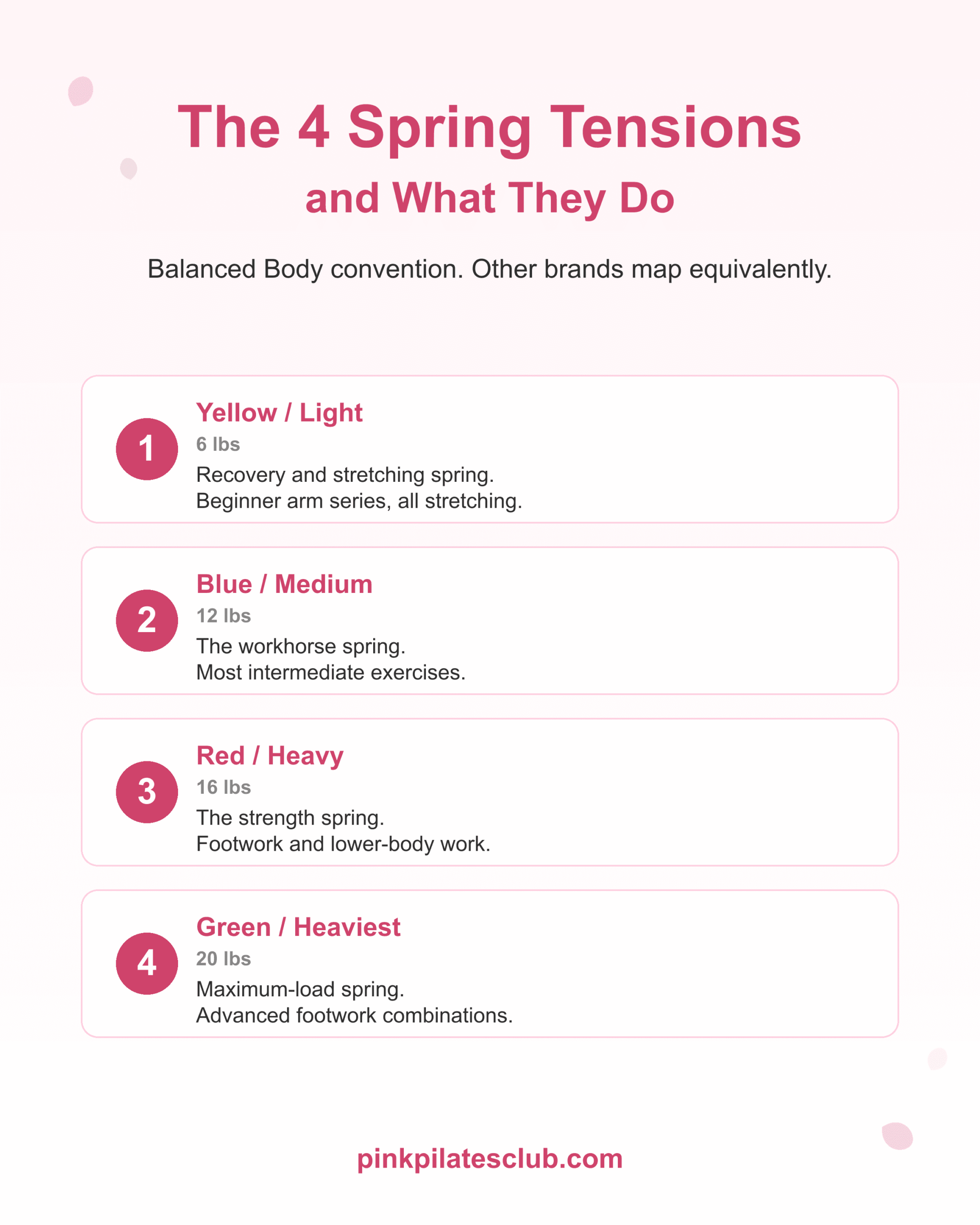
Light spring (Yellow on Balanced Body, 6 lbs) is the recovery and stretching spring. Used alone for arm series at beginner level, stretching at every level, and some core variations. It is also the right answer when you want to feel resistance without resistance being the point. Medium spring (Blue, 12 lbs) is the workhorse spring. Used in most intermediate exercises, paired with another spring for advanced control work, or alone for advanced arm series. Most pilates princesses spend more time on the Medium spring than any other.
Heavy spring (Red, 16 lbs) is the strength spring. Footwork, advanced core, long stretch, and most lower-body strength work uses Heavy alone or paired with Medium. The Heavy spring is what makes reformer feel like real strength training when paired correctly. Heaviest spring (Green on Balanced Body, Black on Peak Pilates, 20 lbs) is the maximum-load spring. Used rarely, mostly for footwork combinations needing the highest resistance, or for advanced practitioners during specific sustained holds. Most pilates princesses do not need to load the Heaviest spring on a regular basis.
Spring Combinations by Exercise Type
Below is the canonical spring combination chart for the five exercise types at intermediate level. Beginner and advanced versions adjust the load up or down within the same exercise family.
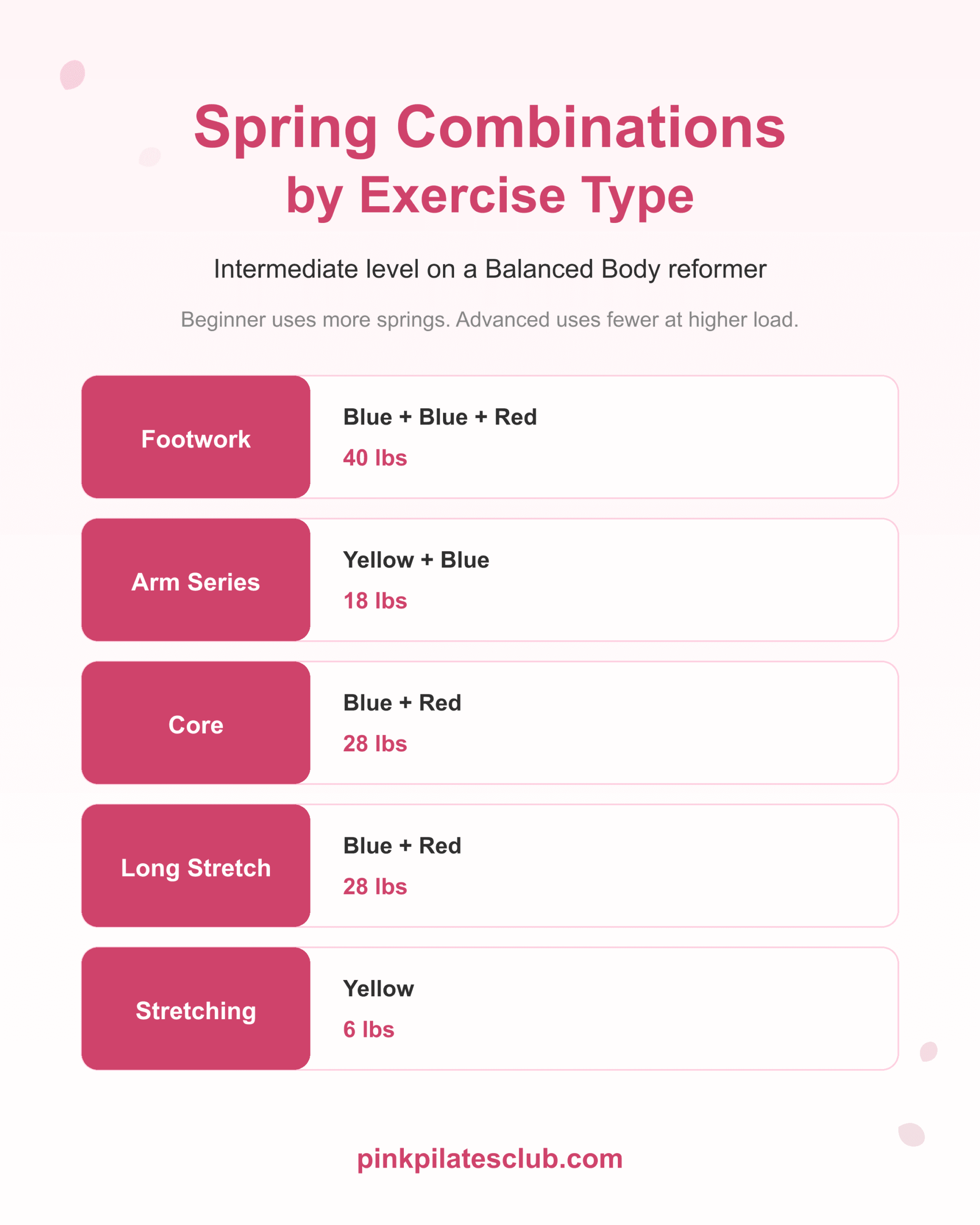
Footwork at intermediate level uses Medium plus Medium plus Heavy (40 lbs total). The three-spring stack gives strong glute and quad activation while keeping the carriage controlled enough to focus on alignment. Arm Series at intermediate level uses Light plus Medium (18 lbs). The two-spring combo provides enough resistance to feel scapular work without overwhelming the smaller upper-body muscles.
Core exercises at intermediate level use Medium plus Heavy (28 lbs). The combo challenges the deep core while maintaining the stability the carriage needs for productive abdominal work. Long Stretch at intermediate level uses Medium plus Heavy (28 lbs) for the same reason — the plank-based work needs significant resistance to feel like real strength training. Stretching uses Light spring alone (6 lbs) at every level, because the goal is mobility through full range, not resistance. Heavier springs in stretching limit range and defeat the purpose.
Why Spring Selection Matters More Than Most Pilates Princesses Realize
Wrong spring selection is the most common reason reformer sessions feel either too easy or genuinely painful. Most studios teach you the exercises but skim over the spring logic, leaving you to guess. The four reasons spring selection matters more than visitors expect:
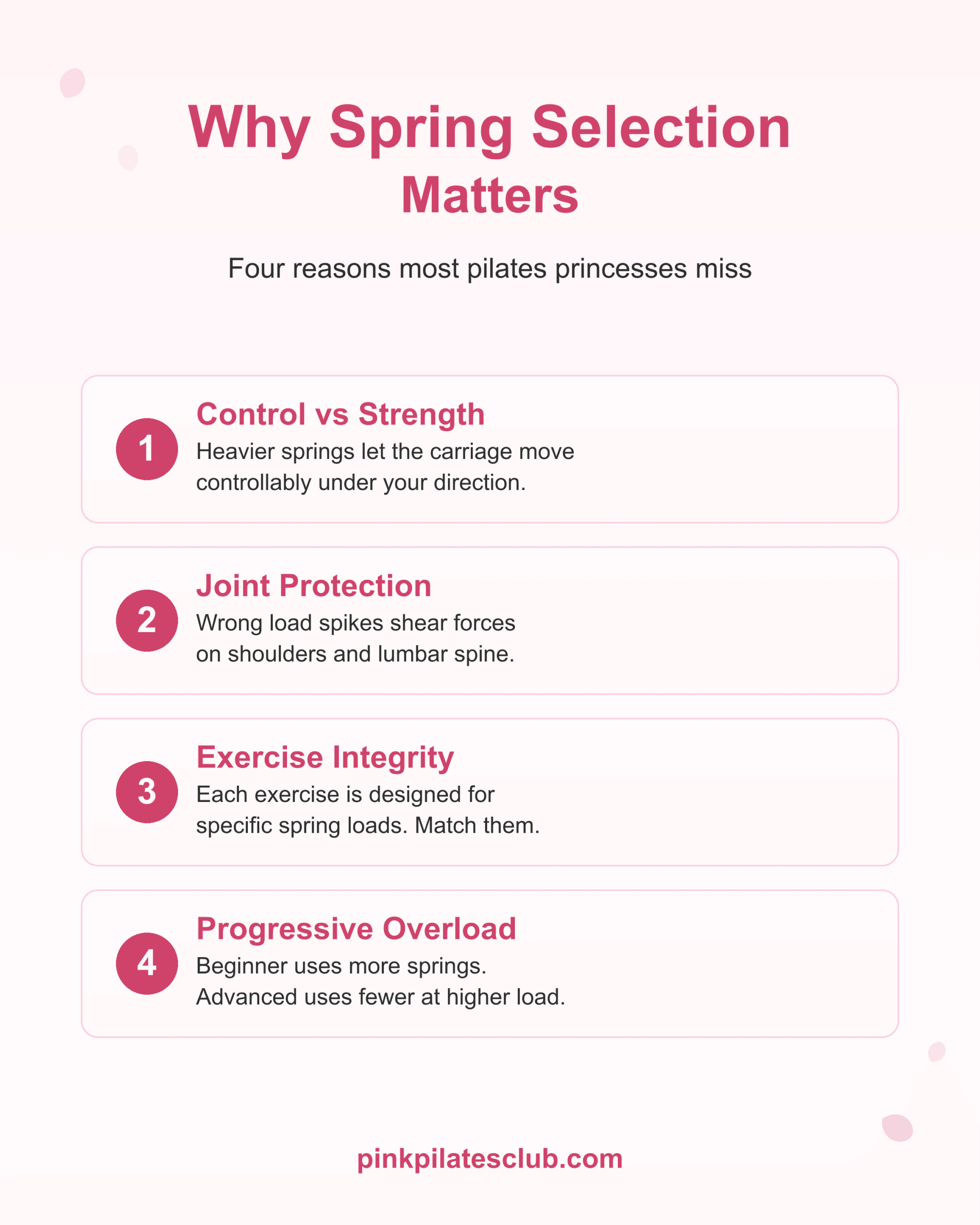
First, control versus strength. Heavier springs let the carriage move more easily under your control, which is why advanced arm series uses a heavier spring than beginner arm series — the goal is precision, not maximum effort. Lighter springs make the carriage drift, which forces beginners to over-stabilize. The right spring lets you focus on the muscle, not the equipment. Second, joint protection. Too-heavy springs in core or arm work spike shear forces on shoulders and lumbar spine. Too-light springs in footwork let the knees collapse inward. The right combo protects the joints by matching load to capacity.
Third, exercise integrity. Reformer exercises are designed for specific spring loads. Doing footwork with arm-series springs means the exercise simply does not work as designed. The lower body is under-loaded, the alignment cues do not land, and the visible adaptation never arrives. Fourth, progressive overload. As you advance, the spring combinations change in non-obvious ways. Beginner-to-intermediate often means more total springs. Intermediate-to-advanced often means fewer springs at higher individual load. Following the progression is how reformer produces the visible body composition results pilates princesses come for. Random spring loading flattens the progression curve.
The 30-Day Full Body Pilates Program
Want a structured monthly program that uses spring guidance like this throughout? The 30-Day Full Body Pilates includes mat-and-reformer-friendly variations with spring callouts on the reformer days. Built for pilates princesses who want progression, not random session selection.
$99.97 · instant digital access
Frequently Asked Questions
How do I know which springs to use on a reformer?
The exercise type and your level determine the combo. The calculator above gives the canonical recommendation for the five most common exercise families. Beginners benefit from more total springs for stability. Advanced practitioners often use fewer springs at higher individual load for control work.
Is heavier always more challenging on a reformer?
No, and this is the most common misconception. Heavier springs make the carriage easier to control because there is more resistance opposing your movement. Lighter springs make the carriage drift more, which is harder to stabilize. The right load matches the exercise principle, not maximum weight.
Why do my reformer instructors use different springs than me?
Instructors often demonstrate at higher loads to show the exercise mechanics, then dial back for student work. They may also have different leverage and capacity. Match the recommendation to your level rather than copying the instructor's load directly.
What is the difference between Balanced Body and STOTT spring colors?
Balanced Body uses Yellow, Blue, Red, Green for light to heaviest. STOTT uses Light, Medium, Full, Heavy without color codes. Peak Pilates uses Yellow, Blue, Red, Black. The absolute lbs differ slightly between brands but the relative tensions are similar enough that recommendations transfer cleanly.
Can I do reformer exercises with no springs?
Yes, for some exercises. Zero-spring work uses gravity and your bodyweight against the carriage. Most useful for stretching variations and certain rotational core work. Most strength exercises require at least one spring to provide the resistance the exercise was designed around.
How do I know if a spring is too heavy or too light?
Too heavy: you cannot complete full range of motion, form breaks, joints feel strained. Too light: the carriage drifts uncontrollably, you cannot feel the target muscles working, alignment cues do not land. The right load lets you maintain form through full range while feeling the target muscle clearly.
Your Next Step
You now have the canonical spring combinations for the five most common reformer exercise families across all three fitness levels and five major brands. If you want the full printable cheat sheet plus a 30-day reformer-friendly routine, take the email plan offered above. If you are ready for a structured monthly program with spring guidance throughout, the 30-Day Full Body Pilates includes mat-and-reformer variations. You do not need to be perfect. You just need to load the right springs.
Keep Reading
- the Pilates Calorie Burn Calculator to see what your reformer sessions burn
- the Wall Pilates Calorie Burn Calculator if you also do wall work
- our Pilates Weight Loss Calculator for pound projections
- the Pilates vs Yoga Calorie Comparison if you do both practices
- the Hormone Balance Quiz for the symptom-side hormone read
- the Posture Assessment Quiz to track structural alignment
- the Pilates Protein Calculator for daily targets
- the Anti-Bloat Food Quiz to find your bloating triggers
- the Pilates Results Timeline to see when results land
- the 7-Day Pilates Plan generator for a free starting week
- the Pilates Program Quiz to match yourself to a structured plan
- the Cycle Syncing Pilates Planner for cycle-aware programming
- the 30-Day Pilates Challenge if you want a structured month
- real mat pilates results stories from pilates princesses
- the consistency tips that turn reformer sessions into real change