If you have ever caught your reflection in a window and noticed your shoulders rolling forward or your head jutting out, you already have a hunch. This 10-question posture assessment quiz turns the hunch into a number. The questions check the patterns most posture problems hide behind: hours at a desk, phone position, sleep alignment, breath depth, hip tightness, and where in your body the discomfort actually shows up. The result places you on one of four tiers, from Mostly Aligned to Significant Posture Concerns, and routes you to the exact next step. The basic result is yours immediately. No email required.
Posture Assessment Quiz
Ten questions. Honest answers. Your posture score and tier in 60 seconds. No email required for the basic result.
Question 1 of 10
Q1. Where do you experience the most discomfort?
Q2. How many hours per day do you spend at a desk or in front of a screen?
Q3. When you sit, how does your body land naturally?
Q4. How often do you look down at your phone?
Q5. Do you get tension headaches or jaw tension?
Q6. How do you sleep most nights?
Q7. Can you take a deep breath that fills your full ribcage?
Q8. When you see yourself in photos, do you notice rounded shoulders or a forward head?
Q9. How tight do your hips feel?
Q10. How often do you do dedicated posture or core work?
Your posture tier is
Your score: 0 of 29
Mostly Aligned
Score range: 0 to 7
Your posture is in the top tier. The fact that you took this quiz means you care, and your habits show it. The 14-Day Posture Fix becomes a maintenance protocol for you: keep the deep core engaged, hold your alignment under fatigue, and lock in the small daily routines that prevent drift over the next decade.
Lock In Your Alignment
14 days of gentle pilates routines that keep aligned bodies aligned. Maintenance work that protects against the slow drift most women only notice in their forties.
$39.97
Your score: 0 of 29
Early Posture Drift
Score range: 8 to 15
Your posture is mostly holding up but starting to drift. Mild signals: a little tension, occasional shoulder rounding, some tightness. This is the easiest tier to correct. The 14-Day Posture Fix bundles 14 days of gentle pilates routines specifically targeting the drift before it sets in. You will notice the difference in week one.
Reverse the Drift in 14 Days
A 14-day daily progression that reverses early posture drift before it becomes structural. Each session is short, gentle, and builds on the last.
$39.97
Your score: 0 of 29
Moderate Posture Issues
Score range: 16 to 22
Your body has been signaling for a while. Real symptoms across multiple zones: tension headaches, hip tightness, shoulder rounding, shallow breathing. This is fixable but it needs a structured plan, not random stretching. The 14-Day Posture Fix walks you through the exact daily routines and the form cues that retrain alignment in two weeks.
Address the Symptoms with a Structured Plan
A focused 14-day plan that targets multiple posture zones at once: neck, shoulders, deep core, hips. Daily routines plus the form cues that make every rep count.
$39.97
Your score: 0 of 29
Significant Posture Concerns
Score range: 23 to 29
Your symptoms have stacked. Daily discomfort, constant tension, multiple posture markers all firing at once. This is exactly when a structured plan matters most. The 14-Day Posture Fix gives you a daily progression that addresses the layers in order: nervous system first, deep core second, alignment third. If symptoms persist or worsen after 14 days, see a physical therapist for a hands-on assessment.
Start the Recovery Path with a Structured Plan
A step-by-step 14-day plan calibrated for stacked symptoms. Layered progression from nervous-system calm to deep core to alignment, with the option to combine with PT.
$39.97
Want a Personalized Posture Plan?
We will send you a custom 14-day routine tuned to your score tier, with the daily 5-minute reset for your dominant posture issue and long-term maintenance after the reset. Free, no spam, easy unsubscribe.
How the Posture Assessment Quiz Works
Each question carries 0 to 3 points. The answers most associated with poor posture earn the highest points. You answer 10 questions. The total is your posture score, between 0 and 29. The score maps to one of four tiers, each with a different urgency framing and a matched recommendation. There is no archetype routing here. Posture is one continuous spectrum, not separate categories.
This is a self-assessment quiz, not a medical evaluation. A physical therapist or chiropractor uses hands-on tests, gait analysis, and sometimes imaging to make precise calls. A 10-question quiz reads patterns. It is the right tool for catching drift early, sanity-checking your hunch, or deciding whether to invest in a structured 14-day reset. If your symptoms are severe or have lasted longer than three months, see a professional.
The four tiers were chosen to match the natural arc of posture work. Mostly Aligned visitors keep what they have. Early Drift visitors reverse small habits before they set in. Moderate visitors need a structured plan to address multiple zones at once. Significant Concerns visitors get a layered progression that calms the nervous system first, builds the deep core second, and retrains alignment third. Every tier benefits from the same core protocol, dialed to severity.
The 4 Posture Score Tiers
Here is the short version of each tier, so you can sanity-check the quiz result against your own experience. Most pilates princesses recognize themselves in one or two of these.
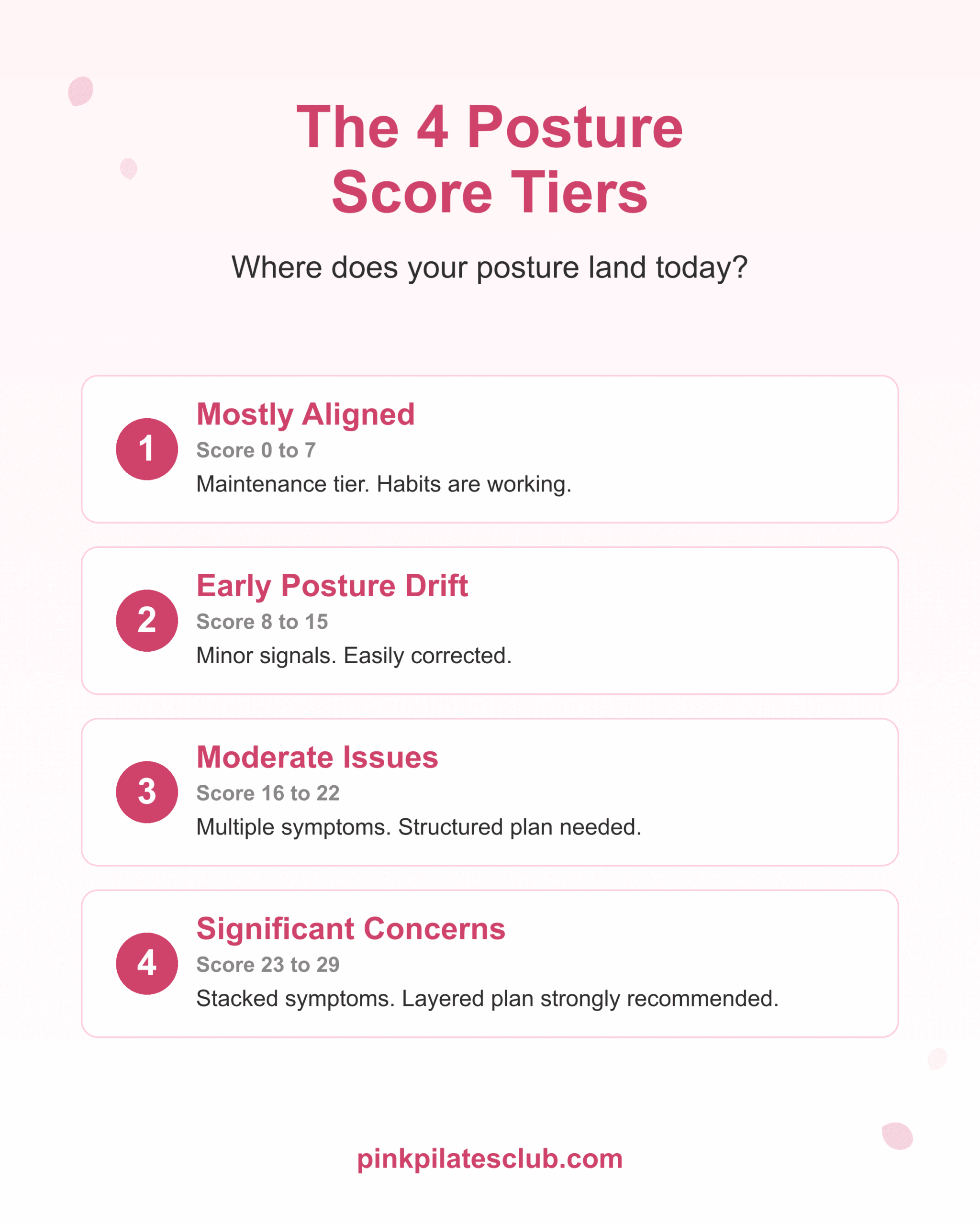
Mostly Aligned (score 0 to 7) is the maintenance tier. Your habits are working: you notice when you slouch, you do regular core work, your sleep position is reasonable. The 14-Day Posture Fix becomes preventive maintenance for you, locking in the alignment so the next decade of desk work and phone scrolling does not undo it.
Early Posture Drift (score 8 to 15) is the easiest tier to correct. You have minor signals: occasional shoulder rounding, mild tightness, light tension. Nothing has set in structurally. Two weeks of focused daily routines reverse most of it. The window is open and easy.
Moderate Posture Issues (score 16 to 22) is where most pilates princesses land if they have not been doing dedicated work. Symptoms across multiple zones at once: tension headaches, hip tightness, rounded shoulders, shallow breathing. This is fixable with a structured plan, not random stretching. The 14-Day Posture Fix walks through each zone in order.
Significant Posture Concerns (score 23 to 29) is the urgent tier. Daily discomfort, constant tension, multiple markers firing at once. This is exactly when a structured plan matters most. Two weeks of layered progression makes a real difference, and if symptoms persist after that, see a physical therapist for a hands-on assessment to rule out anything structural.
Why Posture Matters Beyond How It Looks
Most posture content sells you the cosmetic case: longer neck, taller line, the way you carry yourself in photos. That part is real, but it is not the strongest argument. The strongest argument is what happens inside your body when alignment is off.
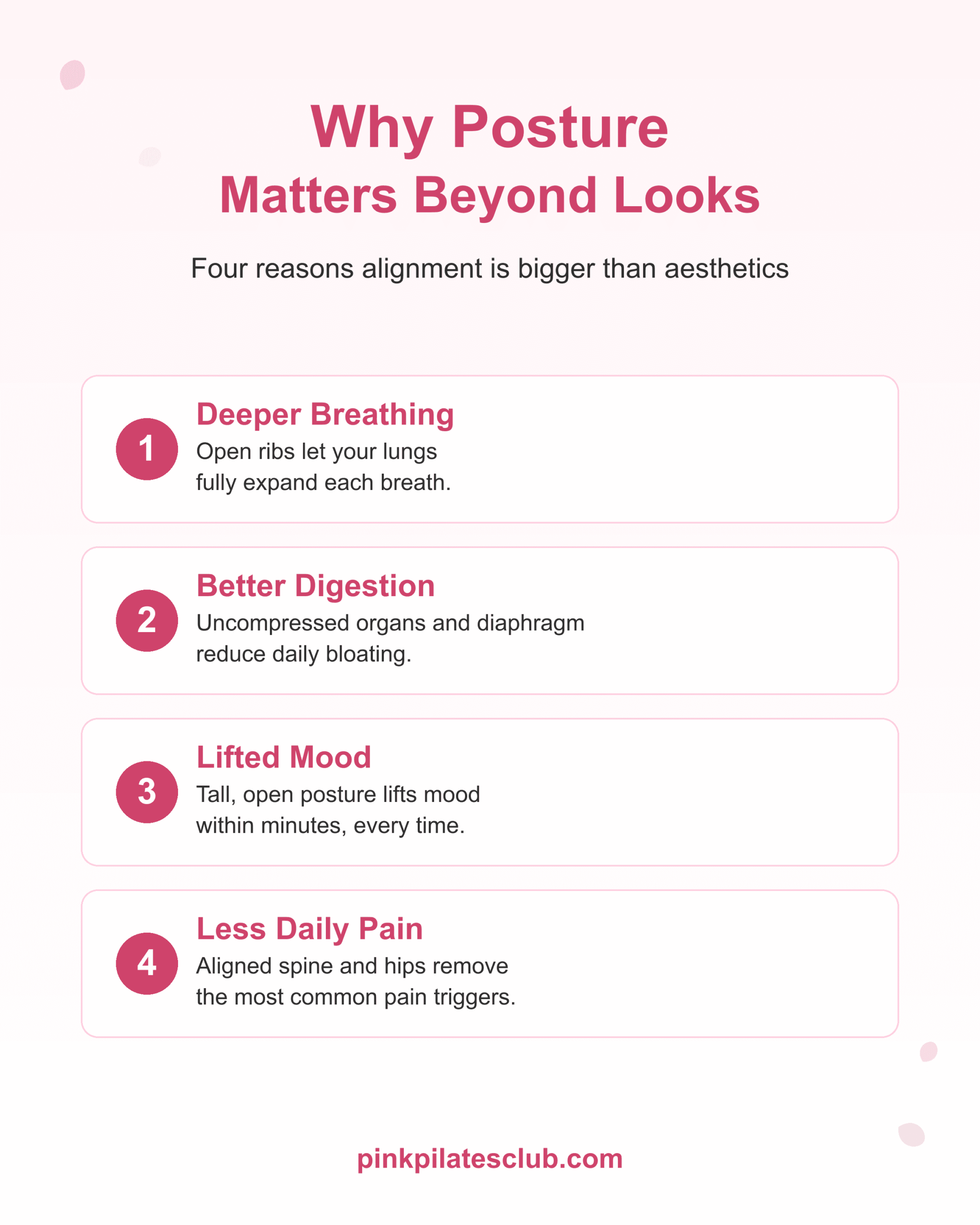
Rounded shoulders and forward head position compress the ribcage, which means your lungs cannot fully expand. Shallow breathing keeps the nervous system in a low-grade fight-or-flight state, which keeps cortisol elevated. Most women with chronic stress also have posture issues. The two reinforce each other.
A collapsed lower back compresses the digestive tract. Visitors with chronic bloating often have a posture component on top of the gut and hormone components. Pelvic alignment affects how the abdominal organs sit, how transit moves through, and how the diaphragm engages with breath. Better alignment, less daily bloating.
Posture also affects mood. Slumped sitting reliably lowers self-reported mood within minutes in lab studies. Tall, open posture lifts mood. The mind and body run on the same nervous system. When your body collapses, your mood follows. When you stand up and breathe deep, the mood follows too. And then there is the pain piece. Most chronic neck, upper back, and lower back pain has a posture component. Fix the alignment, the pain often eases without medication.
A Daily Posture Reset Routine
The quiz gives you a tier. The 14-Day Posture Fix gives you the structured plan. In the meantime, here is a 5-minute daily reset that works for every tier. Do it once in the morning and once in the afternoon. Layered with three to four pilates sessions a week, this routine alone shifts most Early Drift visitors into Mostly Aligned within a month.
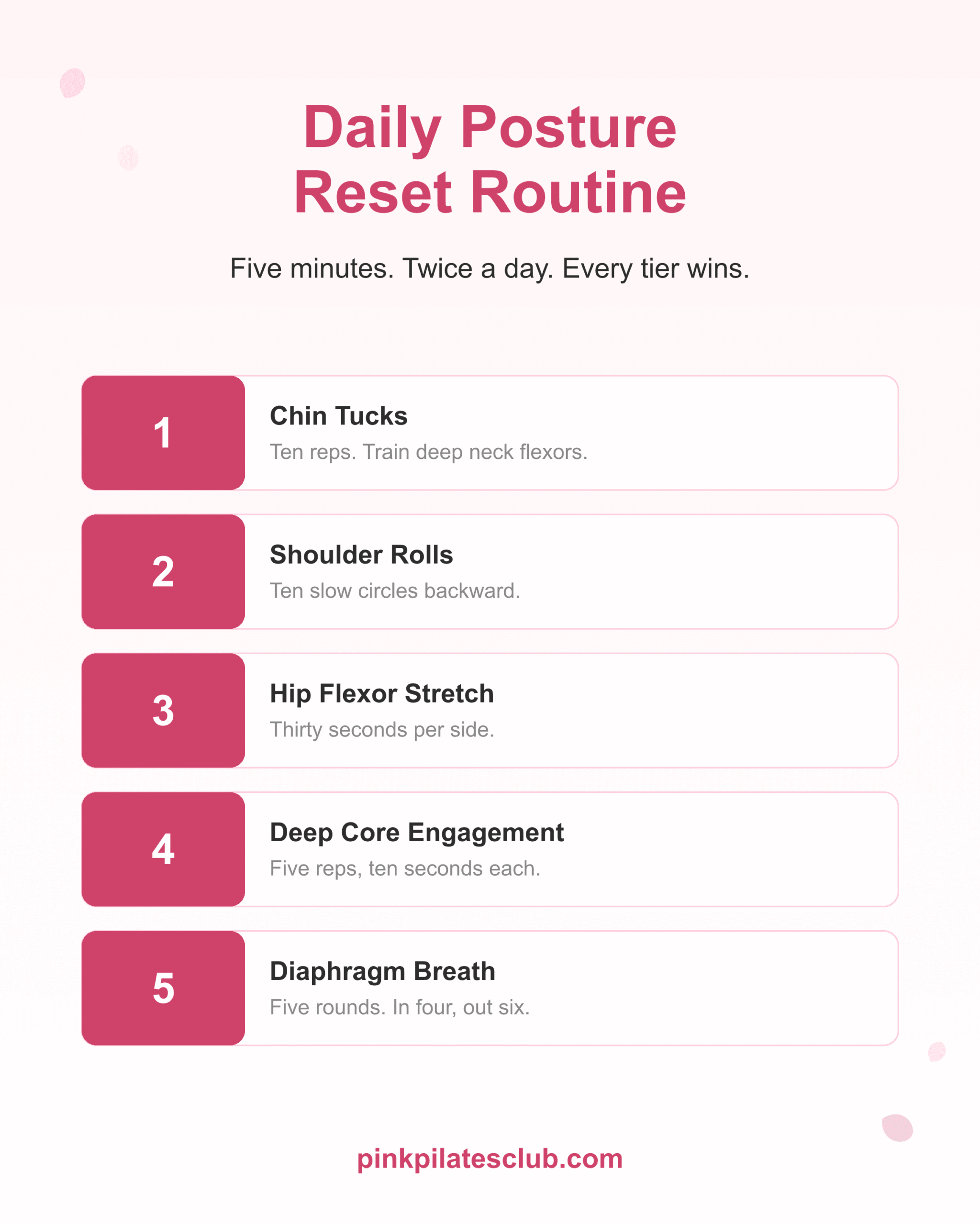
Start with chin tucks. Stand or sit tall, draw your chin straight back like you are making a small double chin. Hold for five seconds, release. Repeat ten times. This trains the deep neck flexors that fight forward head position. Move to shoulder rolls. Big slow circles backward, ten times, focus on the squeeze at the bottom of the rotation.
Then a hip flexor stretch. Half-kneel with one knee down, the other foot in front, knee over ankle. Tuck the pelvis under, gently press the hips forward. Hold for thirty seconds per side. Hip flexor tightness drives most lower back pain in desk workers. Then deep core engagement: lie on your back, knees bent, feet flat. Without flattening your spine, draw your low belly toward your spine and hold for ten seconds. Repeat five times.
Finish with a breath drill. Hands on your lower ribs, breathe in through your nose for a count of four, expand the ribs out into your hands, exhale for a count of six. Five rounds. This trains diaphragmatic breathing, which is what makes everything else stick. Five minutes total. Twice a day. The 14-Day Posture Fix builds on this foundation with progressive routines that retrain alignment more deeply.
The 14-Day Posture Fix
Whatever your tier, the 14-Day Posture Fix is the structured plan that turns the quiz result into actual change. Daily pilates routines targeting neck, shoulders, deep core, and hips. Form cues that retrain alignment. A progression layered from nervous-system calm to structural alignment. Two weeks. Real shifts.
$39.97 · instant digital access
Frequently Asked Questions
How accurate is a self-administered posture assessment quiz?
A 10-question quiz reads patterns, not precise alignment angles. The accuracy depends on how honestly you answer. Most women whose tier matches their daily experience can rely on it as a useful starting point. For precise diagnosis, a physical therapist or chiropractor uses hands-on tests, gait analysis, and sometimes imaging.
What does my posture score mean?
Your score lands you in one of four tiers: Mostly Aligned (0 to 7), Early Posture Drift (8 to 15), Moderate Posture Issues (16 to 22), or Significant Posture Concerns (23 to 29). Each tier has different urgency. All four benefit from the same core protocol, dialed to severity. The 14-Day Posture Fix scales to your tier.
Should I see a physical therapist or chiropractor based on my score?
If your score lands you in Significant Posture Concerns and your symptoms have lasted longer than three months, yes. A PT can rule out structural issues and prescribe targeted exercises. Pilates supports their work beautifully. For Early Drift and Moderate Issues, a structured pilates plan is usually enough on its own.
Can pilates fix bad posture?
Pilates is one of the most effective gentle modalities for posture. It builds deep core strength, retrains shoulder position, lengthens the spine, and increases hip mobility. Combined with daily reset routines and conscious sitting, pilates addresses the root causes of most posture issues for women in their thirties and forties.
How long does it take to fix bad posture with pilates?
Early signs typically improve within two weeks of a structured plan. Moderate issues take four to eight weeks of consistent work. Significant concerns can take three months or more, especially when stacked symptoms include hip tightness and shoulder rounding. The 14-Day Posture Fix is calibrated as the foundation; consistency afterward locks in the change.
Why does posture affect breathing and digestion?
Rounded shoulders and forward head position compress the ribcage and limit lung expansion. A collapsed lower back compresses the abdominal organs and limits diaphragm range. Both reduce oxygen intake, increase shallow breathing, and slow digestion. Better alignment reopens both systems, which is why posture work often improves chronic bloating and energy.
Your Next Step
You now have a posture score, a tier, and the brand-voice context that explains what each tier means. If you want a personalized 14-day routine tuned to your specific tier, take the email plan offered above. If you are ready for the structured product that turns the quiz result into actual change, the 14-Day Posture Fix is the next step. You do not need to be perfect. You just need to begin.
Keep Reading
- the Pilates Calorie Burn Calculator if you want to add the calorie math to your plan
- the Wall Pilates Calorie Burn Calculator for wall-specific routines
- our Pilates Weight Loss Calculator for a 12-week timeline view
- the Pilates vs Yoga Calorie Comparison if you do both practices
- the Hormone Balance Quiz for cortisol-driven posture issues
- the deeper guide to pilates for lower back pain
- what to check when pilates feels like it is not working yet
- why gentle pilates outperforms HIIT for posture and core