If you have been scrolling postpartum pilates content wondering whether you are ready, whether your body can handle it, and whether the workout in front of you is safe, you are asking the right questions. The answer is rarely “wait six weeks” or “you can do anything after clearance.” The answer is phased, and the phase you are in matters more than the calendar date your provider gave you. This planner uses your birth date, your birth type, and your current focus to reveal which of the 5 postpartum pilates phases you are in, what is safe to do this week, what to avoid for now, and the warning signs that need professional review. The basic plan is yours immediately. No email required.
Postpartum Pilates Planner
Tell the planner your birth date, your birth type, and your focus. Your current postpartum phase plus the safe routine, what to skip, and the warning signs to watch for appear immediately. No email needed for the basic plan.
You are 0 weeks postpartum
Phase
Safe for now
Avoid for now
Watch for these
Important: This planner is a guide, not a clearance. Always confirm with your healthcare provider before resuming structured exercise after birth, especially after a C-section or complicated delivery.
Get Your Personalized 16-Week Postpartum Roadmap
We will send you a 16-week phased return-to-pilates roadmap tuned to your birth date and birth type, a diastasis recti self-screening guide, a pelvic floor red-flag checklist, cycle-aware programming guidance for when periods return, and sample full-week schedules per phase. Free, no spam, easy unsubscribe.
How the Postpartum Pilates Planner Works
The planner takes three inputs: your birth date, your birth type, and your focus. From those it calculates the number of weeks postpartum and maps you into one of five postpartum pilates phases. The phase boundaries are different for vaginal versus C-section births. Vaginal phases transition at 2, 6, 12, and 24 weeks. C-section phases transition at 4, 8, 14, and 26 weeks. Complicated births and medical holds route to a separate provider-clearance headline regardless of weeks postpartum.
Inside each phase, the focus selector tunes the safe routine list. Core and diastasis prioritizes deep transverse abdominis activation and removes flexion until diastasis closes. Pelvic floor prioritizes Kegel and breath integration with high-impact removed entirely. Energy and mood prioritizes 15-minute gentle flows, walking, sleep alignment, and protein density. Full body return delivers the standard phase routine that most postpartum pilates princesses follow.
This planner is informational, not medical advice. Diastasis recti, pelvic floor dysfunction, and postpartum mood disorders all benefit from professional assessment a quiz cannot replicate. The planner gives you the framework. Your obstetrician, pelvic floor physiotherapist, or postpartum specialist gives you clearance.
The 5 Postpartum Pilates Phases
Below are the five phases that govern a safe return to pilates. Most postpartum pilates princesses skip phases entirely or rush past phase boundaries because the calendar said it was time. The body is the calendar, not the date.
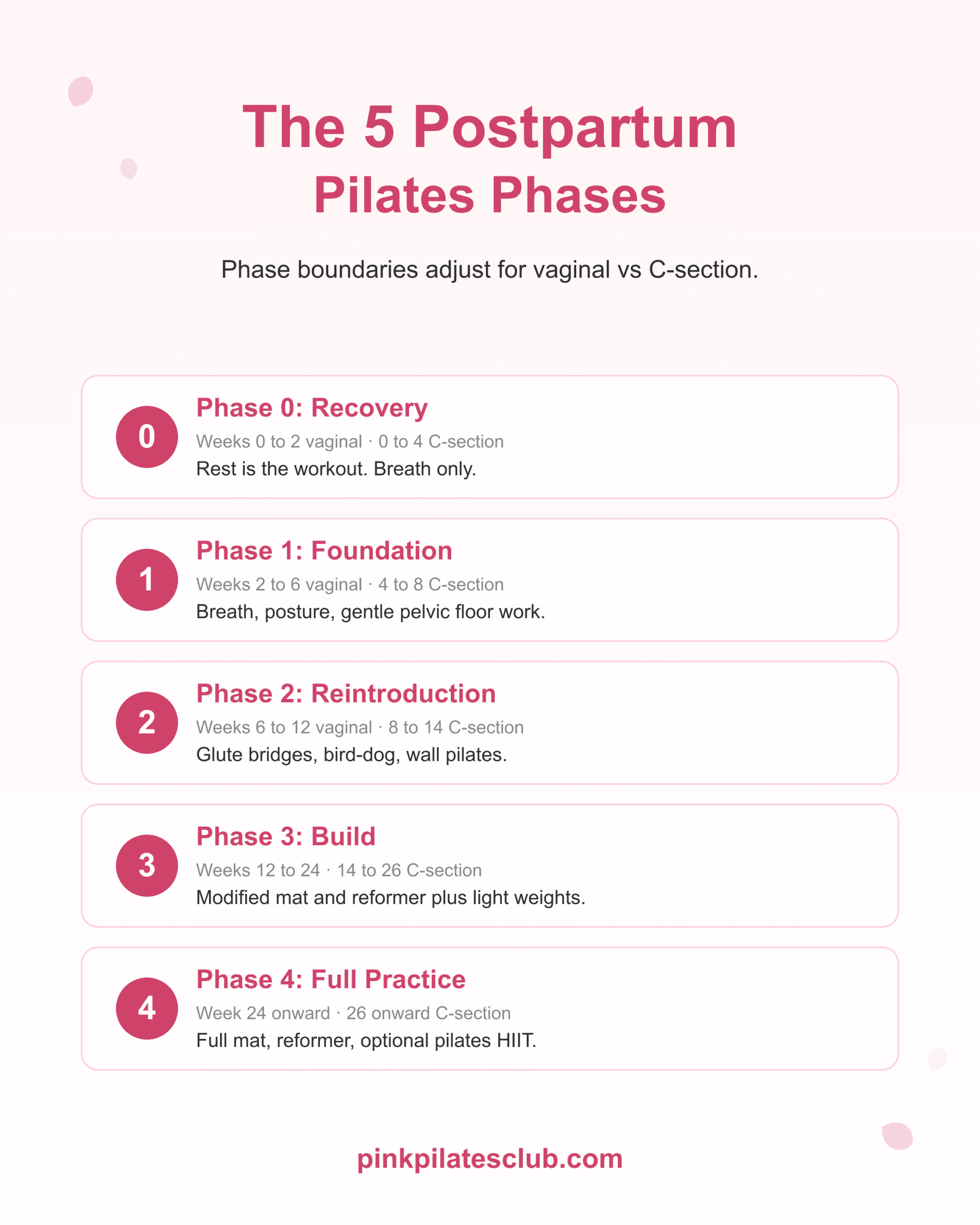
Phase 0 is recovery. Weeks 0 to 2 vaginal, 0 to 4 C-section. Rest is the workout. Diaphragmatic breathing reconnects the deep core and pelvic floor without strain. Walking when you can. No structured pilates yet, no matter how good you feel. The healing happening internally is invisible from the outside, and pushing through it slows the timeline rather than speeding it up. Phase 1 is foundation. Weeks 2 to 6 vaginal, 4 to 8 C-section. Connection breath with pelvic floor activation, posture awareness, walking 5 to 15 minutes, gentle hip mobility. This is the prep work that makes Phase 2 productive. Skipping it is the most common reason postpartum pilates returns end in injury or stalled progress.
Phase 2 is reintroduction, post-clearance. Weeks 6 to 12 vaginal, 8 to 14 C-section. Connection breath with core engagement, glute bridges, bird-dog, side-lying leg series, gentle wall pilates, modified standing pilates. This is when structured pilates returns, modified for the postpartum body. Phase 3 is build. Weeks 12 to 24, with C-section adjusted to 14 to 26. Modified mat pilates, modified reformer, light weight integration, plank progressions if diastasis is closed. Strength returns gradually. Phase 4 is full practice. 24 weeks and beyond, 26 for C-section. Full mat pilates, reformer at appropriate intensity, optional pilates HIIT introduction, returning to pre-pregnancy practice. Postpartum is not forever, and Phase 4 confirms the foundation has rebuilt.
Safe vs Avoid Exercises by Phase
Below is the canonical safe-versus-avoid chart for the four active pilates phases. Phase 0 has no pilates list because rest is the work. The chart applies to a standard postpartum return without complications. Diastasis recti, pelvic floor symptoms, and pain shift the chart toward the conservative side until those resolve.
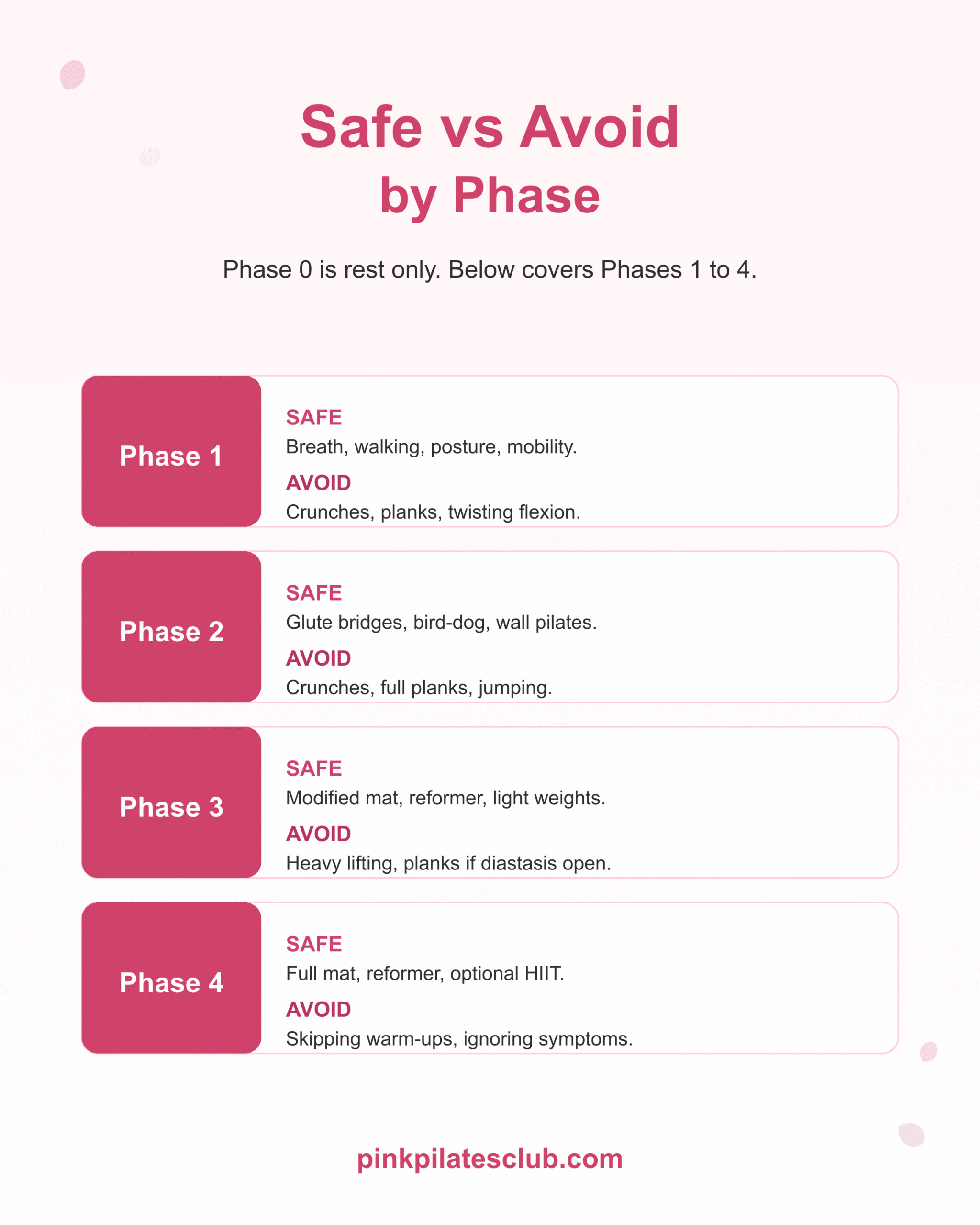
Phase 1 (foundation) is breath, posture, and gentle pelvic floor connection. Avoid all crunches, full planks, and twisting. Phase 2 (reintroduction) adds glute bridges, bird-dog, side-lying series, and wall pilates. Avoid traditional crunches, forward planks until diastasis closes, and high-impact jumping. Phase 3 (build) reintroduces modified mat and reformer plus light weights. Avoid heavy lifting beyond 15 lb until cleared, and skip plank progressions if diastasis is still open. Phase 4 (full practice) returns to the pre-pregnancy practice, with cycle-aware programming once your period returns and the option to introduce pilates HIIT if cleared.
Diastasis recti screening matters more than calendar weeks. A simple screen: lie on your back with knees bent. Place fingers above the navel and gently lift your head. If you feel a gap wider than two fingers or visible doming, treat diastasis as still open and stay in modified work until it closes. Wall pilates is the safest bridge between Phase 1 and Phase 2 for most postpartum pilates princesses, because vertical loading is gentler on the abdominal wall than supine flexion work.
Postpartum Red Flags to Watch For
The planner above gives you safe-routine lists per phase. The red flags below are not phase-specific. They apply to every postpartum pilates princess at every phase. If any of these show up, pause the routine and talk to your provider before continuing.
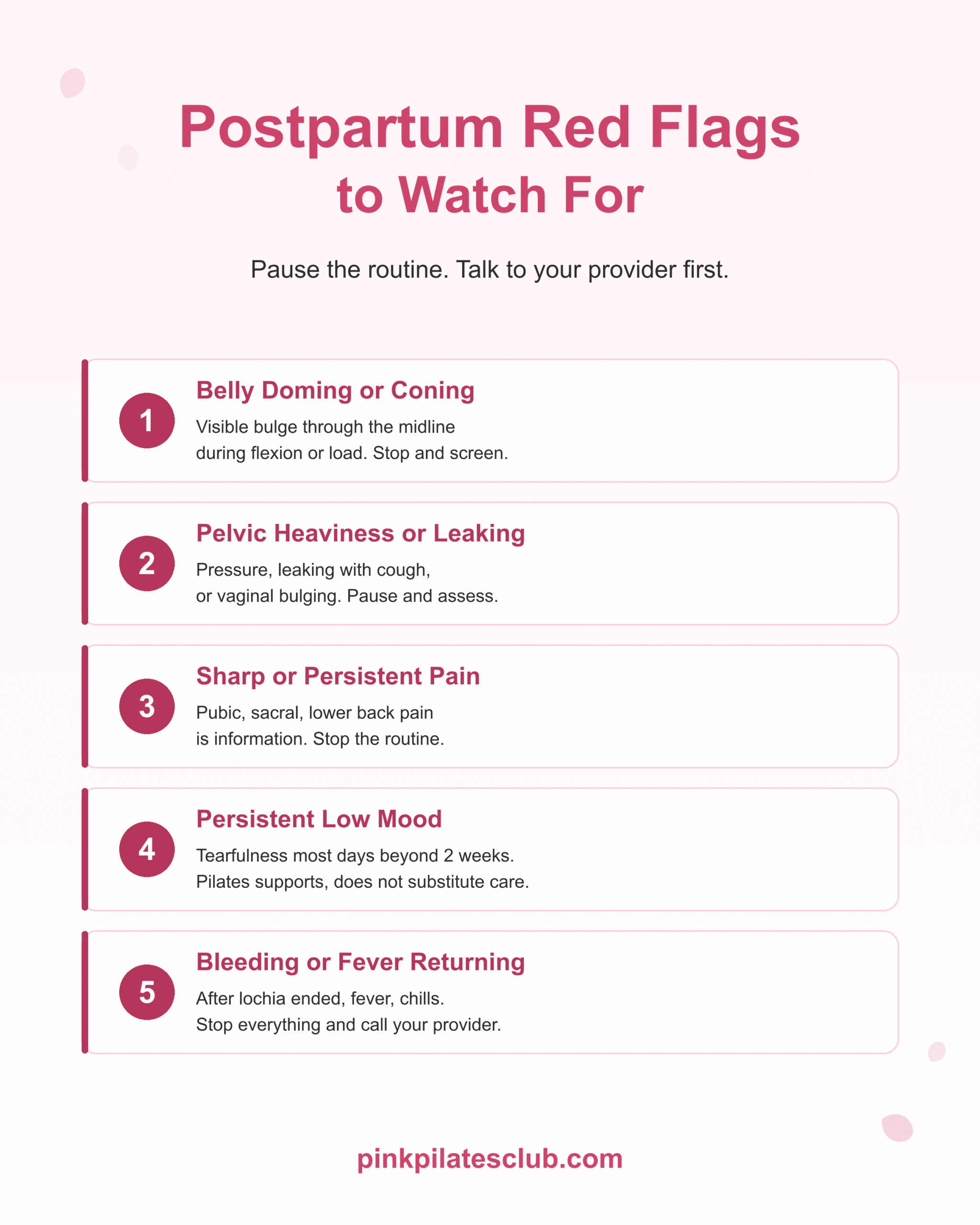
First, doming or coning of the belly during exercise. Visible bulging through the midline of the abdomen during any flexion or load is a sign that diastasis recti is open and the exercise is not appropriate. Second, pelvic heaviness, bulging, or leaking. Pressure, heaviness, urinary leakage with cough or sneeze, or a sensation of bulging in the vaginal area indicates pelvic floor dysfunction that needs assessment, not more exercise. Third, pain. Postpartum exercise should never produce sharp pain in the pubic symphysis, sacrum, lower back, or anywhere else. Discomfort and effort are normal. Pain is information.
Fourth, persistent low mood, severe anxiety, or tearfulness most days for more than two weeks. Postpartum depression and postpartum anxiety are clinical conditions that respond to treatment. Pilates supports mood but does not substitute for professional care. Fifth, returning bleeding after the lochia phase ended, or fever, or chills. These can indicate retained tissue or infection. Stop everything and call your provider. None of these red flags mean pilates is wrong for you. They mean the timing or modification needs adjustment based on what your body is telling you, and professional assessment is the next step rather than the next workout.
The Postpartum Pilates Core Restore
Want a structured program that walks you through every phase with diastasis screening, pelvic floor reconnection, and progressive return to full practice? The Postpartum Pilates Core Restore is the program built for exactly this journey. Phase-by-phase video work, modifications for vaginal and C-section, and the framework that turns the planner above into actual movement.
$34.97 · instant digital access
Frequently Asked Questions
When can I start pilates after giving birth?
Diaphragmatic breathing and gentle walking can begin within days of a vaginal birth, longer after a C-section. Structured pilates with movement and load typically waits for 6-week medical clearance after a vaginal birth, 8 weeks after a C-section. The phase matters more than the date. Phase 0 is rest, Phase 1 is breath and walking, Phase 2 is the structured return.
How long after a C-section can I do pilates?
Phase 1 (breath, walking, posture) can begin around week 4. Structured pilates typically waits for 8-week medical clearance, then Phase 2 begins with connection breath, glute bridges, side-lying work, and gentle wall pilates. Avoid full planks until your scar has fully healed externally and internally, which often takes 12 to 14 weeks.
What pilates exercises are safe postpartum?
By phase: Phase 1 is breath, walking, gentle pelvic floor activation, and posture work. Phase 2 adds glute bridges, bird-dog, side-lying leg series, wall pilates, and connection breath with core engagement. Phase 3 adds modified mat and reformer with light weights. Avoid traditional crunches, full forward planks, and twisting flexion until diastasis recti is closed.
How do I know if I have diastasis recti?
Lie on your back with knees bent. Place two or three fingers just above your navel. Gently lift your head and shoulders. If you feel a gap wider than two fingers, or visible doming bulging through the midline, treat diastasis as open. A pelvic floor physiotherapist can perform a more detailed assessment and recommend specific exercises to close the gap.
Is wall pilates safe postpartum?
Yes, wall pilates is one of the safer entry points back into structured pilates postpartum. The vertical wall loading is gentler on the abdominal wall than supine flexion work, and the stability of the wall reduces the demand on the pelvic floor and core. Most pilates princesses can begin gentle wall pilates in Phase 2 with proper modifications.
Can pilates help with postpartum pelvic floor?
Yes, breath-led pilates with explicit pelvic floor cuing rebuilds connection and strength faster than isolated Kegels for most postpartum pilates princesses. The breath-floor coordination work in Phases 1 and 2 directly trains the pelvic floor to release and engage with the diaphragm. Persistent symptoms (leaking, heaviness, prolapse sensation) need pelvic floor physiotherapy.
Your Next Step
You now know which postpartum pilates phase you are in, what is safe for this week, what to skip, and the warning signs that need professional review. If you want a personalized 16-week phased roadmap with diastasis screening and pelvic floor red-flag checklists, take the email plan offered above. If you are ready for a structured program that walks you through every phase with video work and modifications, the Postpartum Pilates Core Restore is the next step. You do not need to be perfect. You just need to honor the phase you are in.
Keep Reading
- the Pilates Calorie Burn Calculator for once you reach Phase 4
- the Wall Pilates Calorie Burn Calculator since wall work is the safest postpartum entry
- our Pilates Weight Loss Calculator for postpartum body composition planning
- the Pilates vs Yoga Calorie Comparison if you do both practices
- the Hormone Balance Quiz since postpartum hormones drive symptom load
- the Posture Assessment Quiz since postpartum posture shifts dramatically
- the Pilates Protein Calculator since postpartum and breastfeeding raise protein needs
- the Anti-Bloat Food Quiz to find postpartum digestive triggers
- the Pilates Results Timeline so postpartum expectations stay realistic
- the 7-Day Pilates Plan generator for once you reach Phase 4
- the Pilates Program Quiz to match yourself to a structured plan
- the Cycle Syncing Pilates Planner for when your period returns
- the 30-Day Pilates Challenge once you have completed Phase 4
- the Reformer Spring Resistance Calculator for modified reformer work
- the Pilates Afterburn Calculator once intensity returns in Phase 4
- the Cortisol Stress Quiz since postpartum cortisol patterns are often elevated