
If your fitness watch shows you a heart rate during pilates and you have no idea whether 130 bpm is too high, too low, or exactly right, you are asking the right question. Heart rate zones are how training intensity gets quantified, but generic HR zone charts assume you are running, not flowing through pilates. The right zone for restorative pilates is different from the right zone for jumpboard reformer. This calculator uses the Tanaka max heart rate formula plus the optional Karvonen heart rate reserve method to give you 5 personalized training zones with pilates-specific application labels for each. The basic answer is yours immediately. No email required.
Pilates Heart Rate Zone Calculator
Enter your age to find your max heart rate and 5 training zones. Add your resting heart rate (optional) for the more personalized Karvonen calculation. Free, no email needed for the basic answer.
Your Pilates Heart Rate Zones
Estimated Max Heart Rate
0 bpm
Get Your Personalized HR Zone Training Plan
We will send you a 7-day pilates training plan with target HR zones per session, wearable-specific zone setup guides for Apple Watch, Fitbit, Garmin, and WHOOP, recovery zone vs fat-burn zone explained for your specific numbers, and cycle-aware zone adjustments for menstruating visitors. Free, no spam, easy unsubscribe.
How the Pilates Heart Rate Zone Calculator Works
The calculator uses two well-validated formulas. First it estimates your maximum heart rate using the Tanaka equation: max HR = 208 minus 0.7 times age. The Tanaka formula is more accurate than the classic 220-age formula, especially for adults over 40. The 220-age formula systematically underestimates max HR for older adults; Tanaka corrects that bias.
Second, if you provide a resting heart rate, the calculator uses the Karvonen heart rate reserve method to personalize each zone. Heart rate reserve (HRR) is your max HR minus your resting HR. Each zone bpm range is calculated as HRR times the zone percentage plus your resting HR. This produces zones that actually match your fitness level. Two pilates princesses with the same max HR but different resting HRs (one fitter, one less fit) end up with different zone bpm ranges, which is more accurate than treating them identically.
If you do not provide a resting HR, the calculator uses the simple percentage method: each zone bpm range is the zone percentage of max HR. Less personalized but still useful as a starting point. Measure your resting HR first thing in the morning before getting out of bed for the most accurate Karvonen result. Wearables that measure overnight resting HR (WHOOP, Apple Watch, Garmin) are reliable; the resting HR shown during the day on most watches is not your true resting HR.
The 5 Heart Rate Zones and Their Pilates Application
The 5-zone system used here is the same one most fitness watches use, with pilates-specific application labels added so you know what each zone actually means in your practice. Below is what each zone looks like for a 30-year-old pilates princess (max HR around 187 bpm using Tanaka).
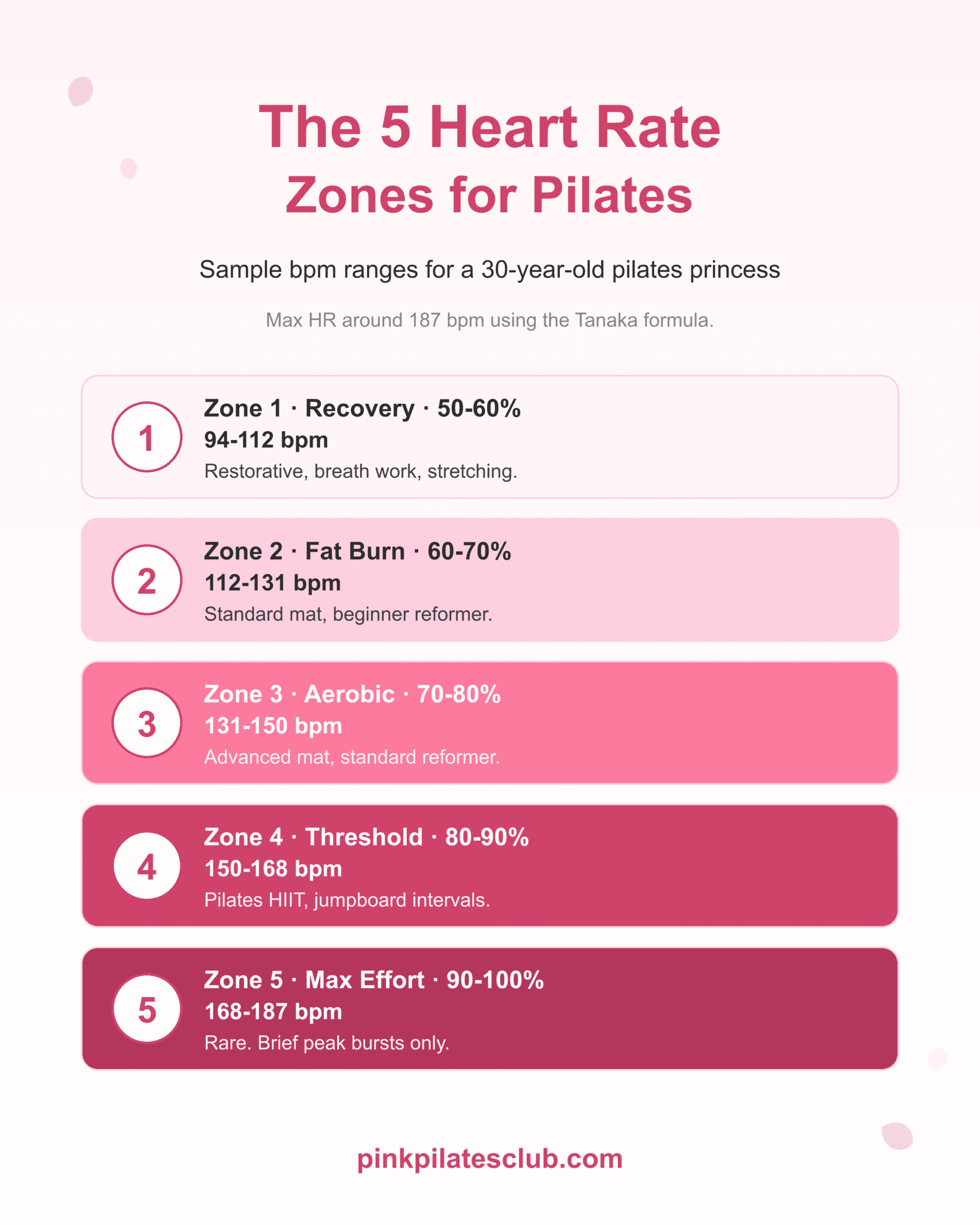
Zone 1 (Recovery, 50-60% max HR, around 94-112 bpm for a 30-year-old) is the recovery zone. Restorative pilates, breath work, stretching, and walking with a breath cue all sit here. Most pilates princesses underestimate Zone 1 because the heart rate is low and the work feels gentle. The benefit is parasympathetic activation, nervous system regulation, and recovery quality, not calorie burn. Zone 2 (Fat Burn, 60-70% max HR, around 112-131 bpm) is where standard mat pilates, beginner reformer, and walking-with-purpose live. The cumulative weekly time in this zone is what produces the body composition results most pilates princesses come for.
Zone 3 (Aerobic, 70-80% max HR, around 131-150 bpm) is the productive sweet spot for advanced mat pilates, standard reformer, and wall pilates at higher intensity. This zone is where the cardiovascular adaptations stack up: improved stroke volume, better lactate clearance, more efficient oxygen use. Zone 4 (Threshold, 80-90% max HR, around 150-168 bpm) belongs to pilates HIIT, jumpboard intervals, and sprint pilates. Most pilates princesses spend 0-2 sessions per week here, not more. Zone 5 (Max Effort, 90-100% max HR, 168-187 bpm for a 30-year-old) is reserved for brief peak bursts. Rare in pilates and not necessary for most goals.
Why Pilates Lives Mostly in Zones 1 to 3
Most pilates is gentler than most fitness content suggests, and that is by design. The brand philosophy is built around sustained, anti-burnout practice rather than peak-intensity training, and the heart rate zone distribution reflects that.
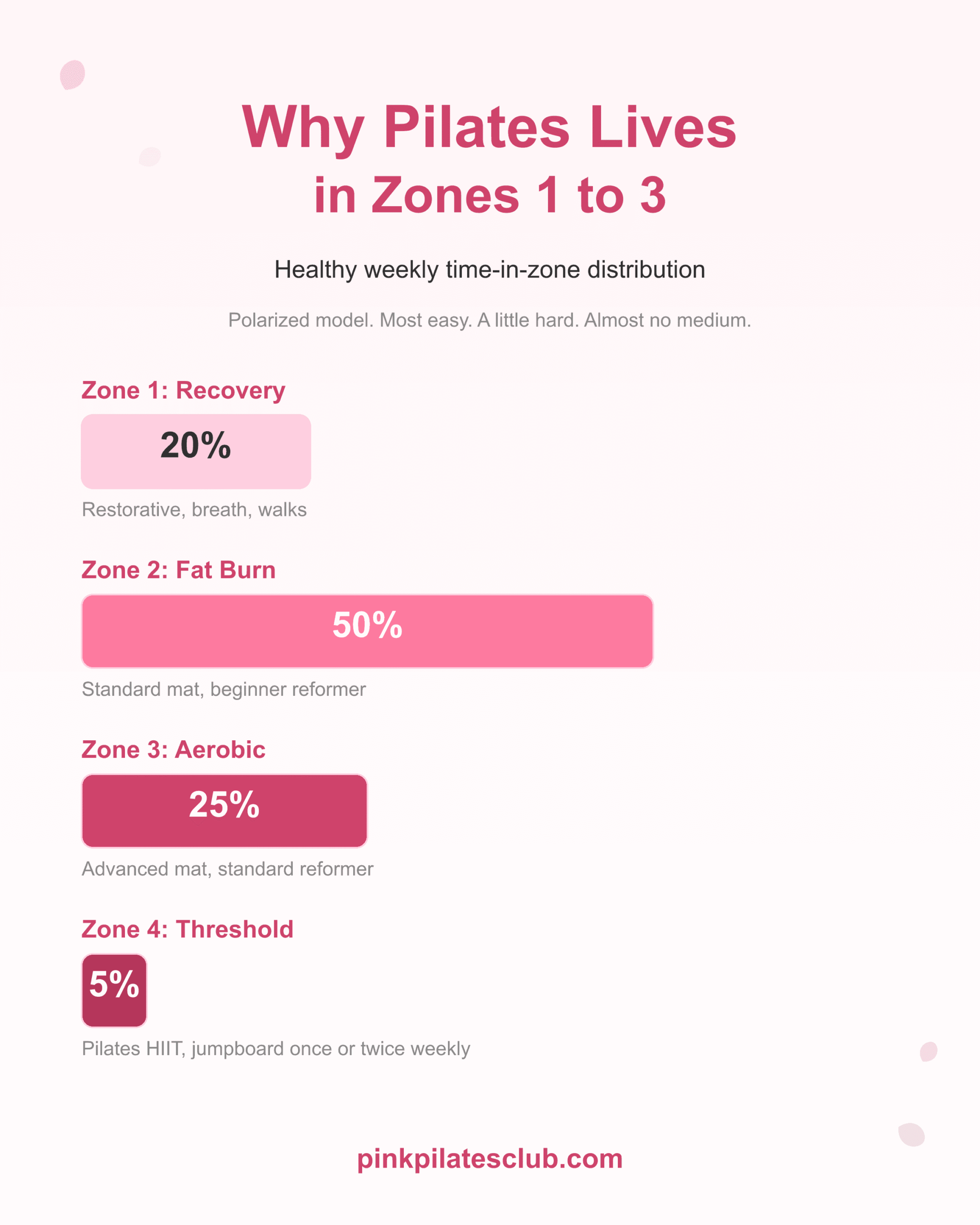
The healthy weekly pattern for most pilates princesses is roughly 20% Zone 1, 50% Zone 2, 25% Zone 3, and 5% Zone 4. Zone 5 is essentially zero for most weeks. This distribution mirrors the polarized training model used by elite endurance athletes: a lot of easy work, a little hard work, almost no medium work. Translated to pilates: lots of restorative and standard sessions, occasional advanced or HIIT work, no daily threshold pounding.
The mistake most pilates princesses make when they start tracking heart rate is panic when they see Zone 4 numbers during reformer or wall pilates. Brief Zone 4 spikes during higher-intensity exercises are normal and useful. The problem is not visiting Zone 4 occasionally; the problem is living there. Chronic Zone 4-5 training raises cortisol, blunts recovery, and stalls body composition results. The Cortisol Stress Quiz covers what those signals look like in daily life.
How to Use HR Zones to Train Smarter
Heart rate data is only useful if you act on it. Below are four ways to translate the zones into practical weekly programming, all consistent with the brand’s gentle, sustained-practice philosophy.
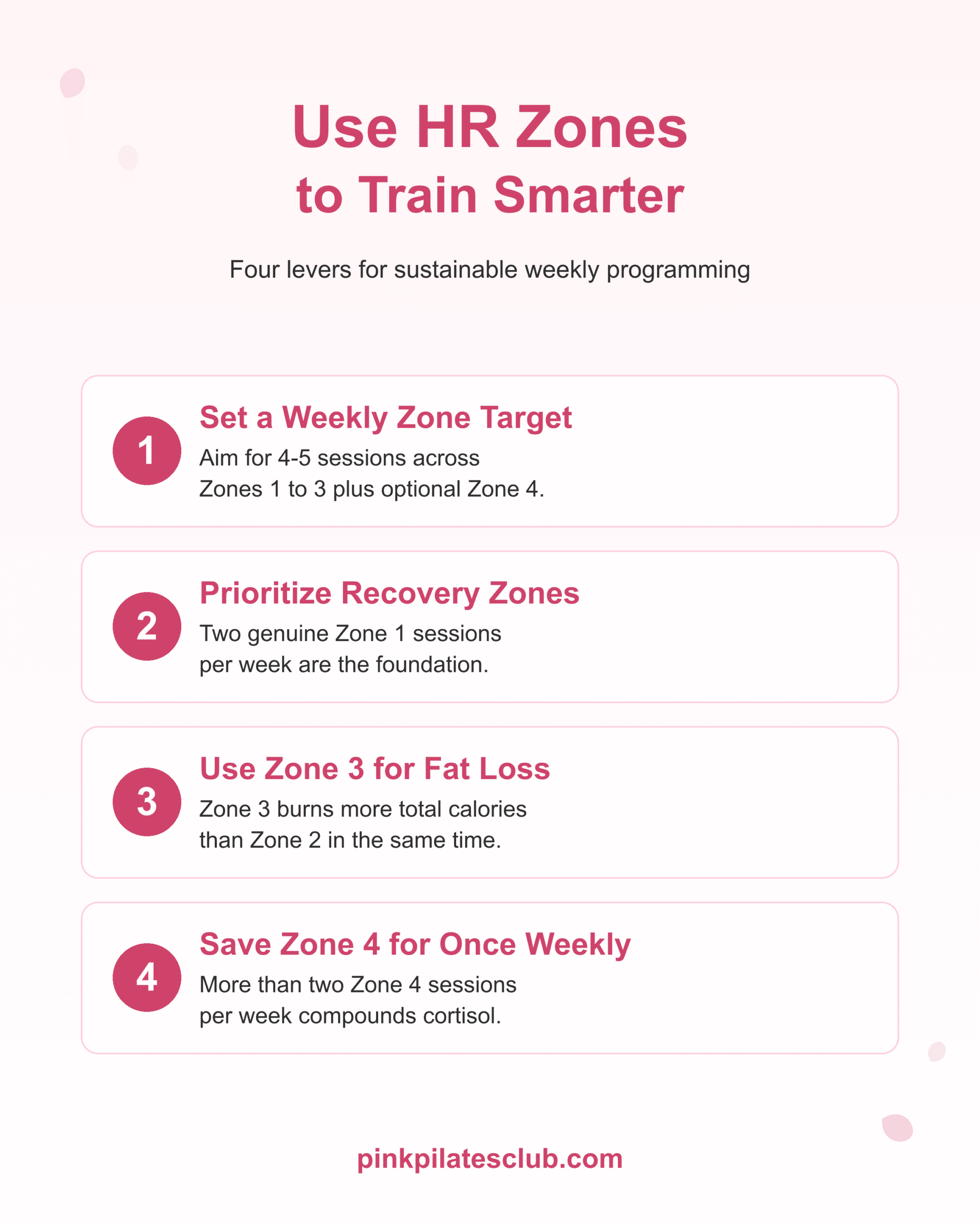
First, set a weekly zone target. A typical productive week is 4-5 sessions distributed across Zones 1-3, with optionally one Zone 4 session. Track your time-in-zone in your watch app to confirm you are actually hitting this distribution rather than drifting toward Zone 2 monotony or Zone 4 overreach. Second, prioritize recovery zones. Zone 1 sessions feel like they do not count, but they do. Two genuine Zone 1 sessions per week (restorative, breath work, gentle walking) are the foundation that lets the harder sessions actually adapt. Skipping recovery is the most common reason pilates princesses stall.
Third, use Zone 3 for fat loss. The fat-burn zone marketing is technically Zone 2, but the calorie volume and post-exercise oxygen consumption (EPOC) of Zone 3 work usually produces faster body composition change than pure Zone 2 training. The Pilates Afterburn Calculator covers the EPOC math directly. The exception: pilates princesses with elevated cortisol (per the Cortisol Stress Quiz) often respond better to Zone 2 dominance because Zone 3 cortisol response is amplified in their state. Fourth, save Zone 4 for once or twice a week, maximum. Pilates HIIT, jumpboard intervals, and sprint sessions belong here. More than 2 Zone 4 sessions per week starts to compound cortisol and undo the recovery benefit of Zones 1-2. The pilates princess pattern is intensity used like seasoning, not like the main meal.
The 30-Day Full Body Pilates Program
Want a structured monthly program that distributes intensity across HR zones the right way? The 30-Day Full Body Pilates includes restorative, standard, and interval sessions that target Zones 1-3 with occasional Zone 4 work, all programmed for sustainable weekly distribution. Built for pilates princesses who want intentional intensity instead of accidental drift.
$99.97 · instant digital access
Frequently Asked Questions
What heart rate zone should I be in during pilates?
Most pilates lives in Zones 1 to 3. Restorative pilates and breath work in Zone 1 (50-60% max HR). Standard mat and beginner reformer in Zone 2 (60-70%). Advanced mat, standard reformer, and wall pilates in Zone 3 (70-80%). Zone 4 belongs to pilates HIIT and jumpboard intervals once or twice per week. Zone 5 is rare.
Is pilates cardio? Does it raise heart rate enough?
Standard pilates raises heart rate into Zone 2 (60-70% max HR), which is the cardiovascular benefit zone. Advanced reformer, wall pilates, and pilates HIIT push into Zones 3 and 4. Pilates is moderate-intensity cardio for most pilates princesses, with the option to go higher when you want it.
How do I find my max heart rate?
The most accurate way is a clinical maximal exercise test, which you do not need. The estimation formulas are within 5-10 bpm for most adults. The Tanaka formula (208 minus 0.7 times age) is more accurate than the classic 220-age, especially for adults over 40. The calculator above uses Tanaka.
What is the difference between Tanaka and 220-age formulas?
The 220-age formula was published in 1971 based on a small study and systematically underestimates max HR for adults over 40. Tanaka et al. 2001 published the updated 208 minus 0.7 times age formula based on much larger data. For a 30-year-old, both give 187-190 bpm. For a 50-year-old, Tanaka gives 173 bpm versus 220-age at 170, a meaningful gap.
Should pilates be in the fat-burn zone?
The fat-burn zone (Zone 2, 60-70% max HR) marketing is real but oversimplified. Zone 2 burns a higher percentage of fat per calorie, but Zone 3 burns more total calories and more total fat in the same time. For most pilates princesses, mixing Zones 2 and 3 across the week produces faster body composition change than Zone 2 dominance alone.
Why does my heart rate spike during reformer?
Reformer combines resistance work with cardiovascular demand more than mat pilates does. Spring-loaded exercises briefly recruit more muscle, which raises oxygen demand, which raises heart rate. Brief Zone 3-4 spikes during reformer are normal. The sustained average across a 50-minute class is typically Zone 2-3, not Zone 4.
Your Next Step
You now have your max heart rate, your 5 training zones with pilates application labels, and a clear picture of where your practice should mostly live. If you want a personalized 7-day pilates training plan with target HR zones per session, take the email plan offered above. If you are ready for a structured monthly program that distributes intensity across HR zones the right way, the 30-Day Full Body Pilates is the next step. You do not need to live in Zone 4 to see results. You just need consistent training across Zones 1-3 with intentional Zone 4 spikes.
Keep Reading
- the Pilates Calorie Burn Calculator since calorie burn rises with HR zone
- the Wall Pilates Calorie Burn Calculator for wall-specific intensity
- our Pilates Weight Loss Calculator for pound projections
- the Pilates vs Yoga Calorie Comparison if you do both practices
- the Hormone Balance Quiz for the hormone read
- the Posture Assessment Quiz to track structural alignment
- the Pilates Protein Calculator for daily targets
- the Anti-Bloat Food Quiz to find your bloating triggers
- the Pilates Results Timeline to see when results land
- the 7-Day Pilates Plan generator for a free starting week
- the Pilates Program Quiz to match yourself to a structured plan
- the Cycle Syncing Pilates Planner since cycle phase shifts the optimal HR zone
- the 30-Day Pilates Challenge if you want a structured month
- the Reformer Spring Resistance Calculator to load the right springs
- the Pilates Afterburn Calculator since EPOC rises with HR zone
- the Cortisol Stress Quiz since chronic Zone 4 training raises cortisol
- the Postpartum Pilates Planner for safe HR zone return after birth
- the Reformer Pilates Calorie Calculator for reformer-specific burn
- the Pilates TDEE Calculator for the daily energy picture