
If you have ever plugged your numbers into a generic TDEE calculator and felt the result did not actually reflect your pilates practice, you are right. Most TDEE tools treat pilates as “light yoga” or “sedentary” even when you train four days a week with a mix of mat, reformer, and walking. The TDEE number that comes out is too low, the deficit you build from it is too aggressive, and the cortisol rises while the scale stalls. This calculator uses pilates-specific activity tiers and the Mifflin-St Jeor BMR formula to give you the honest number for your body, your age, and the way you actually train. The basic answer is yours immediately. No email required.
Pilates TDEE Calculator
Tell the calculator your sex, age, weight, height, and pilates activity tier. Your BMR, TDEE, and gentle calorie targets appear immediately. Free, no email required for the basic answer.
Your Pilates Princess TDEE
Total Daily Energy
0 kcal/day
Gentle Cut
0 kcal
For steady fat loss
Maintenance
0 kcal
Keep current weight
Lean Gain
0 kcal
For muscle support
Note: The Gentle Cut is intentionally a 300 kcal deficit, not the aggressive 500 kcal that most TDEE calculators suggest. Smaller deficits work better for cortisol-prone audiences and produce comparable long-term results without the cortisol spike.
Get Your Personalized TDEE-Based Meal Plan
We will send you a full macro breakdown (protein, carbs, fats) per calorie target, 7-day sample meal templates aligned to your cut, maintenance, or gain goal, cycle-aware calorie adjustments for menstruating visitors, and the chronic under-eating signals to watch for. Free, no spam, easy unsubscribe.
How the Pilates TDEE Calculator Works
The calculator uses two well-validated steps. First it estimates your Basal Metabolic Rate (BMR) using the Mifflin-St Jeor equation, which is the most accurate formula for modern adult populations. The Mifflin-St Jeor equation accepts sex, age, weight, and height and returns the calories your body burns at complete rest, which is the foundation of your daily energy needs. Second it multiplies your BMR by an activity multiplier matched to your weekly pilates frequency, which gives you Total Daily Energy Expenditure (TDEE). TDEE is the number that actually matters for setting calorie targets.
The activity multipliers are the part most generic TDEE tools get wrong for pilates princesses. Sedentary (1.20) covers no structured exercise. Beginner (1.38) covers 1-2 sessions per week. Regular (1.55) covers 3-4 sessions per week plus daily walking. Active (1.73) covers 5+ sessions per week plus daily walking. Intense (1.90) covers daily mixed pilates plus cardio or sport. Most pilates princesses doing 3-4 sessions a week plus walks land in Regular, not Beginner, and certainly not Sedentary the way some calculators classify them when “running” is not their primary cardio.
The three calorie targets that come out of the tool are deliberate. Maintenance equals your TDEE: this is the number that holds your current weight steady. Gentle Cut subtracts 300 calories from TDEE: smaller than the aggressive 500-calorie deficit most calculators recommend, because smaller deficits sustain better for cortisol-prone audiences and produce comparable long-term fat loss without the cortisol spike. Lean Gain adds 200 calories to TDEE: the right number for visitors building muscle through reformer or strength work without spilling into unwanted fat gain.
The 5 Pilates Activity Tiers
Below is what each activity tier looks like in practice. Your honest answer matters more than your aspirational one. If you trained Active for one week last month and Regular for the three weeks since, you are Regular for TDEE purposes.
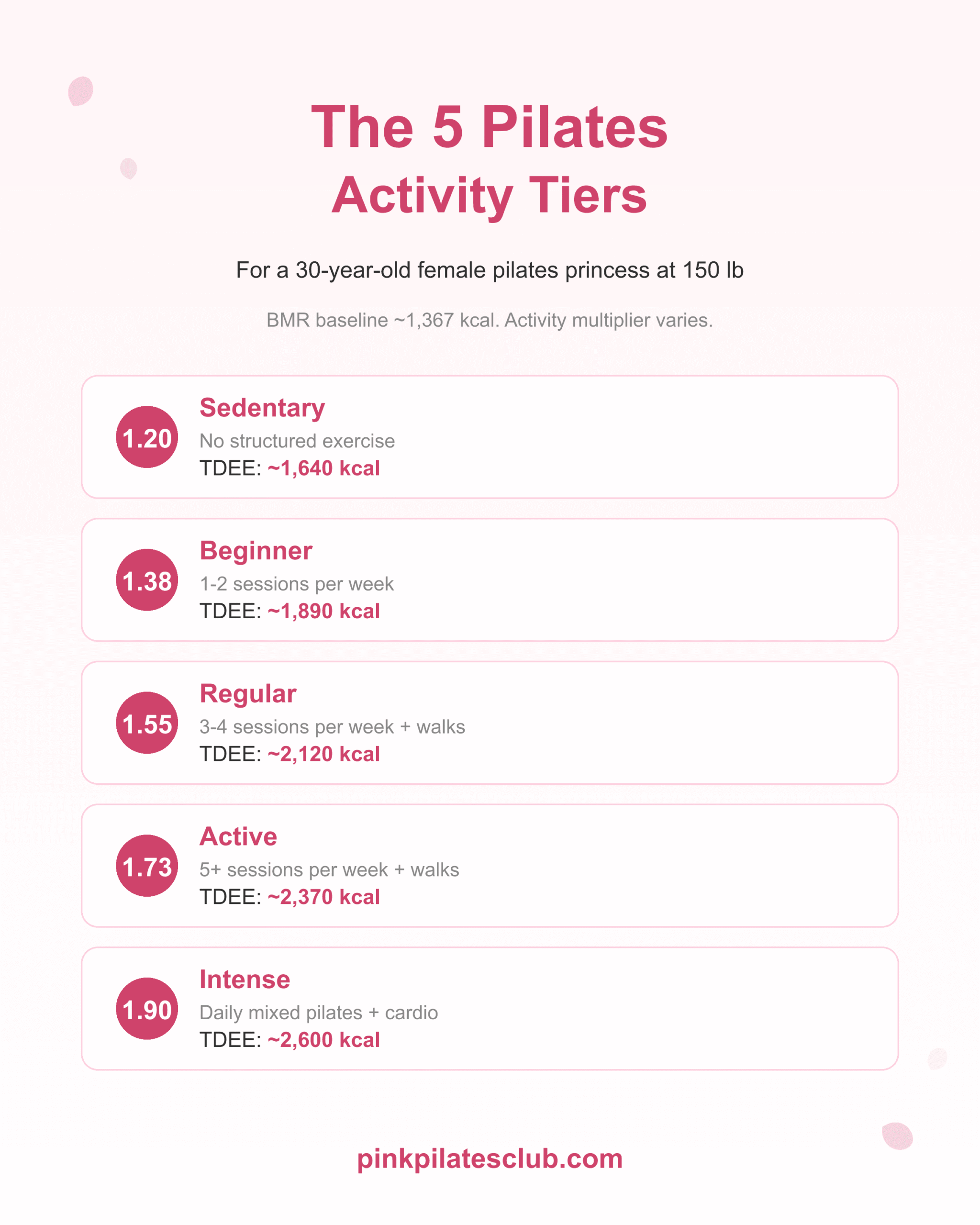
Sedentary (multiplier 1.20) covers no structured exercise. Mostly seated work, no consistent pilates yet. TDEE for a typical 30-year-old female pilates princess at 150 lb sits around 1,640 kcal. Beginner (multiplier 1.38) covers 1-2 pilates sessions per week with some daily walking. TDEE for the same example sits around 1,890 kcal. The 250-calorie jump between Sedentary and Beginner is meaningful: it is roughly the difference between a thin slice of toast and three meals of toast.
Regular (multiplier 1.55) covers 3-4 pilates sessions per week plus regular daily walks. TDEE for the same example sits around 2,120 kcal. This is the productive sweet spot most pilates princesses land in once they build a consistent practice. Active (multiplier 1.73) covers 5+ pilates sessions per week plus daily walking. TDEE around 2,370 kcal. Recovery quality matters more at this tier than at any lower tier; insufficient sleep or protein here is what stalls results. Intense (multiplier 1.90) covers daily mixed pilates plus cardio or sport. TDEE around 2,600 kcal. Sustainable only with deliberate sleep, protein, and recovery work; otherwise chronic cortisol blunts the calorie burn the activity is supposed to produce.
TDEE-Based Calorie Targets for Pilates Princesses
TDEE itself is a number. The targets you build from it are what matter for the goals you actually have. Below is the canonical three-target framework: maintenance, gentle cut, and lean gain.
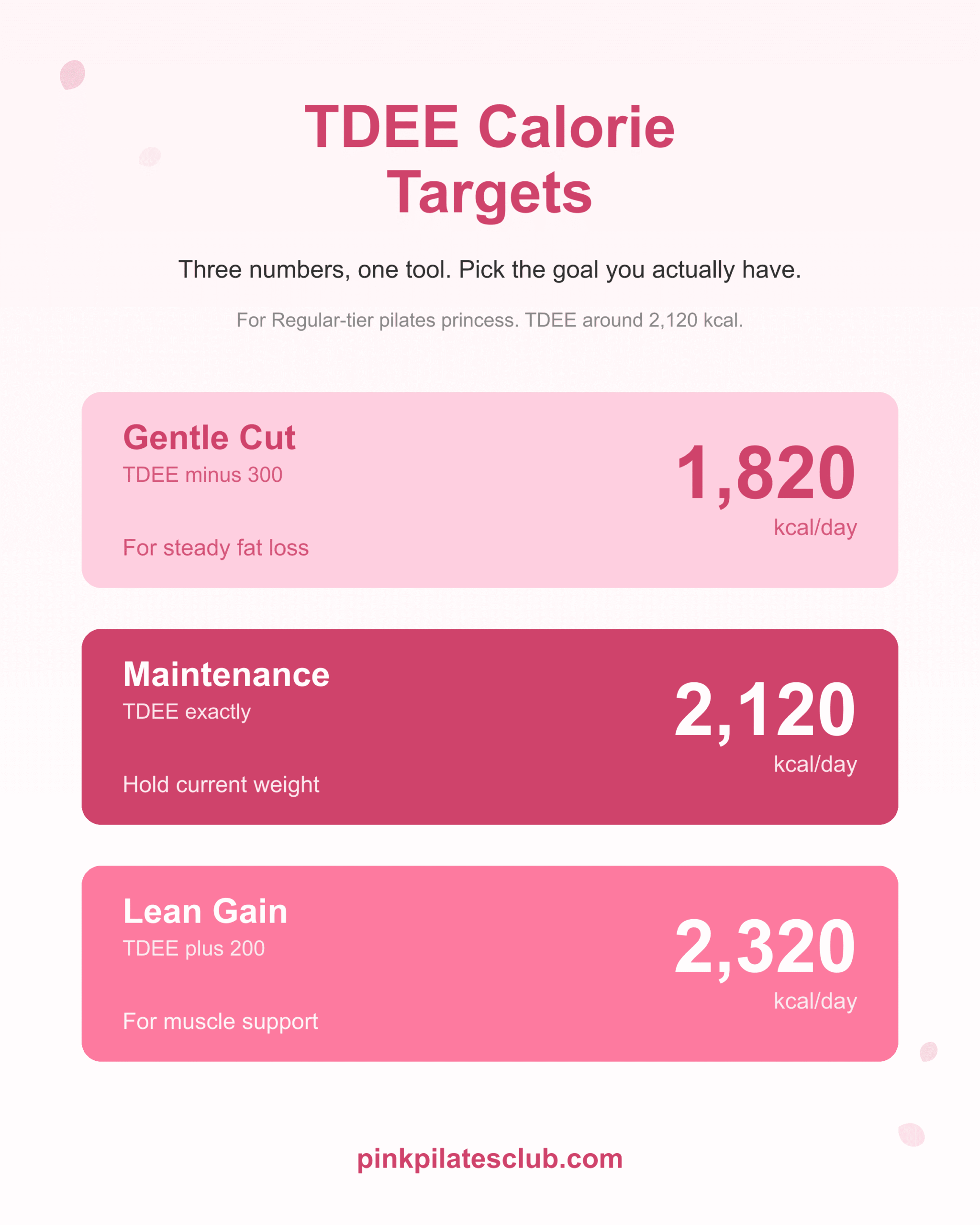
Maintenance equals TDEE. Eat at this number to hold your current weight while continuing to train. Most pilates princesses underestimate maintenance because the cultural default for women is to assume you need to eat less than you actually do. For a Regular-tier 30-year-old female at 150 lb, maintenance is about 2,120 kcal per day. Gentle Cut equals TDEE minus 300 kcal. For the same example, that is around 1,820 kcal per day. The 300-calorie deficit (versus the conventional 500) produces about 0.6 lb of fat loss per week, which is sustainable for months without cortisol spikes, sleep disruption, or training compromise. Aggressive 500-calorie deficits work in the short term and stall in the long term for most pilates princesses.
Lean Gain equals TDEE plus 200 kcal. For the same example, that is around 2,320 kcal per day. Right number for visitors actively building muscle through reformer or strength work without unwanted fat gain. Pilates princesses building muscle benefit from the modest surplus paired with adequate protein (the Pilates Protein Calculator covers exact daily targets). Most fitness content recommends larger surpluses; 200 kcal is sufficient for the moderate muscle-building rate most non-bodybuilders should target. Going higher than 500 kcal surplus is rarely productive for the audience this tool serves.
Why Most Pilates Princesses Eat Below Their TDEE Without Realizing It
The single most common pattern this calculator surfaces is a maintenance number that is meaningfully higher than the visitor was eating. Below are four reasons most pilates princesses chronically eat below TDEE without realizing it.
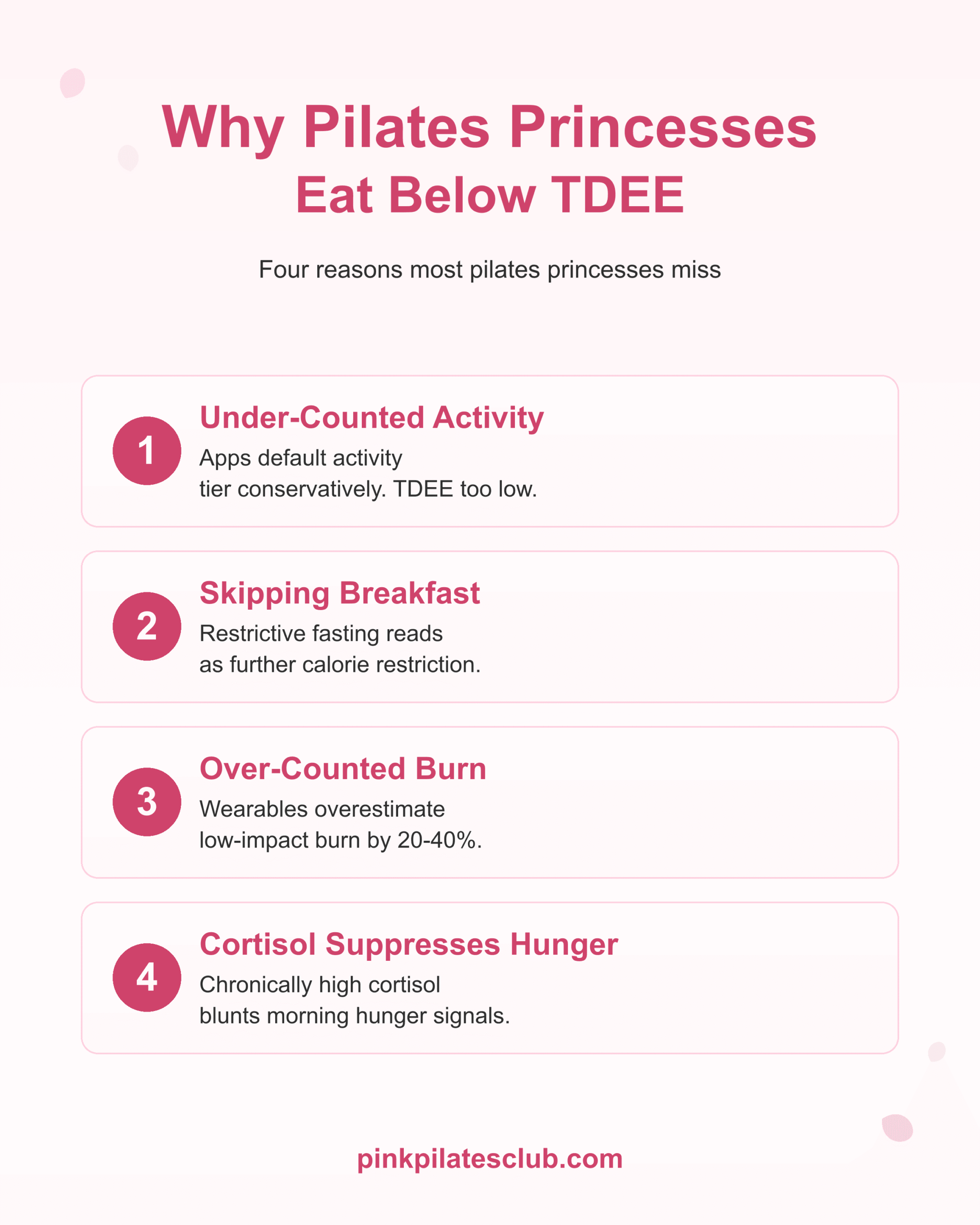
First, under-counted activity. Most calorie-counting apps default the activity tier conservatively, which produces a TDEE 200-300 calories lower than reality for someone training 3-4 days per week. Acting on the lower TDEE means an effective 500-800 calorie daily deficit before any deliberate cut. That is the cortisol-spike zone. Second, skipping breakfast or restrictive intermittent fasting. The trend toward delayed first meal often produces a daily intake meaningfully below maintenance, especially when paired with a moderate evening dinner. Stressed bodies read this as further calorie restriction.
Third, over-counted exercise burn from fitness watches. Most consumer wearables overestimate calorie burn by 20-40% for low-impact movement like pilates and walking. When you “eat back the calories you burned,” you may be eating back calories you did not actually burn, which lifts perceived intake without raising actual intake. The TDEE-based approach this calculator uses sidesteps that error entirely. Fourth, cortisol-driven appetite suppression. Chronically high cortisol blunts hunger signals, especially in the morning. Pilates princesses with the High or Very High tier on the Cortisol Stress Quiz often eat well below maintenance not because they are dieting but because hunger does not arrive when it should. The Cortisol Cocktail Recipe Book and the gentle calming routine cover this directly.
The 28-Day Flat Tummy Reset
Want a structured 4-week program that uses your TDEE to set sustainable calorie targets, balance training intensity, and avoid the cortisol spike that aggressive deficits produce? The 28-Day Flat Tummy Reset stacks gentle deficit, intensity progression, and recovery balance so the results compound without burnout. Built for pilates princesses who want results without the deprivation.
$89.97 · instant digital access
Frequently Asked Questions
What is TDEE and why does it matter for pilates?
TDEE stands for Total Daily Energy Expenditure. It is the total calories your body burns in a day, including BMR (calories at rest) plus the calories you burn moving, training, and digesting food. TDEE matters for pilates princesses because the right number sets the foundation for sustainable calorie targets, which is what produces results without cortisol spikes.
How accurate is a self-reported TDEE calculator?
The Mifflin-St Jeor formula used here is within ±10% for most adults. Activity multipliers add some additional uncertainty since they depend on honest tier selection. Treat the number as a strong starting point and adjust by 100-200 calories up or down if the scale moves the wrong direction over 2-3 weeks of consistent eating at the target.
How many calories should I eat to lose weight doing pilates?
The Gentle Cut target (TDEE minus 300) is the right number for most pilates princesses. For a Regular-tier 30-year-old female at 150 lb, that is about 1,820 kcal per day. Smaller deficits work better for cortisol-prone audiences than the aggressive 500-calorie deficit most calculators recommend.
Why is my TDEE lower than my friend’s even at the same weight?
Three factors create gaps between people at the same weight: age (BMR drops about 5 kcal per year), height (taller bodies have higher BMR), and activity tier honesty. A 30-year-old at 150 lb in the Regular tier has a higher TDEE than a 50-year-old at 150 lb in the Beginner tier. The calculator handles all three.
Should I eat back the calories I burn in pilates?
If you used the right activity tier in the calculator, no. Activity-tier-based TDEE already accounts for the calories you burn in pilates throughout the week. Eating back the calories on top of that double-counts. The exception is if your tracker shows a single unusually long or intense session; even then, eat back about 50-70% of what the tracker shows, since wearables overestimate.
Do pilates princesses need to eat in a deficit to see results?
Not always. If your goal is body composition (more muscle, less fat) rather than scale weight, eating at maintenance with adequate protein and consistent training produces gradual recomposition without any deficit. Deficit becomes useful when scale weight loss is the explicit goal. Most pilates princesses get better results from a brief, gentle deficit than from a prolonged aggressive one.
Your Next Step
You now have a TDEE you can trust, plus three calorie targets matched to the actual goal you have. If you want a personalized 7-day meal plan with macro breakdown matched to your target, take the email plan offered above. If you are ready for a structured 4-week program that uses TDEE to set sustainable calorie targets and balance training intensity, the 28-Day Flat Tummy Reset is the next step. You do not need an aggressive deficit to see change. You just need an honest number and consistent practice.
Keep Reading
- the Pilates Calorie Burn Calculator for the per-session number
- the Wall Pilates Calorie Burn Calculator for wall-specific sessions
- our Pilates Weight Loss Calculator for pound-loss timeline projections
- the Pilates vs Yoga Calorie Comparison if you do both practices
- the Hormone Balance Quiz for the symptom-side hormone read
- the Posture Assessment Quiz to track structural alignment
- the Pilates Protein Calculator for the macro breakdown of your TDEE
- the Anti-Bloat Food Quiz to find your bloating triggers
- the Pilates Results Timeline to see when results land
- the 7-Day Pilates Plan generator for a free starting week
- the Pilates Program Quiz to match yourself to a structured plan
- the Cycle Syncing Pilates Planner for cycle-aware programming
- the 30-Day Pilates Challenge if you want a structured month
- the Reformer Spring Resistance Calculator to load the right springs
- the Pilates Afterburn Calculator since afterburn is part of TDEE
- the Cortisol Stress Quiz since cortisol blunts deficit results
- the Postpartum Pilates Planner since TDEE shifts after birth
- the Reformer Pilates Calorie Calculator for reformer-specific burn