If you have ever finished a pilates session and wondered whether your body is still burning calories an hour later, the answer is yes. The metric is called EPOC, which stands for excess post-exercise oxygen consumption, and it is the technical name for the afterburn effect. Most fitness articles only discuss EPOC for HIIT and heavy strength training. The truth is pilates produces meaningful afterburn too, especially at higher intensities like reformer, wall pilates, and pilates HIIT. This calculator gives you the honest number for your session, your weight, and your style. The basic recommendation is yours immediately. No email required.
Pilates Afterburn (EPOC) Calculator
Tell the calculator your weight, your session length, and your pilates style. The afterburn calories appear immediately, free, no email needed for the basic recommendation.
Your Pilates Afterburn
Session Burn
0 kcal
Afterburn (EPOC)
0 kcal
Total Burn
0 kcal
The afterburn grows when intensity rises. Adding short interval bursts to a pilates session can lift afterburn without losing the gentleness this practice is built around.
Get Your Personalized Afterburn Plan
We will send you a 7-day pilates afterburn plan with progressive intensity tiers, a style-by-style afterburn comparison tailored to your weight, sample HIIT-pilates intervals to layer into a typical week, and the recovery balance that keeps the practice gentle. Free, no spam, easy unsubscribe.
How the Pilates Afterburn Calculator Works
The calculator uses three inputs: body weight, session duration, and pilates style and intensity. From there it estimates two distinct numbers. The session burn is what you spend during the session itself. The afterburn is what your body keeps spending after you stop, while it returns to baseline oxygen use, replenishes phosphocreatine stores, repairs micro-fatigue, and clears metabolic byproducts. Both numbers are calorie estimates, and both belong in the picture if you want a credible read on what pilates actually contributes to your weekly burn.
The session burn uses the standard MET formula: calories per minute equal METs times weight in kilograms divided by 60. The four pilates intensity tiers in the dropdown each have a research-anchored MET value. Restorative pilates sits at 2.8 METs, standard mat pilates at 3.8 METs, reformer or wall pilates at 4.5 METs, and pilates HIIT or interval work at 6.0 METs. These are conservative midpoints from peer-reviewed exercise physiology, not the inflated numbers you see on fitness apps that round upward to flatter the user.
The afterburn estimate multiplies session calories by an EPOC percentage that varies by intensity. Restorative work produces around 3.5% afterburn, standard mat around 6%, vigorous reformer or wall around 9%, and pilates HIIT around 14%. The afterburn duration also scales: 15 minutes for restorative, 30 for standard, 60 for vigorous, and 90 for HIIT. These ranges sit inside the documented EPOC literature and deliberately avoid the inflated 21% figures sometimes quoted for true elite-level HIIT, which pilates HIIT does not reach.
The 4 Pilates Intensity Tiers and Their Afterburn
The four tiers below cover almost every pilates session a pilates princess does in a normal week. The MET, EPOC percentage, and EPOC duration scale with intensity for one biological reason: harder sessions take longer for the body to fully recover from, and recovery costs oxygen, which costs calories.
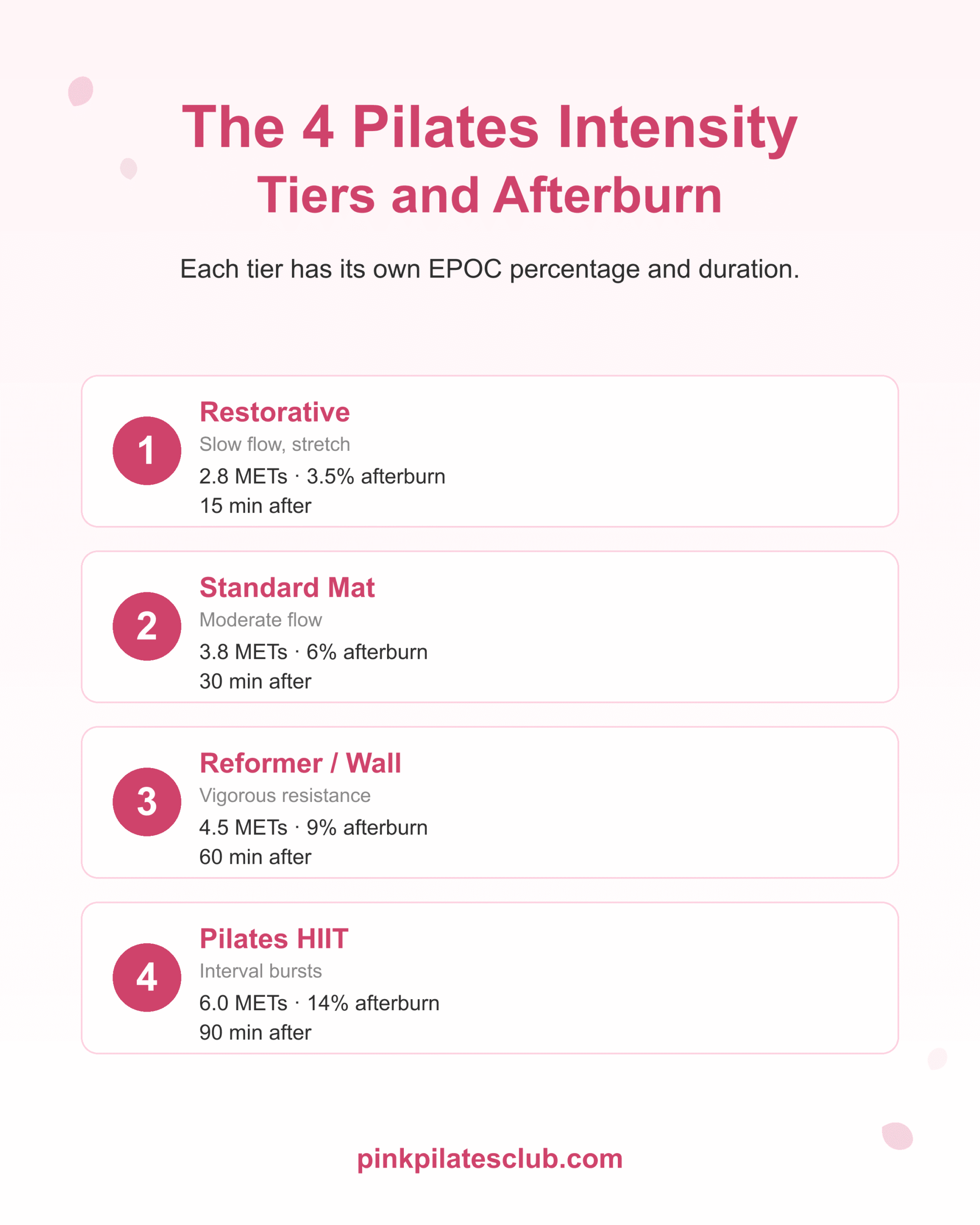
Restorative pilates is the slow flow, stretching, and recovery tier. Useful for nervous-system regulation, post-injury work, and the rest days that turn the practice from punishing to sustainable. The afterburn here is small, around 3.5% of session calories, and it lasts about 15 minutes. Do not rule out this tier because of the small afterburn. The benefit is in the parasympathetic activation, not the calorie spend, and the brand philosophy is built around honoring this tier rather than skipping it.
Standard mat pilates is the productive sweet spot for most pilates princesses. Moderate flow, beginner reformer, and most home workouts fall here. The afterburn is about 6%, lasting 30 minutes after the session. Reformer or wall pilates pushes intensity meaningfully higher, with afterburn around 9% lasting an hour, because resistance work and the spring loading or wall work increases oxygen demand and recovery cost. Pilates HIIT and interval work, when done with real intensity bursts, produces about 14% afterburn lasting 90 minutes. This is the highest tier most pilates princesses ever reach, and it does not need to be done every day.
Session Calories vs Afterburn
The afterburn never matches the session itself. That is not a flaw in the practice. That is the biology. The session burn is the headline number, and the afterburn is the multiplier that compounds across a consistent week.
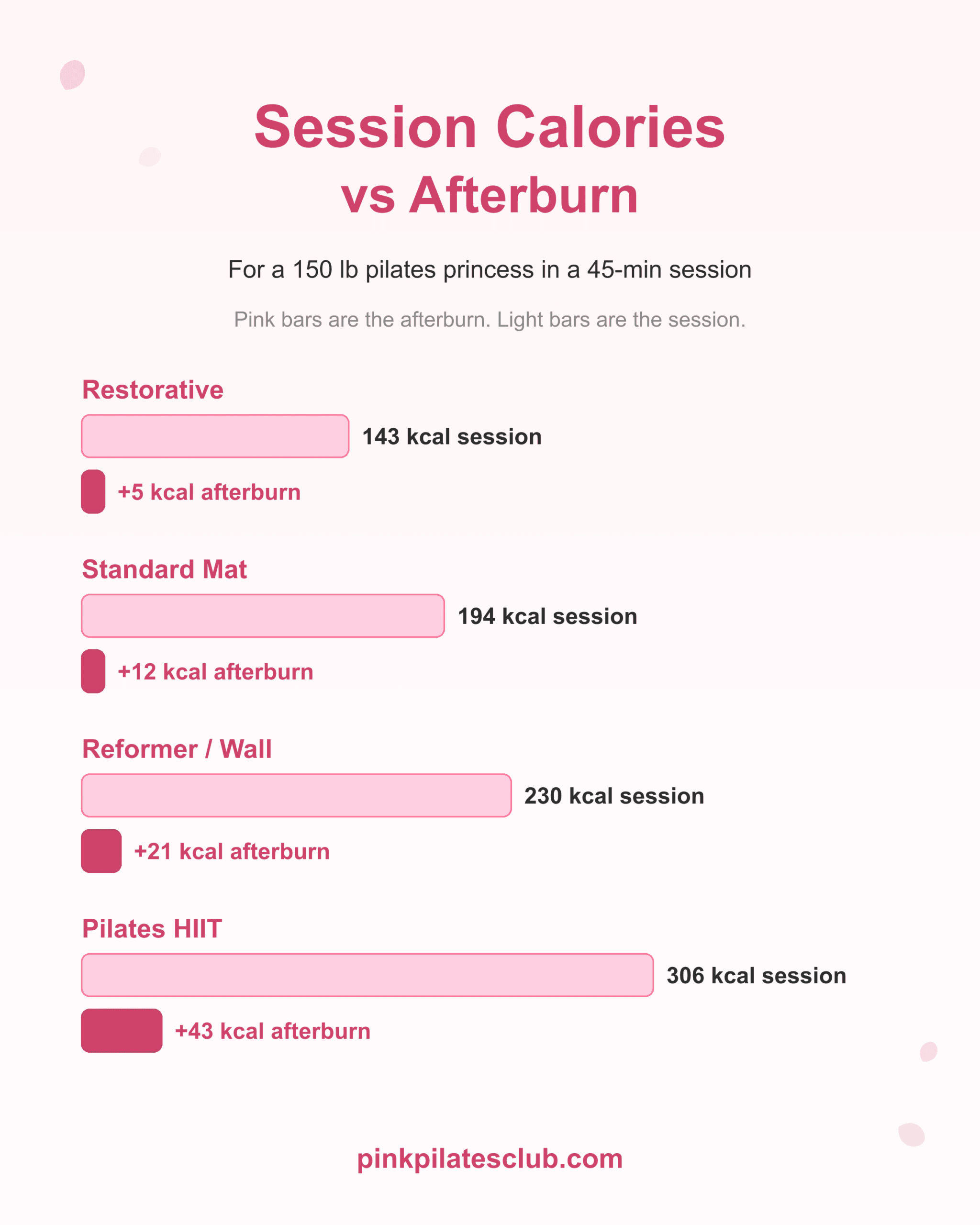
For a 150 lb pilates princess in a 45-minute session, the four tiers produce these numbers. Restorative pilates burns about 145 session calories with around 5 calories of afterburn. Standard mat burns about 195 session calories with around 12 calories of afterburn. Reformer or wall pilates burns about 230 session calories with around 21 calories of afterburn. Pilates HIIT burns about 305 session calories with around 43 calories of afterburn. Across a 5-session week, the afterburn alone adds 25 to 215 extra calories depending on intensity tier.
The honest takeaway is that pilates afterburn matters more across a week than it does in a single session. Compulsively chasing afterburn in one workout is the wrong frame. Stacking 4 to 6 sessions of varied intensity across a week gives the metabolism repeated low-level lift without the cortisol spike that aggressive daily HIIT produces. This is the pattern that actually shifts body composition over months, and it is the one this brand is built around.
How to Maximize Pilates Afterburn (Without Losing the Gentleness)
If you want more afterburn from your pilates without drifting into burnout-culture training, four levers make the biggest difference. Each one stays inside the brand philosophy of gentle movement compounded over time.
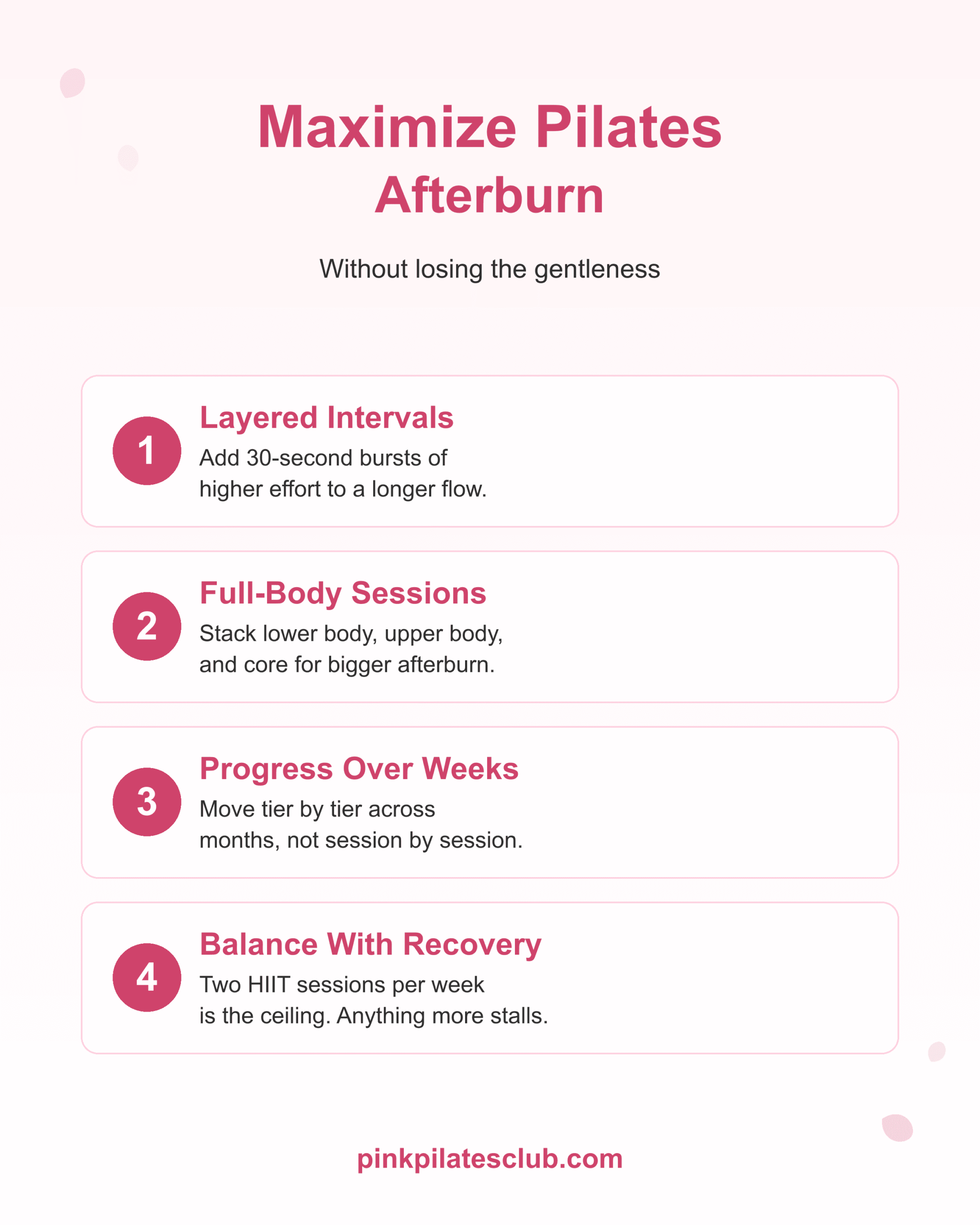
First, layer short interval bursts into a longer session. Adding 4 to 6 rounds of 30 seconds at higher effort followed by 90 seconds back to standard flow lifts the EPOC contribution noticeably without turning the entire session into HIIT. Second, prioritize full-body integration. Sessions that stack lower body, upper body, and core in the same flow generate more afterburn than isolation sessions because more total muscle is recruited and more total recovery is needed afterward.
Third, progress intensity over weeks, not days. Moving from standard mat to reformer or wall pilates, then introducing one HIIT-pilates session per week, gives the nervous system time to adapt and the afterburn-stacking effect compounds month after month. Fourth, balance intensity with recovery. Two HIIT-pilates sessions per week is the realistic ceiling for most pilates princesses. Beyond that, cortisol output starts working against fat loss, sleep quality drops, and afterburn gains stall. The pilates princess pattern is intensity used like seasoning, not like the main meal.
The 28-Day Flat Tummy Reset
Want a structured 4-week program that uses intensity progressions designed to maximize afterburn without losing the gentleness? The 28-Day Flat Tummy Reset stacks restorative, standard, and short interval sessions so the afterburn compounds across the month while cortisol stays calm. Built for pilates princesses who want results without the burnout.
$89.97 · instant digital access
Frequently Asked Questions
Does pilates have an afterburn effect?
Yes. Every form of structured movement produces some EPOC. Pilates afterburn ranges from about 3.5% of session calories at restorative intensity to about 14% for pilates HIIT. The afterburn is real, modest at low intensities, and meaningful at higher intensities. It compounds across a consistent week of practice.
How long does the pilates afterburn last?
About 15 minutes for restorative pilates, 30 minutes for standard mat work, 60 minutes for reformer or wall pilates, and 90 minutes for pilates HIIT. The duration scales with intensity because higher-effort sessions take longer for the body to fully recover from, which keeps oxygen demand elevated.
Is pilates afterburn the same as HIIT afterburn?
Not quite. True HIIT afterburn ranges from 10% up to 21% of session calories in some studies. Pilates HIIT sits at the lower end, around 14%, because pilates HIIT includes mobility work and slower transitions that traditional HIIT does not. Pilates HIIT still produces meaningful afterburn, just at a smaller multiple than running intervals.
Why is my pilates afterburn lower than my friend’s?
Body weight is the biggest single factor. Heavier bodies burn more session calories at the same intensity, which makes the afterburn percentage produce a larger absolute number. Session length and intensity tier also shift the calculation. Use the calculator above to check the personalized number for your inputs.
Can I increase my pilates afterburn?
Yes. Layer short interval bursts into a longer session, prioritize full-body sessions over isolation, and progress intensity over weeks. The biggest lever is moving from restorative to standard to reformer or wall, then adding one HIIT-pilates session per week. Two HIIT sessions weekly is the realistic ceiling for most pilates princesses.
What is EPOC and why does it matter for pilates?
EPOC stands for excess post-exercise oxygen consumption. It is the oxygen and calorie cost your body pays after a workout to return to baseline. EPOC matters for pilates because it answers the question of what gentle movement actually contributes to weekly burn beyond the session itself, which is the question most pilates princesses care about.
Your Next Step
You now have an honest read on your pilates afterburn for your weight, your session length, and your intensity tier. If you want a personalized 7-day afterburn plan with style-by-style comparisons, take the email plan offered above. If you want a structured 4-week program that stacks afterburn across the month while keeping cortisol calm, the 28-Day Flat Tummy Reset is built around exactly that pattern. You do not need to chase afterburn every session. You just need consistent practice with intentional intensity layering.
Keep Reading
- the Pilates Calorie Burn Calculator for the session-only number
- the Wall Pilates Calorie Burn Calculator since wall work is one of the higher-EPOC styles
- our Pilates Weight Loss Calculator for pound-loss projections that include afterburn
- the Pilates vs Yoga Calorie Comparison if you do both practices
- the Hormone Balance Quiz to check whether cortisol is blocking your afterburn gains
- the Posture Assessment Quiz to track structural alignment alongside intensity work
- the Pilates Protein Calculator since recovery from afterburn-heavy sessions needs protein
- the Anti-Bloat Food Quiz to find your bloating triggers
- the Pilates Results Timeline to see when intensity work shows up visibly
- the 7-Day Pilates Plan generator for a free starting week with mixed intensities
- the Pilates Program Quiz to match yourself to a structured plan
- the Cycle Syncing Pilates Planner for cycle-aware intensity programming
- the 30-Day Pilates Challenge if you want a structured month of progressive intensity
- the Reformer Spring Resistance Calculator since heavier reformer work raises afterburn
- real mat pilates results stories from pilates princesses
- the consistency tips that turn intensity-layered weeks into real change