
If the scale has stopped telling you anything useful and your jeans fit differently than the number says they should, your waist-to-hip ratio is a better metric than the scale ever was. WHR measures where you carry weight, not how much. It is one of the few body composition signals that actually correlates with health markers and that pilates can meaningfully shift over months of consistent practice. This calculator uses your sex, waist, and hip measurements to give you a WHR ratio, a WHO-aligned risk category, and a body shape interpretation matched to the kind of pilates work that shifts WHR over time. The basic answer is yours immediately. No email required.
Waist-to-Hip Ratio Calculator
Enter your sex, your waist measurement, and your hip measurement. Your WHR ratio, risk category, and body shape interpretation appear immediately. Free, no email needed for the basic answer.
Your Waist-to-Hip Ratio
WHR
0.00
Risk Category
Your body composition pattern is Balanced.
Note: WHR is a useful body composition signal, not a verdict. Pilates plus walking plus cortisol management can shift this ratio over months of consistent practice. The number is a starting point for action, not a judgment.
Get Your Personalized Waist-to-Hip Ratio Plan
We will send you a 12-week pilates progression specifically targeting your WHR, cortisol-aware programming since cortisol drives apple-shape fat distribution, a measurement tracking template to monitor change every 2 weeks, and cycle-aware adjustments since cycle phase influences waist measurements. Free, no spam, easy unsubscribe.
How the Waist-to-Hip Ratio Calculator Works
The calculation is the simplest in the SEO tools system: WHR equals your waist measurement divided by your hip measurement. Because it is a ratio, the units do not matter as long as both inputs are in the same unit. The calculator accepts inches or centimeters via the unit toggle and converts automatically when you switch.
The output has three layers. First, the ratio itself, rounded to two decimal places. A WHR of 0.78 looks similar to a WHR of 0.84 on a casual glance but they sit in different risk categories, which is why the precision matters. Second, the WHO-aligned risk category. For women, low risk is below 0.80, moderate is 0.80 to 0.85, and high is 0.85 or above. For men, the thresholds are 0.90 and 0.95. Third, the body shape interpretation: pear (below 0.75), balanced (0.75 to 0.85 for women, 0.75 to 0.90 for men), or apple (above those thresholds). Each shape has different body composition implications and different pilates levers that work best for it.
WHR is a more useful signal than BMI for most pilates princesses because it accounts for fat distribution, not just total mass. A pilates princess and a runner at the same BMI can have very different WHRs because they carry weight in different places. WHR also responds to consistent training in ways the scale often does not: a visible WHR shift can happen in 8 to 12 weeks of pilates plus walking plus cortisol management, even when the scale weight has barely moved.
The 3 WHR Risk Categories
The risk categories below come from WHO body composition guidance. They are not predictions, they are signals about where on the metabolic-risk spectrum your current body composition sits. The number is a starting point for action, not a verdict.
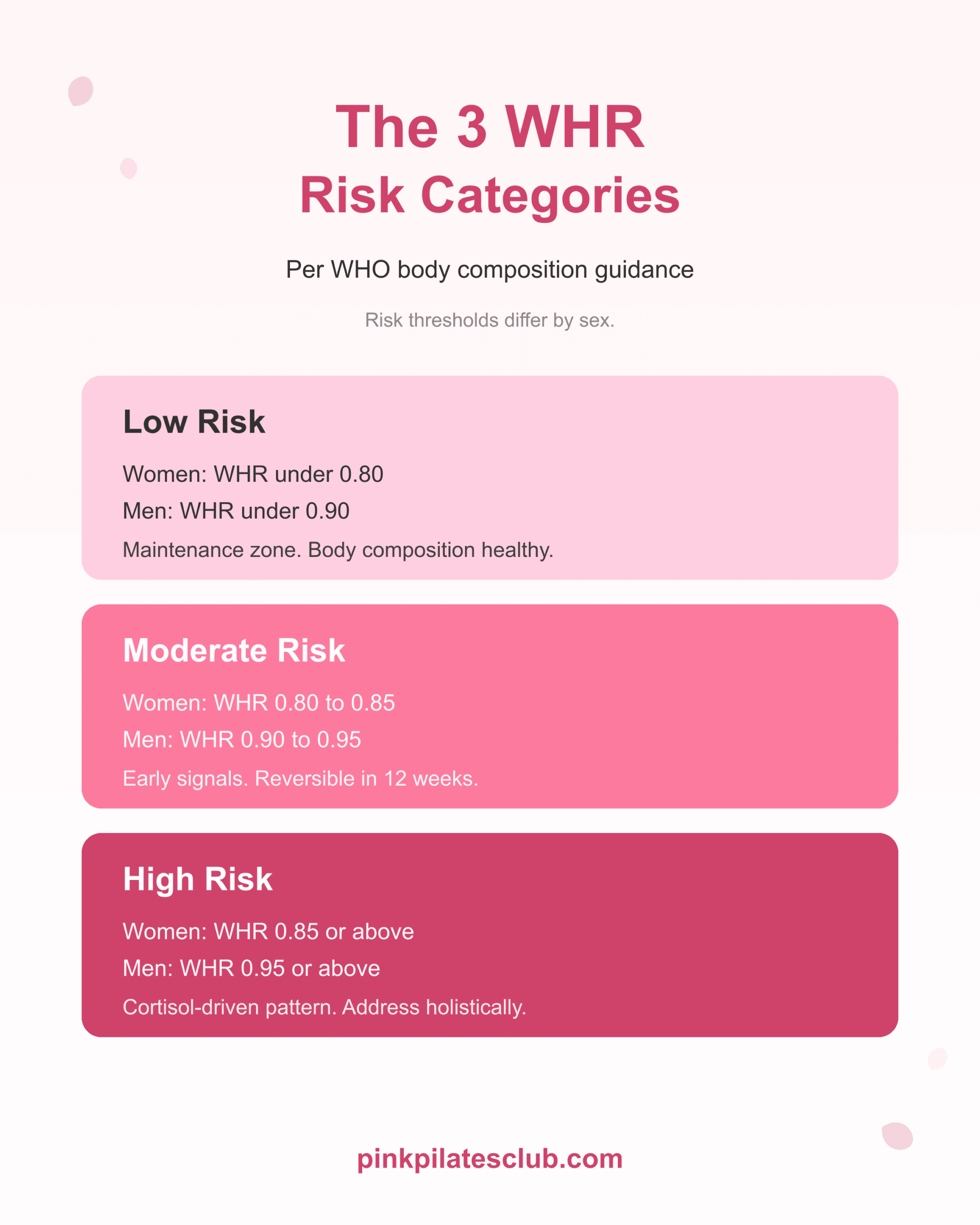
Low risk for women is a WHR below 0.80, for men below 0.90. This is the maintenance zone. The body composition is in a metabolically healthy range, abdominal fat is moderate or low, and the goal is preservation through consistent training and protein intake. Most pilates princesses who land here got here through years of conscious work and want to stay here. The 30-Day Full Body Pilates is the maintenance product for this tier because the structure preserves what the visitor has built without forcing them into deficit they do not need.
Moderate risk for women is WHR 0.80 to 0.85, for men 0.90 to 0.95. This is the most common tier and the easiest to address. Body composition is showing early signs of abdominal accumulation but the trend is still gentle to reverse. Twelve weeks of pilates plus walking plus protein intake plus a gentle calorie deficit (the 300-calorie target from the TDEE Calculator) typically shifts pilates princesses from moderate back into low risk. High risk for women is WHR 0.85 or above, for men 0.95 or above. The body composition is dominantly abdominal, which is the pattern with the strongest metabolic implications. Cortisol management becomes the leverage point, not just calorie deficit, because chronic cortisol drives the abdominal fat pattern that pure deficit alone often cannot move. The Cortisol Stress Quiz is the natural pairing for high-risk WHR.
How Pilates Shifts Waist-to-Hip Ratio Over Time
WHR responds to pilates more than the scale does, but the change is gradual. Most pilates princesses who land in moderate or high risk and commit to consistent practice see a measurable WHR shift in 8 to 12 weeks. Below are the four mechanisms that drive that shift, all of which pilates targets directly.
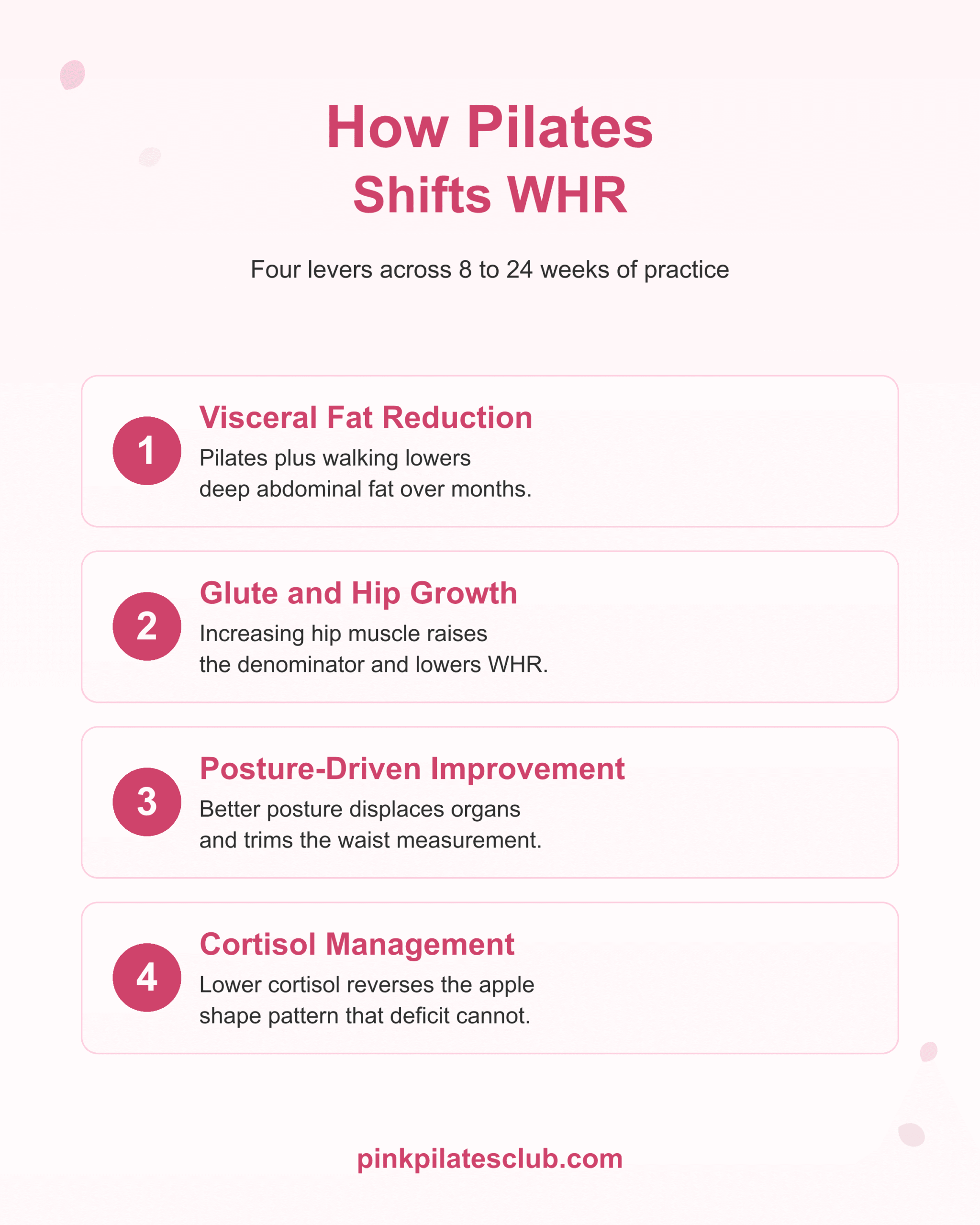
First, visceral fat reduction. Pilates plus walking is one of the most effective combinations for reducing visceral (deep abdominal) fat, the type that shows up in WHR before it shows up in scale weight. The cumulative weekly time-in-zone matters here more than any single intense session. Second, glute and hip development. Increasing the muscle mass of the hips and glutes increases the denominator of the WHR ratio, which lowers the ratio even before any change in waist. Pear-shape and balanced-shape pilates princesses can shift their WHR favorably through hip muscle growth alone.
Third, posture-driven measurement improvement. Hunched posture artificially expands the waist measurement by displacing organs forward. The Posture Assessment Quiz covers the structural assessment side of this. As posture corrects through consistent pilates practice, the waist measurement often drops 0.5 to 1.5 inches without any change in fat mass. The change is structural, not compositional, but it is real and measurable. Fourth, cortisol management. Chronic high cortisol drives abdominal fat accumulation specifically, which is why apple-shape pilates princesses often have a cortisol pattern (per the Cortisol Stress Quiz) and why pure calorie deficit often fails to shift their WHR until cortisol is addressed. Pilates is itself a cortisol-lowering practice when programmed gently; aggressive HIIT-style training can work against the WHR shift even when calorie burn is high.
How to Measure Waist and Hip Correctly
Inconsistent measurement is the most common reason pilates princesses get confusing WHR results week to week. Below is the protocol that produces reliable, comparable measurements. Use the same protocol every time you measure, ideally in the morning before food and after the bathroom, on the same day of your cycle if applicable.
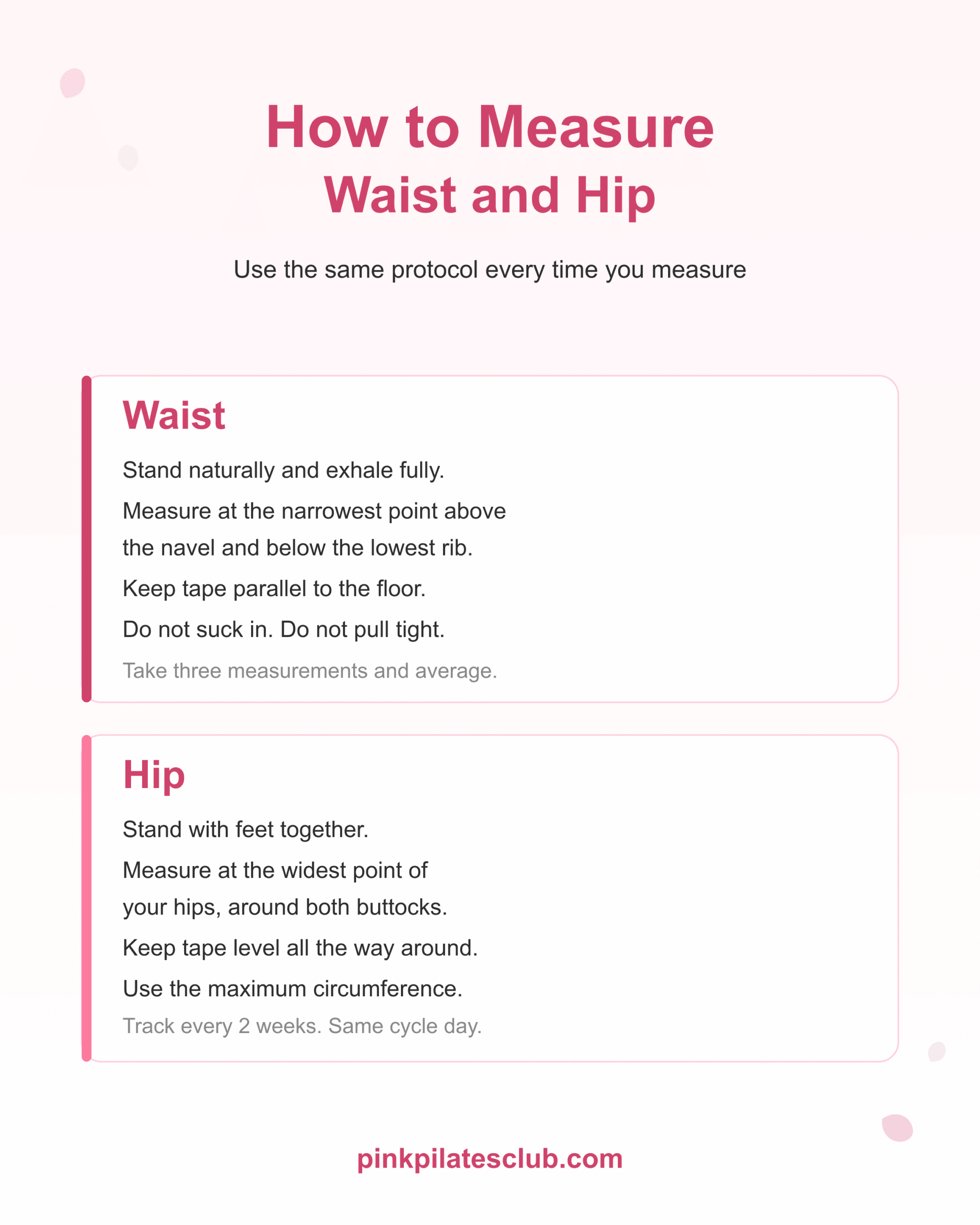
For waist: stand naturally, exhale fully, and measure at the narrowest point of your waist. For most pilates princesses this is just above the navel and just below the lowest rib. Keep the tape parallel to the floor. Do not suck in. Do not pull the tape tight enough to indent the skin. The tape should sit comfortably against the skin without compressing it. For hip: stand with feet together and measure at the widest point of your hips, going around both buttocks. The tape should be level all the way around (look in a mirror or have someone check the back). Take the measurement at the maximum circumference; if you are unsure where the widest point is, measure at three positions a few inches apart and use the largest number.
Repeat both measurements three times in the same session and use the average. Single measurements vary by ±0.5 inch easily; three measurements averaged are reliable. Track WHR every 2 weeks rather than every day; the ratio changes too slowly for daily tracking to be useful, and daily tracking encourages anxiety patterns the brand philosophy explicitly rejects. Cycle phase shifts waist measurements by about 0.5 to 1.5 inches for most menstruating pilates princesses, so measure on the same cycle day each time for the most reliable trend data.
The 28-Day Flat Tummy Reset
Want a structured 4-week program that targets the abdominal-dominant fat pattern WHR identifies? The 28-Day Flat Tummy Reset stacks gentle deficit, cortisol-aware programming, and intensity progression to shift apple-shape WHR toward balanced over a month. Built for pilates princesses whose stomach will not flatten despite working out.
$89.97 · instant digital access
Frequently Asked Questions
What is a healthy waist-to-hip ratio for women?
Per WHO guidance, a WHR below 0.80 is the low-risk range for women. 0.80 to 0.85 is moderate risk. 0.85 or above is high risk. These thresholds reflect metabolic health correlations across large populations. Individual variation is real, and WHR is one signal among many rather than a complete picture of health.
Can pilates change waist-to-hip ratio?
Yes. Pilates plus walking plus protein intake plus cortisol management can shift WHR by 0.02 to 0.08 over 8 to 12 weeks of consistent practice for most pilates princesses. The change comes from four sources: visceral fat reduction, glute and hip muscle gain, posture improvement, and cortisol-driven abdominal fat reduction.
How long does it take to shift waist-to-hip ratio with pilates?
Measurable shifts typically appear at 8 weeks of consistent practice and continue through 12 to 24 weeks. The first 8 weeks often produce small shifts (0.01 to 0.03) driven by posture and water balance. Weeks 8 to 24 produce the larger shifts (0.03 to 0.08) driven by genuine body composition change.
Why is WHR better than BMI?
BMI is a height-and-weight metric that does not account for fat distribution. Two people at the same BMI can have very different WHRs because one carries weight abdominally and one carries it in hips and thighs. WHR captures the part that BMI misses: where the fat sits, which correlates with metabolic health more strongly than total mass alone.
Is apple shape worse than pear shape?
Apple shape correlates with elevated visceral fat, which is the type with stronger metabolic implications. Pear shape correlates with subcutaneous fat in hips and thighs, which is metabolically more neutral. That said, neither shape is a verdict; both shift over months of consistent practice. The shape is a starting point for tailored action, not a fixed outcome.
Where exactly do I measure waist and hip?
Waist: at the narrowest point above the navel and below the lowest rib, on an exhale, with the tape parallel to the floor. Hip: at the widest point of your hips, going around both buttocks, with the tape level all the way around. Take three measurements and average them. Track every 2 weeks.
Your Next Step
You now have your WHR, your risk category, your body shape interpretation, and the pilates levers that shift WHR over time. If you want a personalized 12-week pilates progression specifically targeting your WHR, take the email plan offered above. If you are ready for a structured 4-week program that targets the abdominal-dominant fat pattern WHR identifies, the 28-Day Flat Tummy Reset is the next step. You do not need to be perfect. You just need consistent practice and an honest measurement.
Keep Reading
- the Pilates Calorie Burn Calculator for the per-session number
- the Wall Pilates Calorie Burn Calculator for wall-specific sessions
- our Pilates Weight Loss Calculator for pound-loss timeline projections
- the Pilates vs Yoga Calorie Comparison if you do both practices
- the Hormone Balance Quiz for the hormone read
- the Posture Assessment Quiz, sister tool in body measurement
- the Pilates Protein Calculator since muscle mass shifts WHR
- the Anti-Bloat Food Quiz since bloating affects waist measurement reliability
- the Pilates Results Timeline to see when WHR shifts land
- the 7-Day Pilates Plan generator for a free starting week
- the Pilates Program Quiz to match yourself to a structured plan
- the Cycle Syncing Pilates Planner since cycle phase shifts waist measurements
- the 30-Day Pilates Challenge if you want a structured month
- the Reformer Spring Resistance Calculator to load the right springs
- the Pilates Afterburn Calculator for the post-session burn
- the Cortisol Stress Quiz since cortisol drives apple-shape fat distribution
- the Postpartum Pilates Planner since WHR shifts after birth
- the Reformer Pilates Calorie Calculator for reformer-specific burn
- the Pilates TDEE Calculator for the daily energy picture
- the Pilates Heart Rate Zone Calculator for training intensity