
If you wake up flat, eat normally, and end the day looking three months pregnant, the answer is rarely your pilates routine. It is almost always something on your plate or in your glass. Daily bloating is one of the loudest signals women in their thirties and forties get from their gut, and most online advice oversimplifies it to either “drink more water” or “go gluten-free.” Both are usually wrong. The actual triggers are specific, personal, and surprisingly easy to identify. This 15-item quiz walks you through the most common offenders across drinks, foods, and habits, then surfaces your personal top swaps. The basic result is yours immediately. No email required.
Anti-Bloat Food Quiz
Check every item that applies to you. Hit Calculate at the bottom for your bloat risk score, severity tier, and personalized swap list. No email required for the basic result.
Your bloat risk score: 0 of 32
Low Bloating Risk
Score range: 0 to 7
Your gut is in good shape. The triggers you checked are minor or rare. Light optimization is enough — focus on the swaps below and keep your daily walking and pilates rhythm. The Anti-Bloat Meal Templates becomes preventive maintenance for you.
Your top swaps based on what you checked:
Lock In Your Gut Comfort
7 days of meal templates that maintain the gut comfort you already have. Preventive maintenance against the slow drift most women only notice in their forties.
$17.97
Your bloat risk score: 0 of 32
Moderate Bloating Risk
Score range: 8 to 15
You have clear patterns but nothing screaming. The triggers you checked are common and manageable. Make the top three swaps below and you will likely see a flatter morning within two weeks. The Anti-Bloat Meal Templates gives you the full week of swaps and meal patterns calibrated to your triggers.
Your top swaps based on what you checked:
Reverse the Bloat in 7 Days
A 7-day meal framework that removes your most common triggers and rebuilds gut comfort. Designed for pilates princesses who want results without elimination drama.
$17.97
Your bloat risk score: 0 of 32
Moderate-High Bloating Risk
Score range: 16 to 23
Multiple triggers are stacking against you. This is exactly when a structured plan beats random swaps. The Anti-Bloat Meal Templates walks through 7 days of meals designed to remove the highest-risk triggers and rebuild gut comfort. Most pilates princesses see real change in 7 to 14 days at this tier.
Your top swaps based on what you checked:
Address the Stack with a Structured Plan
A focused 7-day meal plan that targets the multiple triggers stacking against you. Daily meals plus reintroduction guidance once your gut calms.
$17.97
Your bloat risk score: 0 of 32
High Bloating Risk
Score range: 24 to 32
Significant triggers are present across food and habits. A structured elimination plan is what you need now, not piecemeal swaps. The Anti-Bloat Meal Templates is the foundation: 7 days of low-trigger meals plus reintroduction guidance. If symptoms persist beyond 4 weeks of consistent application, see a registered dietitian or gastroenterologist for further investigation.
Your top swaps based on what you checked:
Start the Elimination Reset
A step-by-step 7-day low-trigger reset calibrated for stacked symptoms. Layered progression with reintroduction guidance, designed to be combined with professional consultation if needed.
$17.97
Want a Personalized Anti-Bloat Plan?
We will send you a custom 7-day elimination plan tuned to the specific triggers you checked, with recipe swaps for your highest-risk foods and a gentle reintroduction protocol after the reset. Free, no spam, easy unsubscribe.
How the Anti-Bloat Food Quiz Works
The 15 items above cover the most evidence-backed bloating triggers for women: high-carbonation drinks, sugar alcohols, fermentable carbs eaten raw or unprepared, dairy at high frequency, gluten at every meal, and a small set of habits that swallow air or compress digestion. Each item has a risk weight from 1 to 3 based on how strongly it correlates with daily bloating in clinical and dietary research. Check every item that applies to you. The tool sums the risk weights of your checked items and surfaces your top swaps.
This is not an elimination diet, and it is not a diagnosis. A registered dietitian uses food journals, symptom tracking, and sometimes breath testing to make precise calls about lactose intolerance, fructose malabsorption, SIBO, or IBS. A 15-item quiz reads patterns. It is the right tool for catching the obvious culprits, sanity-checking your hunch, or deciding whether to invest in a structured 7-day reset. If your bloating is severe, sudden, or accompanied by pain, see a doctor before changing your diet.
The four severity tiers map to the four ways most pilates princesses hold bloating: low and intermittent, moderate and patterned, moderate-high with stacked triggers, or high with multiple categories firing at once. All four route to the same product but with different urgency framing. The tier for your score appears in the result panel along with your top 3 to 5 swap cards.
The Top Anti-Bloat Trigger Categories
Bloating triggers fall into a few categories that interact with each other. Recognizing the categories helps you spot patterns the quiz might miss when you have an unusual habit.
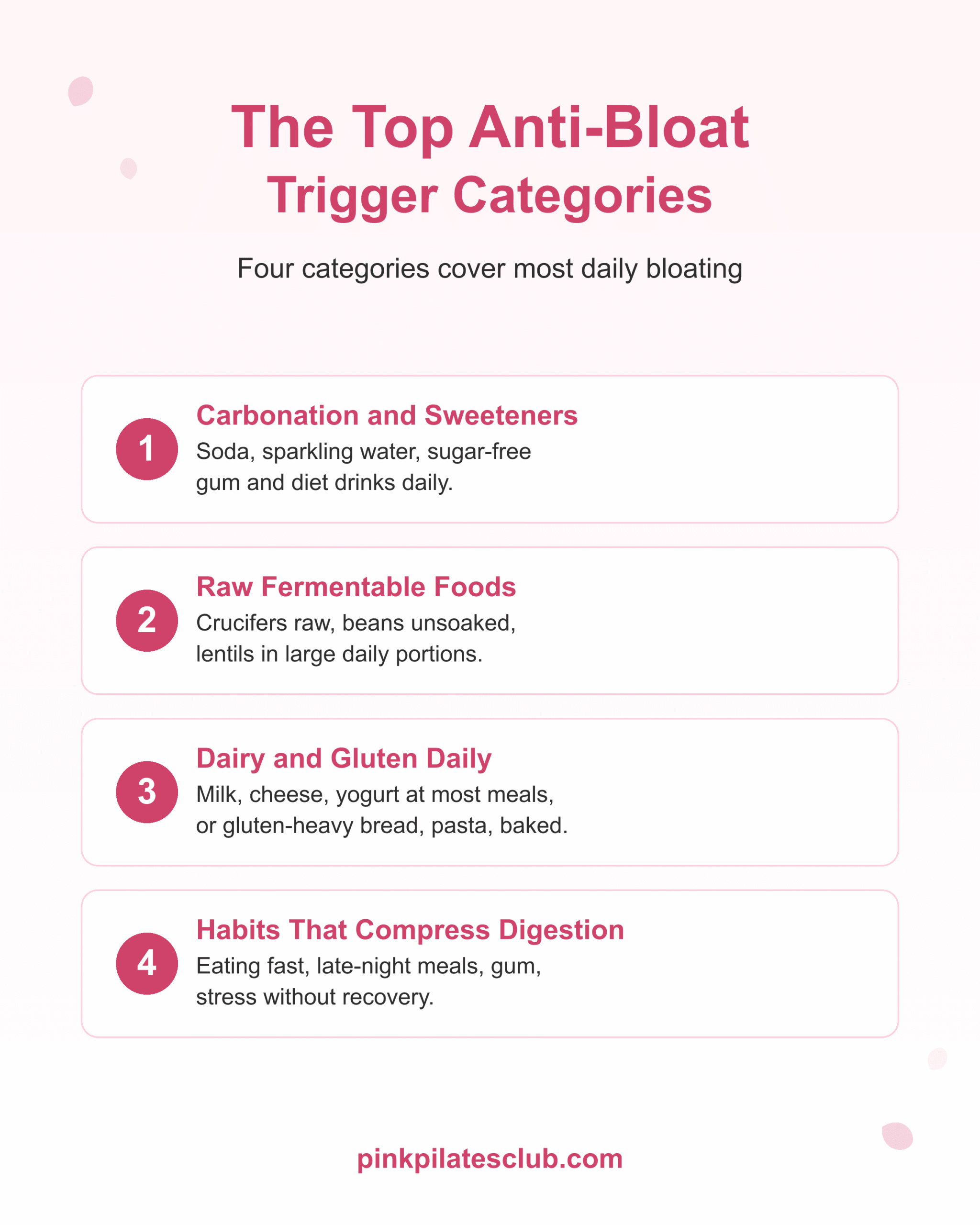
Carbonated drinks and artificial sweeteners are the loudest single category. Carbonation introduces gas directly into the gut, and artificial sweeteners (especially sugar alcohols ending in "-ol" like sorbitol or xylitol) are not absorbed and ferment in the colon, producing more gas. A single daily diet soda can drive significant chronic bloating in sensitive women.
Fermentable carbohydrates eaten in large or raw portions are the second category. Cruciferous vegetables, beans, lentils, and some fruits produce gas when bacteria in the colon break them down. The fix is not avoidance, it is preparation: cook crucifers, soak legumes, eat smaller portions and build tolerance.
Dairy and gluten at high daily frequency are the third category, especially for women whose tolerance has dropped over time. The fix is rarely full elimination — it is rotation, smaller portions, and choosing fermented forms (kefir, yogurt) over fresh milk and cheese. Habits are the fourth category. Eating fast, eating late, chewing gum, and stress all swallow air or compress digestion. None of these are about the food itself; they are about how you eat.
Why These Foods Cause Bloating
The mechanism behind bloating is mostly about gas, water retention, and inflammation. Different triggers produce different combinations of these three.
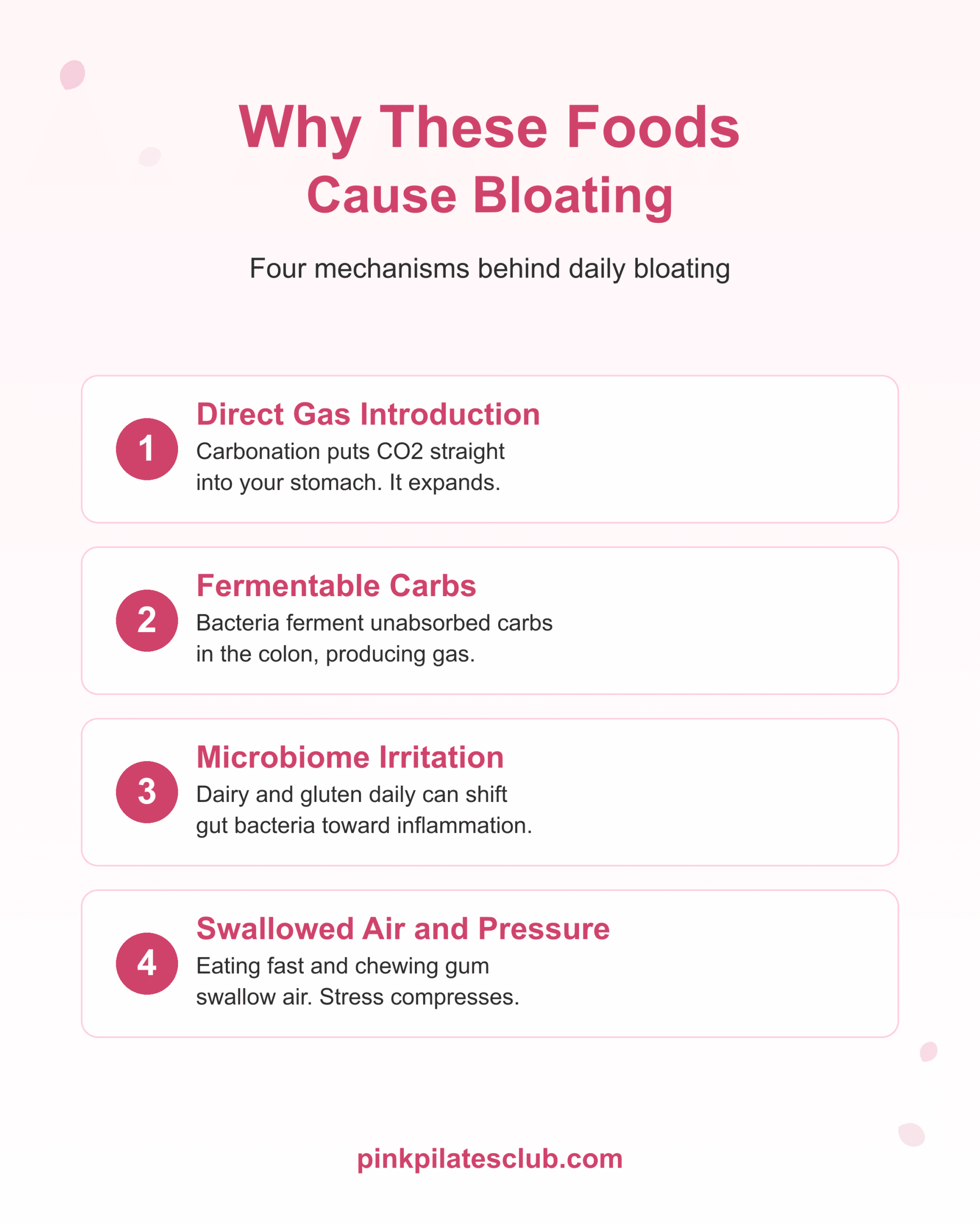
Carbonation introduces gas directly. The bubbles in a soda or sparkling water do not dissolve in the gut as easily as marketing suggests. They expand, which is why your stomach feels tight after a fizzy drink. Sugar alcohols and artificial sweeteners are mostly unabsorbed; they reach the colon intact, where bacteria ferment them, producing hydrogen and methane gas. The same mechanism explains why beans and lentils bloat sensitive eaters.
Dairy intolerance is dose-dependent for most women. The lactase enzyme that breaks down dairy sugar declines slightly with age and varies wildly across individuals. A woman who tolerated dairy at 25 may bloat after a single yogurt at 38. The fix is rarely full elimination; it is rotating in fermented dairy (kefir, aged cheeses) and dairy-free days. Gluten causes bloating for non-celiac sensitive people through inflammation and gut permeability changes, not just gas.
The habit triggers operate differently. Eating fast and chewing gum swallow extra air, which has nowhere to go but bloat. Eating late presses food against the diaphragm during sleep, which slows digestion. Chronic stress lowers stomach acid and slows gastric emptying. The fix for habits is not food at all; it is the small behavioral shifts the swap card surfaces in your result.
A Daily Anti-Bloat Plate
Numbers and swaps without a real meal day are abstract. Below is what a daily anti-bloat plate looks like for a pilates princess in moderate-to-high bloat tier. Heavier or lighter triggers scale the protocol up or down. The full 7-day plan lives in the Anti-Bloat Meal Templates product.
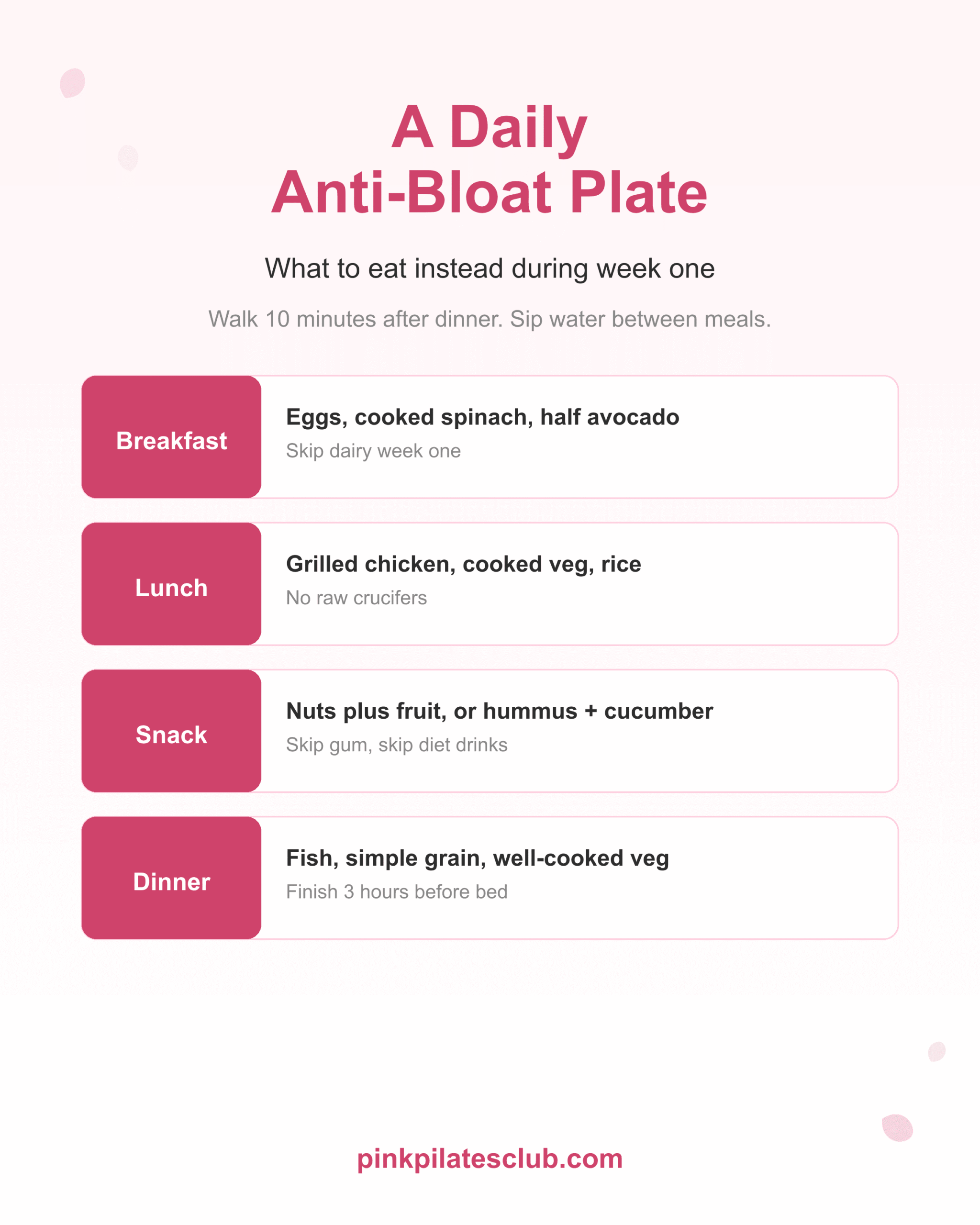
Breakfast is a low-trigger high-protein opener. Two eggs, half a cup of cooked spinach, half an avocado. No bread, no dairy at this meal in the first week. If you usually have yogurt, switch to kefir for the week and see how you feel. Lunch is grilled chicken or fish with cooked vegetables and a small portion of rice or quinoa. Cooked vegetables, never raw cruciferous, in the first week.
Snack is something gentle: a handful of nuts and a piece of fruit, or hummus with cucumber slices. Skip gum, skip diet drinks. If you reach for sparkling water, swap to room-temperature still water with a slice of lemon. Dinner is a clean protein with a simple grain and well-cooked vegetables, finished at least three hours before bed. Throughout the day, sip room-temperature water between meals rather than during. Walk for 10 minutes after dinner. The walk alone unlocks digestion in a way no probiotic does.
The Anti-Bloat Meal Templates
Whatever your tier, the Anti-Bloat Meal Templates is the structured plan that turns your quiz result into actual change. Seven days of low-trigger meals designed for pilates princesses, with reintroduction guidance for the second week. No deprivation. No complicated protocols. Just the swaps that produce a flatter morning.
$17.97 · instant digital access
Frequently Asked Questions
What foods cause the most bloating in women?
Carbonated drinks, artificial sweeteners, raw cruciferous vegetables, beans without soaking, dairy at high frequency, and ultra-processed snacks are the heaviest hitters across most women. Habits matter too: eating fast, chewing gum, and eating within 2 hours of bed all stack on top of food triggers.
How long does it take to fix bloating with diet changes?
Most pilates princesses see noticeable improvement within 7 to 14 days of consistent swaps. The first 3 days are about removing the loudest triggers (carbonated drinks, sugar alcohols, gum). Days 4 to 7 are about meal pattern changes. By day 14, most women report a flatter morning and easier digestion.
Is bloating always caused by food, or can it be hormonal?
Hormonal bloating exists, especially in the luteal phase before your period. Estrogen-driven water retention combined with gut sensitivity can produce daily bloating that mimics food triggers. The Hormone Balance Quiz is the better starting point if your bloating tracks with your cycle. Otherwise, food triggers are the more common driver.
Should I try an elimination diet to find my bloating triggers?
For most women, a 7-day swap protocol works without a full elimination diet. Full elimination (low-FODMAP, dairy-free, gluten-free) is the next step if a 7-day reset does not move the needle. Always reintroduce one category at a time so you can isolate the trigger.
Does pilates actually help with bloating?
Yes, indirectly. Gentle pilates lowers cortisol, supports lymph drainage, builds the deep core that compresses the abdominal cavity correctly, and improves breath depth. All four mechanisms reduce bloating over weeks of consistent practice. Pilates plus walking is one of the most effective gentle interventions for chronic bloating.
Why does carbonated water cause bloating if it is just water?
The carbon dioxide in sparkling water does not dissolve fully in the stomach. The bubbles expand and stretch the stomach lining, which produces a tight, full feeling and sometimes audible gas. Sensitive women can bloat from a single can. The swap is room-temperature still water with lemon or cucumber.
Your Next Step
You now have a personalized swap list and a tier that places your bloating in context. If you want a 7-day elimination plan tuned to the specific triggers you checked, take the email plan offered above. If you are ready for the structured product that turns the quiz result into actual change, the Anti-Bloat Meal Templates is the next step. You do not need to be perfect. You just need to begin.
Keep Reading
- the Pilates Calorie Burn Calculator if you want the calorie side of the equation
- the Wall Pilates Calorie Burn Calculator for wall-specific routines
- our Pilates Weight Loss Calculator for a 12-week timeline view
- the Pilates vs Yoga Calorie Comparison if you do both practices
- the Hormone Balance Quiz if your bloating tracks with your cycle
- the Posture Assessment Quiz, since posture compresses digestion
- the Pilates Protein Calculator for the protein side of bloating
- what to check when pilates feels like it is not working yet
- real mat pilates results stories from pilates princesses
- the consistency tips that turn slow gut change into permanent change