
If you have ever told yourself you would do a 30-day challenge starting Monday, then never did, the problem was rarely your willpower. It was the absence of an actual plan. Most online “30-day pilates challenges” are 30 random YouTube videos in a playlist with no progression, no recovery built in, and no logic for why day 17 is harder than day 4. This planner generates an actual structured challenge tuned to your level, your focus area, your equipment, and your daily time commitment. The basic 30-day calendar is yours immediately. No email required for the basic plan.
30-Day Pilates Challenge Planner
Pick your level, your focus, your equipment, and your daily commitment. Your full 30-day phased challenge appears immediately, free, no email required for the basic plan.
Your 30-Day Pilates Challenge
The 5 Phases
Foundation
Days 1-6
Light
Build
Days 7-12
Moderate
Challenge
Days 13-18
Mod-High
Peak
Days 19-24
High
Sustain
Days 25-30
Mod + Restore
Your 30-Day Calendar
Day three is the most common drop-off. Day fifteen is the second. Push through both and the last fifteen carry themselves.
Get the Printable PDF Plus 30 Daily Check-Ins
We will send you the printable PDF of your full 30-day challenge, plus a daily check-in email each morning of the challenge with that day's session and brief encouragement, plus a mid-challenge boost at day 15 and a celebration email at day 30. Free, no spam, easy unsubscribe.
How the 30-Day Pilates Challenge Works
The challenge runs across five distinct phases of six days each. Foundation (days 1 to 6) is the form-focus phase: gentler intensity, shorter holds, building the habit. Build (days 7 to 12) brings full session intensity and longer flows. Challenge (days 13 to 18) is when the harder variations and longer holds appear. Peak (days 19 to 24) is the highest-intensity stretch of the program — the four-day window where you push your strongest sessions. Sustain (days 25 to 30) winds the intensity back down, locks in the adaptations, and finishes the challenge with a mix of moderate work and restorative recovery.
Each 6-day phase contains four active pilates sessions, one walking day, and one rest day. That total — 20 active sessions, 5 walking days, 5 rest days across 30 days — is the realistic training load that builds visible adaptation without producing the burnout that ends most challenge attempts at day 17. The sessions cycle through a 5-name pool tuned to your focus area: Glutes, Core, Full Body, or Posture. The equipment prefix matches your home setup: Mat Only stays on the mat, Mat plus Wall alternates mat and wall sessions, Mat plus Reformer alternates mat and reformer.
The calendar above shows your full 30 days as a 5-row × 6-column grid color-coded by phase. The intensity gradient is intentional: light pink for Foundation, building through medium and deep pink to Peak, then softening to blush for Sustain. You can see the entire arc at a glance, which is exactly the visual reassurance most pilates princesses need before committing to a month.
The 5 Phases of the Challenge
Each phase exists for a reason. Skipping any of them is the most common reason 30-day challenges crash before day 30. Below is the short version of what each phase does and why it matters.
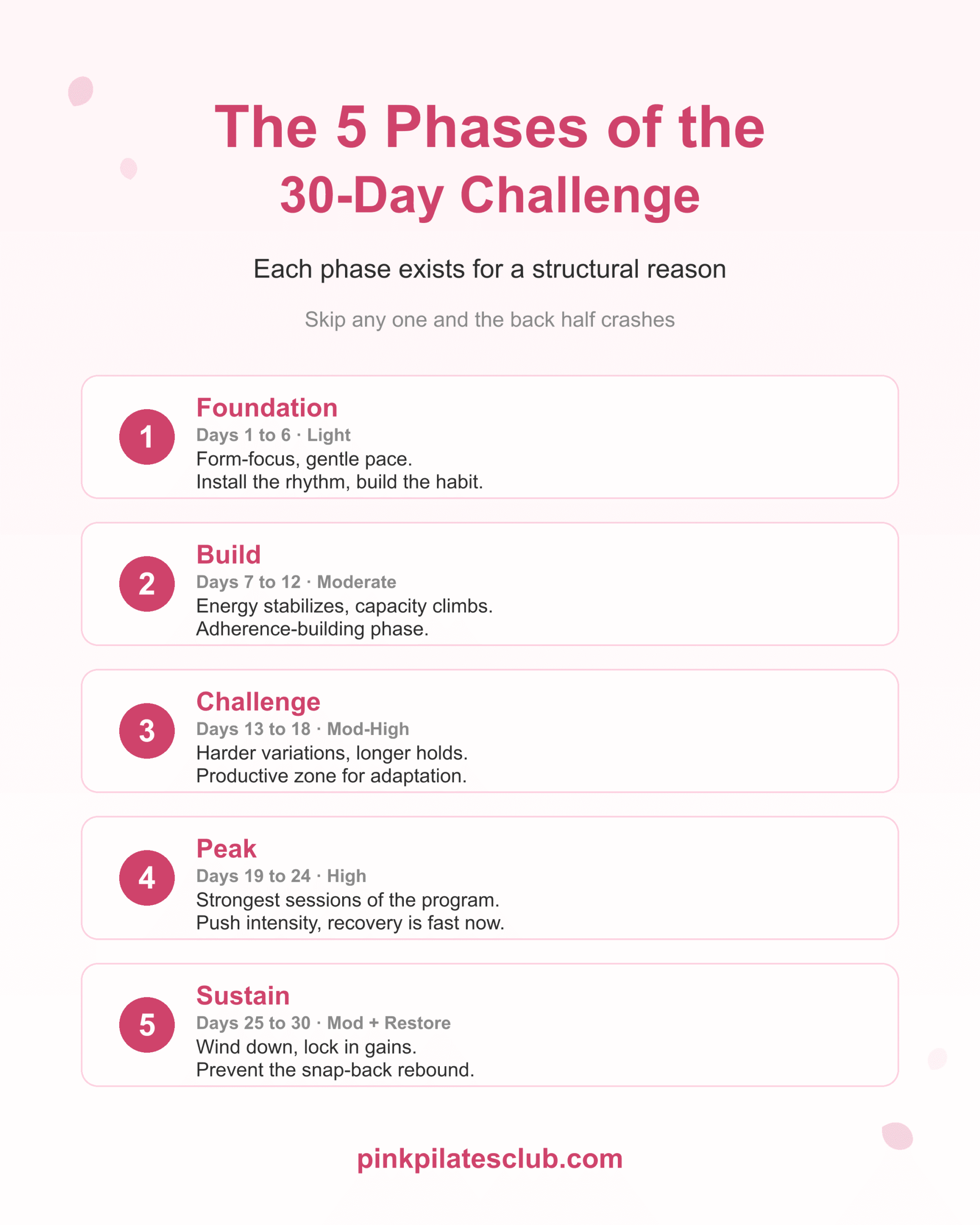
Foundation (days 1 to 6) installs the rhythm. Most pilates princesses underestimate how much of the 30-day result depends on the first six days. Form is built here. The deep core wakes up. The body learns the pace. Going too hard in foundation is the most common reason the back half of the challenge crashes — the nervous system never settled, so by week three the demand exceeds capacity. Six days of light-to-moderate work installs the rhythm without spiking cortisol.
Build (days 7 to 12) is when you start to feel the program working. Energy stabilizes, sessions feel less effortful, and capacity starts climbing. This is the phase where most adherence is built — visitors who finish week two complete the challenge at much higher rates than visitors who quit in foundation. Challenge (days 13 to 18) is the productive zone. Harder variations land here. Longer holds. Peak overload of the program. Most visible adaptation across the 30 days happens in these six days.
Peak (days 19 to 24) is where you push your strongest sessions. The body is now adapted, recovery is faster, and you can land sessions in this window that would have crushed you in week one. Sustain (days 25 to 30) intentionally winds down. Locking in adaptations matters as much as building them. Four moderate sessions, one walking day, one restorative day — the pattern designed to consolidate the gains, not extend the peak. Pushing peak intensity through the last six days is how 30-day challenges turn into 60-day burnouts.
Why a Phased 30-Day Structure Beats Random Daily Sessions
Most online "30-day pilates challenge" content stacks 30 unrelated sessions into a playlist. The video on day 17 has no relationship to the video on day 16. There is no progression, no recovery built in, no logic for why this session today rather than that one. A real 30-day challenge solves four problems random sessions ignore.
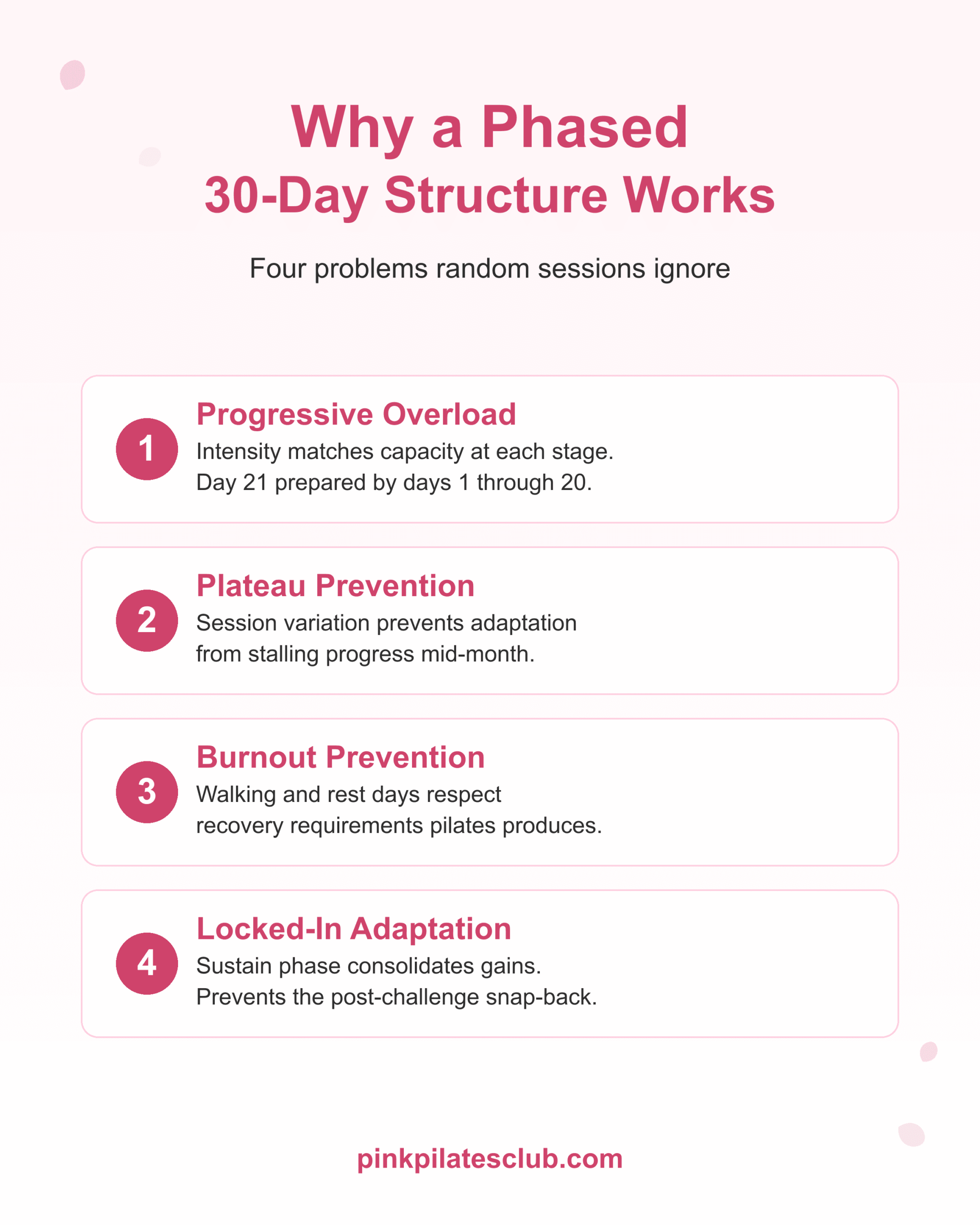
First, progressive overload. Phased structures match intensity to capacity at each stage of the challenge. Day 1 is light because your body has not adapted yet. Day 21 is hard because three weeks of foundation and build have prepared you for it. Random sessions ignore this and either crush you in week one or bore you in week three. Second, plateau prevention. Repeating the same session 30 times creates fast adaptation and then no more progress. Phased variation keeps the body responding. The 5-name session pool inside each focus area cycles enough to prevent staleness while staying recognizable.
Third, burnout prevention. The 4-active + 1-walking + 1-rest pattern per 6-day phase respects the recovery requirements pilates produces. Walking days carry no recovery cost but maintain calorie expenditure and lymph flow. Rest days are when adaptation actually consolidates. Skip these and the challenge becomes the cause of your week-three crash. Fourth, locked-in adaptation. The Sustain phase exists specifically to consolidate gains rather than extend Peak. Most random challenges have no equivalent — they ramp through day 30 and produce a snap-back rebound. Sustain prevents that rebound.
A Sample 30-Day Calendar
Below is what a generated calendar looks like for an intermediate full-body challenge with mat-only equipment and 30-minute sessions. Beginner and advanced versions adjust the session-name picks slightly but keep the same five-phase structure and 4-active-1-walk-1-rest pattern per phase.
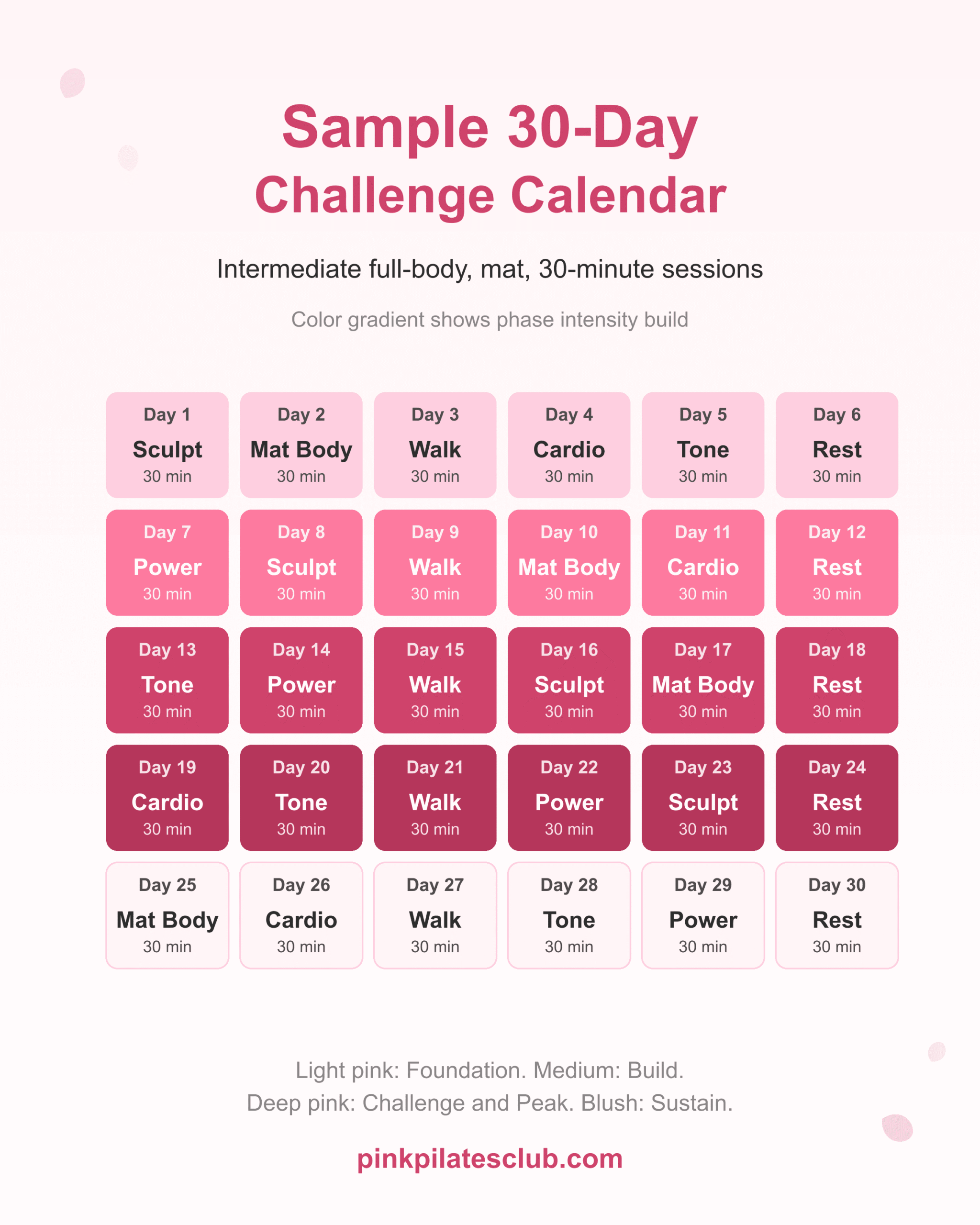
Notice how the calendar reads. Days 1, 2, 4, 5 are active sessions (with day 3 walking and day 6 rest). The same pattern repeats every six days through Foundation, Build, Challenge, Peak, and Sustain. Within each phase, the four active sessions cycle through the focus-area session pool, with equipment alternating if you chose Mat plus Wall or Mat plus Reformer.
The color gradient is the visual proof of the progression. Light pink in week one. Medium pink building through week two. Deep pink through Challenge and Peak. Blush in Sustain. Visitors who print the calendar (via the email opt-in PDF) tape it to the bathroom mirror and check off each day. The visual completion of the calendar is one of the strongest predictors of finishing the challenge.
The 30-Day Full Body Pilates Program
The planner generates the structure. The 30-Day Full Body Pilates fills in the actual sessions: progressive routines for every day of the challenge, form cues, video-led workouts that match the phase pattern. No willpower required, just press play. Built to take a finished challenge plan and turn it into a finished month.
$99.97 · instant digital access
Frequently Asked Questions
Can pilates 30-day challenges actually transform your body?
30 days is enough to install the rhythm, build visible posture and core changes, and produce small but real body composition shifts. Full body composition transformation typically takes 12 weeks. Most pilates princesses who finish a structured 30-day challenge see meaningful posture and energy changes plus 1 to 4 pounds of fat loss when paired with daily walking and reasonable nutrition.
How many days a week should I do pilates during a 30-day challenge?
Four active sessions, one walking day, one rest day per week is the realistic load that builds adaptation without producing burnout. The planner above uses this pattern across all five phases. Pushing more than four active sessions per week typically crashes the challenge by day 17 to 21.
What if I miss a day during the challenge?
Skip the missed day rather than doubling up the next day. Doubling up is how minor missed days become full-week crashes. The 4-active + 1-walk + 1-rest pattern has built-in recovery margin. One missed active day is recoverable. Try to avoid missing two consecutive days in the same phase.
Is a 30-day pilates challenge enough for beginners?
Yes for installing the rhythm and seeing the first visible changes. The Foundation phase specifically eases beginners into the load with lighter intensity for the first six days. Most beginners finish a structured 30-day challenge feeling stronger, more aware of their posture, and ready for a longer programming commitment.
Should I do the same routine every day for 30 days?
No. Repeating the same session 30 times produces fast adaptation and then no more progress. The planner cycles through a 5-name session pool within your focus area, which gives the body new stimuli while keeping the focus consistent. Variation within a focus area is the right balance for 30-day challenges.
What should I do after I finish the 30-day challenge?
Three options: repeat the same challenge with a new focus area, extend into the structured 30-Day Full Body Pilates product if you used the planner as a starter, or move into a longer 12-week program for body composition results. Most pilates princesses repeat a challenge twice before moving to longer commitments.
Your Next Step
You now have a structured 30-day plan that matches your level, your focus area, your equipment, and your daily time commitment. If you want the printable PDF version with daily check-in emails for the full 30 days, take the email plan offered above. If you are ready to layer the actual progressive video sessions onto the structure, the 30-Day Full Body Pilates is the next step. You do not need to be perfect. You just need to push through day three and day fifteen.
Keep Reading
- the Pilates Calorie Burn Calculator to see what your sessions burn
- the Wall Pilates Calorie Burn Calculator if you chose Mat plus Wall
- our Pilates Weight Loss Calculator for pound projections
- the Pilates vs Yoga Calorie Comparison if you do both
- the Hormone Balance Quiz to align the challenge with your hormonal pattern
- the Posture Assessment Quiz if posture is your focus
- the Pilates Protein Calculator since under-eating stalls the challenge
- the Anti-Bloat Food Quiz for the gut side of your challenge
- the Pilates Results Timeline to see when challenge results land
- the 7-Day Pilates Plan generator if 30 days feels too long to start with
- the Pilates Program Quiz to match yourself to the right structured plan
- the Cycle Syncing Pilates Planner for cycle-aware challenge variations
- the consistency tips that turn a 30-day challenge into a finished one
- real mat pilates results stories from pilates princesses