It is the question that keeps coming up in every pilates comment section, every group chat, and every late-night Google session: reformer pilates vs mat pilates, which one actually gets better results? The reformer looks more impressive. The mat is more accessible. Instagram makes the reformer look essential. Your bank account makes the mat look very appealing.
Here is the honest answer before we go any further: both work. Both build core strength, improve posture, increase flexibility, and tone your body. Neither is objectively “better.” But they are genuinely different in how they feel, what they cost, what they demand from your body, and what results they produce.
This guide gives you a side-by-side comparison across every factor that actually matters: cost, accessibility, muscle engagement, body results, learning curve, and long-term sustainability. By the end, you will know exactly which one fits your life, your goals, and your budget.
The Fundamental Difference: What Each One Actually Is
Before comparing results, it helps to understand what makes these two forms of pilates mechanically different.
Mat Pilates
Mat pilates is the original form. You perform exercises on the floor using your body weight as the sole source of resistance. Gravity and your own muscles create every challenge. There is no equipment assisting or resisting your movement. Your core has to do all the stabilising work, which is why mat pilates is often described as more demanding on the deep core muscles.
If you are new to mat work, our complete mat pilates beginner guide walks you through 10 foundational exercises and a free 20-minute routine.
Reformer Pilates
Reformer pilates uses a machine with a sliding carriage, adjustable springs, and straps. The springs create variable resistance, meaning you can make exercises harder or easier by changing the spring setting. The carriage moves beneath you, adding an element of instability that challenges your balance and coordination in ways a mat cannot.
Our reformer pilates beginner guide covers everything you need to know before your first class, including how springs work and what to wear.
Cost Comparison: What You Will Actually Spend
This is where the two forms diverge most dramatically, and for many women, it is the deciding factor.
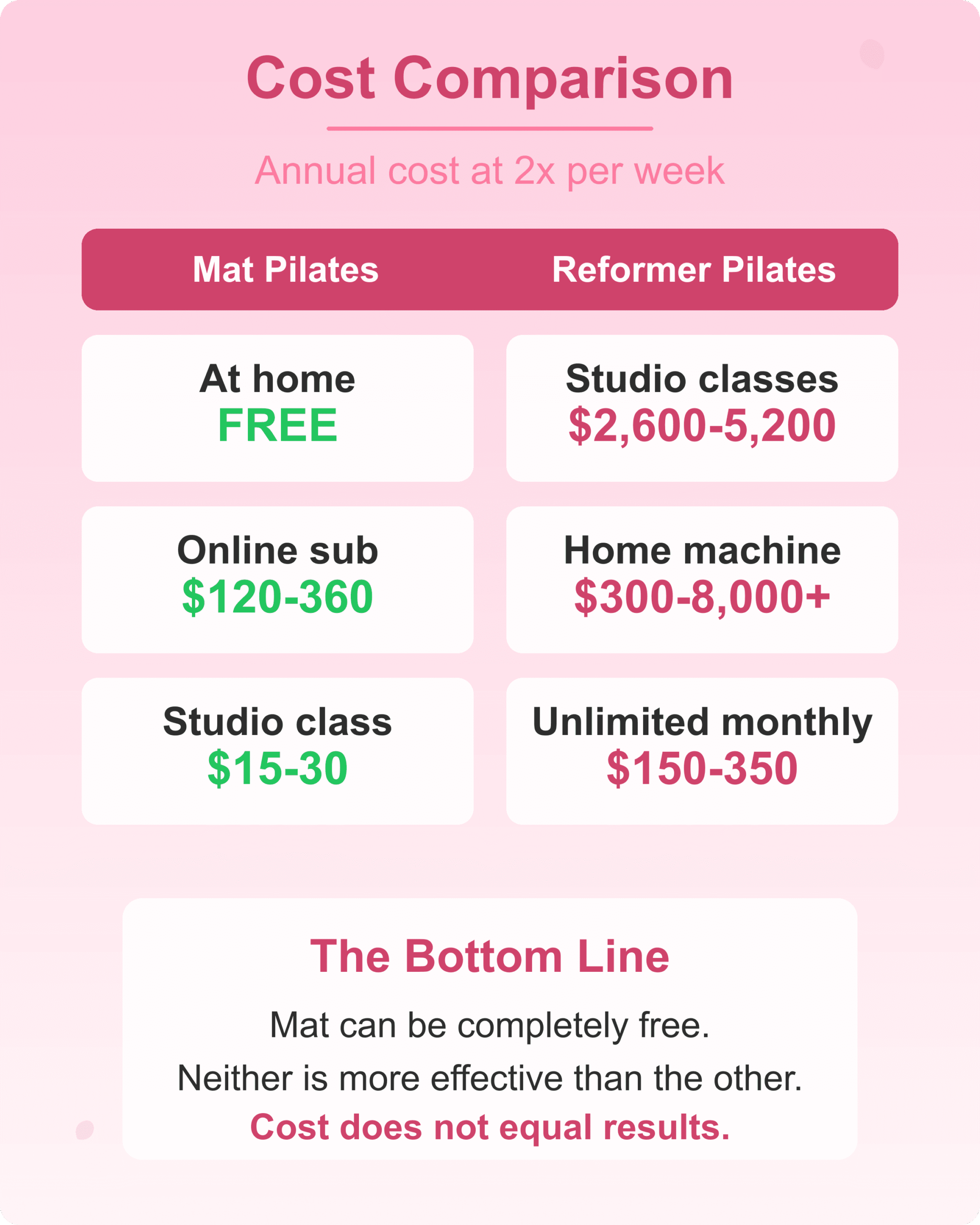
Mat Pilates Costs
- At home (free): All you need is floor space. A yoga mat is optional (a towel works). Free YouTube videos and blog routines like our beginner guide provide structured workouts at zero cost.
- Online classes: $10 to $30 per month for subscription platforms.
- Studio mat classes: $15 to $30 per class, often with larger class sizes (15 to 30 people).
Reformer Pilates Costs
- Studio classes: $25 to $50 per class. Class sizes are smaller (8 to 16 people) because each person needs their own machine.
- Class packs: $20 to $40 per class when buying 5 to 10 at once.
- Unlimited monthly: $150 to $350 per month at boutique studios.
- Home reformer: $300 to $8,000+ depending on quality. Budget foldable models start around $300. Studio-grade machines run $3,000 to $8,000.
The Bottom Line on Cost
Mat pilates can be completely free. Reformer pilates will cost you at minimum $25 per session at a studio. Over a year of twice-weekly classes, that is roughly $2,600 to $5,200 for reformer versus $0 to $360 for mat. This does not make one better than the other, but it makes one dramatically more accessible.
If budget is a concern, our pink pilates on a budget guide has strategies for getting studio-quality results without studio-level spending.
Muscle Engagement: How Each One Challenges Your Body
This is where the comparison gets interesting. Both forms of pilates work the same muscle groups, but they challenge them differently.
Core Activation
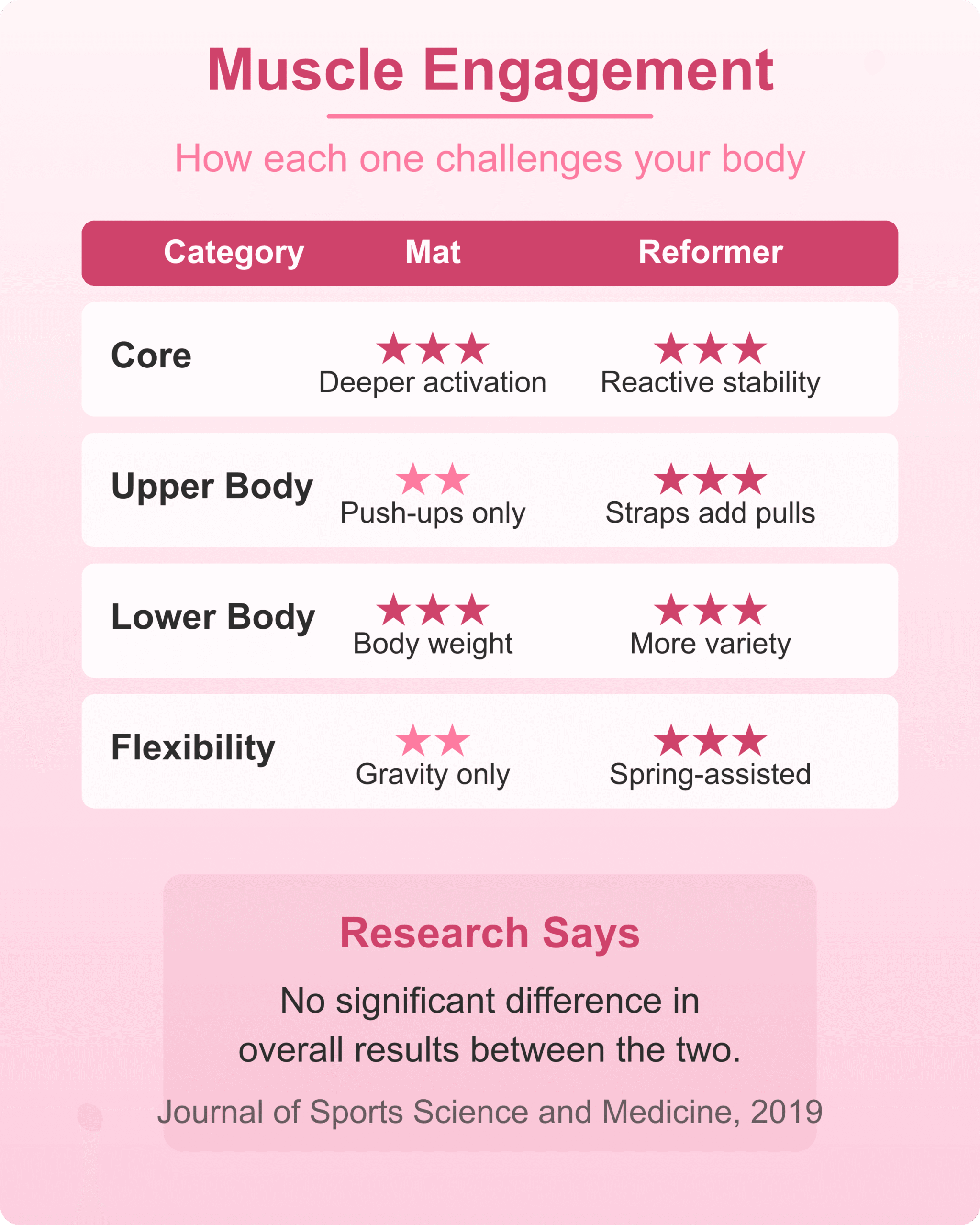
Mat pilates arguably demands more from your deep core. Without springs to assist or a carriage to guide your movement, your transverse abdominis (the deepest core muscle) has to do all the stabilising work. A 2020 study in the Journal of Bodywork and Movement Therapies found that mat pilates produced comparable or greater core muscle activation than reformer pilates for several foundational exercises.
Reformer pilates challenges the core differently. The sliding carriage creates instability, meaning your core has to stabilise against an unpredictable surface. This is a different type of core challenge: reactive stability rather than static stability. Both are valuable.
Upper Body
The reformer has a clear advantage for upper body work. The straps allow for pulling exercises (rows, arm circles, chest expansion) that are difficult to replicate on a mat without equipment. Mat pilates upper body work is limited to push-up variations and exercises where your arms support your body weight.
Lower Body
Both excel at lower body work, but the reformer offers more variety. The footbar allows for leg press variations, standing work on the carriage, and single-leg exercises with spring resistance. Mat pilates relies on body weight and gravity for leg work, which is effective but less varied.
Flexibility and Stretching
The reformer provides spring-assisted stretching that can take you deeper into stretches than you could go on your own. This is particularly helpful for tight hamstrings and hip flexors. Mat pilates stretching is effective but relies entirely on gravity and your own flexibility, which can be limiting for beginners who are very tight.
Results Comparison: What Changes and When
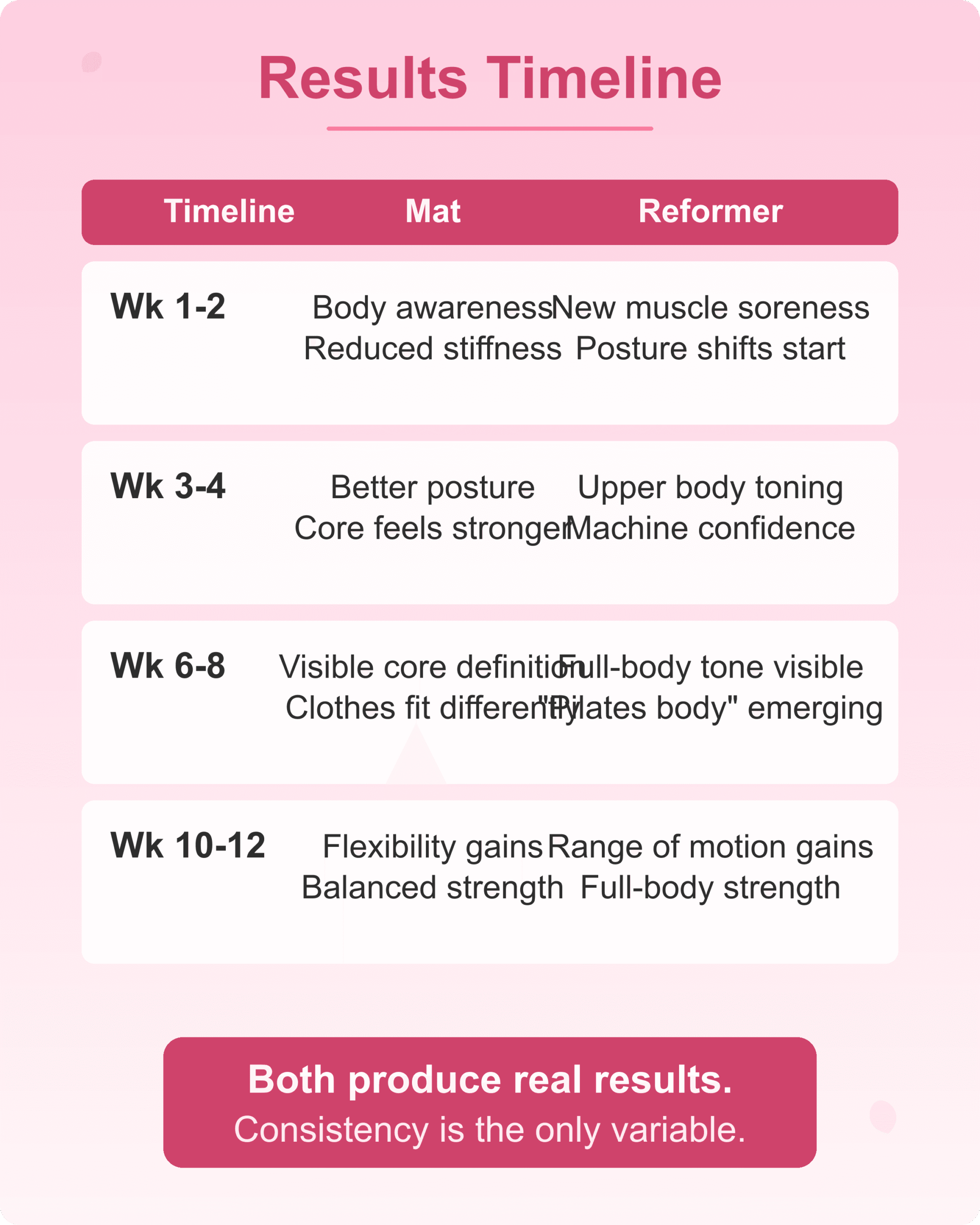
Both mat and reformer pilates deliver real, measurable results. The timeline and the type of results differ slightly.
Mat Pilates Results Timeline
- Weeks 1-2: Improved body awareness, reduced stiffness, muscles “waking up.”
- Weeks 3-4: Noticeable posture improvement, core feels stronger, less back pain.
- Weeks 6-8: Visible core definition, improved muscle tone, clothes fit differently.
- Weeks 10-12: Significant flexibility gains, balanced muscle development, sustained energy levels.
Reformer Pilates Results Timeline
- Weeks 1-2: Muscle soreness in new areas (the springs find muscles you did not know existed), posture shifts beginning.
- Weeks 3-4: Upper body tone improving, core stability noticeably better, more confidence on the machine.
- Weeks 6-8: Visible toning in arms, legs, and core. Improved balance. The “pilates body” starts emerging.
- Weeks 10-12: Full-body strength gains, significant flexibility improvement, spring-assisted stretching producing noticeable range of motion changes.
Which Produces “Better” Results?
Neither produces dramatically better overall results. The reformer tends to produce faster visible toning in the arms and legs because of the variable spring resistance. Mat pilates tends to build deeper core strength because your body has to do all the work without assistance.
A 2019 systematic review in the Journal of Sports Science and Medicine concluded that both mat and reformer pilates produced significant improvements in core strength, flexibility, and body composition, with no statistically significant difference between the two for most measures.
The biggest factor in your results is not which type you choose. It is how consistently you show up. Two mat sessions per week will always outperform one reformer session per week. Our pilates consistency guide has strategies for building a habit that sticks.
The Learning Curve: Which Is Easier to Start?
Mat Pilates Learning Curve
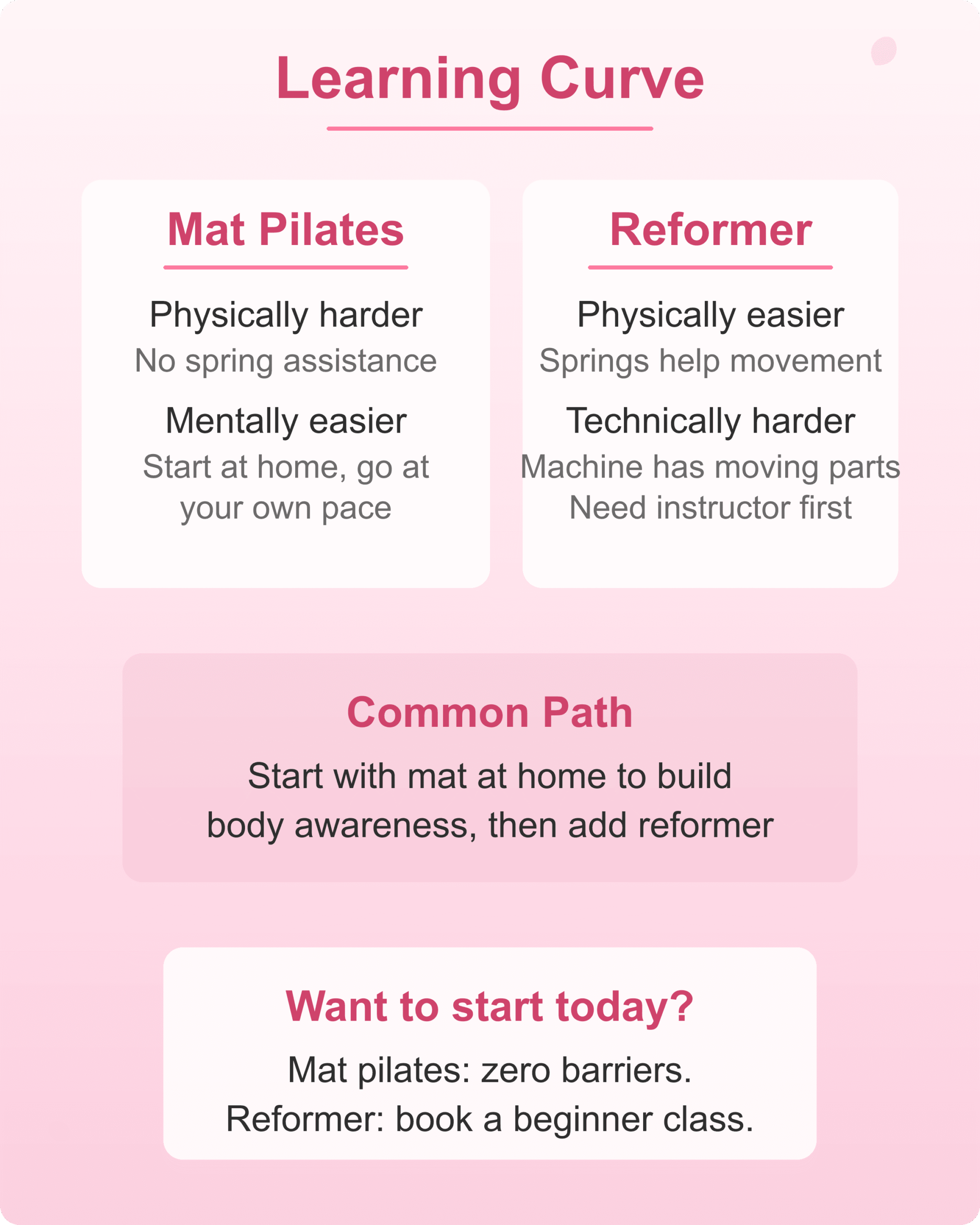
Mat pilates has a steeper physical learning curve. Without the reformer’s springs to assist you, exercises like the roll-up, the teaser, and the hundred can feel impossible at first. Your core has to be strong enough to perform the movement unassisted, which means beginners often struggle with exercises that would be accessible on a reformer.
The mental learning curve, however, is low. You can start at home with a video, pause and rewind as much as you want, and progress at your own pace with zero pressure.
Reformer Pilates Learning Curve
The reformer has a steeper technical learning curve. The machine has multiple moving parts, spring settings to understand, and positions that need to be demonstrated before you try them. Your first class will feel overwhelming. But physically, the springs assist your movement, making the exercises more accessible from day one.
The trade-off is that you need an instructor (at least initially) to learn the machine safely. You cannot just watch a video and figure it out the way you can with mat work.
The Verdict on Learning Curve
If you want to start today with zero barriers, mat pilates wins. If you want exercises to feel more physically accessible from the first session (and you are willing to pay for a class), the reformer wins. Many women start with mat work at home to build a foundation, then add reformer classes once they have basic body awareness and core strength.
Accessibility and Convenience
Mat Pilates: Maximum Flexibility
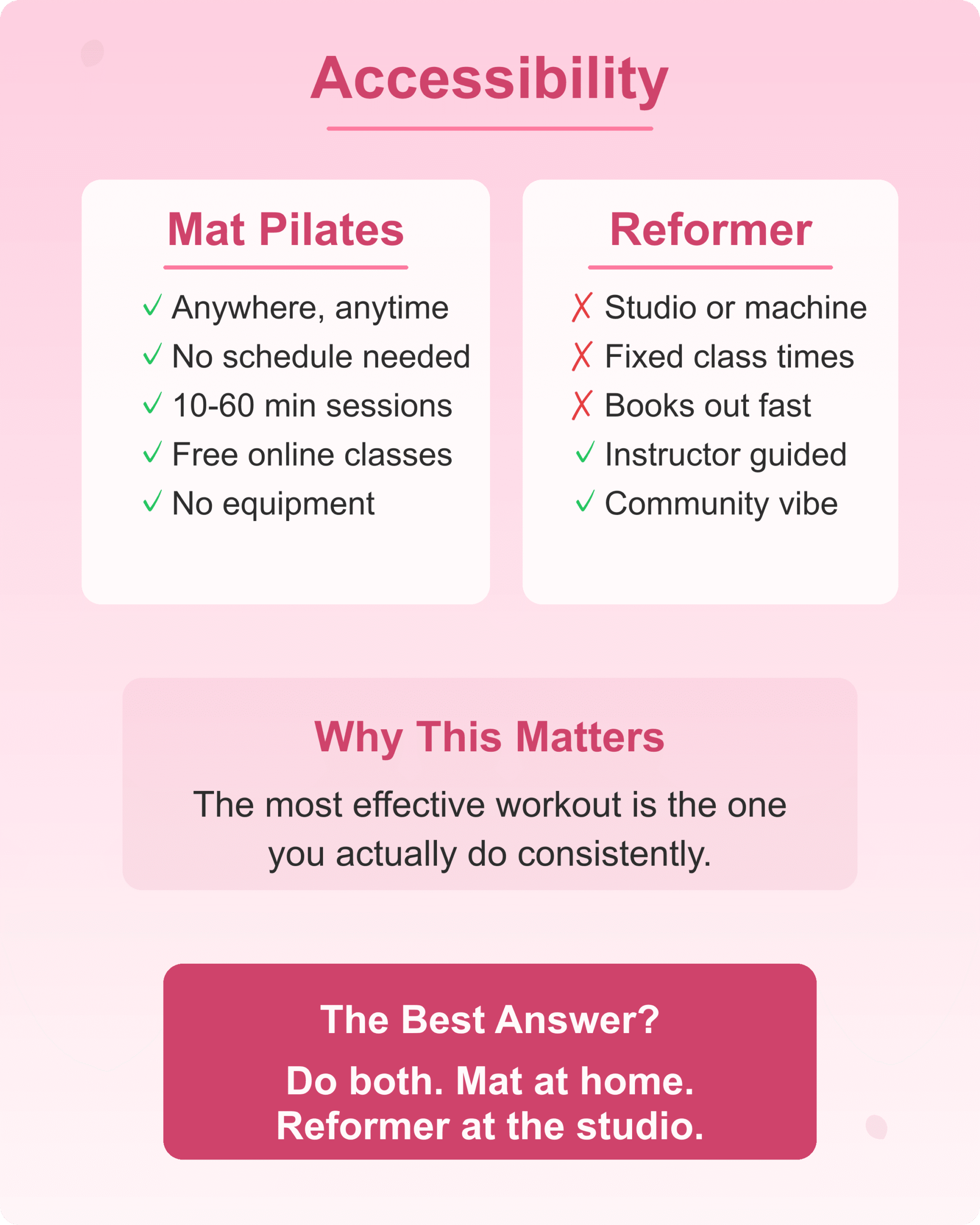
- Do it anywhere: home, hotel room, park, office
- Do it anytime: no class schedule, no commute
- No equipment required
- Thousands of free online classes available
- Can be done in 10 to 60 minutes depending on your schedule
Reformer Pilates: Requires Planning
- Requires access to a studio or home reformer
- Studio classes run on fixed schedules
- Popular time slots book out days or weeks in advance
- Travel time to and from the studio adds to the commitment
- Classes are typically 45 to 55 minutes (non-negotiable)
Why This Matters More Than You Think
The most effective workout is the one you actually do. If you can roll out of bed and do 20 minutes of mat pilates before your morning coffee, you will be more consistent than if you have to drive 25 minutes to a studio for a 6:30am reformer class that you keep cancelling because life gets in the way.
If the convenience of at-home workouts appeals to you, our wall pilates beginner guide offers another equipment-free option that adds variety to your mat routine. Or if you are ready for a structured at-home challenge, our free 28-day wall pilates challenge gives you a complete four-week plan.
Who Should Choose Mat Pilates?
Mat pilates is ideal if you:
- Want to start immediately with zero financial commitment
- Prefer working out at home on your own schedule
- Are building deep core strength as your primary goal
- Travel frequently and need a workout you can do anywhere
- Have a busy schedule and need the flexibility of 10 to 20 minute sessions
- Want to build a strong pilates foundation before trying the reformer
Who Should Choose Reformer Pilates?
Reformer pilates is ideal if you:
- Want a guided, instructor-led experience
- Are motivated by the structure and accountability of studio classes
- Have upper body toning as a priority (the straps are unmatched for arm work)
- Want spring-assisted stretching to improve flexibility faster
- Enjoy the social and community aspect of group classes
- Have the budget for regular studio sessions
Use our Studio Finder to discover reformer classes near you if you decide the studio route is right for your goals.
The Best Answer: Do Both
The women who get the best long-term results are the ones who combine both. A typical balanced week might look like this:
- Monday: 20-minute mat pilates at home (core focus)
- Wednesday: 50-minute reformer class at a studio (full body)
- Friday: 15-minute wall pilates at home (lower body)
- Sunday: 20-minute mat pilates at home (flexibility and recovery)
This gives you the deep core benefits of mat work, the variable resistance and upper body toning of the reformer, and the consistency of at-home sessions to fill the gaps between studio classes. You get the best of both worlds without being dependent on either one.
The real question was never reformer pilates vs mat pilates. It was: which one will you actually do consistently? Start with whichever one removes the most barriers between you and your first session. You can always add the other later.
Frequently Asked Questions
Can mat pilates get the same results as reformer pilates?
Yes. Research shows comparable improvements in core strength, flexibility, and body composition for both forms. Mat pilates builds deeper core stability because your body does all the work without spring assistance. The reformer adds variety and upper body options but does not produce fundamentally better overall results.
Is reformer pilates worth the money?
If you value instructor guidance, enjoy the studio experience, and can comfortably afford it, yes. The reformer offers exercise variety and spring-assisted stretching that a mat cannot replicate. If budget is tight, mat pilates delivers equivalent core and flexibility results at zero cost.
Should beginners start with mat or reformer?
Either works. Mat pilates is more accessible (start today, at home, free). Reformer pilates is more physically accessible (springs assist movement). Many instructors suggest starting with a few mat sessions to build body awareness, then trying the reformer once you understand basic pilates principles.
How many times a week should I do each?
Two to four sessions per week total produces optimal results. This could be all mat, all reformer, or a mix. For beginners, three sessions per week of either form is the sweet spot for building strength without overloading recovery.
Can I switch between mat and reformer in the same week?
Absolutely. Alternating between mat and reformer is one of the best approaches. Mat sessions build deep core stability and can be done on busy days (short, at home). Reformer sessions add variety and challenge. They complement each other perfectly.
Your Next Step
Stop comparing. Start moving. The debate between reformer pilates vs mat pilates has kept too many women stuck in research mode instead of actually doing pilates. Both work. Both build the body you want. Both feel incredible once you get past the first week.
If you want to start right now, for free, at home, grab our Mat Pilates at Home Playbook for a structured beginner programme. If you want to try the reformer, the Reformer Pilates at Home Starter Kit will help you get set up. Or simply find a studio with our Studio Finder and book your first class today.
The best pilates is the pilates you do. Pick one. Start today. Let your body bloom.