You love reformer pilates. The spring resistance, the sliding carriage, the way your body feels after a session. But between studio pricing, class schedules, and the commute, you have started wondering: could I do this at home?
The answer is yes. Reformer pilates at home is not only possible, it is becoming the preferred practice for thousands of women who want the reformer experience on their own schedule, in their own space, without the ongoing cost of studio memberships.
This guide covers everything you need to set up a home reformer practice from scratch: how much space you actually need, which machine fits your budget, the accessories that matter (and the ones that do not), and how to learn proper form without an instructor standing over you. By the end, you will know exactly what it takes to bring the studio experience home.
The Financial Case for a Home Reformer
Before diving into the how, let us address the why. A home reformer is an investment, but the maths often make it a smart one.
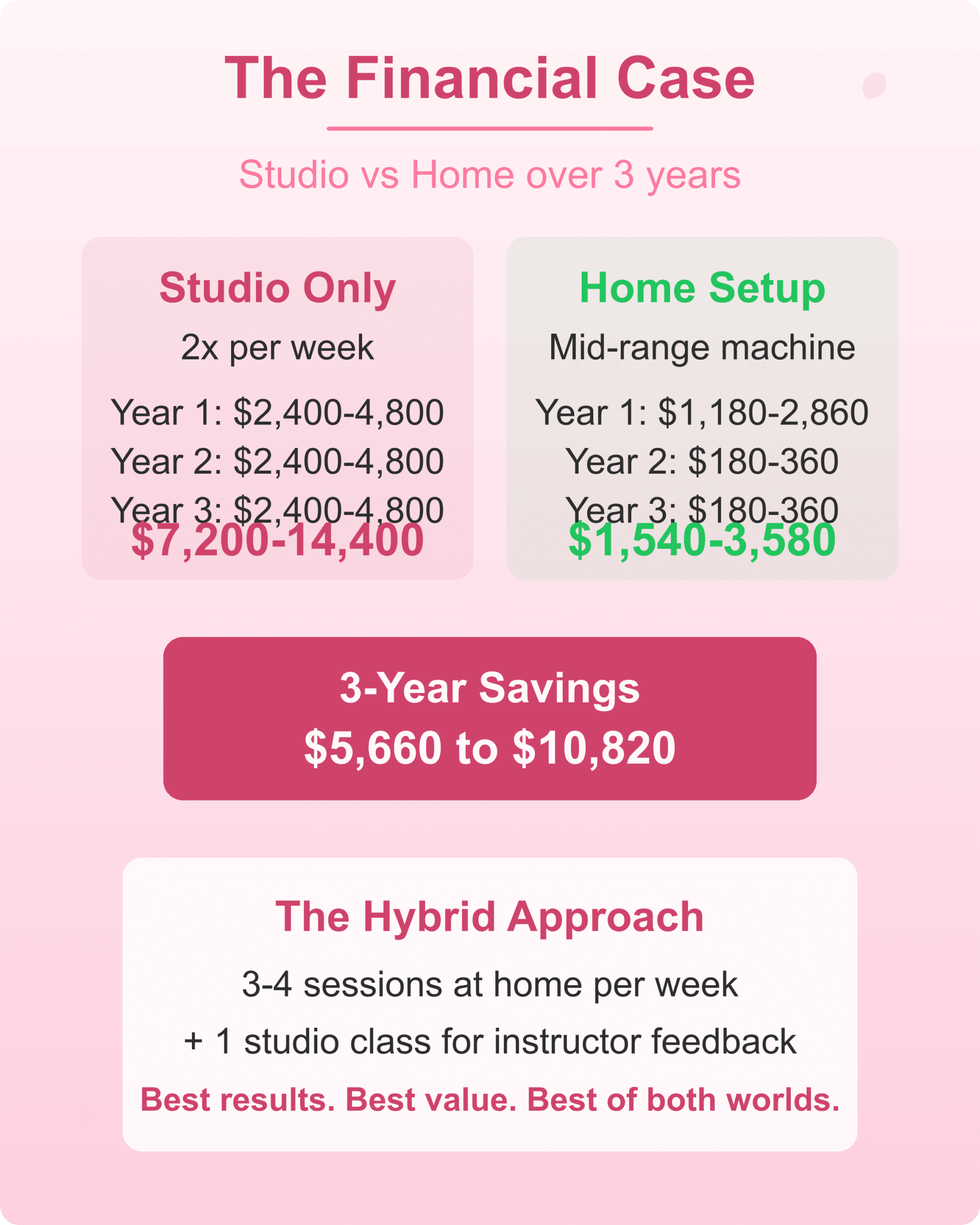
The Studio Cost Reality
- Single class: $25 to $50 per session
- Twice per week: $200 to $400 per month
- Annual cost: $2,400 to $4,800 per year
The Home Reformer Investment
- Mid-range machine: $1,000 to $2,500 (one-time purchase)
- Online class subscription: $15 to $30 per month ($180 to $360 per year)
- Year one total: $1,180 to $2,860
- Year two onwards: $180 to $360 per year (subscription only)
The Breakeven Point
A $2,000 mid-range reformer pays for itself in 5 to 10 months compared to twice-weekly studio classes. From month 11 onwards, every session is essentially free. By year three, you have saved $4,000 to $12,000 compared to studio attendance.
This does not mean you should never go to a studio again. Many women keep one monthly studio class for instructor feedback and social motivation while doing three to four sessions at home. That hybrid approach gives you the best of both worlds at a fraction of the full studio cost.
For a detailed breakdown of machines at every price point, our best home reformer buyer’s guide compares everything from $300 budget models to $8,000 studio-grade machines.
Space Requirements: How Much Room Do You Actually Need?
This is the first practical question, and it stops many women before they start. The good news: you need less space than you think.
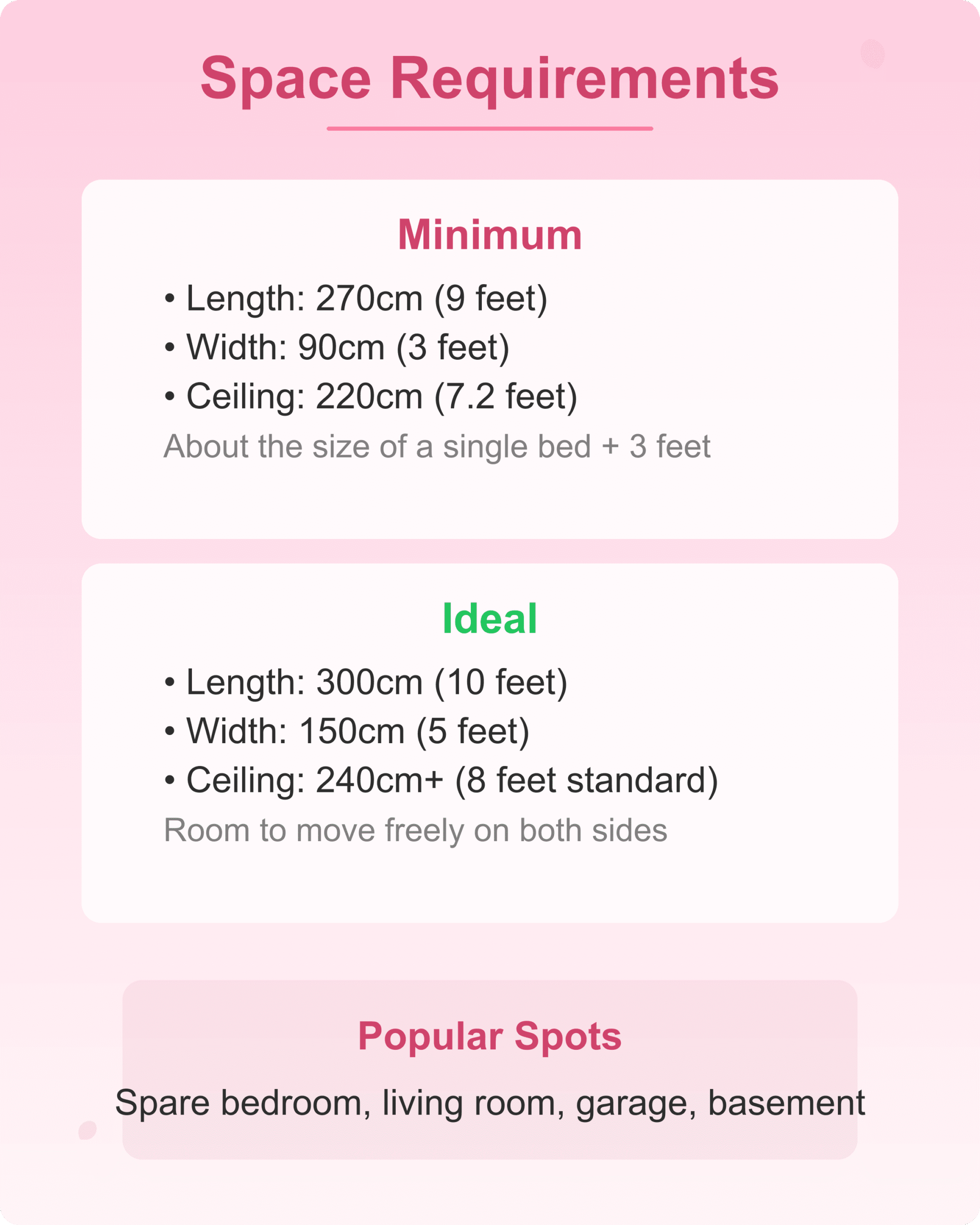
Minimum Space Requirements
- Length: 270cm (9 feet). The reformer itself is roughly 240cm, plus 30cm clearance at the head end for exercises where your arms extend overhead.
- Width: 90cm (3 feet). The machine is about 60cm wide, plus 30cm on one side for getting on and off safely.
- Height: 220cm (7.2 feet) minimum ceiling height. You need clearance for kneeling and standing exercises on the carriage.
Ideal Space Requirements
- Length: 300cm (10 feet). Extra clearance allows for long strap exercises and comfortable movement around the machine.
- Width: 150cm (5 feet). Room on both sides makes standing work and side-lying exercises comfortable.
- Height: 240cm+ (8 feet). Standard ceiling height in most homes. Allows full standing work without feeling cramped.
Where Women Set Up Their Reformers
- Spare bedroom: The most common choice. Dedicate the room or share it with an office desk pushed to one wall.
- Living room: Works well with a foldable reformer that tucks away after sessions.
- Garage: Great space, but ensure it is climate-controlled. Humidity damages wood frames and can rust metal components.
- Basement: Often ideal for space but check ceiling height (basements can be low) and ventilation.
- Large hallway: A surprisingly common setup for foldable reformers in apartments.
Flooring Considerations
Place your reformer on a hard, level surface. Carpet absorbs the machine’s stability and can cause uneven movement. If your space is carpeted, place a large piece of plywood (at least the footprint of the machine) underneath, topped with a thin rubber mat to prevent sliding and protect your floor.
Hard floors (wood, tile, laminate) are ideal. Place rubber feet pads or a thin mat underneath to prevent scratching and reduce noise, especially if you have neighbours below.
Choosing Your Machine: A Quick Decision Guide
We covered machines in depth in our buyer’s guide, but here is the quick decision framework for home setup.
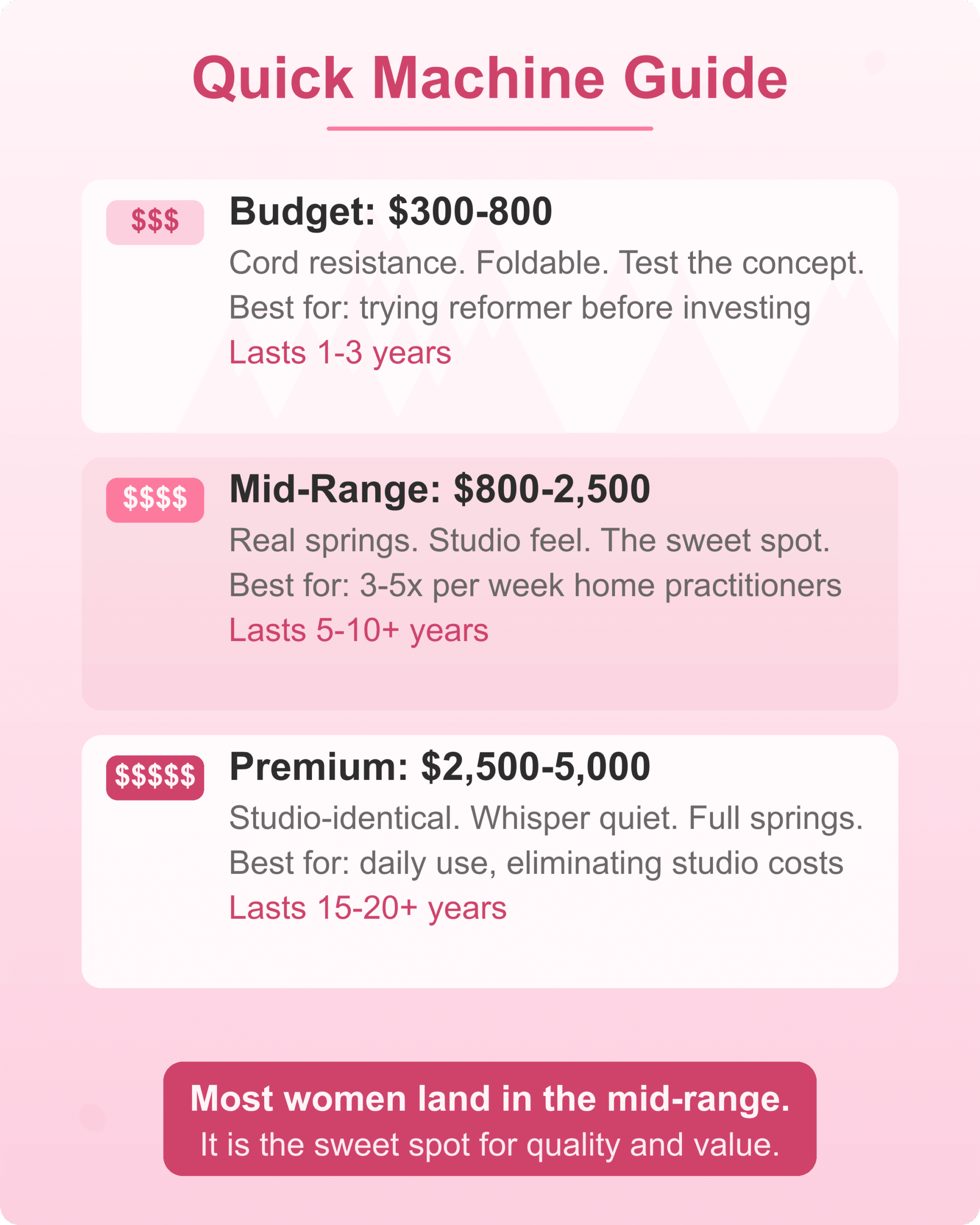
Budget ($300 to $800): The Test Run
Cord-based resistance, foldable metal frame. Best for women who want to try reformer-style exercises at home before committing to a larger investment. Expect to use it for 1 to 3 years before wanting an upgrade.
Mid-Range ($800 to $2,500): The Sweet Spot
Real coil springs, sturdy frame, smooth carriage. This is where most serious home practitioners land. Feels like a studio reformer. Lasts 5 to 10+ years. Our top recommendation for women who plan to use their machine three to five times per week.
Premium ($2,500 to $5,000): The Forever Machine
Studio-identical quality. Whisper-quiet carriage. Full spring colour system. Lasts 15 to 20+ years. Worth the investment for daily practitioners, women who want to eliminate studio dependency entirely, or pilates instructors working from home.
Foldable vs Non-Foldable
Choose foldable if your reformer shares space with other furniture or activities. Choose non-foldable if you have a dedicated room. Non-foldable machines are more stable and can support tower attachments for expanded exercise options.
Essential Accessories (And What You Can Skip)
Reformer accessories can add hundreds to your setup cost. Here is what you actually need versus what can wait.
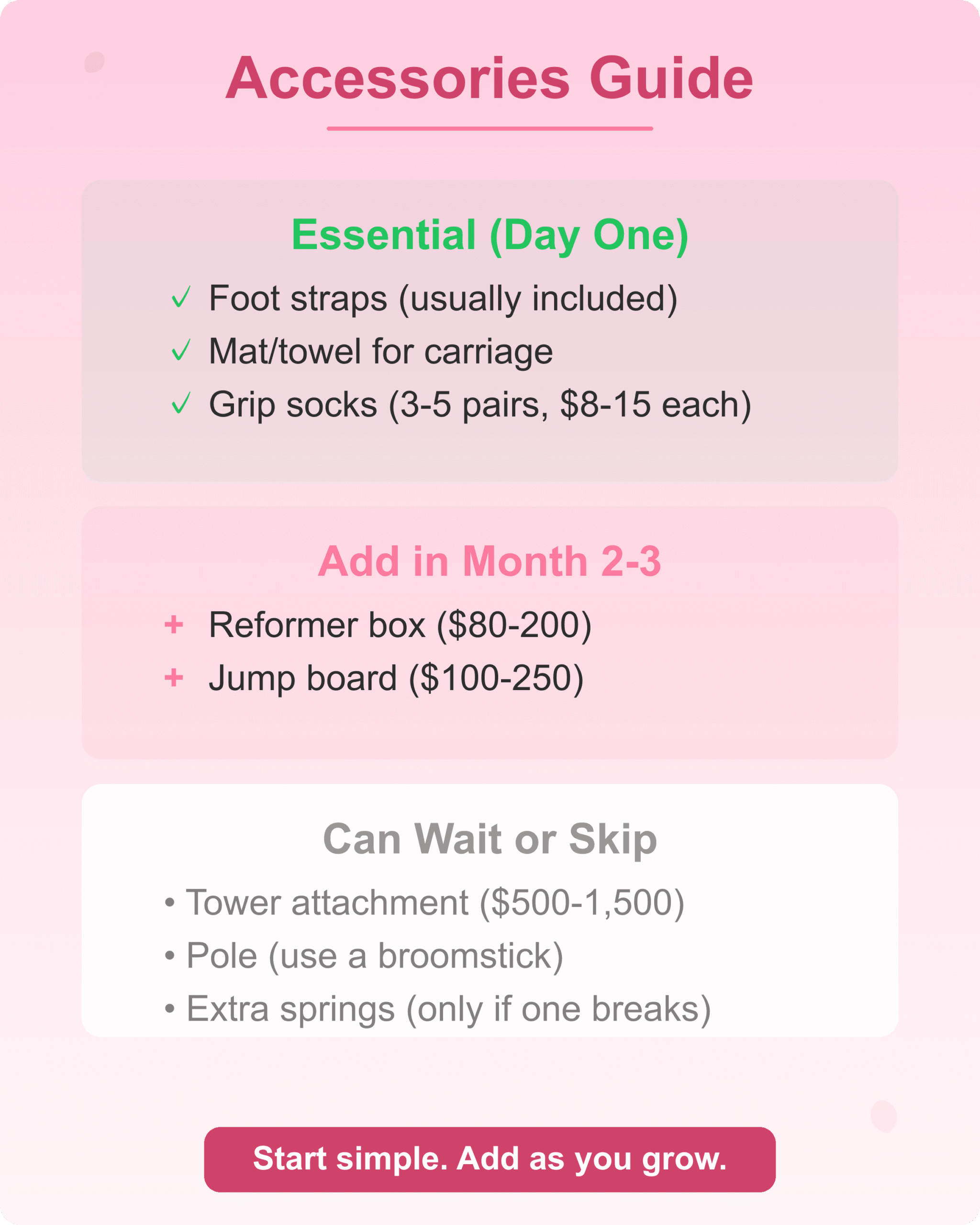
Essential from Day One
- Foot straps: These come with almost every reformer. If buying second-hand, check that they are included and not worn out. Replacements cost $30 to $60.
- A mat or towel for the carriage: Protects the vinyl, absorbs sweat, and makes kneeling exercises more comfortable. A standard yoga mat cut to size works perfectly.
- Grip socks: Non-negotiable for safety. Your feet will slip on the footbar without them. Buy 3 to 5 pairs so you always have a clean pair ready. $8 to $15 per pair.
Worth Adding in Month 2-3
- Reformer box: A padded box that sits on the carriage for seated and prone exercises. Expands your exercise library significantly. $80 to $200 depending on brand. Some reformers include one.
- Jump board: Attaches to the footbar end for cardio-style jumping exercises while lying on your back. Excellent for raising your heart rate without impact. $100 to $250.
Can Wait (or Skip Entirely)
- Tower/Cadillac attachment: Adds vertical spring work. Wonderful but expensive ($500 to $1,500) and requires a non-foldable reformer. Wait until you have exhausted your current exercise options.
- Pole: Used for stretching and balance exercises. Nice but not necessary. A broomstick works as a substitute.
- Extra spring sets: Your machine comes with a full set. Extra springs are only needed if one breaks or if you want duplicates for specific exercises.
How to Learn Reformer Pilates Without an Instructor
This is the biggest concern women have about practising at home: how do you learn proper form without someone watching and correcting you?
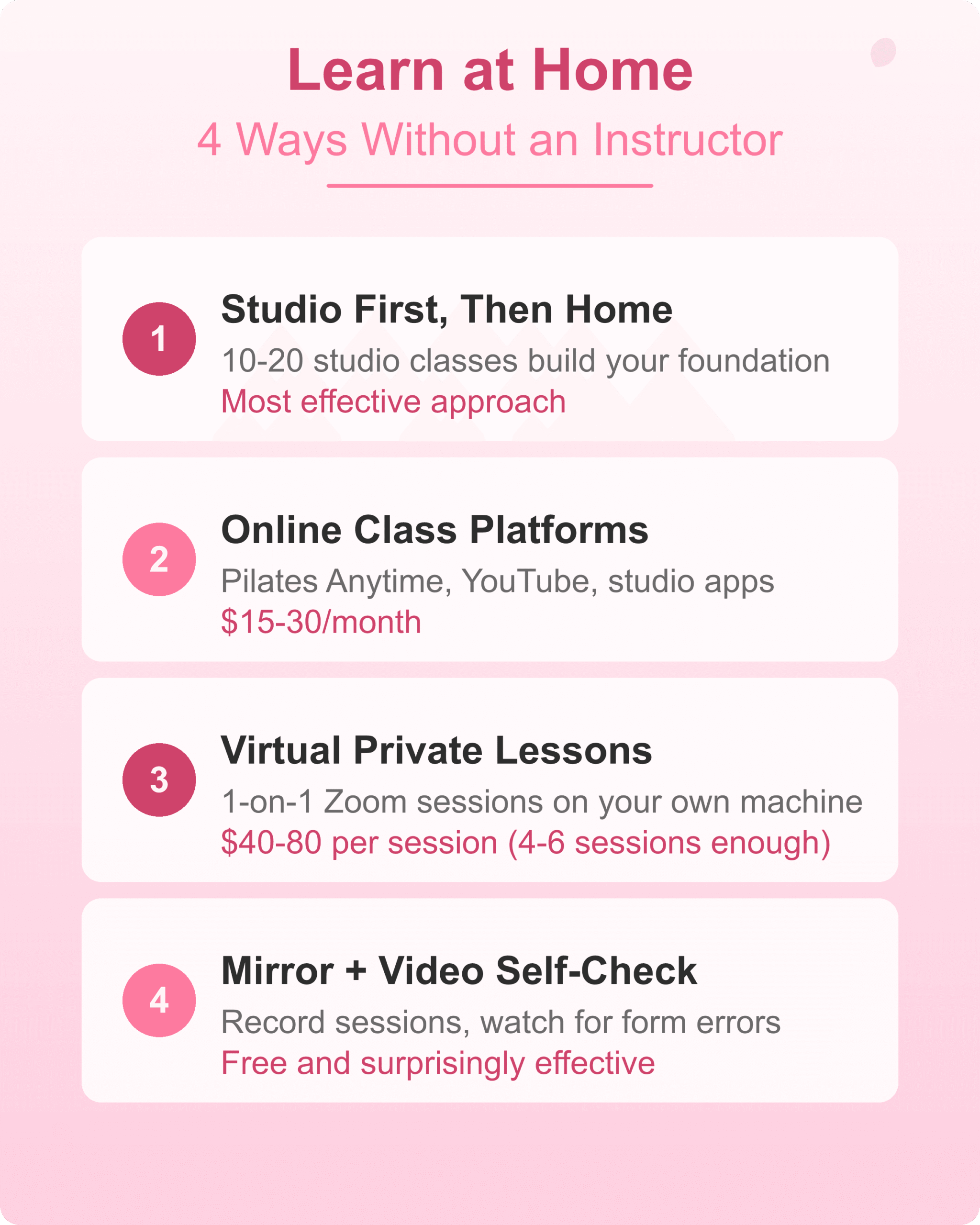
Option 1: Start at a Studio, Then Transition Home
The most effective approach is taking 10 to 20 studio classes before setting up at home. This gives you foundational form, spring awareness, and body confidence that you can carry into independent practice. You do not need to be an expert. You just need enough experience to self-correct basic form errors.
Our reformer pilates beginner guide covers everything you need to know for those first studio sessions, from spring colours to etiquette.
Option 2: Online Class Platforms
Several platforms offer structured, instructor-led reformer classes filmed from multiple angles with detailed form cues. The best options include:
- Pilates Anytime: The largest online pilates library. Thousands of reformer classes at every level. $22/month.
- Move with Nicole: Popular YouTube channel with free reformer workouts. Great for beginners.
- Studio-specific apps: Many boutique studios (Club Pilates, Solidcore) offer on-demand classes for members and non-members.
When choosing online classes, look for instructors who cue spring settings at the beginning of each exercise, demonstrate modifications, and film from angles that let you see foot placement and spinal alignment.
Option 3: Private Lessons (Virtual)
Many certified pilates instructors now offer one-on-one virtual sessions via Zoom. You set up your camera so the instructor can see your form, and they guide you through exercises in real time. This is more affordable than in-person privates ($40 to $80 versus $80 to $150) and lets you learn on your own machine in your own space.
Even 4 to 6 virtual private sessions can give you enough form foundation to practise independently with confidence.
Option 4: Mirror and Video Self-Check
Set up a full-length mirror beside your reformer, or prop your phone to record your sessions. Watching yourself during or after exercises reveals form issues you cannot feel: rib flaring, uneven hips, neck tension, and carriage control problems. This is free and surprisingly effective once you know what to look for.
Building Your Home Practice: A Weekly Structure
Having a machine is one thing. Using it consistently is another. A structured weekly plan prevents the reformer from becoming an expensive clothes rack.
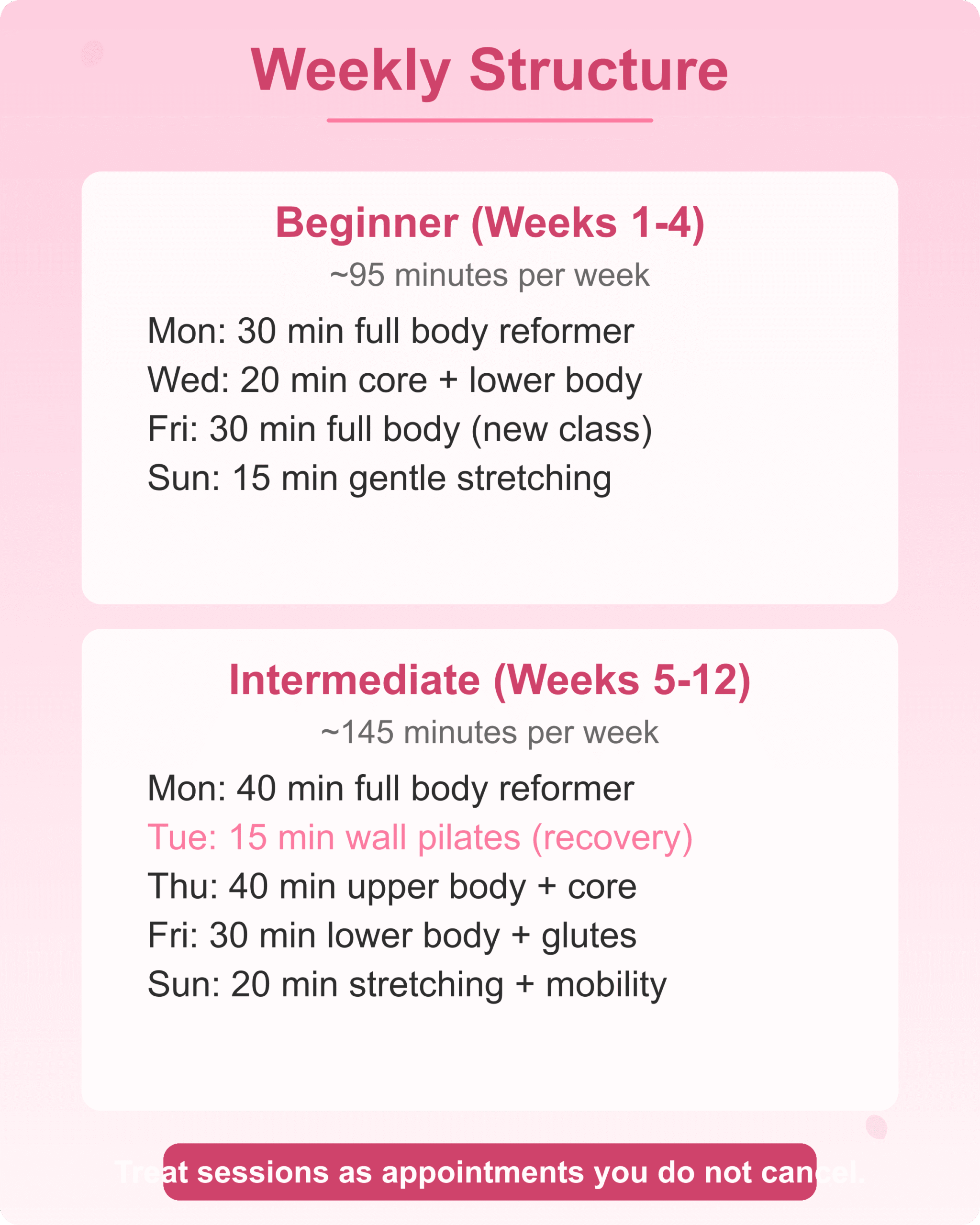
Beginner Schedule (Weeks 1-4)
- Monday: 30-minute full body reformer (online class)
- Wednesday: 20-minute core and lower body focus
- Friday: 30-minute full body reformer (different class)
- Sunday: 15-minute gentle stretching on the reformer
Total: 4 sessions, approximately 95 minutes per week.
Intermediate Schedule (Weeks 5-12)
- Monday: 40-minute full body reformer
- Tuesday: 15-minute wall pilates (active recovery, no machine)
- Thursday: 40-minute reformer (upper body and core focus)
- Friday: 30-minute reformer (lower body and glutes)
- Sunday: 20-minute reformer stretching and mobility
Total: 5 sessions (3 reformer + 1 wall + 1 stretch), approximately 145 minutes per week.
The Hybrid Approach
The most sustainable long-term plan combines home reformer sessions with occasional studio classes:
- 3 to 4 home reformer sessions per week (your foundation)
- 1 studio class per week or every two weeks (instructor feedback, new exercises, social motivation)
- 1 to 2 mat pilates or wall pilates sessions (variety, no machine needed)
This hybrid model costs roughly $60 to $120 per month (one weekly studio class + online subscription) versus $200 to $400 for studio-only practice. You get the best instruction, the convenience of home, and significant savings.
Common Mistakes to Avoid
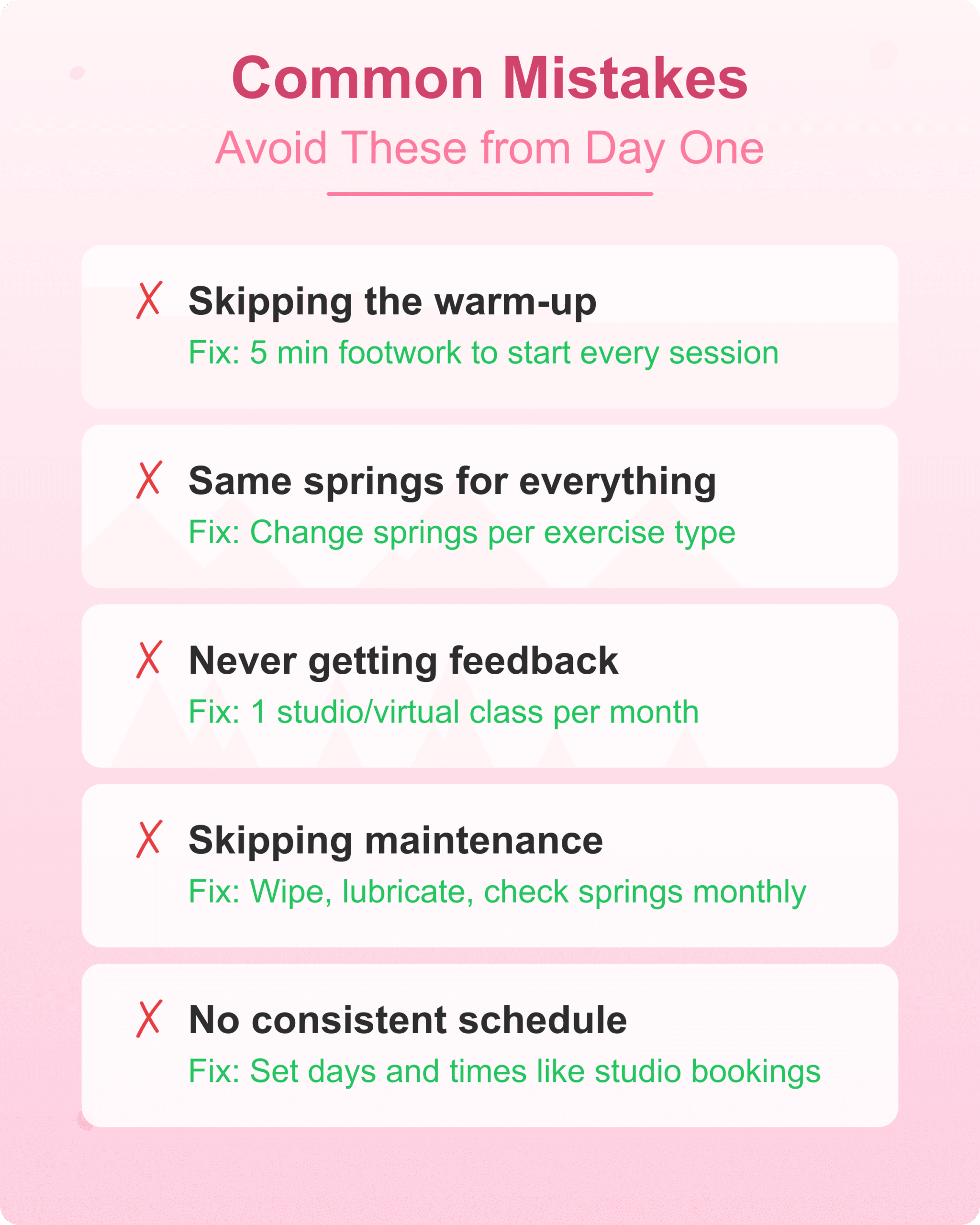
Setting up a home reformer practice comes with pitfalls that studio-goers never face. Avoid these from the start.
Skipping the Warm-Up
In a studio, the instructor builds warm-up into the class. At home, it is tempting to jump straight into the exercises you enjoy. Always start with 5 minutes of footwork or gentle carriage slides to warm up your muscles and calibrate your core engagement.
Never Changing Your Spring Settings
Many home practitioners find a spring setting they like and use it for everything. Different exercises require different resistance levels. Lighter springs for arm work. Heavier for legs. Varying your springs is how you progress and avoid plateaus. Our beginner guide explains the spring colour system in detail.
Practising in Isolation Permanently
Home practice is convenient, but getting occasional instructor feedback prevents bad habits from solidifying. A form error you cannot feel (like subtle rib flaring or hip hiking) will compound over months if never corrected. Schedule a studio class or virtual private at least once a month to check your form.
Neglecting Machine Maintenance
A home reformer needs basic care:
- Wipe down the carriage after every session (sweat degrades vinyl)
- Lubricate rails every 3 months with silicone spray
- Check springs monthly for signs of stretching or discolouration
- Tighten bolts quarterly (vibration loosens hardware over time)
Not Having a Consistent Schedule
The biggest advantage of a home reformer (you can use it anytime) is also its biggest risk (you never actually use it). Set specific days and times for your practice, just like you would book a studio class. Treat it as an appointment with yourself that you do not cancel. Our pilates consistency guide has proven strategies for building unbreakable habits.
Frequently Asked Questions
Can I get the same results at home as in a studio?
Yes, with a mid-range or premium machine and a structured programme. The reformer is the same tool regardless of location. What you miss at home is live instructor correction, which you can supplement with online classes, virtual privates, and occasional studio visits.
How much space do I need for a home reformer?
Minimum 270cm by 90cm (9 by 3 feet). Ideal is 300cm by 150cm (10 by 5 feet). Standard ceiling height of 240cm (8 feet) provides clearance for all exercises. Foldable reformers need about half the length when stored.
Is it safe to use a reformer without an instructor?
Yes, if you have basic form knowledge from studio classes or online instruction. Start with foundational exercises you are comfortable with and progress gradually. Use a mirror or video recording to self-check form. The reformer is designed to guide your movement safely.
How often should I use my home reformer?
Three to four sessions per week produces optimal results. This is easy to maintain at home because you eliminate commute time and scheduling constraints. Even 20-minute sessions count when done consistently.
What is the best way to learn reformer exercises at home?
Start with 10 to 20 studio classes to build foundational form. Then transition to online class platforms like Pilates Anytime for structured home workouts. Add 4 to 6 virtual private sessions for personalised feedback. Use a mirror beside your reformer for real-time self-correction.
Your Next Step
Setting up reformer pilates at home is one of the best investments you can make in your wellness practice. It removes every barrier between you and the workout that is changing your body: no scheduling conflicts, no commute, no per-class pricing, no excuses.
Start with the space. Measure your room. Then choose your machine based on budget and frequency. Add the essential accessories. Find your online class platform. Set your weekly schedule. And then show up for yourself, in your own space, on your own terms.
The Reformer Pilates at Home Starter Kit gives you everything you need to structure your first 12 weeks: progressive workouts, spring setting guides, and a clear path from setup to confident independent practice.
Your studio is wherever you decide it is. Make it home, and let your practice bloom.