You have seen the reformer in Instagram reels and TikTok videos. It looks like a cross between a rowing machine and a medieval torture device, and you cannot figure out which end you are supposed to sit on. If the thought of walking into a reformer class makes your palms sweat, you are not alone. Reformer pilates for beginners can feel genuinely intimidating, but here is the truth: every single person in that studio had a first class too.
The reformer is actually one of the most beginner-friendly pieces of equipment in the fitness world. It supports your body, guides your movement, and gives you feedback that a mat simply cannot. You just need someone to translate the jargon and walk you through what to expect.
That is exactly what this guide does. From understanding how the machine works to knowing what to wear, what the springs mean, and how to survive (and enjoy) your first class, consider this your complete reformer pilates beginners handbook.
What Is a Reformer and Why Does It Look So Intimidating?
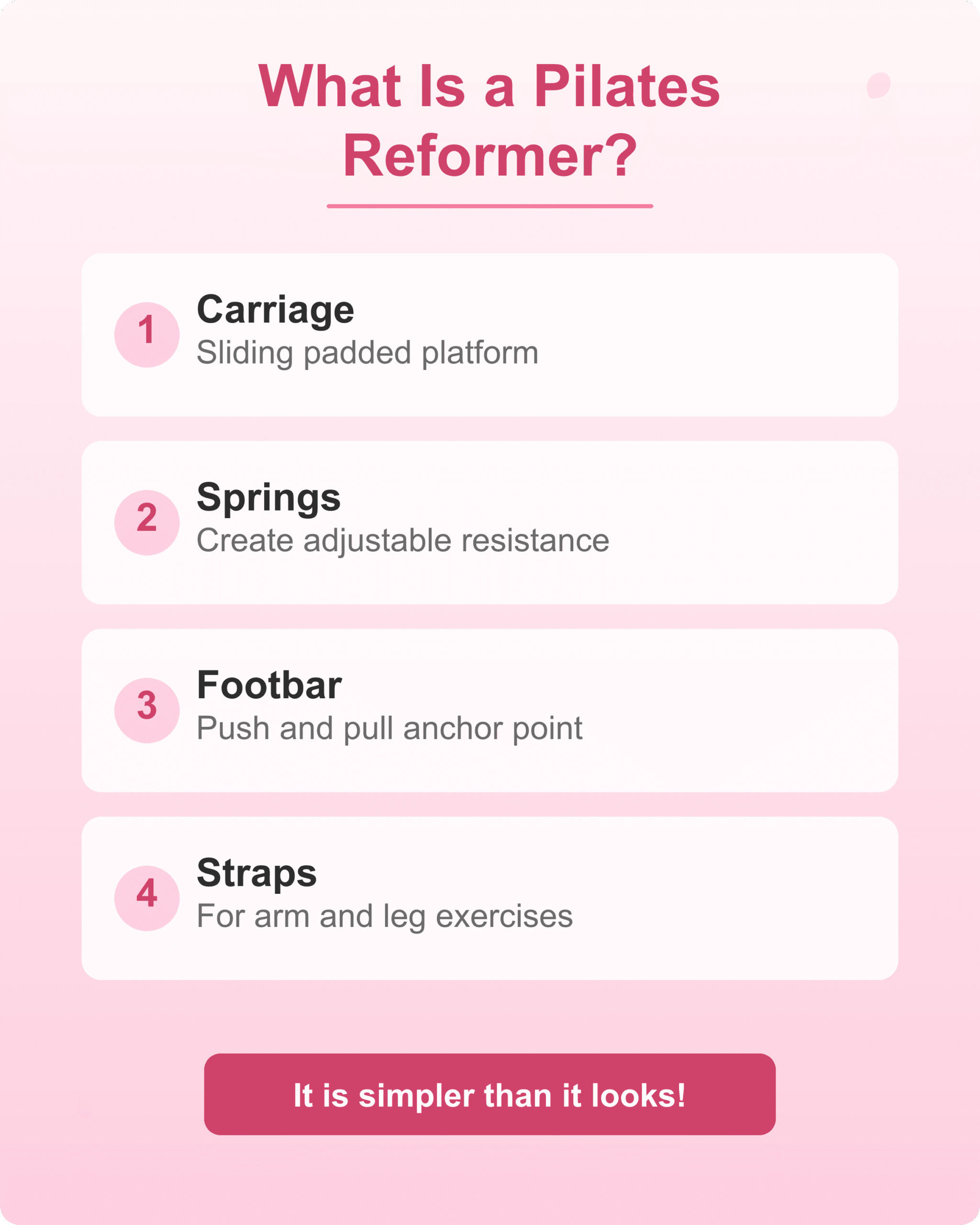
The pilates reformer was invented by Joseph Pilates in the early 1900s. The original version was built from a bed frame and springs, which is why the modern version still has that bed-like shape. It consists of a flat, padded platform called the carriage that slides back and forth on rails. Springs attached beneath the carriage create resistance, and a footbar at one end gives you something to push or pull against.
At the other end, you will find straps with handles (sometimes called ropes or loops) that you can hold with your hands or hook around your feet. There is also a headrest that can be raised or lowered depending on the exercise.
It looks complicated because there are a lot of moving parts. But here is the reassuring bit: in a beginner class, you will only use a fraction of what the reformer can do. Most of the setup is done by your instructor, and every exercise is demonstrated before you try it.
The Reformer vs a Mat: Why Beginners Often Prefer It
This might surprise you, but many instructors actually recommend the reformer for complete beginners over a mat class. On a mat, your body has to do all the stabilising work, and it can be hard to feel whether you are doing an exercise correctly. The reformer gives you physical feedback. If the carriage moves when it should not, you know your form needs adjusting.
The springs also assist your movement, meaning exercises that feel impossible on a mat (like a roll-up or a teaser) become accessible on the reformer. If you have been wondering about the differences between the two, our mat pilates vs reformer results guide breaks it down in detail.
Understanding Springs: The Colour-Coded System Explained
Springs are the heart of the reformer. They control how much resistance you work against, and they are the one thing that confuses every beginner. The good news is that the system is simpler than it looks once you understand the colour coding.
How Spring Colours Work
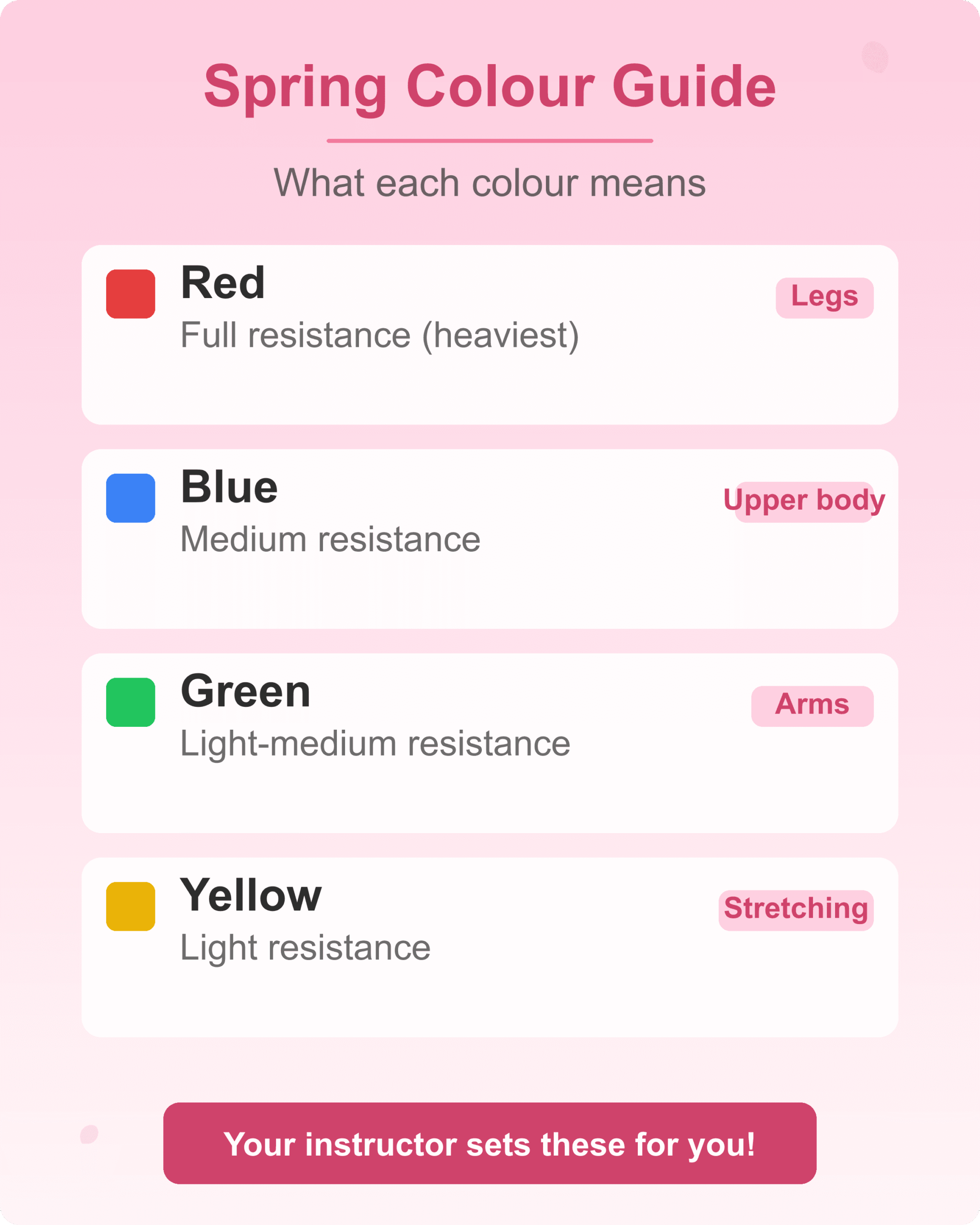
Most reformers (especially Balanced Body brand, the most common in studios) use a colour-coded spring system. Each colour represents a different resistance level:
- Red springs: Full resistance (heaviest). These are your workhorse springs for leg and footwork.
- Blue springs: Medium resistance. Great for upper body work and moderate leg exercises.
- Green springs: Light-medium resistance. Common in arm work and exercises where you need some support but less resistance.
- Yellow springs: Light resistance. Used for delicate movements, stretching, and exercises requiring minimal tension.
Some studios use different brands (like Stott or Peak) with slightly different colour systems, but the principle is the same: lighter colours mean lighter resistance.
A Common Beginner Mistake with Springs
New clients often assume that fewer springs equals an easier workout. It is actually the opposite for many exercises. When you have fewer springs, the carriage moves more freely, which means your core has to work harder to control the movement. Your instructor will guide you on the right spring setting for each exercise, so do not worry about memorising this on day one.
What to Wear to Your First Reformer Class
What you wear to a reformer class matters more than you might think, and not because of aesthetics (although we do love a good pink pilates outfit). It is about safety and comfort on the machine.
The Must-Haves
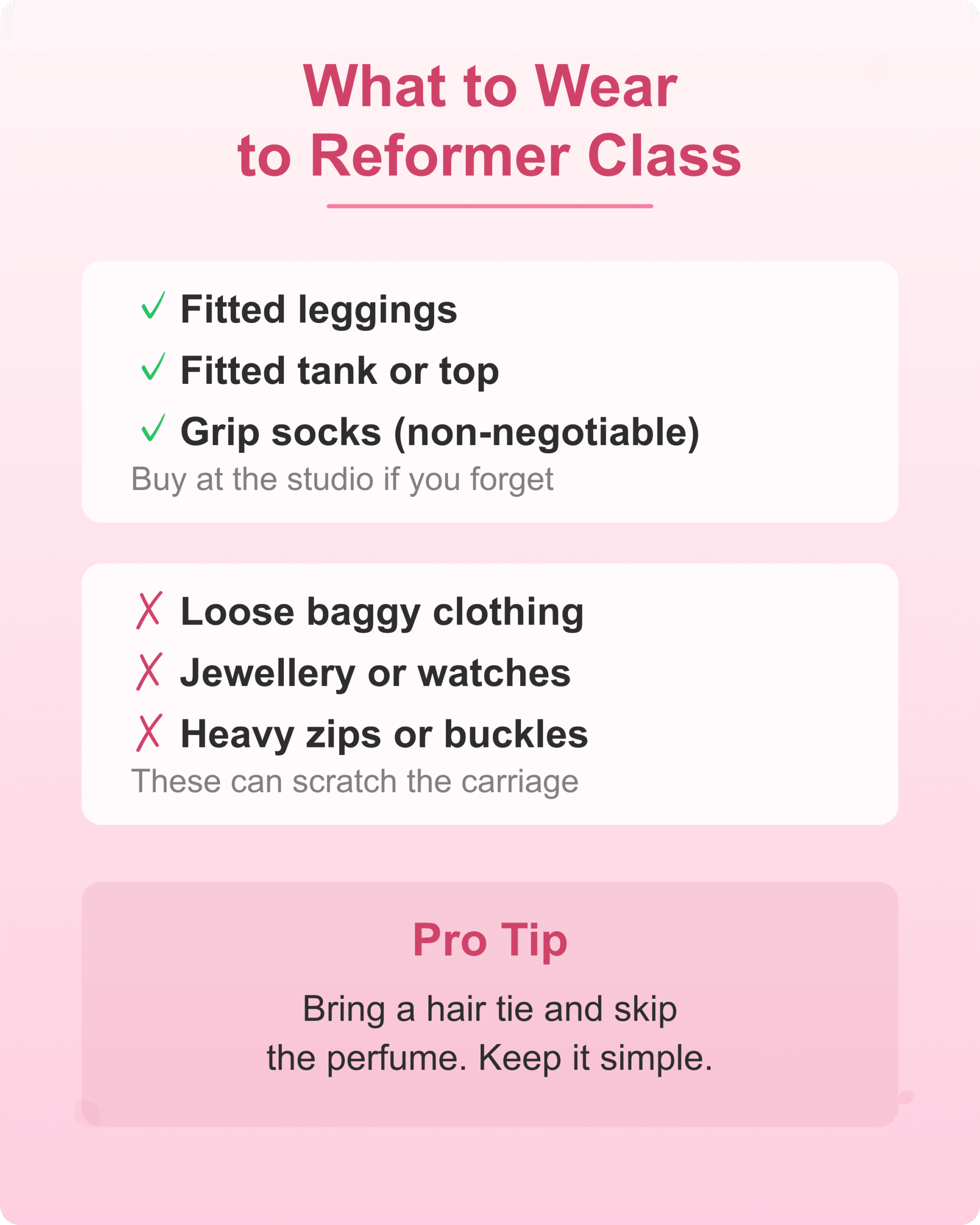
- Fitted clothing: Loose tops and wide-leg trousers can get caught in the springs or carriage. Choose leggings and a fitted tank or long-sleeve top.
- Grip socks: Most studios require grip socks (socks with rubber dots on the bottom). They prevent your feet from slipping on the footbar and the shoulder rests. You can usually buy a pair at reception if you forget.
- A hair tie: You will be lying down, sitting up, kneeling, and sometimes even standing on the reformer. Keep your hair out of your face and away from the springs.
What to Avoid
- Bare feet: Unless the studio specifically says otherwise, grip socks are standard.
- Jewellery: Rings, bracelets, and long necklaces can catch on the straps or springs. Leave them in your bag.
- Heavy zips or buckles: These can scratch the reformer’s vinyl carriage pad.
- Perfume or strong scents: Studios are enclosed spaces with deep breathing. Keep it neutral.
What to Expect in Your First Reformer Class
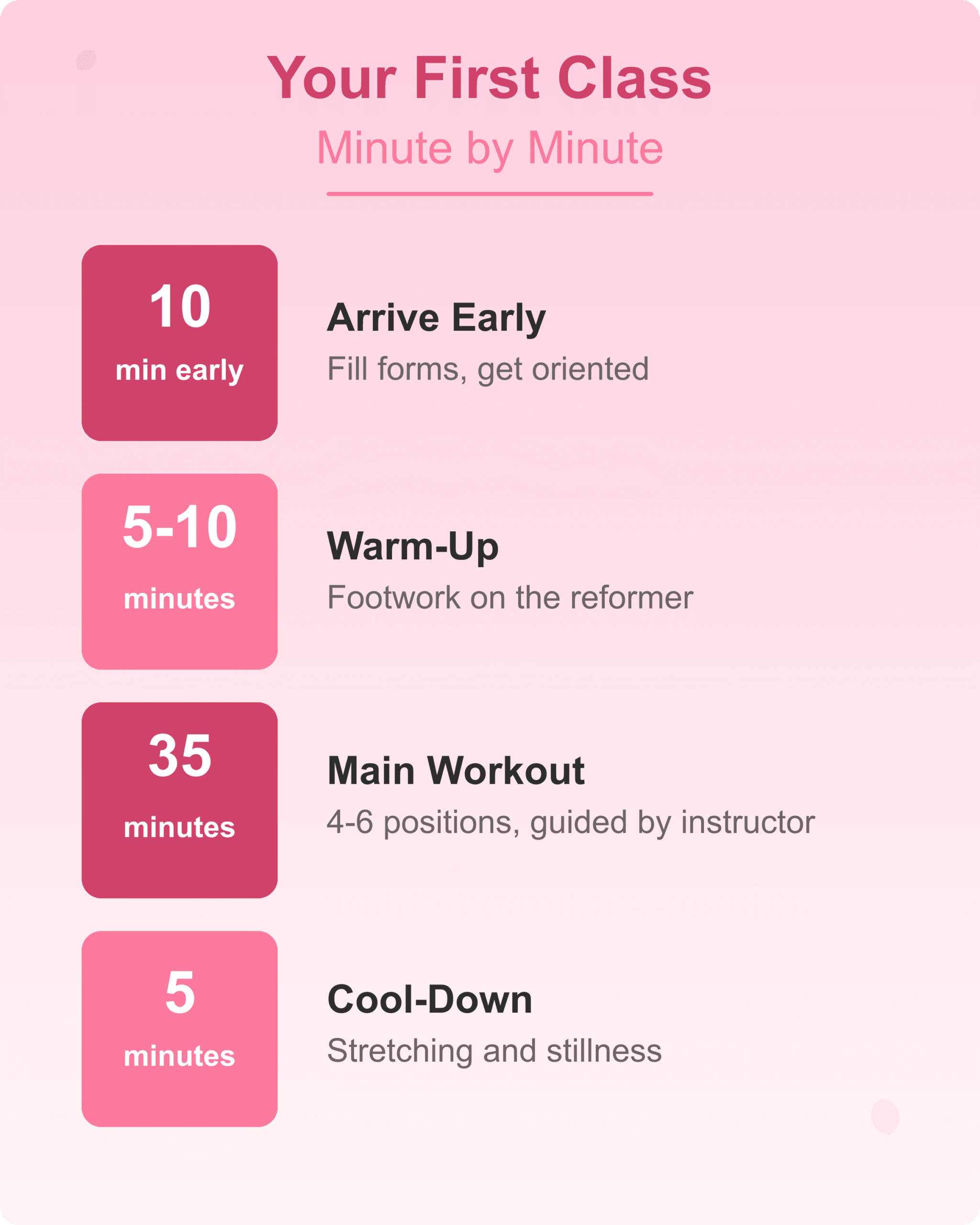
Walking into any new fitness class can feel nerve-wracking. Knowing exactly what will happen takes away most of that anxiety. Here is a typical beginner reformer class, minute by minute.
Before Class Starts (Arrive 10-15 Minutes Early)
Most studios ask first-timers to arrive early to fill out a health questionnaire and get a quick orientation. Your instructor will show you the basic parts of the reformer, how to adjust the headrest, and how to lie down safely. This is your chance to mention any injuries or concerns.
If you feel nervous about being new, tell your instructor. They deal with beginners every single day, and a good instructor will check on you throughout the class without making you feel singled out.
The Warm-Up (5-10 Minutes)
Most classes begin with footwork on the reformer. You lie on your back with your feet on the footbar and press the carriage out and back in. It feels a bit like a leg press, but smoother. This warms up your legs, activates your core, and gets you comfortable with the sliding sensation.
The instructor will cue your breathing pattern: inhale to prepare, exhale to press out. Do not overthink the breathing at first. Just keep breathing and let the rhythm develop naturally.
The Main Workout (35-40 Minutes)
A beginner class typically moves through four to six different positions:
- Supine (lying on your back): Leg circles, hip work, core exercises with the straps.
- Seated: Arm pulls, rowing-style exercises, spine twists.
- Kneeling: Knee stretches, cat-cow variations, arm work.
- Standing: Light standing work on the carriage or beside the reformer.
The instructor will demonstrate each exercise first, then walk around adjusting form. It is completely normal to feel lost for the first few exercises. By the halfway point, your body starts to understand the machine’s rhythm.
The Cool-Down (5 Minutes)
Classes usually end with gentle stretching on the reformer, followed by a moment of stillness. Some studios dim the lights for this section. Enjoy it. You earned it.
Studio Etiquette: The Unwritten Rules Nobody Tells You
Every studio has its own vibe, but there are some universal etiquette guidelines that will help you feel confident from the moment you walk in.
The Essentials
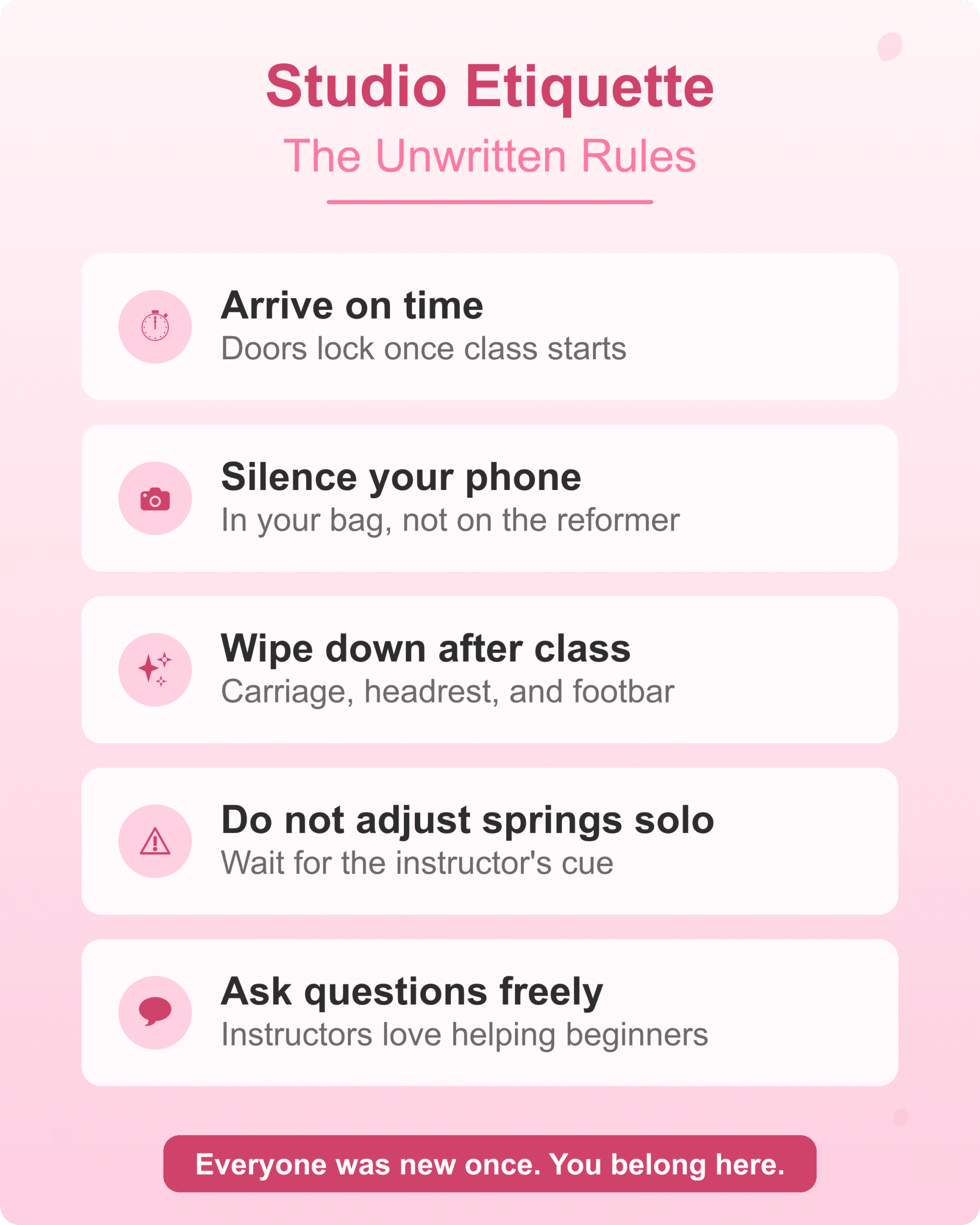
- Arrive on time: Most studios lock the door once class starts. If you are late, you may not be allowed in for safety reasons (the instructor cannot catch you up while teaching the group).
- Silence your phone: Put it in your bag, not on the reformer. A buzzing phone on a wooden carriage is louder than you think.
- Wipe down your reformer after class: Studios provide spray and cloths. Wipe the carriage pad, headrest, and footbar. It takes thirty seconds and the next person will thank you.
- Do not adjust springs mid-exercise unless told: Changing springs while the carriage is moving is a safety risk. Wait for the instructor’s cue.
- Ask questions: No instructor minds a beginner asking for help. What they do mind is a beginner doing an exercise wrong and getting hurt because they were too embarrassed to speak up.
What Not to Worry About
You will not be the only one who does not know what is going on. Studios run beginner classes specifically because there is always demand. Nobody is watching you. Everyone is focused on keeping their own carriage steady and remembering to breathe.
If you have been feeling nervous about starting any kind of pilates, our beginner workout guide is a great place to build confidence before your first studio class.
How Much Does a Reformer Class Cost?
Reformer classes are more expensive than mat classes because the equipment is costly (a single reformer can run from $2,000 to $8,000), studios need more space, and class sizes are smaller (usually 8 to 16 people). Here is what to expect:
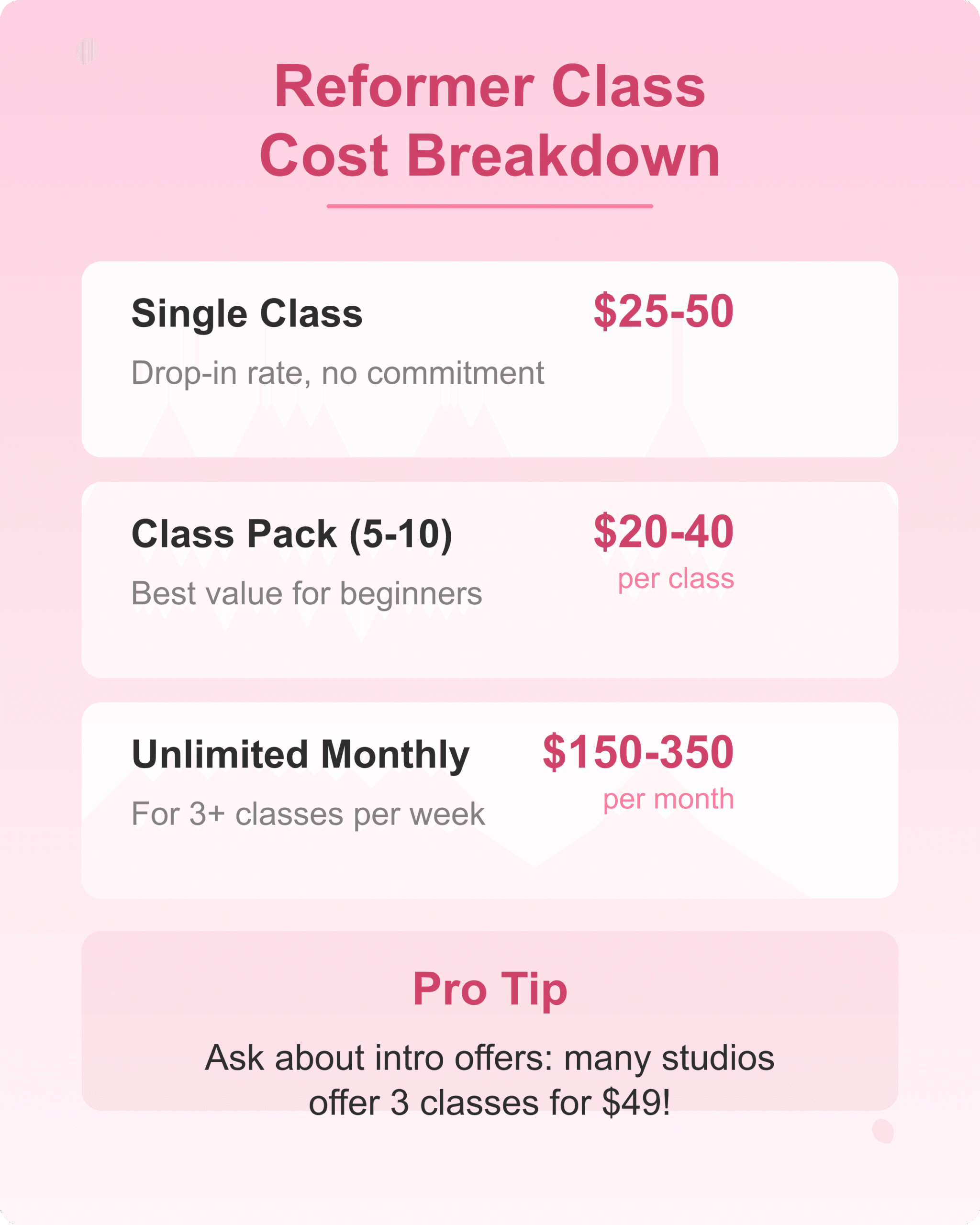
- Single class: $25 to $50, depending on your city and studio tier.
- Class packs (5-10 classes): $20 to $40 per class. Buying in bulk saves money.
- Monthly unlimited: $150 to $350 per month at most boutique studios.
- Introductory offers: Many studios offer a discounted first class or a “new client” pack (e.g., 3 classes for $49). Always ask.
If cost is a concern, you are not alone. Many women start their pilates journey with mat work at home and add reformer classes when the budget allows. Our pink pilates princess on a budget guide has practical tips for making pilates affordable at every income level.
Finding a Studio Near You
The best reformer class is the one you will actually attend, which usually means the one closest to your home or office. Use our Studio Finder to browse beginner-friendly pilates studios in your city, complete with pricing, class types, and neighbourhood details.
Common Beginner Fears (And Why They Are Unfounded)
Let us address the worries that keep women from booking that first class.
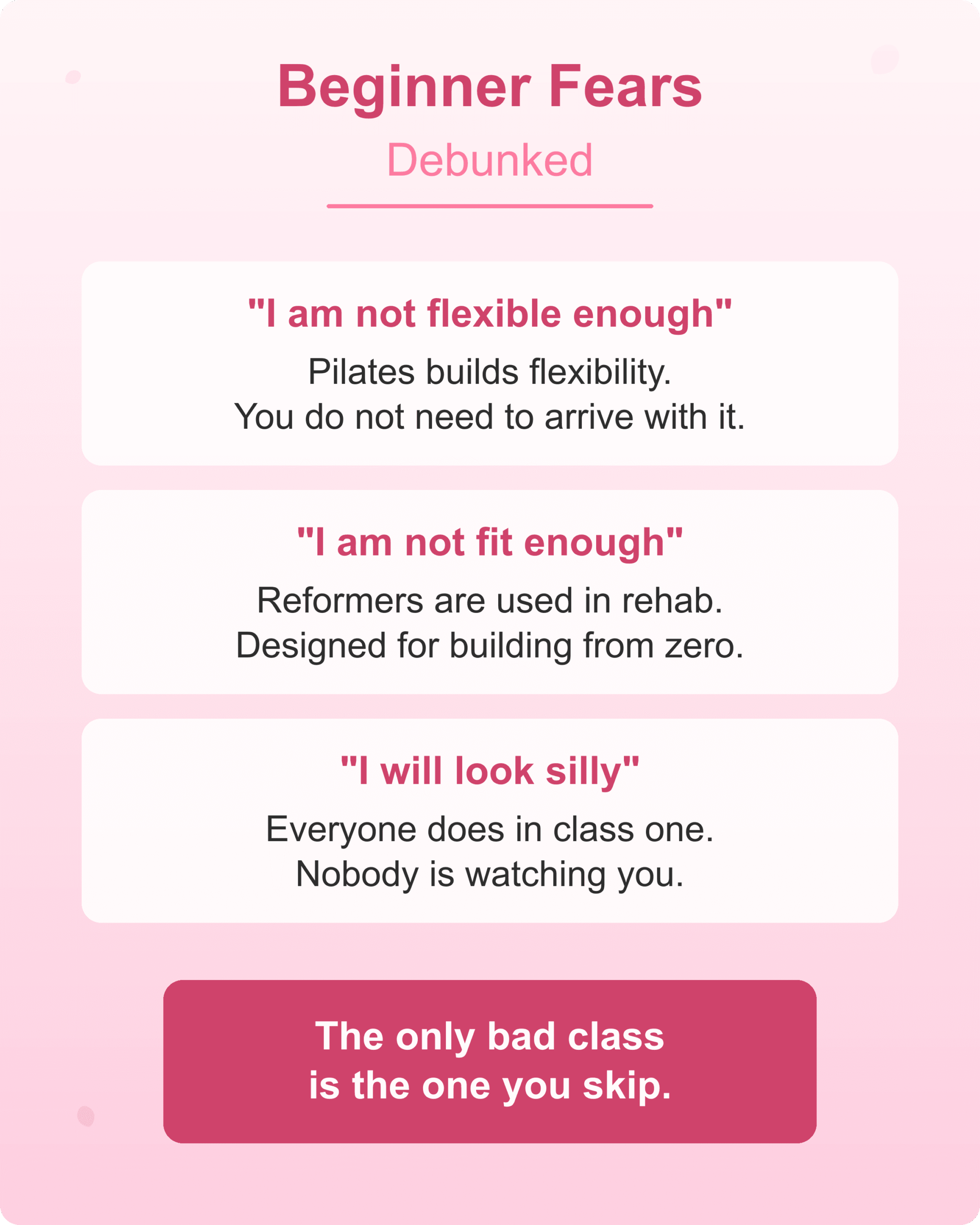
“I Am Not Flexible Enough”
Pilates builds flexibility. You do not need to arrive with it. The reformer’s springs actually assist stretching, making it easier to increase your range of motion than working on a mat alone.
“I Am Not Fit Enough”
Reformer pilates is used in physical rehabilitation. It is literally designed for people who need to build strength from scratch. The springs can be set to provide maximum assistance, so even if you cannot do a single push-up, you can do a reformer version of one.
“I Will Look Silly”
Everyone looks slightly confused in their first class. The straps go the wrong way, the carriage slides when you do not expect it, and you will probably push when you should pull at least once. This is entirely normal. The instructor expects it. The other clients were you six months ago.
“I Will Not Be Able to Keep Up”
Beginner classes move at a beginner pace. If a particular exercise is too challenging, your instructor will offer a modification. You can always reduce your spring resistance or decrease your range of motion. There is no scoreboard, no competition, no reason to push beyond what feels right for your body.
If these fears resonate, you might also relate to our article on why pilates feels like it is not working. Sometimes the biggest barrier is not the exercise itself but the expectations we carry into it.
Your First Month: What to Expect Week by Week
Knowing what progress looks like helps you stick with it. Here is a realistic timeline for reformer pilates beginners.
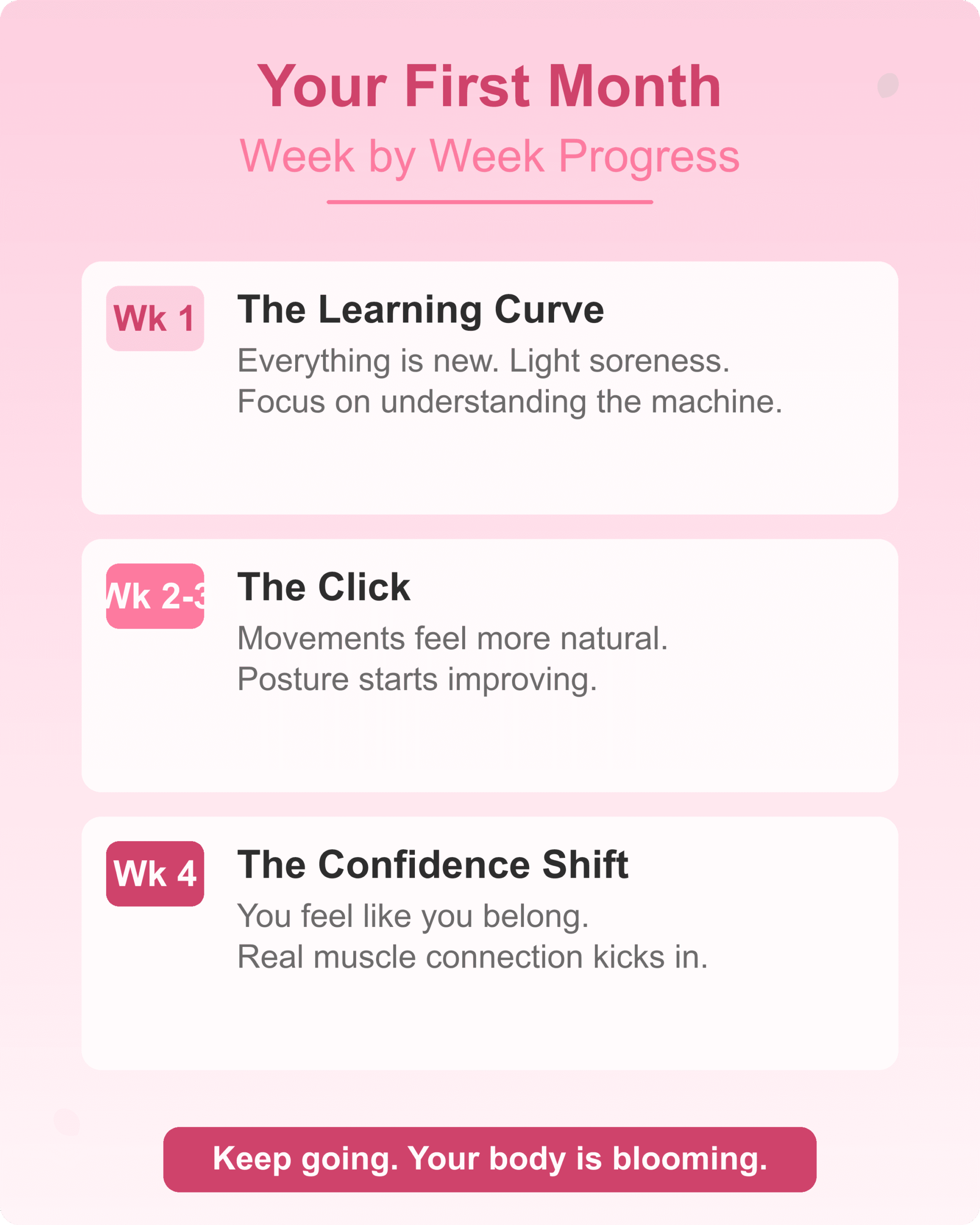
Week 1: The Learning Curve
Everything is new. You spend most of your mental energy understanding the machine and following the instructor. Your muscles will feel worked in places you did not know existed (hello, deep core and inner thighs). Light soreness for a day or two is normal.
Week 2-3: The Click
You start to anticipate the movements. Your body begins to understand the reformer’s rhythm, and you can focus less on the machine and more on your form. You might notice your posture improving without even trying.
Week 4: The Confidence Shift
By the end of your first month (attending two to three classes per week), you will feel like you belong. The terminology makes sense, you know your spring preferences, and you start to feel the difference between just doing the movement and really connecting to your muscles.
Staying consistent through these first four weeks is the hardest part. Our pilates consistency tips can help you build the habit that carries you past the initial learning curve.
Reformer Pilates vs Mat Pilates: Which Should a Beginner Choose?
The honest answer is: whichever one you will actually do consistently. Both are pilates. Both work. Both will strengthen your core, improve your posture, and make you feel more connected to your body.
Choose the reformer if you want guided resistance, feedback from the machine, and a structured studio experience. Choose the mat if you want convenience, affordability, and the freedom to practise at home on your own schedule.
Many women start with mat pilates at home, build a base of strength and familiarity, and then add reformer classes to challenge themselves further. There is no wrong order. For a deeper comparison, our mat vs reformer guide covers the results you can expect from each.
Frequently Asked Questions
How many times a week should a beginner do reformer pilates?
Two to three times per week is ideal for beginners. This gives your body enough stimulus to adapt while allowing recovery time between sessions. Once a week is enough to maintain, but two to three sessions per week is where real progress happens.
Can you lose weight with reformer pilates?
Reformer pilates builds lean muscle, improves posture, and can reduce bloating, all of which change how your body looks. For significant weight loss, combine pilates with a balanced nutrition plan. Pilates alone burns roughly 250 to 400 calories per class depending on intensity.
Is reformer pilates harder than mat pilates?
Not necessarily. The reformer provides spring assistance that makes some exercises easier than on a mat. However, the added instability of the sliding carriage challenges your core in new ways. They are different, not harder or easier.
Do I need to do a mat class before trying the reformer?
No. Many studios design their beginner reformer classes for people with zero pilates experience. If you feel more comfortable starting at home first, try a beginner mat workout to learn the basics, then transition to the reformer when you are ready.
What if I have an injury or health condition?
Tell your instructor before class. Reformer pilates is widely used in rehabilitation, and a good instructor can modify exercises for back pain, knee issues, pregnancy, and most other conditions. If you have a specific concern, our pilates for lower back pain guide shows how pilates adapts to injuries.
Your Next Step
The reformer is not as scary as it looks. It is a tool designed to support your body, guide your movement, and help you get stronger in the gentlest way possible. Everything about it, the springs, the straps, the sliding carriage, exists to make pilates more accessible, not more intimidating.
Your first class will feel unfamiliar. Your second will feel easier. By your fourth, you will wonder why you waited so long. Reformer pilates for beginners is simply pilates with a little extra support, and there is nothing wrong with wanting support.
Ready to find a beginner-friendly studio? Use our Studio Finder to discover reformer classes near you. Or, if you want to build a foundation at home first, grab the Pink Pilates Starter Kit and start your journey on the mat.
You do not need to be perfect. You do not need to be flexible. You just need to show up, grip those socks, and let your body bloom.