You know pilates works. You have felt it: that calm clarity after a session, the slow strengthening in your core, the way your posture shifts when you practise regularly. But then a busy week hits. One skipped day becomes three, three becomes a week, and suddenly you are starting over again. Sound familiar?
If you are searching for pilates consistency tips, you are not looking for motivation. You have motivation. What you need is a system. A structure that makes showing up so effortless that skipping feels harder than doing it.
This guide gives you seven practical strategies that real women use to stay consistent with pilates, even when life is chaotic, energy is low, and time feels impossible. None of them require willpower. All of them work.
Why Consistency Matters More Than Intensity
Before we get into the tips, let us ground this in science. A 2019 study published in the European Journal of Social Psychology found that it takes an average of 66 days for a new behaviour to become automatic. Not 21 days, as the popular myth suggests. Sixty-six days of repeated action before your brain stops requiring conscious effort.
This means the first two months are the hardest. After that, pilates becomes part of who you are, not something you have to force yourself to do. The entire game is surviving those first 66 days. Every strategy in this article is designed to get you through that window with the least possible friction.
And here is the encouraging part: research also shows that missing a single day does not reset your progress. The habit still builds as long as you resume quickly. Perfection is not required. Persistence is.
Tip 1: Shrink Your Minimum to 10 Minutes
The biggest consistency killer is an all-or-nothing mindset. “If I cannot do a full 45-minute session, there is no point.” This thinking guarantees failure because busy days happen constantly, and a 45-minute block rarely survives contact with real life.
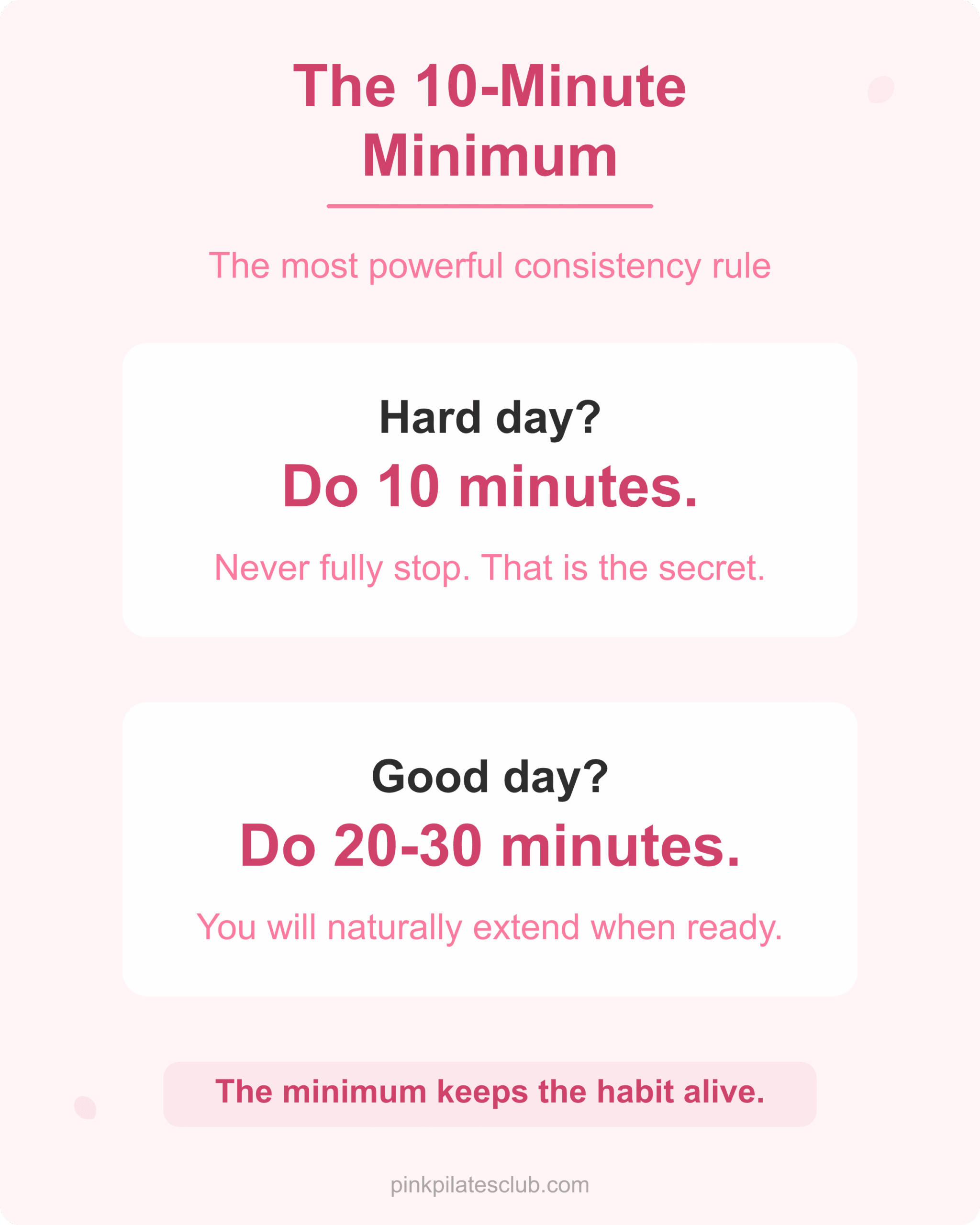
Instead, set your minimum at 10 minutes. Not your ideal, not your goal. Your minimum. The session length below which you do not go. Ten minutes of intentional, focused pilates with proper deep core activation is enough to maintain your progress and keep the habit alive.
On good days, you will naturally extend to 20 or 30 minutes. On hard days, you do your 10 and move on. The magic is that you never fully stop. Our beginner workout guide includes 10-minute options specifically designed for these low-energy days.
Tip 2: Anchor Pilates to an Existing Habit
Habit stacking is one of the most researched behaviour-change techniques. The concept is simple: attach your new behaviour (pilates) to something you already do every day without thinking.
Examples that work:
- After I make my morning coffee, I do 10 minutes of pilates while it cools
- After I drop the kids at school, I do a mat session before anything else
- After I close my laptop for the day, I roll out my mat for 15 minutes
- After I brush my teeth at night, I do a gentle 10-minute wind-down flow
The key word is “after.” Your existing habit becomes the trigger. You do not need to remember, decide, or motivate yourself. The trigger does the work. Our morning routine guide walks through how to build a full habit stack around pilates that feels natural within a week.
Tip 3: Keep Your Mat Out
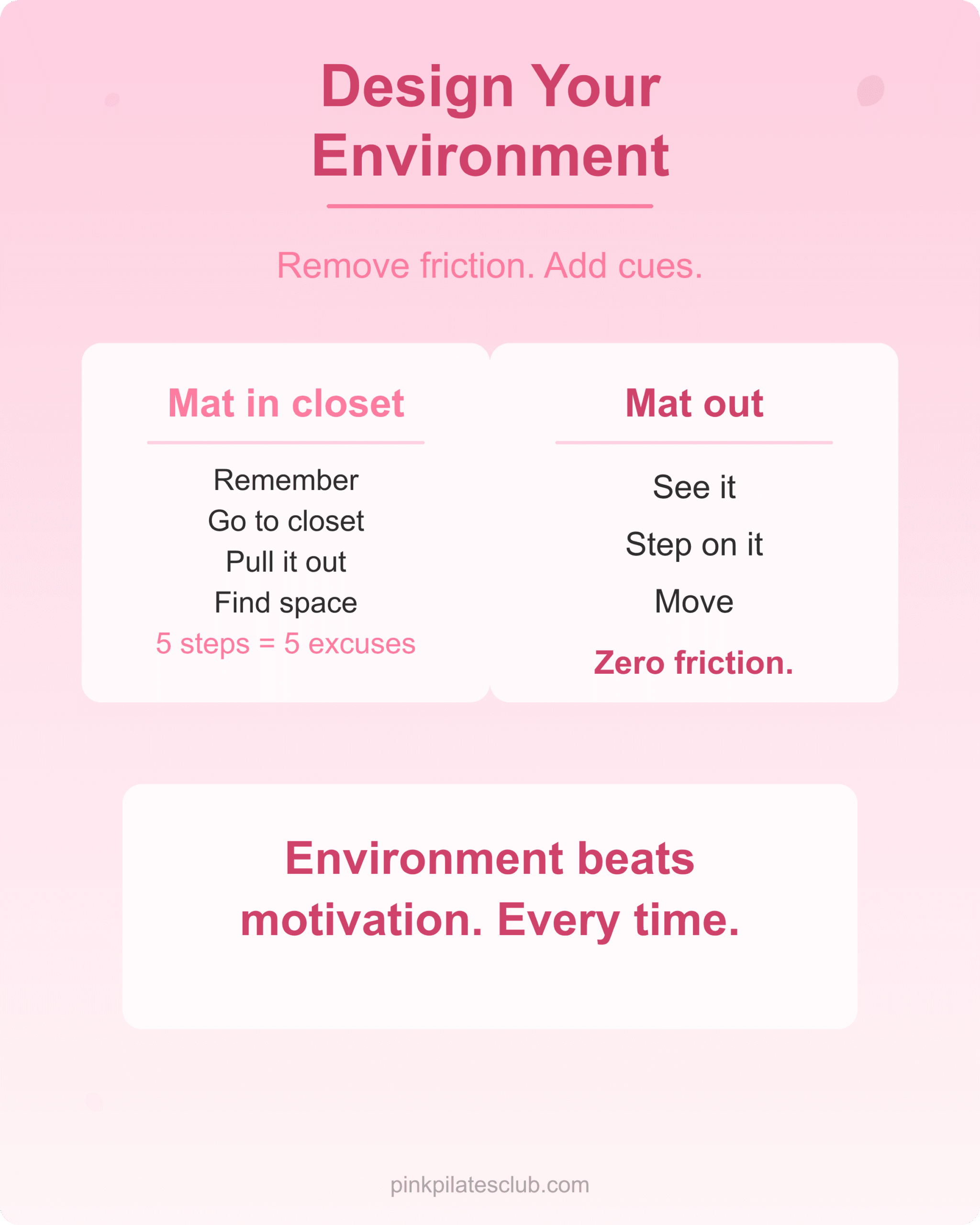
This sounds almost too simple, but it is one of the most effective pilates consistency tips that experienced practitioners swear by. Physical environment shapes behaviour more powerfully than motivation does.
If your mat is rolled up in a closet, using it requires multiple steps: remember to practise, go to the closet, pull out the mat, find space, unroll it, then start. Each step is an opportunity for your brain to talk you out of it.
If your mat is already unrolled in your living room, the barrier drops to near zero. You see it. You step on it. You move. Some women keep their mat permanently in a dedicated corner with a candle and their phone stand ready. The space whispers “come practise” every time they walk past it.
Tip 4: Use the Two-Day Rule
This rule comes from the world of behavioural psychology and it is remarkably effective: never skip two days in a row. One day off is rest. Two days off is the beginning of a new pattern.
When you commit to the two-day rule, you give yourself complete permission to miss a day whenever you need to. No guilt, no stress, no starting over. The only non-negotiable is that the day after a rest day, you show up. Even if it is just your 10-minute minimum.
This rule works because it prevents the most dangerous moment in any habit: the slide from “I skipped one day” to “I have not practised in two weeks.” The second day is the decision point. The two-day rule makes that decision for you in advance.
Tip 5: Schedule It Like a Meeting
If pilates lives in the “I will fit it in somewhere” category of your day, it will consistently lose to everything else. Emails, errands, other people’s requests, scrolling, all of it feels more urgent in the moment.
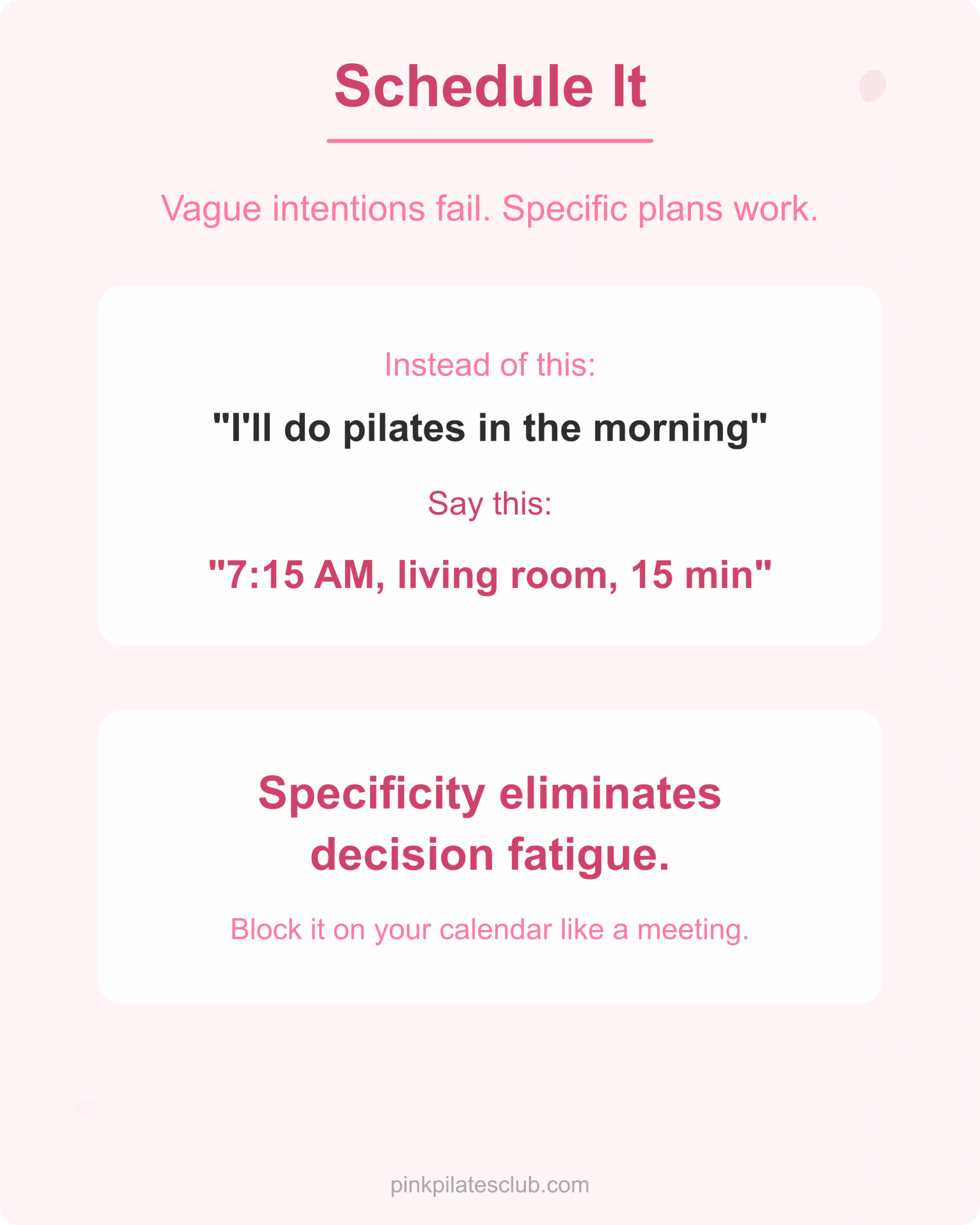
The fix is to give pilates a specific time slot on your calendar. Not “in the morning.” Specifically: “7:15 to 7:30 AM, pilates in the living room.” Block it. Set a reminder. Treat it with the same respect you give a work meeting or a doctor’s appointment.
Research from the British Journal of Health Psychology found that people who write down exactly when and where they will exercise are significantly more likely to follow through than those who simply intend to exercise. The specificity eliminates decision fatigue.
Tip 6: Track Your Streak (But Gently)
Streak tracking taps into a psychological principle called the “endowment effect”: once you have built something (even just a number), you become motivated to protect it. A seven-day streak feels like something you own, something you do not want to break.
But here is the important nuance for the Pink Pilates Club approach: track your streak gently. A missed day does not erase your progress. It does not mean you failed. It means you are human. Mark the miss, note why, and start a new streak the next day.
You can track with something as simple as a pink dot on your paper calendar, a check in your phone notes, or a habit tracking app. The method matters less than the visibility. Seeing your consistency visualised builds momentum and makes the pattern feel real.
Tip 7: Find Your Community
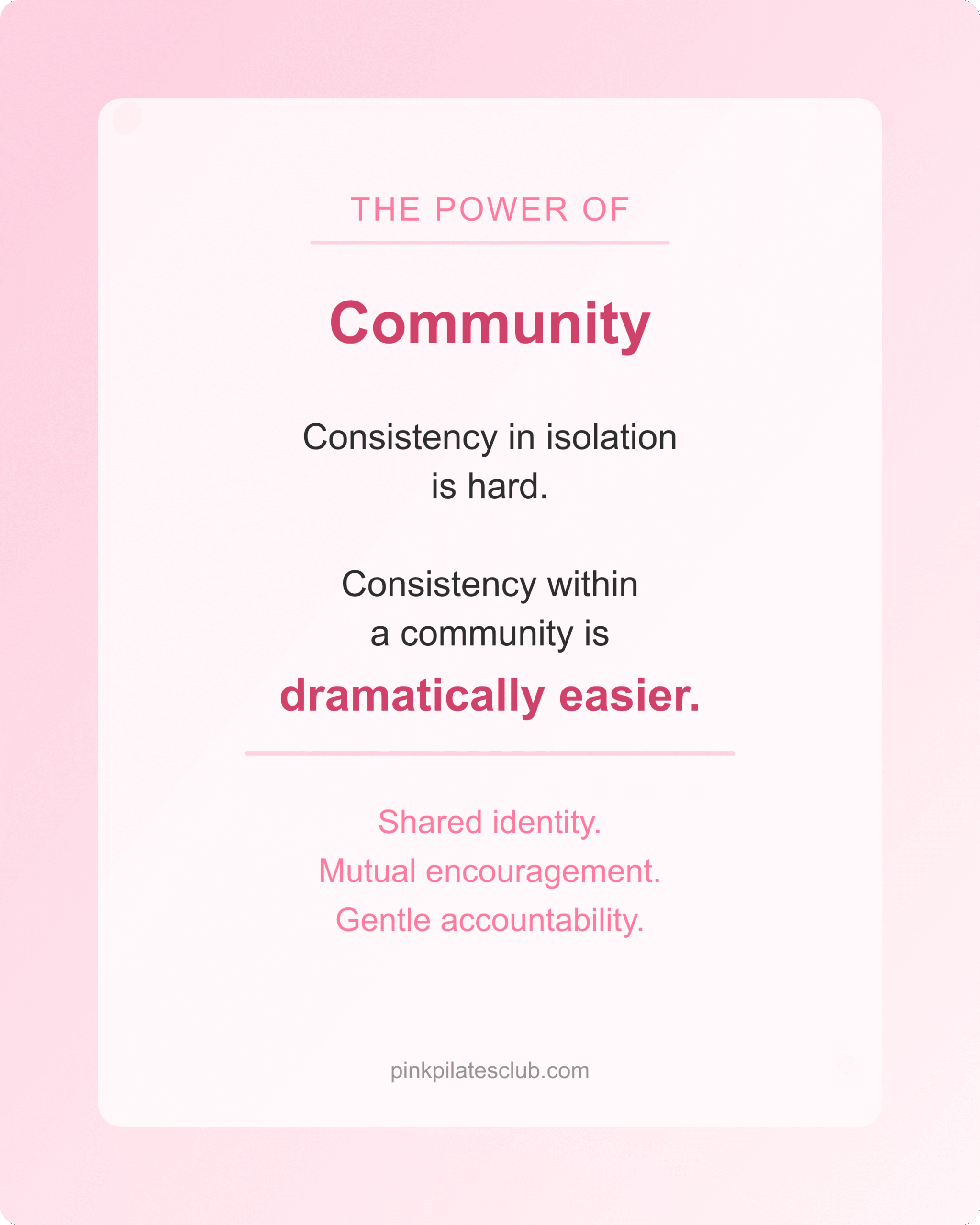
Consistency in isolation is hard. Consistency within a community is dramatically easier. When other women are sharing their sessions, celebrating milestones, and gently holding each other accountable, showing up stops being a solo discipline and becomes a shared rhythm.
This is why the pink pilates princess community has been so powerful for so many women. The aesthetic, the shared identity, the mutual encouragement: these are not surface-level perks. They are behavioural infrastructure that makes consistency feel natural.
Find your people. Join a group, follow creators who inspire you without making you feel inadequate, or recruit a friend to practise alongside you virtually. The accountability does not need to be intense. Even knowing that someone else is on the same journey makes a measurable difference.
Putting It All Together: Your Consistency Plan
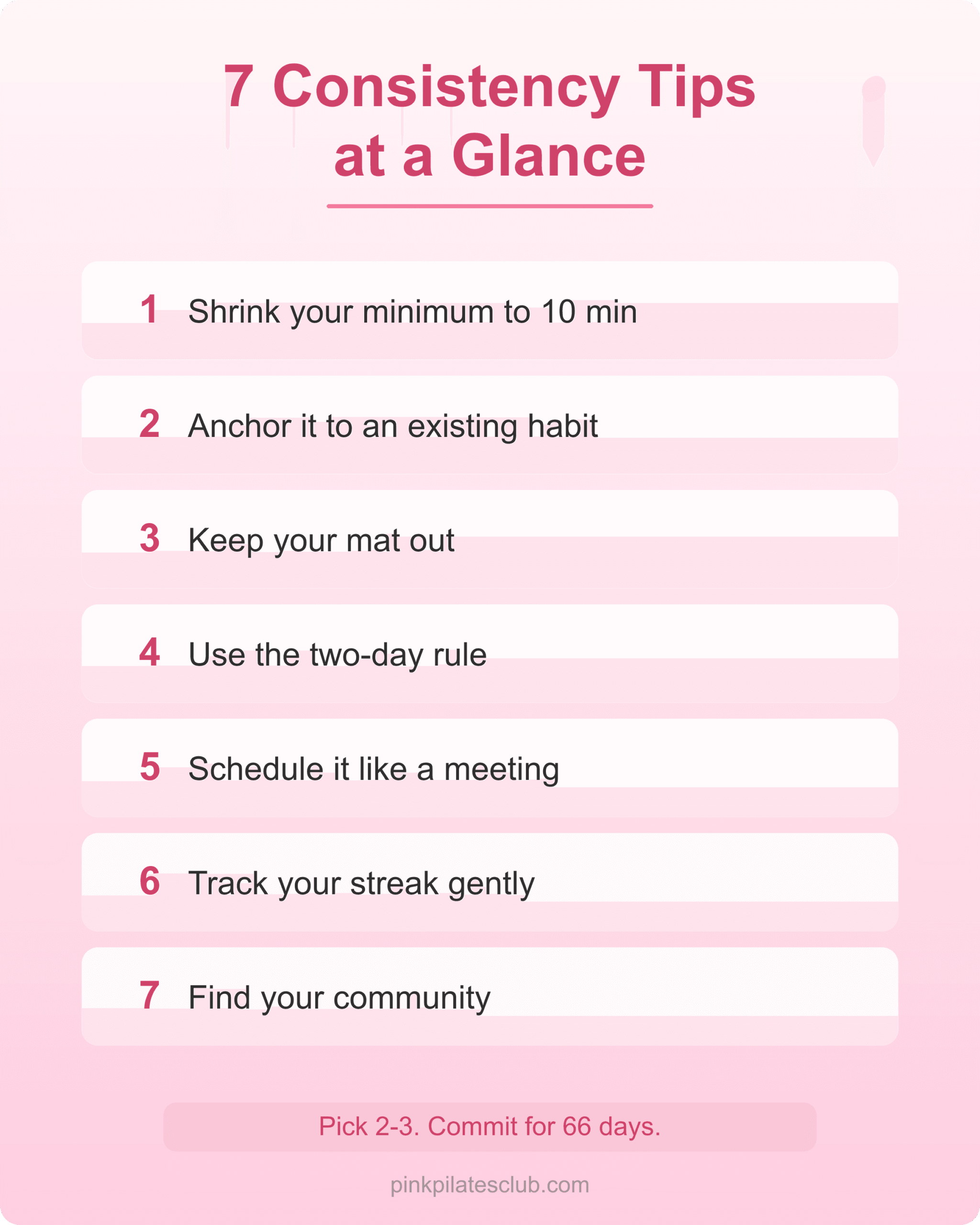
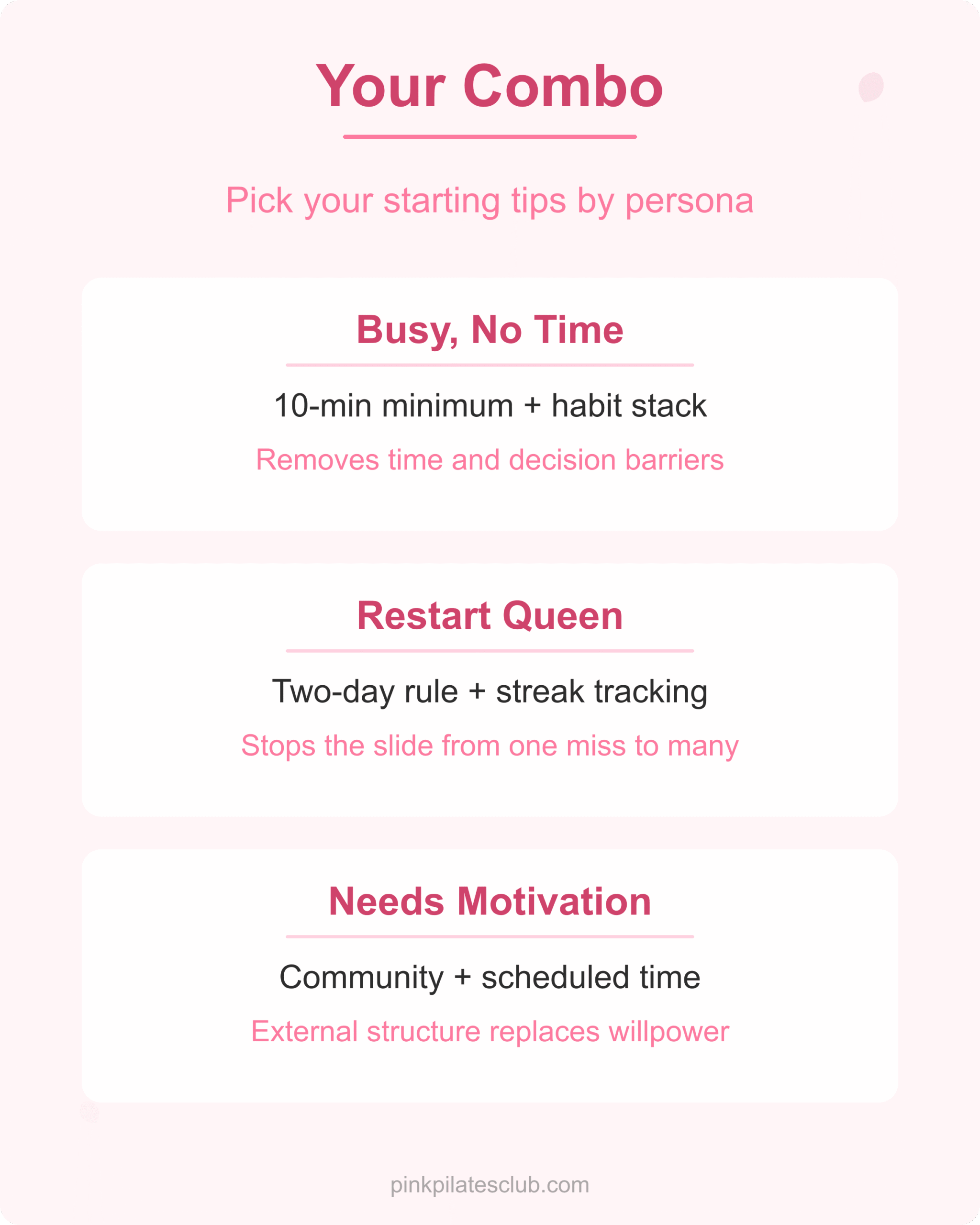
You do not need all seven tips. Pick the two or three that resonate most with your life right now and commit to them for the next 66 days. Here is a suggested starting combination for each persona:
If you are the busy woman with no time: Start with Tip 1 (10-minute minimum) plus Tip 2 (habit stack). These two alone remove the biggest barriers: time and decision fatigue.
If you are the restart queen who keeps falling off: Start with Tip 4 (two-day rule) plus Tip 6 (streak tracking). These target the exact moment where habits die: the slide from one missed day to many.
If you are the woman who needs external motivation: Start with Tip 7 (community) plus Tip 5 (schedule it). External structure and social accountability create a framework that does not rely on internal willpower.
Whichever combination you choose, remember that these pilates consistency tips are not about perfection. They are about building a practice that bends without breaking. A practice that survives bad weeks, busy seasons, and low-energy days.
Frequently Asked Questions
How many times per week should I do pilates to see results?
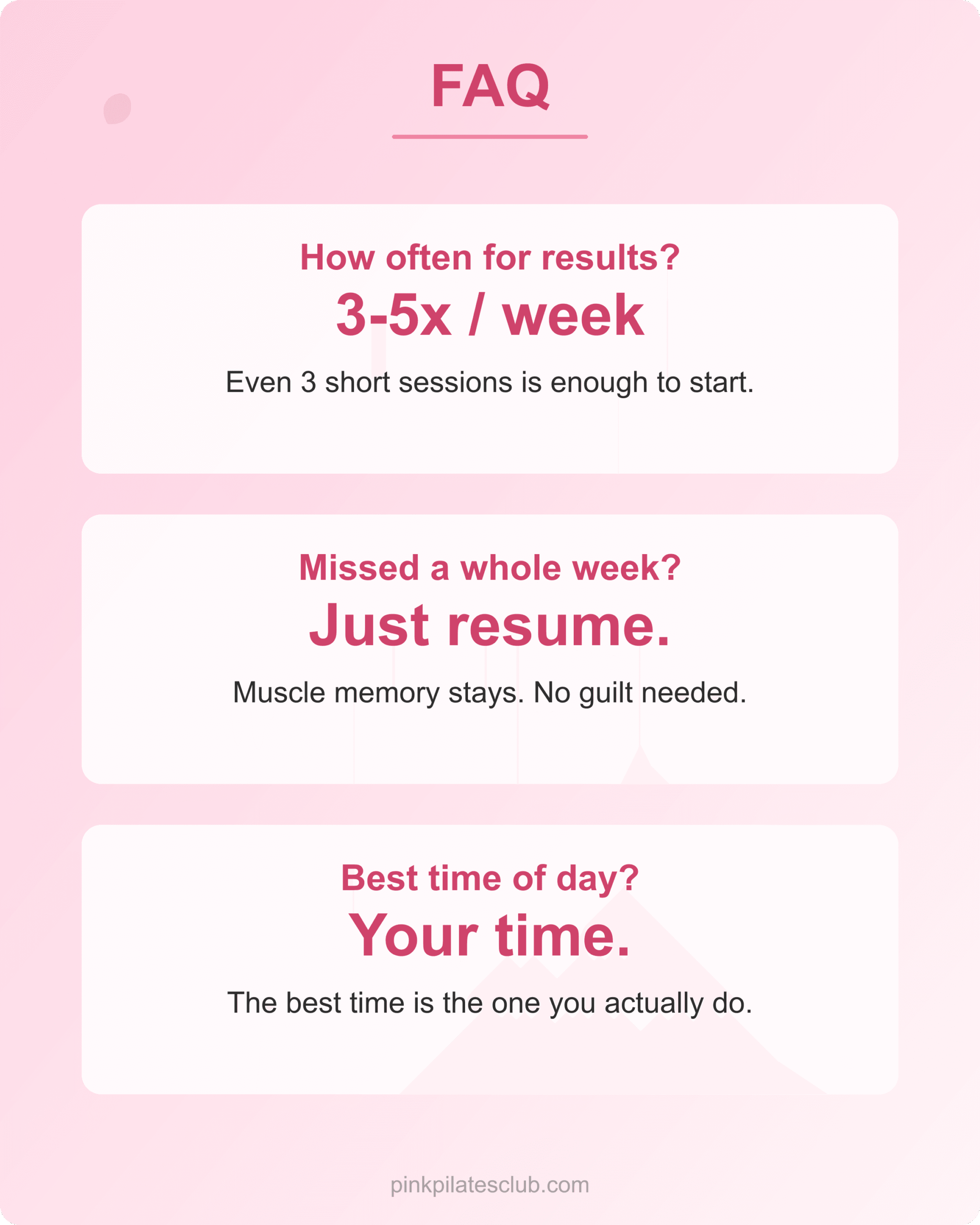
Three to five sessions per week is the sweet spot for visible results. Even three 10-minute sessions per week is enough to build strength and maintain your habit. Consistency at a lower frequency beats inconsistency at a higher one.
What if I miss a week of pilates?
You have not lost your progress. Muscle memory and neural pathways remain for weeks after a break. Simply resume where you left off with your 10-minute minimum and rebuild from there. No guilt, no starting over.
Is 10 minutes of pilates a day really enough?
For maintaining your habit and core activation, absolutely. On days when 10 minutes is all you have, that 10 minutes keeps the pattern alive. On days when you have more energy, you will naturally extend. The minimum is about consistency, not results.
How do I stay motivated when I am not seeing results yet?
Shift your focus from results to process. Track your consistency streak instead of measuring your body. Results follow consistency, not the other way around. Most women see visible changes between weeks four and eight of consistent practice.
What is the best time of day to do pilates?
The best time is the time you will actually do it consistently. Morning sessions work well because they happen before the day’s demands pile up. But evening sessions can help with stress release and sleep. Choose the time that fits your schedule and protect it.
Your Next Step
If you have been searching for pilates consistency tips that go beyond motivational quotes, you now have seven research-backed strategies that actually work. Not motivational quotes. Not “just push through it” advice. Real systems that remove friction, build momentum, and make consistency feel less like discipline and more like a natural part of your day.
Pick your two or three tips. Start tomorrow. Set your 10-minute minimum. Stack it onto a habit you already have. Keep your mat out. And give yourself 66 days before you judge the results.
These pilates consistency tips work because they replace willpower with systems. Need a routine to anchor your new habit to? Our beginner pink pilates princess workout was built for exactly this: short, effective, gentle sessions designed for women building consistency from scratch. Or browse our guide on becoming a pink pilates princess on a budget to build the full lifestyle that makes showing up feel effortless.
You do not need to be perfect. You just need to keep going.