You are starting to wonder: is pilates not working for me?
You have been showing up. You have been doing the moves. You bought the mat, followed the videos, and tried to be consistent. But weeks have passed and your body looks the same. Feels the same.
Before you quit, take a breath. This is one of the most common frustrations in the pilates world, and the answer is almost never that pilates does not work. The answer is almost always that something specific in your approach needs a small adjustment. Not a dramatic overhaul. A small, targeted fix.
This guide walks through the seven most common reasons women feel like pilates is not delivering results, and exactly what to change for each one. Most of these fixes take zero extra time and zero extra money. They just require a shift in understanding.
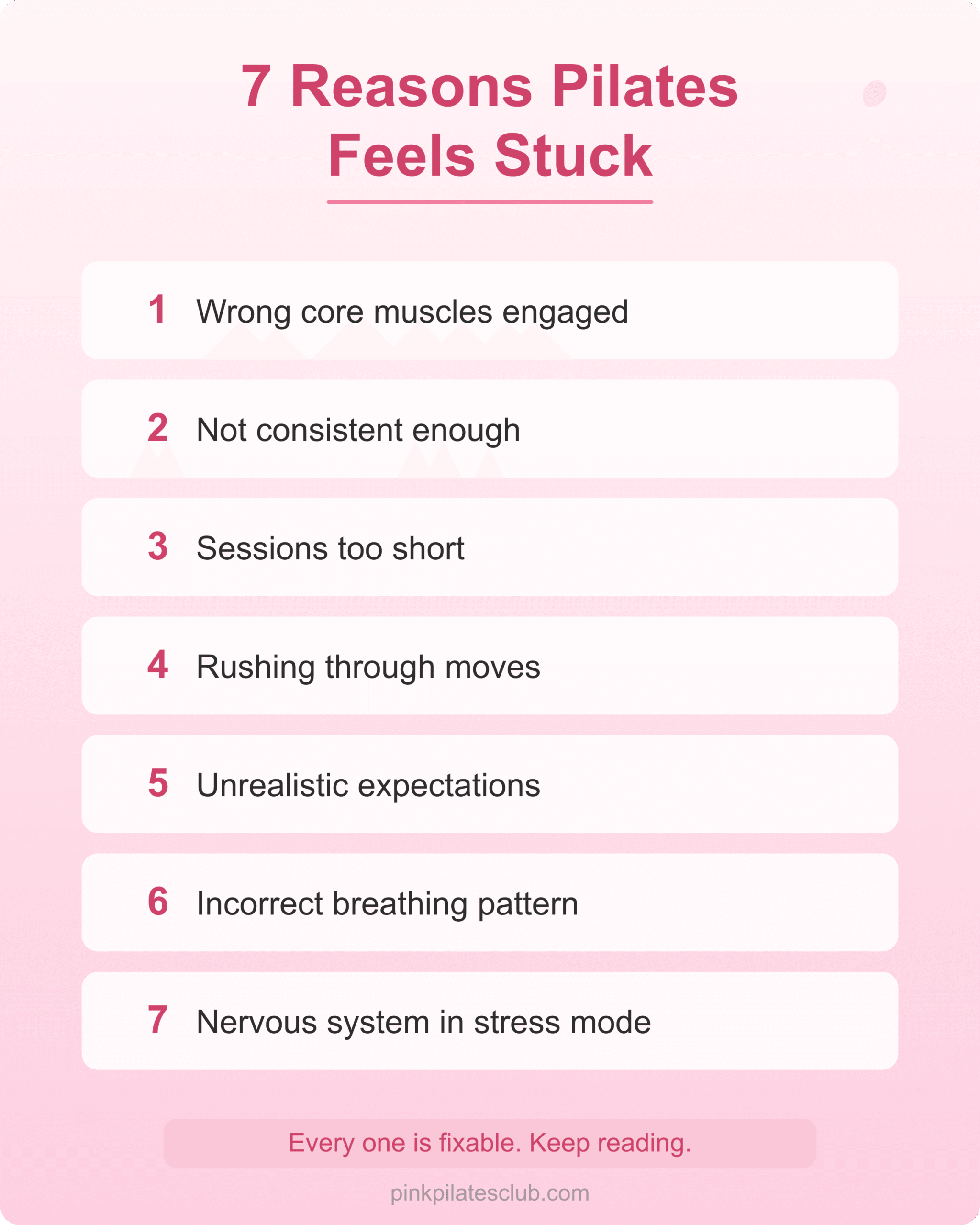
Reason 1: You Are Not Activating Your Deep Core
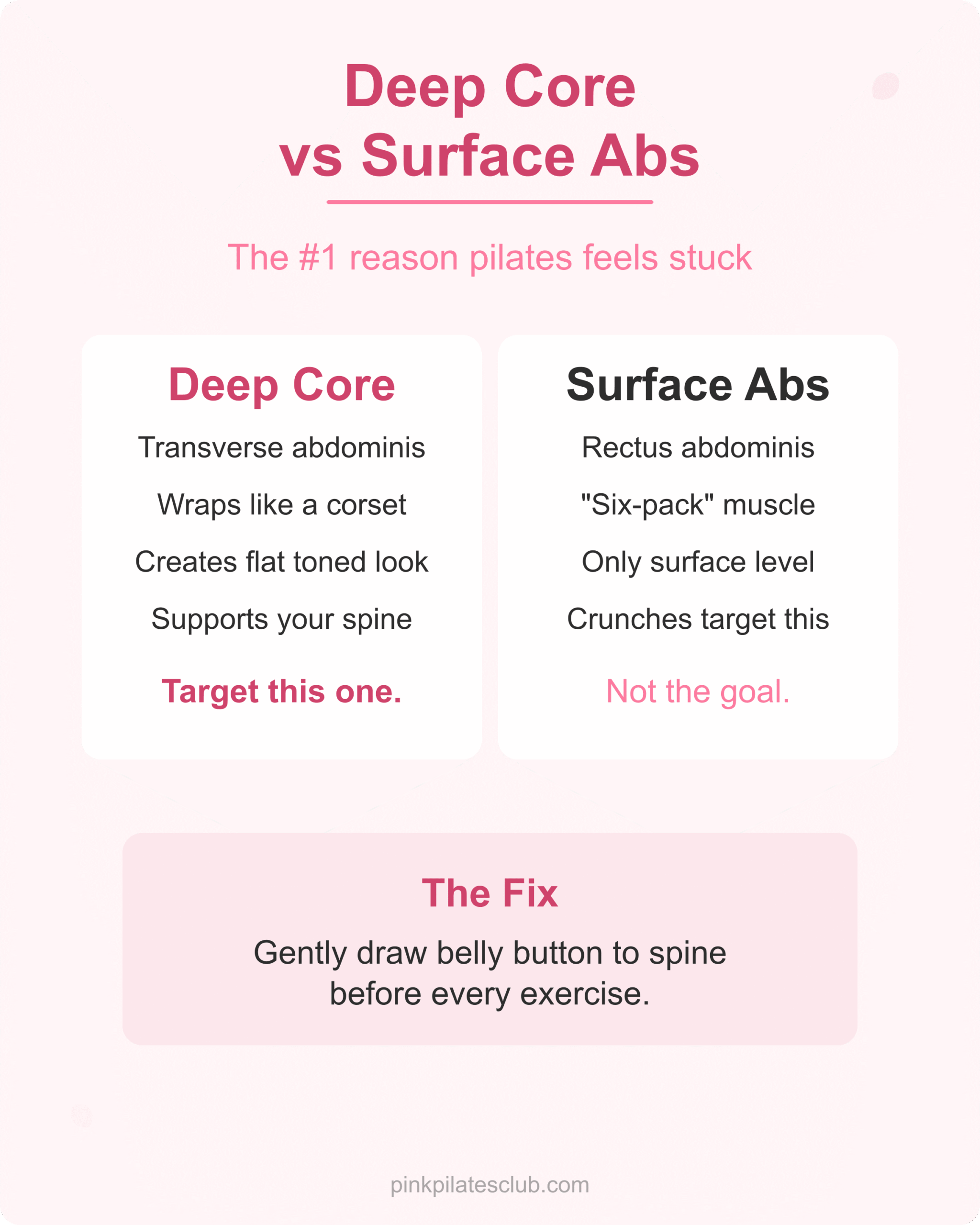
This is the number one reason pilates not working shows up as a search query. Most beginners engage their surface abdominal muscles (the rectus abdominis, the “six-pack” muscle) instead of the deep core muscle that pilates actually targets: the transverse abdominis.
The transverse abdominis wraps around your midsection like a corset. It is the muscle responsible for a flat, toned appearance, good posture, and spinal stability. But it does not activate the way your surface abs do. You cannot crunch your way to it.
The fix: before every exercise, draw your belly button gently toward your spine as if you are zipping up a tight pair of jeans. Do not suck in or hold your breath. It is a gentle, inward pull that you maintain throughout the movement. If you can talk normally while holding this engagement, you are doing it correctly.
This single adjustment transforms the effectiveness of every pilates exercise. Many women report feeling their practice “click” the moment they learn to find their deep core. Research published in the ACSM Health and Fitness Journal confirms that deep core activation is the primary mechanism behind pilates results.
Reason 2: You Are Not Being Consistent Enough
This is the one nobody wants to hear, but it is the most impactful factor. If pilates is not working for you, honestly assess how often you are actually practising.
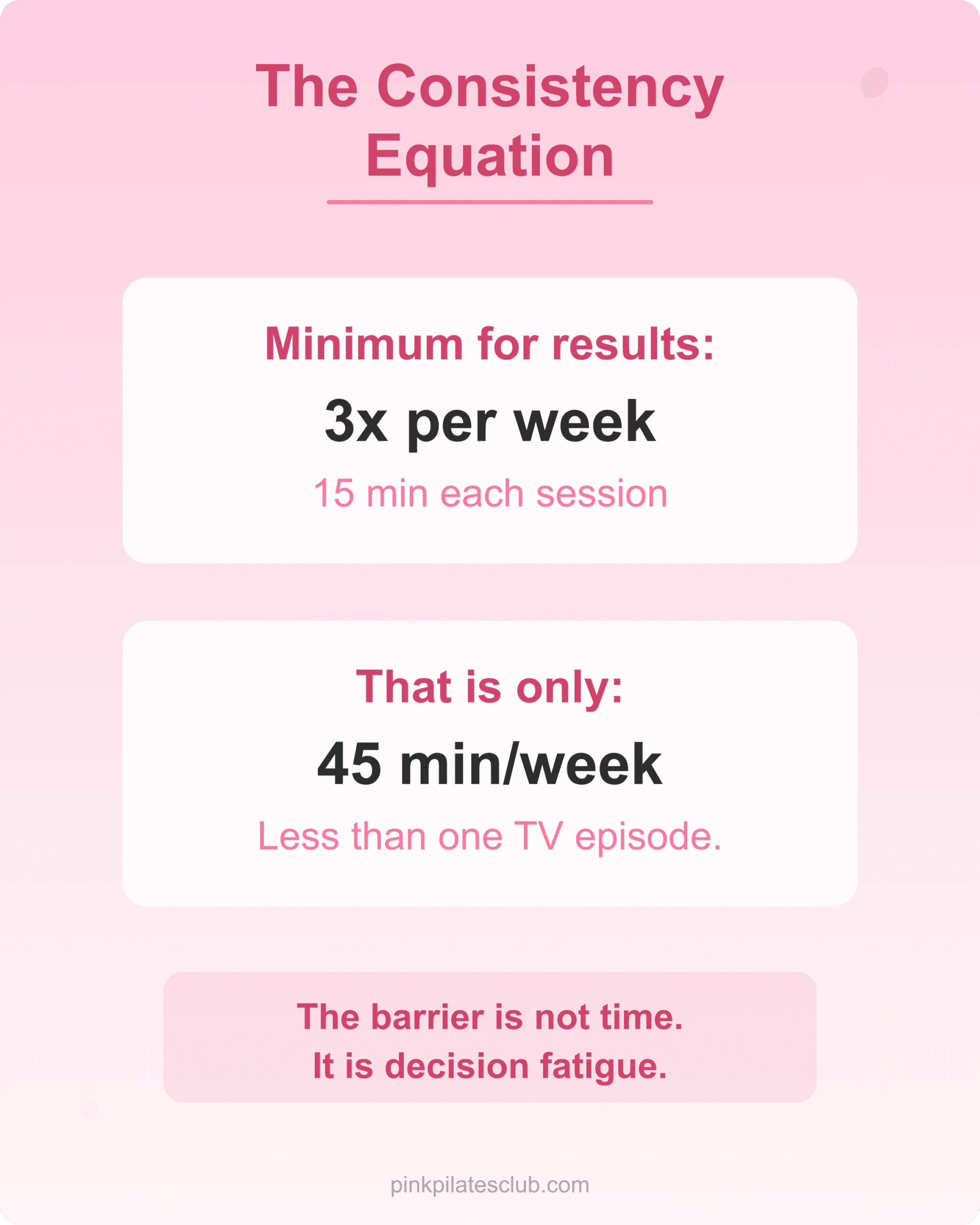
Doing pilates once or twice a week is better than nothing, but it is not enough to produce visible changes. The body needs repeated stimulus to adapt. For most beginners, the sweet spot is three to five sessions per week, even if each session is only 15 to 20 minutes.
The fix: commit to a minimum frequency and protect it. Three sessions per week is the baseline. Set specific days and times. Treat it like an appointment with yourself that cannot be cancelled. If you struggle with consistency, our guide on building a pink pilates princess morning routine shows you how to anchor pilates to a daily ritual that makes it nearly automatic.
The math is simple. Three 15-minute sessions per week is 45 minutes total. That is less time than a single episode of most TV shows. The barrier is not time. It is usually decision fatigue, which is why a fixed routine eliminates the need to decide.
Reason 3: Your Sessions Are Too Short or Too Infrequent
Related to consistency, but slightly different. Some women are consistent in frequency but their sessions are too brief to create enough stimulus. A five-minute stretch is lovely, but it is not a pilates workout.
The minimum effective dose: 15 minutes of focused, intentional pilates movement. This is enough to activate your deep core, challenge your muscles, and create the progressive overload your body needs to change. Our beginner pink pilates princess workout is built around this exact 15-minute minimum.
The fix: if your sessions are under 15 minutes, extend them. If they are 15 minutes but only three times a week, try adding a fourth day. Small increases in total weekly volume produce meaningful results over four to eight weeks.
Reason 4: You Are Rushing Through the Movements
Speed is the enemy of pilates results. If you are moving quickly through exercises, you are using momentum instead of muscle control. Momentum lets your body cheat. Muscle control is what creates change.
Pilates was designed to be performed slowly and deliberately. Joseph Pilates himself said: “It is not about the number of repetitions, but the quality of each one.” A single slow, controlled pelvic curl with proper core engagement is more effective than ten fast ones powered by momentum.
The fix: slow everything down by 50%. If a movement takes you two seconds, make it take four. Pause at the top and bottom of each rep. Feel the muscle working through the entire range of motion. If you cannot control the movement at a slow pace, the exercise is too advanced for you right now, and that is perfectly fine. Choose a modification and master that first.
Reason 5: Your Expectations Are Based on Social Media Timelines
This one is huge, and it is specific to the generation of women who discovered pilates through TikTok and Instagram. Social media compresses timelines. A creator posts a “one-month pilates transformation” and it looks like her body completely changed in 30 days. What you do not see: she may have been working out for years before that month. The lighting changed. The angle changed. The before photo was taken post-meal and the after was taken fasted in morning light.
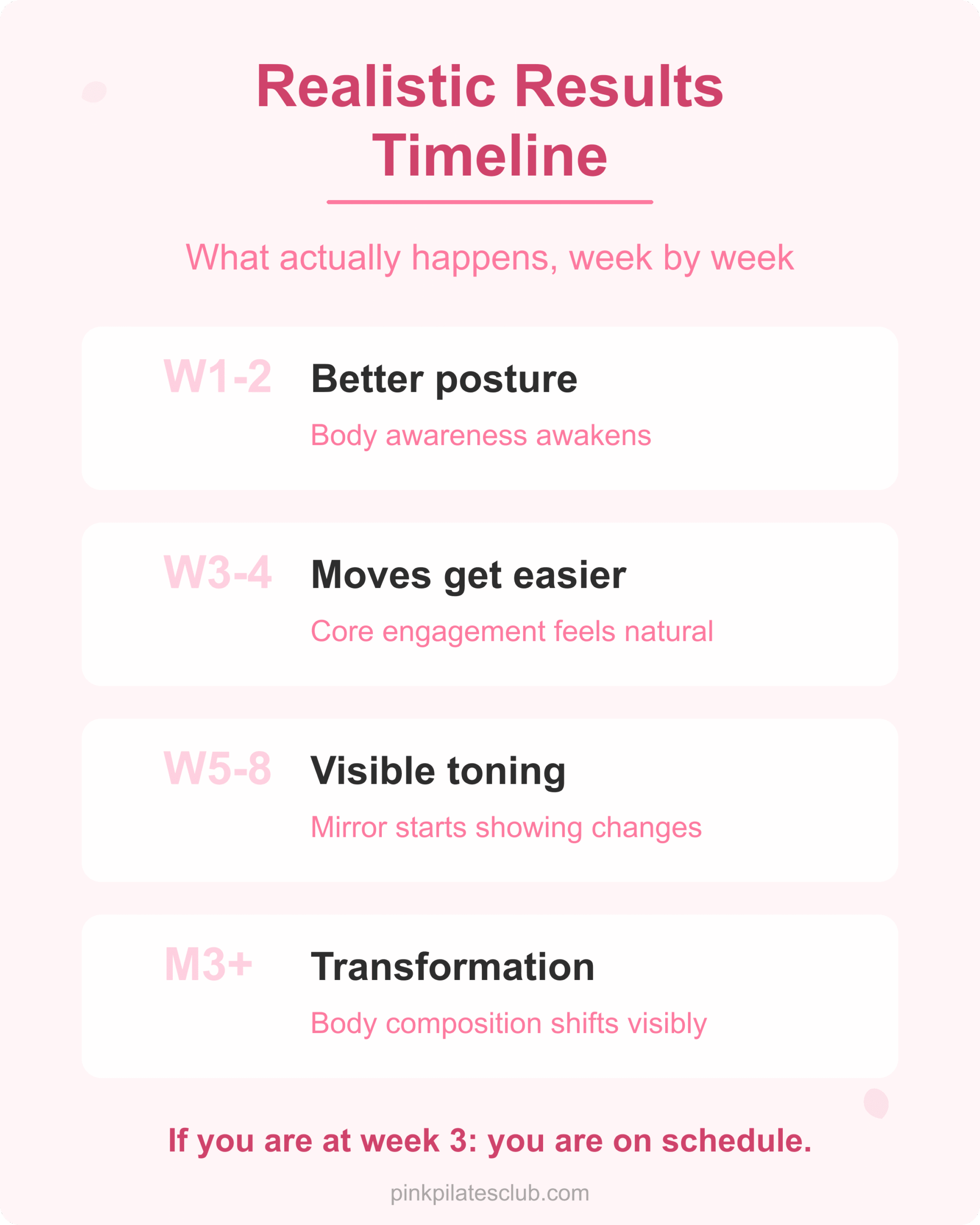
Real pilates results follow a predictable, research-backed timeline:
- Week 1 to 2: improved posture, better body awareness, slight muscle soreness (good soreness)
- Week 3 to 4: movements feel easier, core engagement becomes more natural, you may notice your waist feeling slightly firmer
- Week 5 to 8: visible toning begins, especially in your core and posture. This is where most women start to see changes in the mirror
- Month 3 and beyond: significant body composition changes, defined muscle tone, markedly improved flexibility and posture
The fix: adjust your timeline expectations. If you are at week three and frustrated, you are exactly on schedule. The results are building beneath the surface. Trust the process for at least six to eight weeks before evaluating whether pilates is not working.
Reason 6: You Are Not Breathing Correctly
Breathing is not just background activity in pilates. It is the engine that powers every movement. Incorrect breathing patterns are surprisingly common and they directly reduce the effectiveness of your practice.
The pilates breathing pattern is lateral thoracic breathing: inhaling through your nose to expand your ribcage sideways, then exhaling through your mouth as your ribs draw back together and your core naturally engages. Most beginners breathe into their chest or belly instead, which prevents proper core activation.
The fix: spend the first two minutes of every session on breathing practice alone. Place your hands on your lower ribcage. Inhale for four counts and feel your ribs push outward into your hands. Exhale for six counts and feel them draw inward. Once this pattern feels natural, maintain it throughout your workout. The exhale is always the effort phase: exhale when you curl up, exhale when you lift, exhale when you engage.
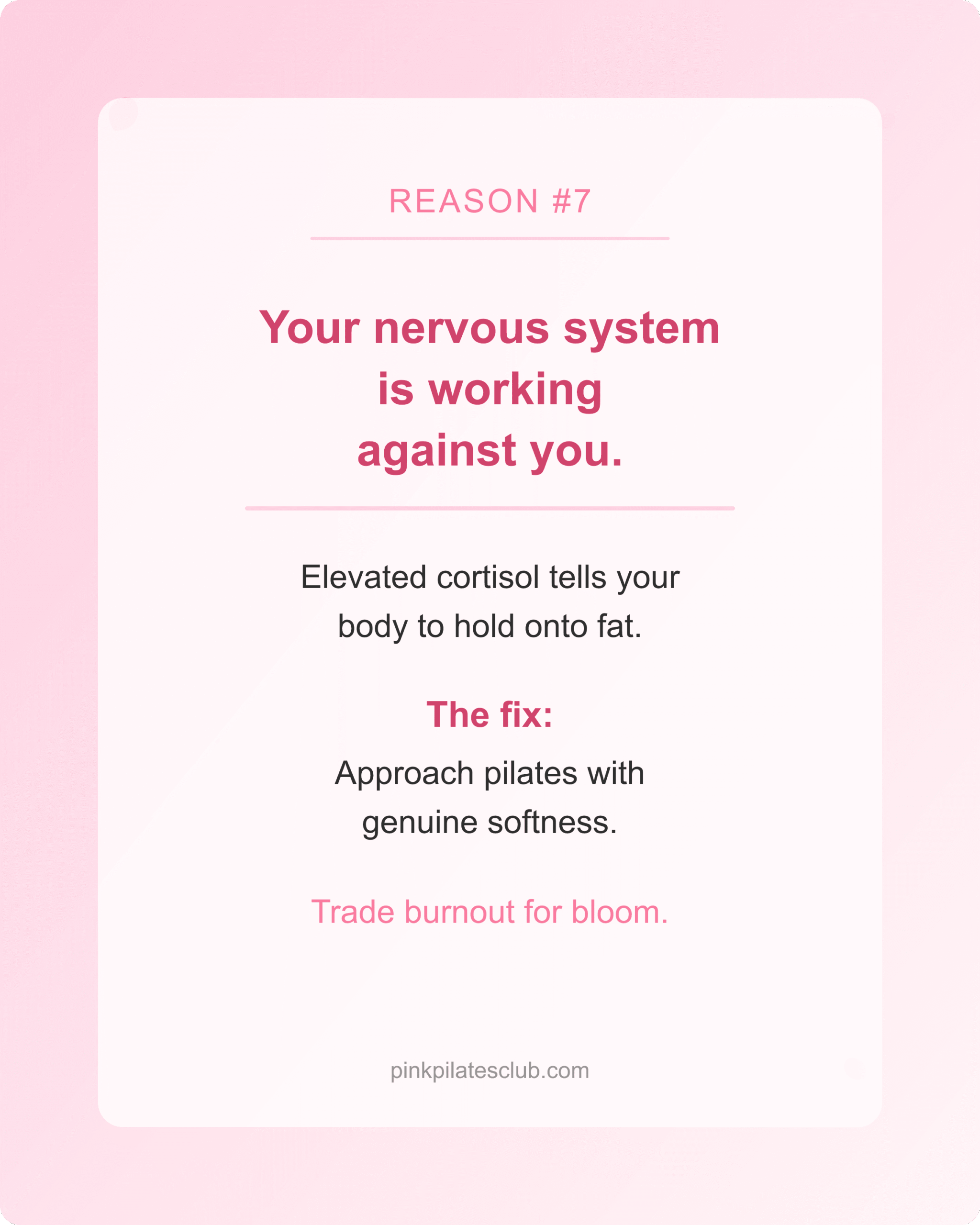
Reason 7: Your Nervous System Is Working Against You
This is the reason that most fitness advice completely ignores, and it is the reason that matters most for the Anxious Burnt-Out Girl.
If your body is in a chronic state of stress, your cortisol levels are elevated. Elevated cortisol tells your body to hold onto fat, especially around your midsection, regardless of how much you exercise. This is why women who are stressed, sleep-deprived, or emotionally exhausted often do not see body composition changes even with consistent exercise.
According to research from Harvard Health, gentle exercise like pilates actually helps regulate cortisol, but only if you approach it gently. If you are pushing yourself aggressively, treating pilates like a punishment, or feeling anxious about not seeing results, you may be keeping your stress response elevated even during your workout.
The fix: approach your practice with genuine softness. Light a candle. Play calming music. Move slowly. Breathe deeply. End with five minutes of stillness. These are not fluffy additions. They are nervous system regulation tools that directly impact whether your body feels safe enough to release stored fat. This is the core philosophy behind the Pink Pilates Club approach: trade burnout for bloom. Gentle movement delivers fierce results because it works with your biology instead of against it.
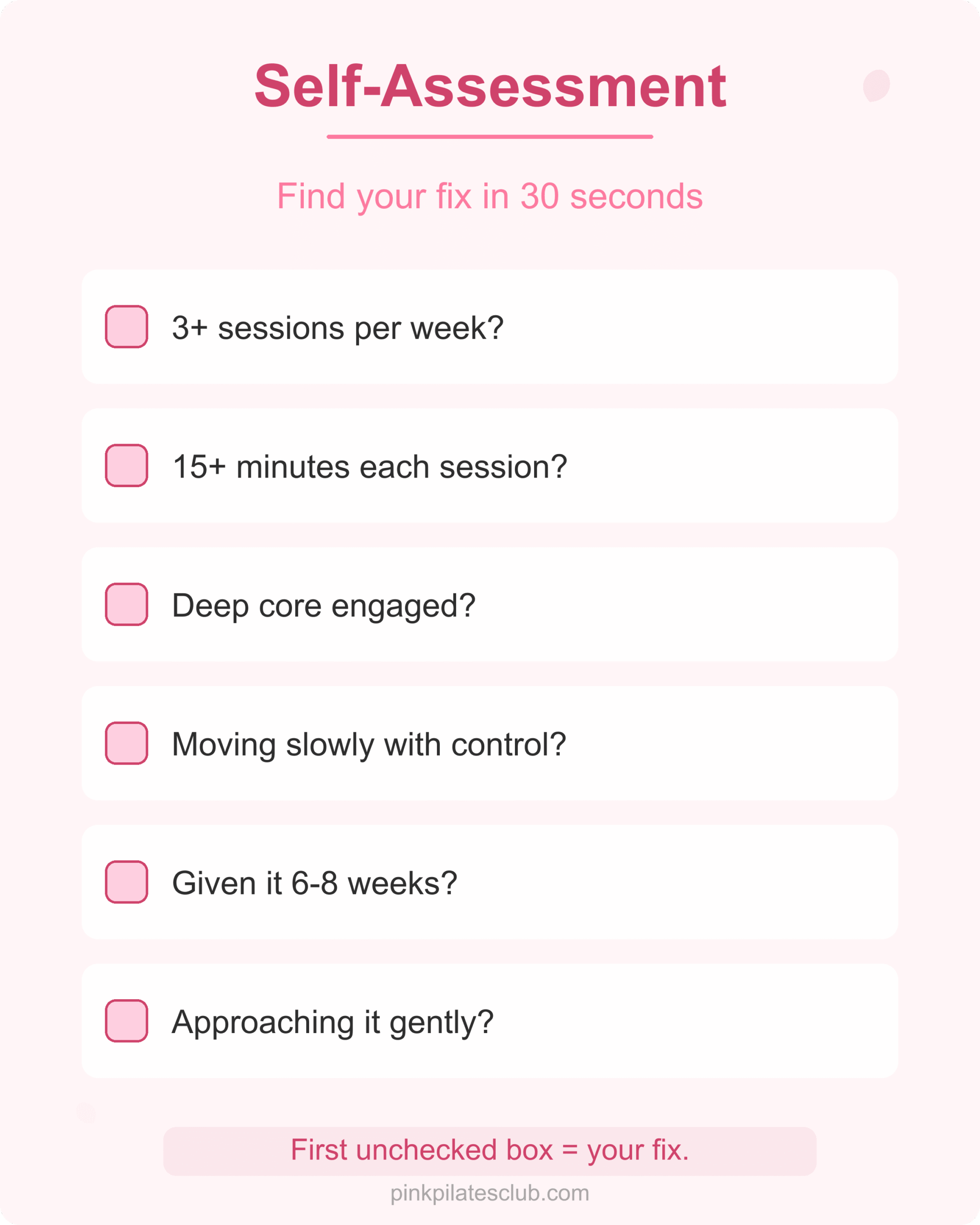
A Quick Self-Assessment: Why Is Pilates Not Working for Me?
Run through this honest checklist. Most women find their answer in one or two of these items:
- Am I practising at least three times per week? (Reason 2)
- Are my sessions at least 15 minutes? (Reason 3)
- Am I engaging my deep core, not just my surface abs? (Reason 1)
- Am I moving slowly with control, or rushing through reps? (Reason 4)
- Have I given it at least six to eight weeks? (Reason 5)
- Am I using the lateral breathing pattern? (Reason 6)
- Am I approaching my practice with softness, or treating it like another stressor? (Reason 7)
If you answered “no” to any of these, that is your fix. You do not need a new programme. You do not need more intensity. You need a small, specific adjustment to what you are already doing. That is the beauty of pilates not working as a problem: the solution is almost always a tweak, not an overhaul.
Frequently Asked Questions
How long does it take to see results from pilates?
Most beginners notice improved posture and body awareness in one to two weeks. Visible muscle tone appears at four to six weeks with consistent practice three to five times per week. Significant body composition changes typically appear by month three.
Why is my stomach not getting flatter with pilates?
The most likely reasons are not activating the deep core muscle (transverse abdominis), not being consistent enough, or having elevated cortisol from chronic stress. Focus on the gentle belly-to-spine engagement before every exercise and practice at least three times per week.
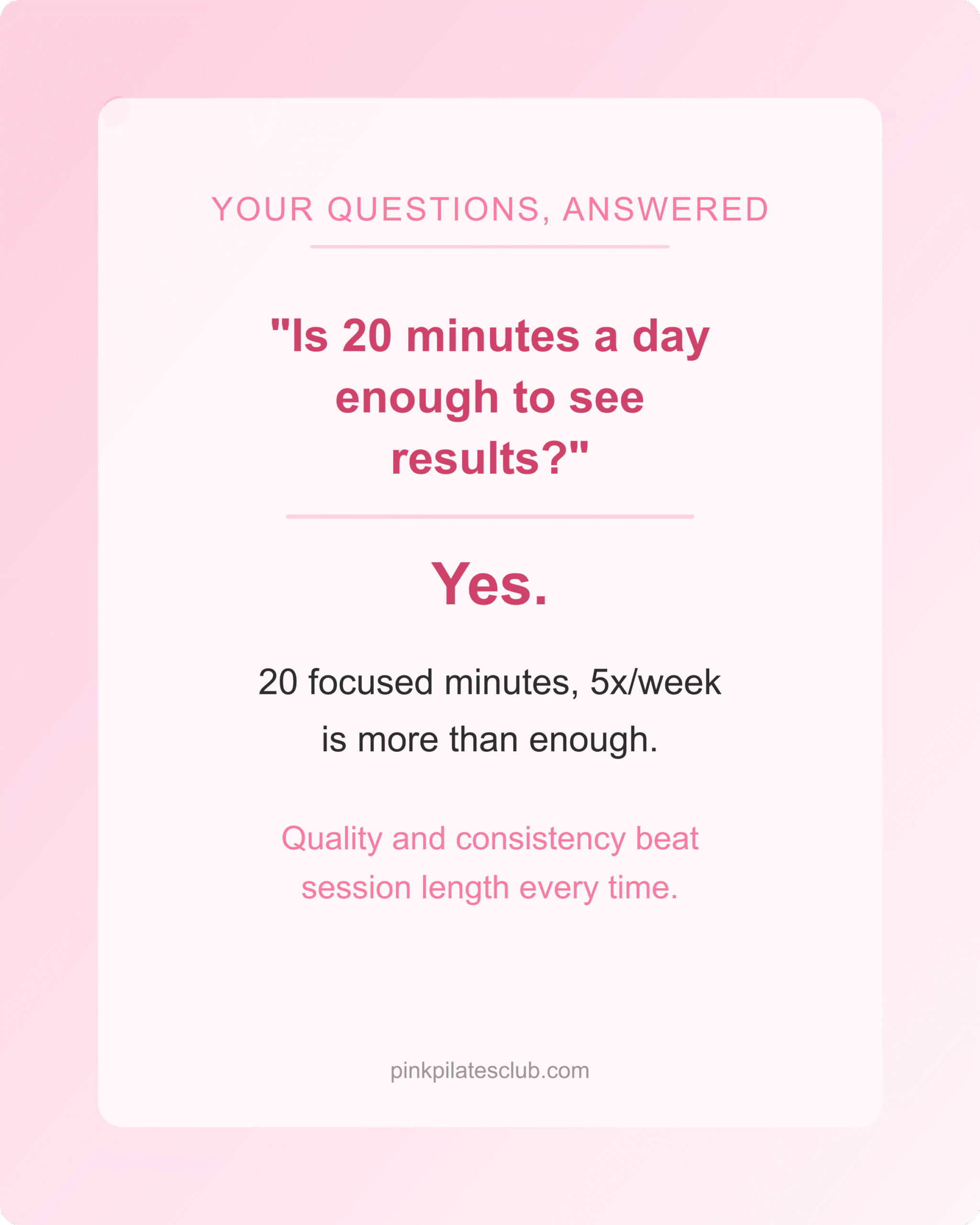
Is 20 minutes of pilates a day enough to see results?
Yes. Twenty minutes of focused, controlled pilates five days a week is more than enough to produce visible toning and strength gains. Quality and consistency matter far more than session length. A focused 20 minutes beats a distracted 60 minutes.
Should I do pilates every day as a beginner?
Start with three to four days per week and include rest days. Your muscles need recovery time to rebuild stronger. After the first month, you can increase to five or six days if your body feels ready. Listen to how you feel the day after a session.
Can pilates alone change your body shape?
Yes. Consistent mat pilates improves posture (which immediately changes how your body looks), builds lean muscle tone, strengthens your core, and supports healthy body composition. For best results, combine it with adequate sleep, hydration, and nourishing food.
Your Next Step
If pilates not working has been your frustration, you now know exactly why. And more importantly, you know it is fixable. Not with more intensity, not with expensive equipment, and not with a completely new programme. Just a small, targeted adjustment to what you are already doing.
The next time you search “pilates not working,” come back to this page and run through the self-assessment. Find your one or two gaps. Fix those. Give it six more weeks. The results will come.
If you need a structured starting point, our beginner pink pilates princess workout is designed with every fix in this article already built in: proper breathing cues, deep core activation prompts, slow controlled pacing, and a gentle approach that works with your nervous system instead of against it. Or read our guide to becoming a pink pilates princess on a budget to build the full lifestyle around your practice.
You do not need to be perfect. You just need to begin again.