You have seen the wall pilates videos. Millions of views. Women pressing their feet into walls, sliding down into squats, and holding bridges with their legs elevated. The comments are split between “this changed my body” and “there is no way this works.” So which is it?
If you are here asking does wall pilates work, you are probably the kind of person who needs more than anecdotal evidence before committing your time and energy. Good. You should be sceptical. The fitness industry is full of trends that promise everything and deliver nothing.
This article gives you the honest, science-backed answer. We look at what research actually says about pilates, core activation, body composition, and the specific benefits of using a wall. The short answer: yes, wall pilates works, but not for everything, and not in the way most viral videos suggest.
First: What “Works” Actually Means
Before evaluating whether wall pilates works, we need to define what “working” means. Different women search this question with different goals in mind.
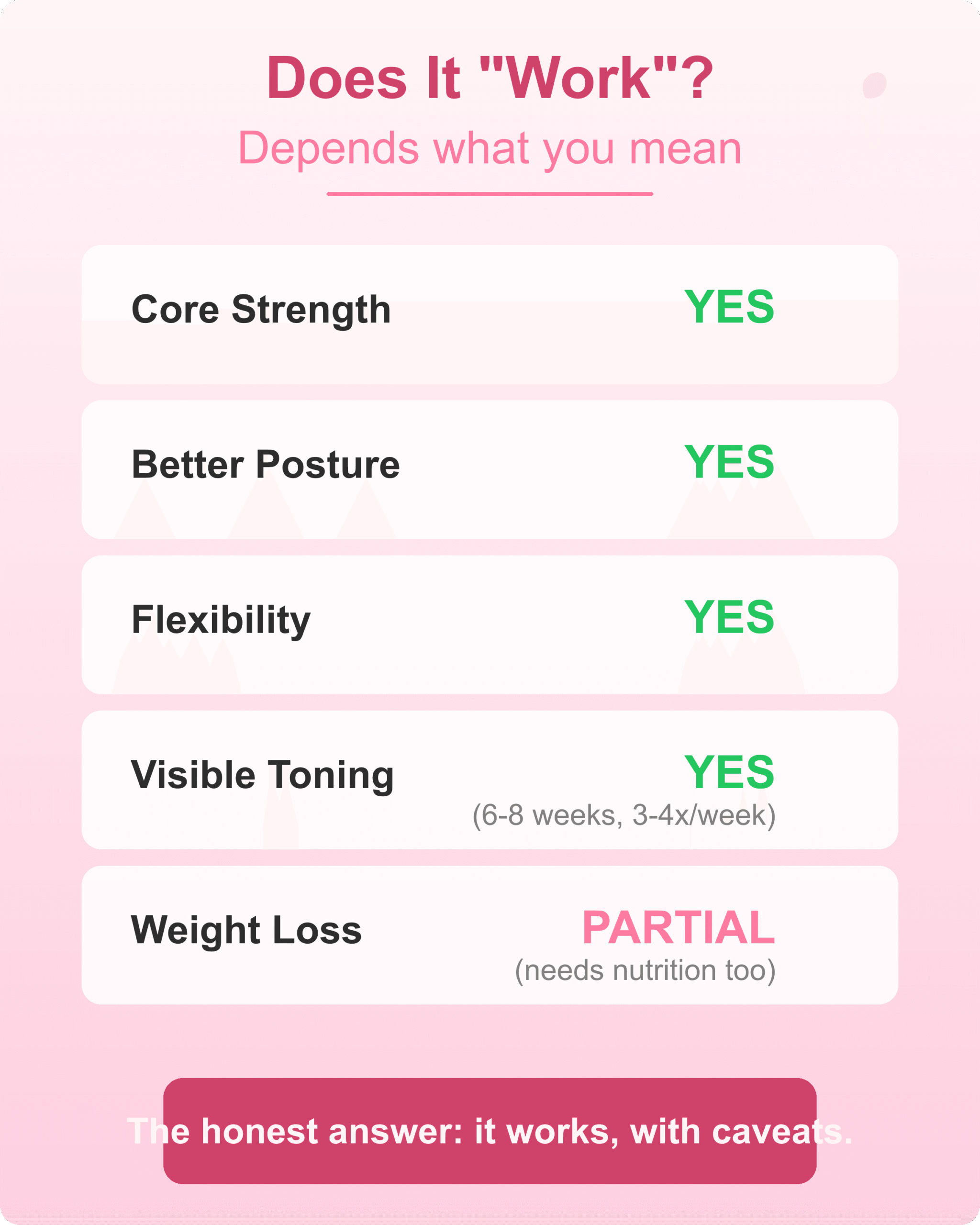
If “Works” Means Core Strength
Wall pilates absolutely works. This is its strongest suit, and the evidence is robust.
If “Works” Means Better Posture
Wall pilates works exceptionally well. The wall itself provides feedback that accelerates postural correction faster than mat-only work.
If “Works” Means Flexibility
Wall pilates works. The wall enables stretches that are difficult to achieve without equipment, particularly for hamstrings and hip flexors.
If “Works” Means Weight Loss
Wall pilates helps, but it is not sufficient on its own. This is the honest part that most viral content leaves out. We will break this down in detail later.
If “Works” Means Visible Toning
Wall pilates works when combined with consistency (three to four sessions per week) and adequate time (six to eight weeks minimum). Our wall pilates before and after timeline shows exactly what to expect at each stage.
The Science Behind Pilates (It Is Solid)
Wall pilates is a variation of traditional pilates, so the broader pilates research base applies directly. And that research base is extensive.
Core Strength and Activation
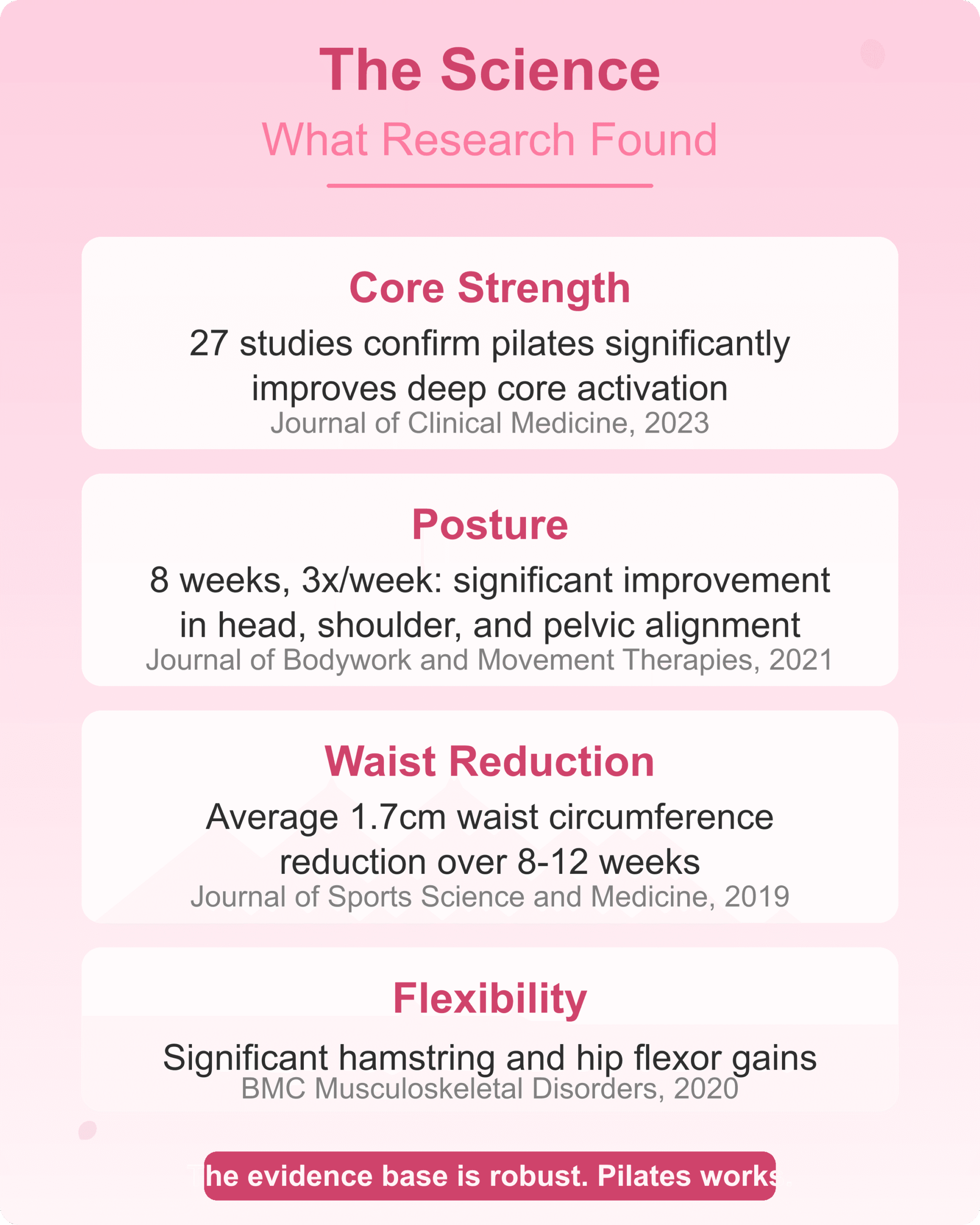
A 2023 systematic review published in the Journal of Clinical Medicine analysed 27 studies on pilates and core strength. The conclusion: pilates significantly improves deep core muscle activation, particularly the transverse abdominis and multifidus (the deep spinal stabilisers). These are the muscles that flatten your midsection, support your spine, and improve your posture.
The transverse abdominis is the key. Unlike crunches that target the surface rectus abdominis, pilates trains this deep corset-like muscle to engage automatically. When it strengthens, it pulls your midsection inward, creating a flatter, more toned appearance without the bloated look that aggressive ab training can produce.
Posture Improvement
A 2021 study in the Journal of Bodywork and Movement Therapies found that 8 weeks of pilates practice (three sessions per week) produced significant improvements in forward head posture, rounded shoulders, and pelvic tilt. These are the three postural issues that make people look heavier, shorter, and less toned than they actually are.
Wall pilates has an additional advantage here. The wall provides a physical reference point for spinal alignment that you cannot get from mat work alone. When you stand with your back against a wall, you can feel exactly where your spine deviates from neutral. This biofeedback accelerates the postural learning process.
Waist Circumference Reduction
A 2019 meta-analysis in the Journal of Sports Science and Medicine found that pilates practitioners experienced an average 1.7cm reduction in waist circumference over 8 to 12 weeks. This reduction came from a combination of deep core muscle toning (pulling the waist inward), reduced abdominal bloating, and improved posture (which changes how the midsection sits).
Important context: this waist reduction was not primarily from fat loss. It was from muscular and postural changes. This is why women often report looking dramatically different while the scale barely moves.
Flexibility and Range of Motion
A 2020 systematic review in BMC Musculoskeletal Disorders confirmed that pilates significantly improves hamstring flexibility, hip flexor length, and spinal mobility. Wall pilates adds to this by allowing gravity-assisted stretches: when your legs are up the wall, gravity gently deepens hamstring and hip flexor stretches beyond what you could achieve on a mat alone.
What the Wall Specifically Adds
Pilates works. But what does the wall add that you would not get from regular mat pilates?
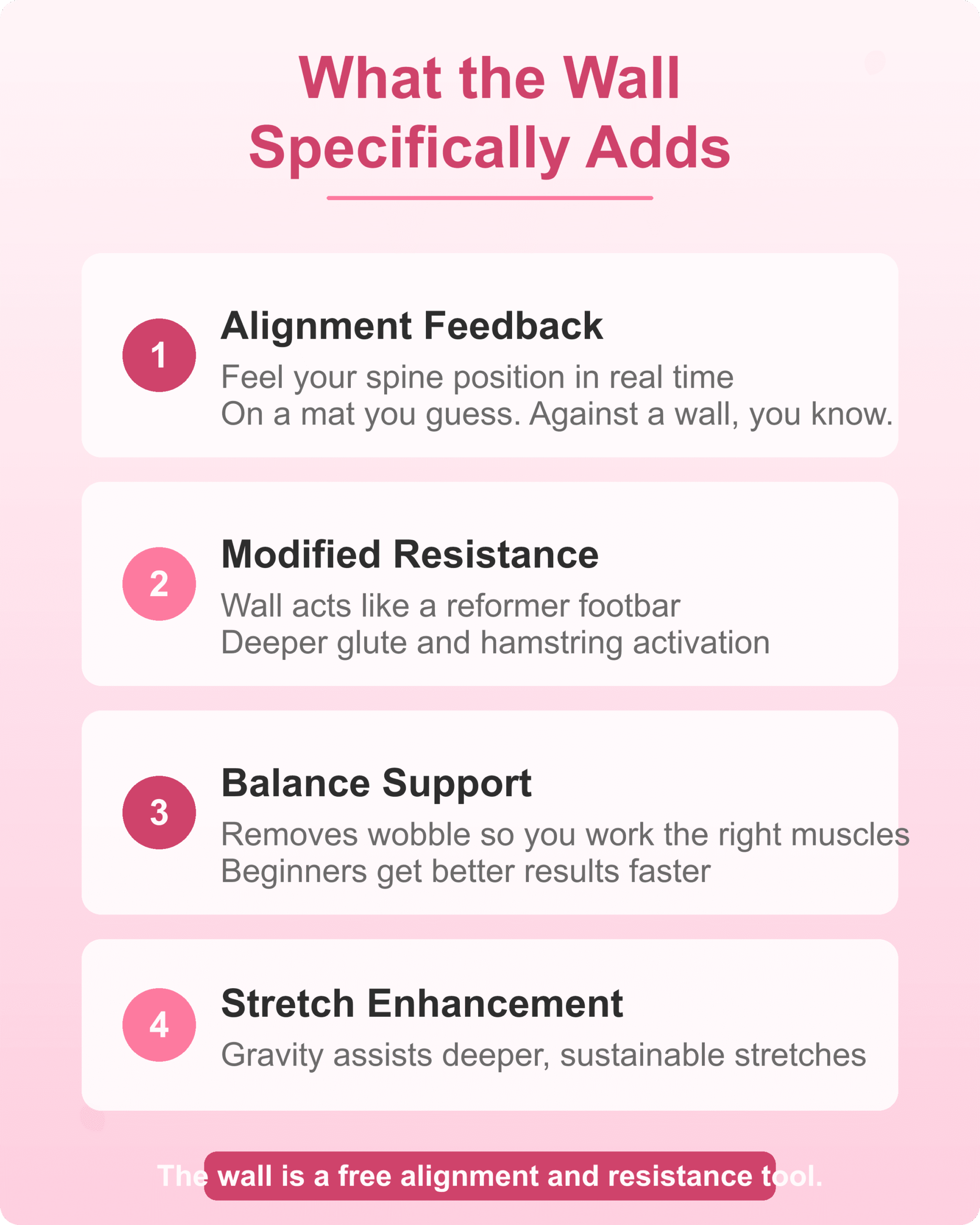
1. Alignment Feedback
The wall is an alignment tool. When your back is pressed against it, you can feel whether your lower back is arching (common beginner mistake), whether your ribs are flaring, and whether your pelvis is tilted. This feedback is invaluable for beginners who have not yet developed the body awareness to self-correct. On a mat, you are guessing. Against a wall, you know.
2. Modified Resistance
Pressing your feet into a wall during bridges and marching exercises creates a stable resistance surface, similar to a reformer footbar. This allows you to engage your glutes, hamstrings, and core against something solid, which produces a different (and often deeper) muscle activation pattern than mat-only versions of the same exercises.
3. Balance Support
Many beginner pilates exercises are challenging not because the muscles are weak, but because the balance requirement is too high. The wall removes the balance variable so you can focus entirely on the target muscles. This means beginners get better results faster because they are actually working the right muscles instead of compensating for wobbliness.
4. Stretch Enhancement
Putting your legs up the wall allows gravity to assist with stretches. Wall-supported hamstring stretches, hip opener stretches, and spinal decompression positions are more effective and more sustainable than floor-only alternatives, particularly for people with tight muscles who cannot reach their toes.
If you want to experience these benefits firsthand, our wall pilates beginner guide has 10 foundational exercises with full instructions.
Where Wall Pilates Falls Short (The Honest Part)
No exercise modality does everything. Here is where wall pilates has genuine limitations.
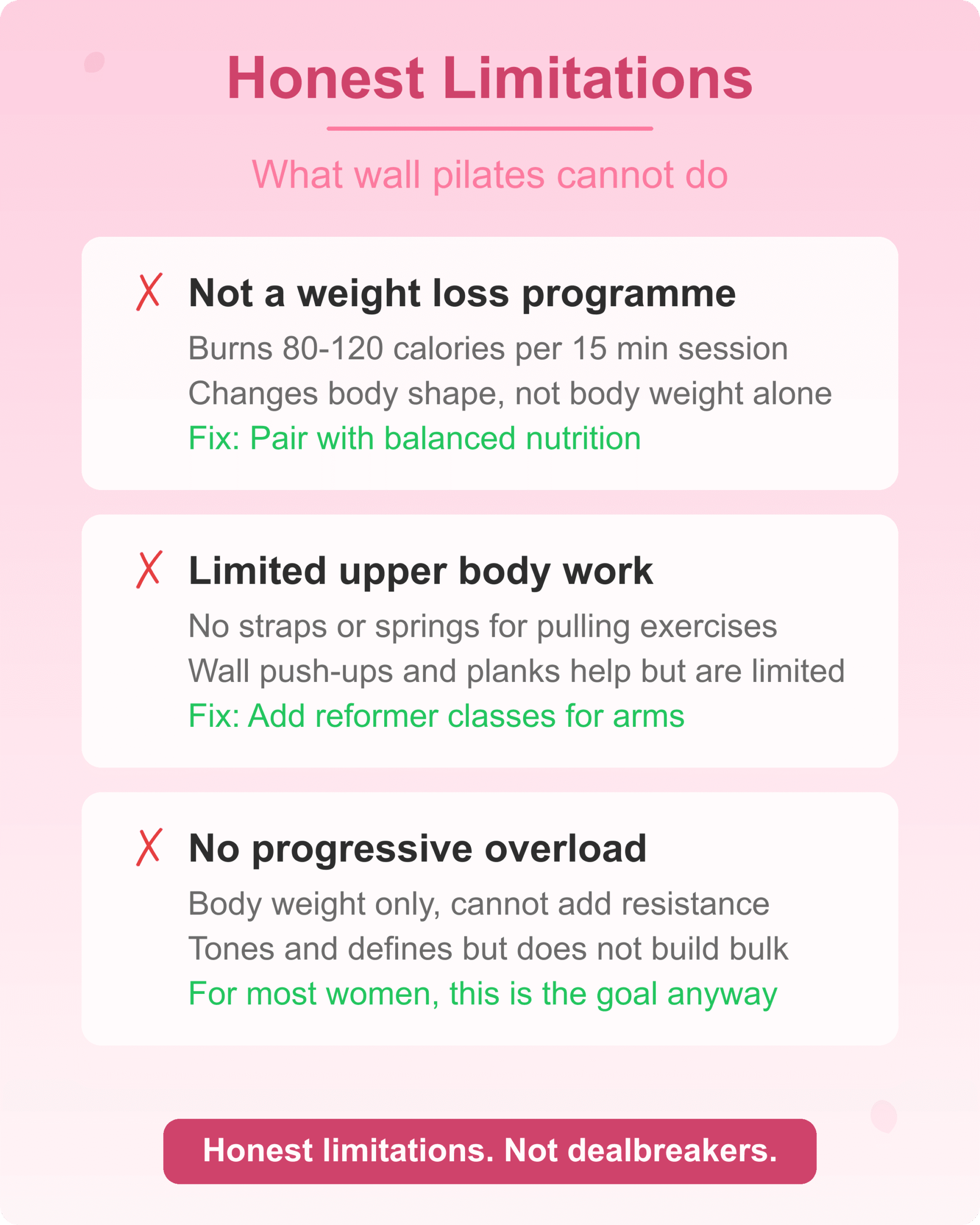
It Is Not a Weight Loss Programme
A 15-minute wall pilates session burns roughly 80 to 120 calories. That is meaningful for muscle building and body composition, but it is not enough to create a significant caloric deficit for weight loss on its own. For context, you would need to eliminate or burn roughly 500 calories per day beyond your intake to lose about half a kilogram per week.
Wall pilates changes how your body looks (more toned, better posture, flatter midsection) and how it functions (stronger, more flexible, less pain). But if your primary goal is losing 10+ kilograms, you need to pair wall pilates with nutritional changes. The pilates handles the body composition and shape; nutrition handles the fat loss.
It Has Less Upper Body Challenge Than Reformer
Wall pilates excels at core, lower body, and postural work. It is more limited for upper body strengthening because you do not have straps or springs to pull against. Wall push-ups and planks help, but they do not match the variety of upper body exercises available on a reformer. For a full comparison, our reformer vs mat pilates guide breaks down where each form excels.
It Cannot Replace Progressive Overload for Muscle Building
Wall pilates uses your body weight as resistance. Once your muscles adapt to that resistance, progress requires increasing reps, hold times, or exercise complexity rather than adding weight. This means wall pilates will tone and define your muscles, but it will not build significant muscle mass the way weighted exercises would. For most women, this is actually the desired outcome: lean and toned, not bulky.
Who Gets the Best Results from Wall Pilates?
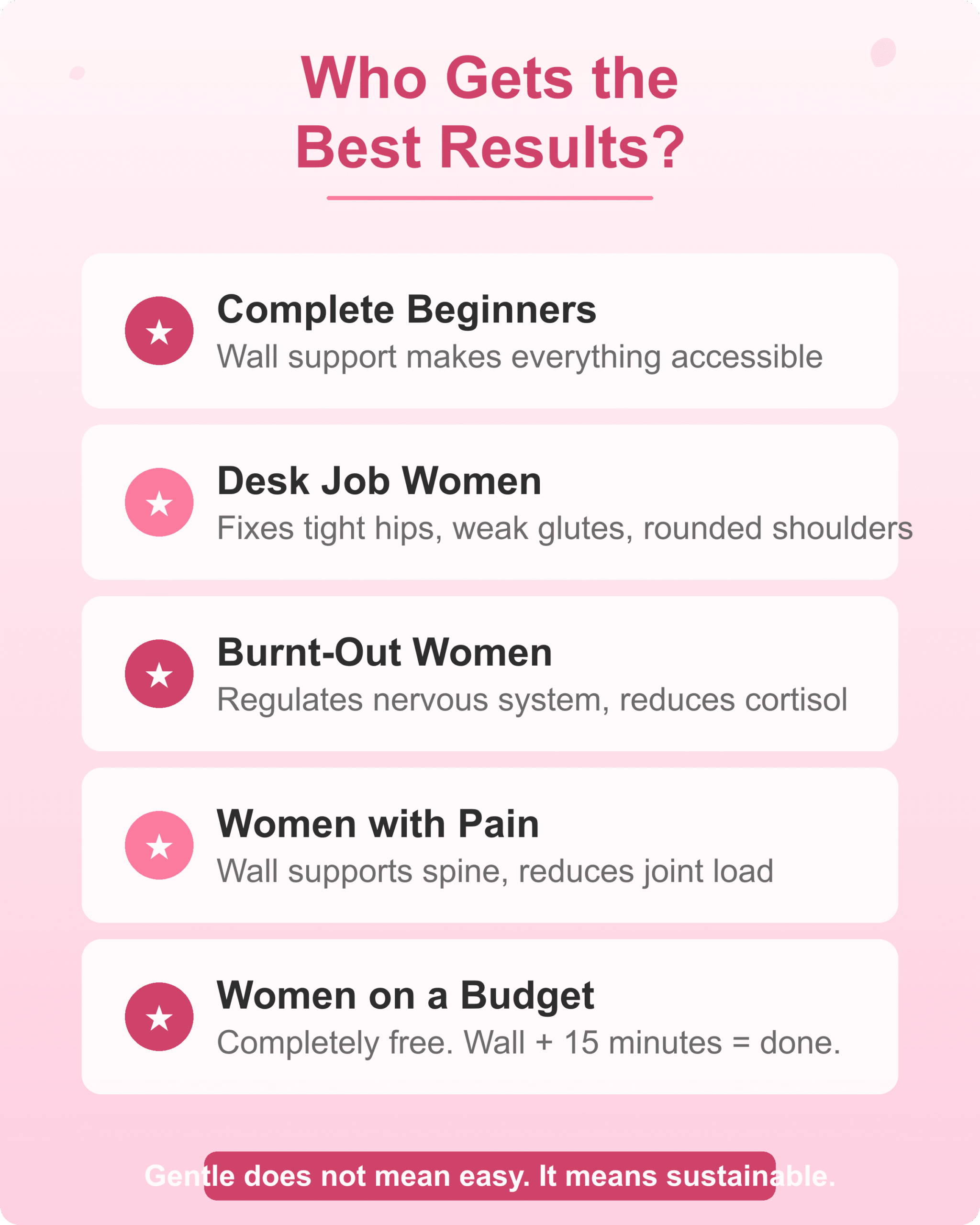
Wall pilates is not for everyone, but it is remarkably effective for specific groups.
Complete Beginners
The wall support makes exercises more accessible and the feedback improves form from day one. If you have never done pilates, wall pilates is arguably the best starting point.
Women with Desk Jobs
If you sit for 8+ hours a day, wall pilates directly addresses the damage that sitting causes: tight hip flexors, weak glutes, rounded shoulders, and a dormant core. The postural benefits are particularly impactful for women who spend their days at a desk.
Women Recovering from Burnout
If intense workouts leave you feeling depleted rather than energised, wall pilates offers nervous system regulation alongside physical strengthening. The controlled breathing and gentle movement patterns reduce cortisol (the stress hormone) rather than spiking it. This is the core philosophy behind our approach: gentle pilates outperforms intense workouts for women dealing with chronic stress.
Women with Back or Joint Pain
The wall provides spinal support during exercises, reducing load on painful joints. Wall pilates is used in rehabilitation settings for exactly this reason. Our pilates for lower back pain guide has specific exercises and modifications.
Women on a Budget
Wall pilates costs nothing. No equipment, no subscription, no gym. If you have a wall and 15 minutes, you have everything you need. Our pink pilates on a budget guide has more strategies for making wellness affordable.
The Verdict: Does Wall Pilates Work?
Based on the available research and the real-world results of consistent practitioners:
- For core strength: Yes. Strongly supported by research. Deep core activation improves significantly within 4 to 6 weeks.
- For posture: Yes. The wall provides alignment feedback that accelerates postural correction. Visible improvement within 3 to 4 weeks.
- For waist reduction: Yes. Average 1.7cm reduction over 8 to 12 weeks from muscle toning and postural changes (not fat loss alone).
- For flexibility: Yes. Wall-assisted stretches improve hamstring and hip flexor flexibility faster than mat-only work.
- For weight loss: Partially. Wall pilates improves body composition and shape, but significant weight loss requires nutritional changes alongside the practice.
- For mental health: Yes. Controlled breathing and focused movement measurably reduce cortisol and anxiety levels.
Wall pilates is not a miracle workout. It will not give you a six-pack in two weeks or make you lose 10 kilograms in a month. What it will do is strengthen your core, fix your posture, reduce bloating, tone your body, and improve your relationship with movement, all for free, all from your living room, all in 15 minutes a day.
If you have been burned out on intense workouts that leave you exhausted and seeing no results, wall pilates might be exactly the approach your body has been asking for. Sometimes the gentlest path is the one that actually gets you where you want to go.
Frequently Asked Questions
How long does it take for wall pilates to show results?
Reduced bloating appears within 1 to 2 weeks. Posture improvement is visible at weeks 3 to 4. Core definition and body shape changes emerge between weeks 6 and 8. Full body composition shift happens around weeks 10 to 12 with three to four sessions per week.
Is wall pilates better than regular pilates?
Neither is better. Wall pilates adds alignment feedback and balance support that mat pilates lacks, making it ideal for beginners. Mat pilates offers a deeper core challenge because there is no wall to assist. Both produce real results. Many women combine both.
Can wall pilates replace going to the gym?
For core strength, flexibility, posture, and general toning, yes. For heavy muscle building or high-intensity cardiovascular conditioning, no. Wall pilates is a complete practice for women whose goals are a lean, toned body with functional strength and good posture.
Is 15 minutes of wall pilates enough?
Yes. Fifteen minutes of focused, controlled wall pilates three to four times per week produces measurable results. The quality of movement matters more than duration. Slow, precise exercises with proper breathing activate more muscle fibres than 30 minutes of rushed, sloppy work.
Why do some people say wall pilates does not work?
Usually because of unrealistic expectations (expecting weight loss without dietary changes), insufficient time (quitting before week 6 when visible changes appear), or inconsistency (doing it sporadically rather than three to four times per week). Wall pilates works. Impatience and inconsistency do not.
Your Next Step
Does wall pilates work? The science says yes. The real-world results say yes. The only variable is you: whether you show up consistently enough, for long enough, to let the results appear.
If you are ready to start, our wall pilates beginner guide gives you 10 exercises and a free 15-minute routine. If you want a structured 4-week programme, our free 28-day wall pilates challenge maps out every single day.
For women who want to combine wall pilates with nutrition for accelerated results, the Pink Pilates Starter Kit gives you the structured foundation, and the Anti-Inflammatory Reset pairs gentle movement with a 14-day meal plan designed to reduce bloating and support body composition change.
You do not need to believe it will work. You just need to try it for six weeks. The results will speak for themselves.