
You have been thinking about starting pilates. You have watched the videos, saved the pins, maybe even bought a pink mat. But then you see the reformer content: sleek machines, smooth gliding movements, studios that look like spas. And the question creeps in: “Am I going to miss out on real results if I just do mat pilates at home?”
Let us settle the mat pilates vs reformer results debate once and for all. The short answer: no, you are not missing out. Mat pilates delivers the same foundational results as reformer work. In some ways, it is actually harder and more effective for building core strength. And you can do it in your living room for the cost of a yoga mat.
This guide breaks down exactly what each method does, where they overlap, where they differ, and why mat pilates is the smarter starting point for most women. No bias toward either method. Just the science and the practical reality of what works.
What Is Mat Pilates vs Reformer Pilates?
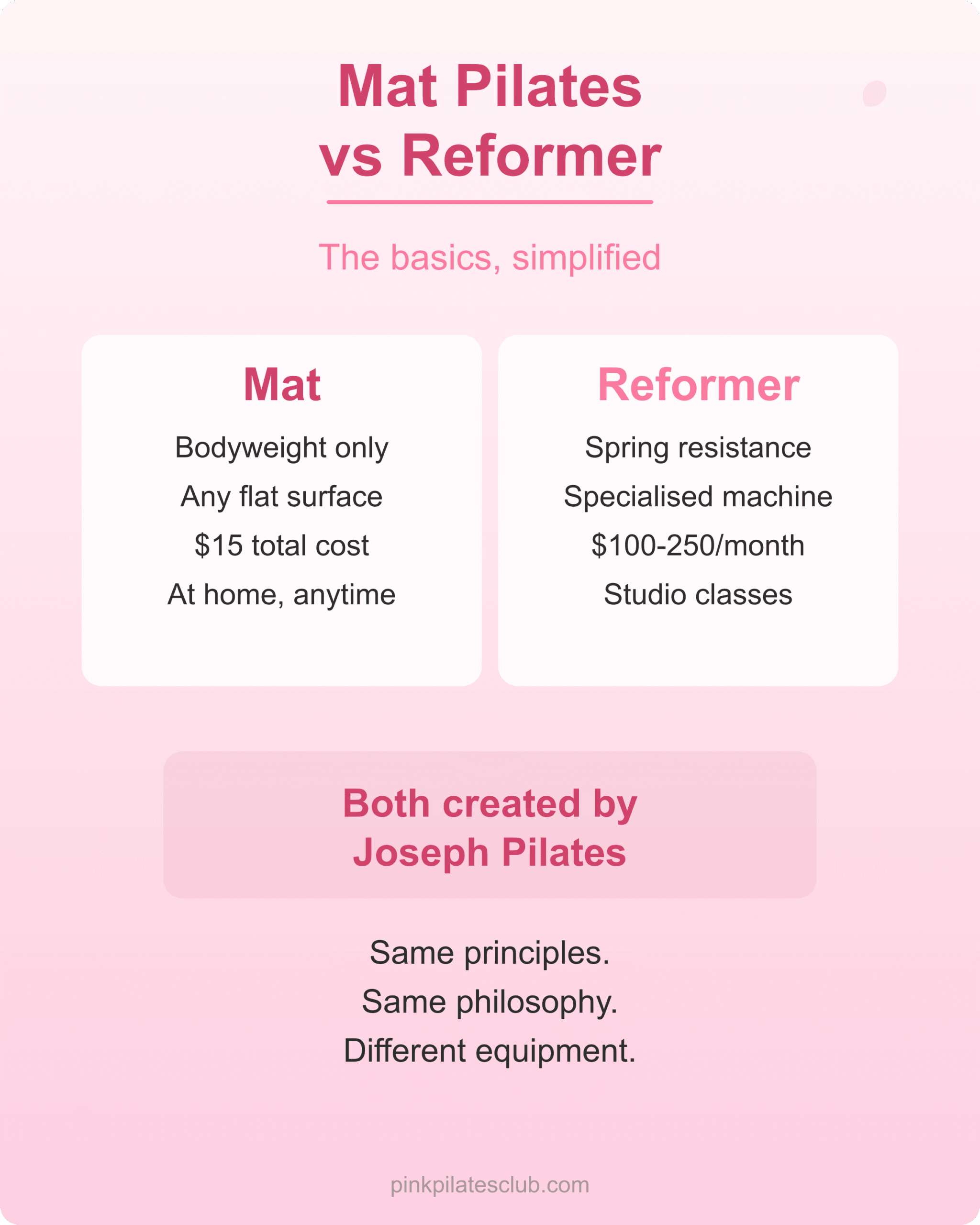
Before we compare results, let us make sure we are talking about the same thing. Both methods were created by Joseph Pilates, but they use different equipment and environments.
Mat Pilates Explained
Mat pilates is performed on a flat mat using only your bodyweight for resistance. Every exercise relies on gravity and your own muscle control. There is no machine assisting or guiding your movement, which means your stabilising muscles have to work harder on every single rep.
Mat pilates can be done anywhere: at home, in a park, in a hotel room. The only equipment needed is a mat. Optional additions include resistance bands, small balls, and magic circles, but none are required.
Reformer Pilates Explained
Reformer pilates uses a specialised machine: a sliding carriage attached to springs of varying resistance. The springs assist or resist your movements, and the carriage glides along a track. This creates a unique feeling of smooth, supported movement.
Reformer classes typically happen in studios and cost $25 to $50 per class, or $100 to $250 per month for unlimited memberships. Home reformer machines range from $300 for basic models to $3,000+ for premium options like Balanced Body or Merrithew.
Mat Pilates vs Reformer Results: The Honest Comparison
Here is where most articles online get it wrong. They either claim reformer is dramatically better (usually written by studios selling memberships) or that mat is identical (usually written by people selling home programmes). The truth is more nuanced.
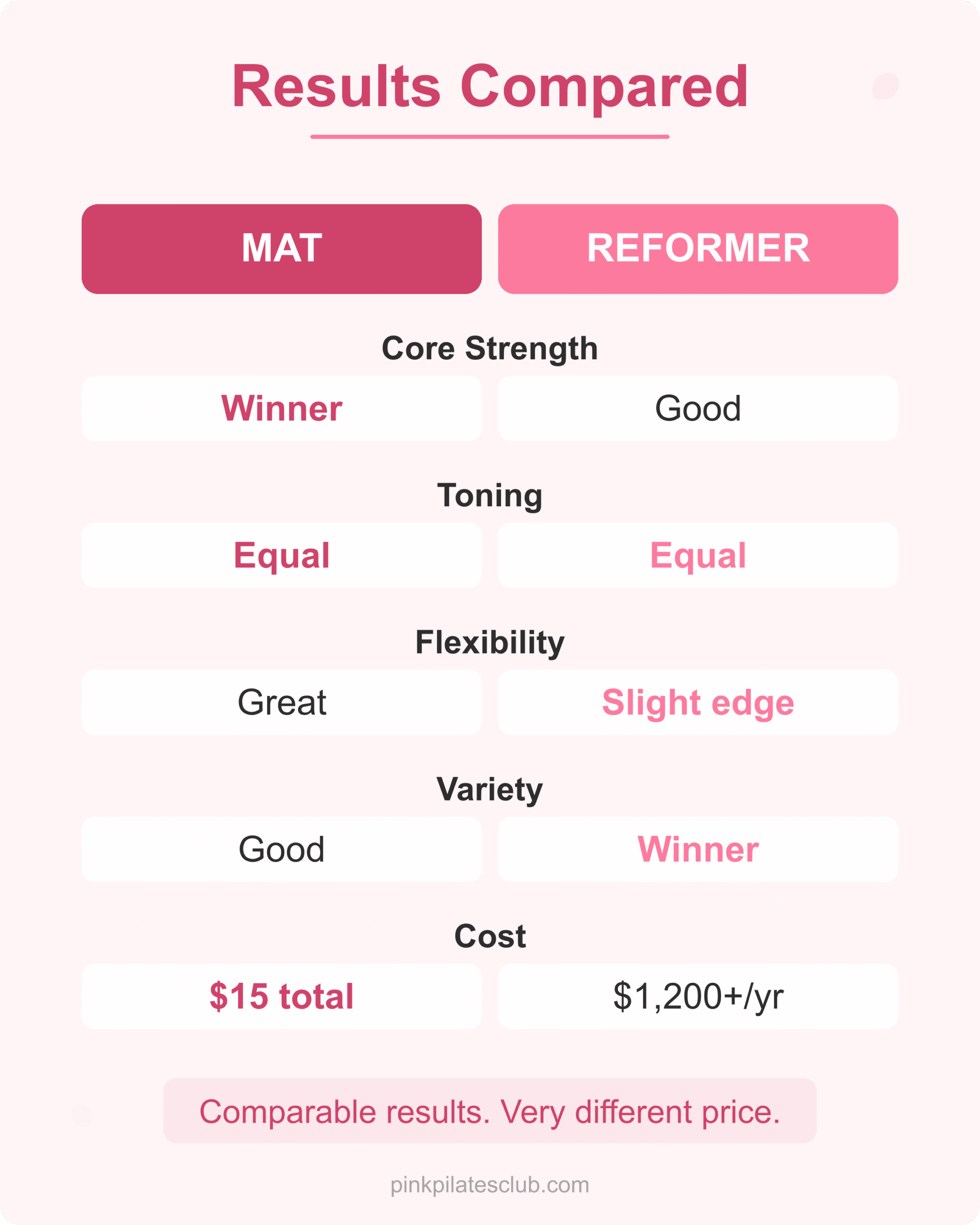
Core Strength
Winner: Mat pilates.
This surprises most people, but mat pilates actually builds deeper core strength than reformer work. The reason is simple: on a mat, your body is the only resistance. There is no machine helping you stabilise. Your transverse abdominis, obliques, and deep spinal muscles have to do all the work themselves.
On a reformer, the springs and carriage provide partial support. This makes movements feel smoother, but it also means your stabilising muscles get less of a challenge. Research published in the ACSM Health and Fitness Journal confirms that both methods improve core strength, with mat pilates showing equal or greater activation of deep core muscles.
Overall Toning and Body Composition
Winner: Tie.
Both mat and reformer pilates improve muscle tone and body composition when practised consistently. The toning effect comes from the principles of pilates itself, which are controlled movements, eccentric muscle loading, and high repetition, not from the specific equipment used.
A study in the Journal of Bodywork and Movement Therapies found that both mat and equipment-based pilates produced significant improvements in body composition, flexibility, and muscular endurance over an eight-week programme. The results were comparable between groups.
Flexibility and Mobility
Winner: Slight edge to reformer.
The reformer’s sliding carriage allows for a greater range of motion in certain stretches, particularly for the hamstrings, hip flexors, and spine. The springs provide gentle assistance that can help you reach deeper into a stretch safely.
That said, mat pilates with proper stretching sequences also dramatically improves flexibility. The difference is modest, not dramatic. And you can close the gap entirely by adding a few minutes of dedicated stretching to your mat routine.
Variety and Progression
Winner: Reformer.
The reformer offers hundreds of exercise variations thanks to different spring settings, strap positions, and carriage movements. This variety can keep workouts interesting and provide more options for progression as you advance.
Mat pilates has fewer total exercise variations, but this is not necessarily a disadvantage. For beginners, a focused set of foundational moves practised consistently produces better results than jumping between dozens of different exercises. Mastery of the basics is more valuable than variety for its own sake.
Injury Rehabilitation
Winner: Reformer (for specific conditions).
The reformer’s spring assistance makes it excellent for rehabilitation. The machine can reduce bodyweight load during movements, which is valuable for people recovering from injuries, surgery, or managing conditions like osteoporosis. Many physical therapists use reformer pilates as part of treatment plans.
For general fitness and prevention, mat pilates is equally safe and effective. If you are healthy and starting from scratch, you do not need a reformer for safety reasons.
The Real-World Factor: Consistency Wins Everything
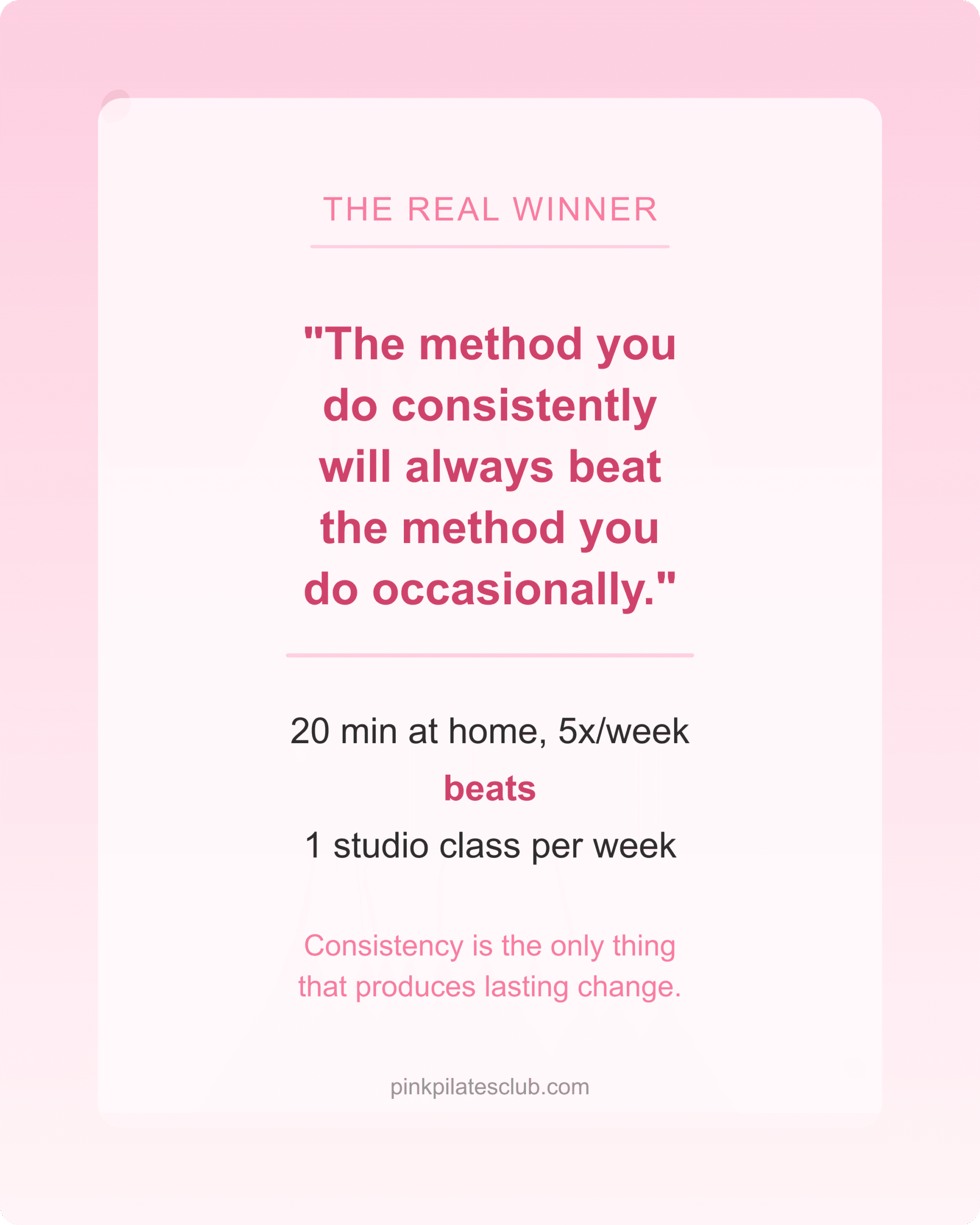
Here is the factor that matters more than any comparison chart: the method you do consistently will always beat the method you do occasionally.
A woman who does 20 minutes of mat pilates at home five days a week will see dramatically better mat pilates vs reformer results than a woman who attends one reformer class per week because that is all her schedule and budget allow.
Consistency is the single biggest predictor of pilates results. And consistency is dramatically easier when your workout is free, requires no travel, fits into any time slot, and can be done in your pyjamas if that is the kind of morning you are having.
This is exactly why the pink pilates princess beginner workout is designed as a 15-minute at-home mat routine. Not because mat is inherently superior in every way, but because it removes every barrier to showing up consistently.
The Cost Comparison: Mat vs Reformer
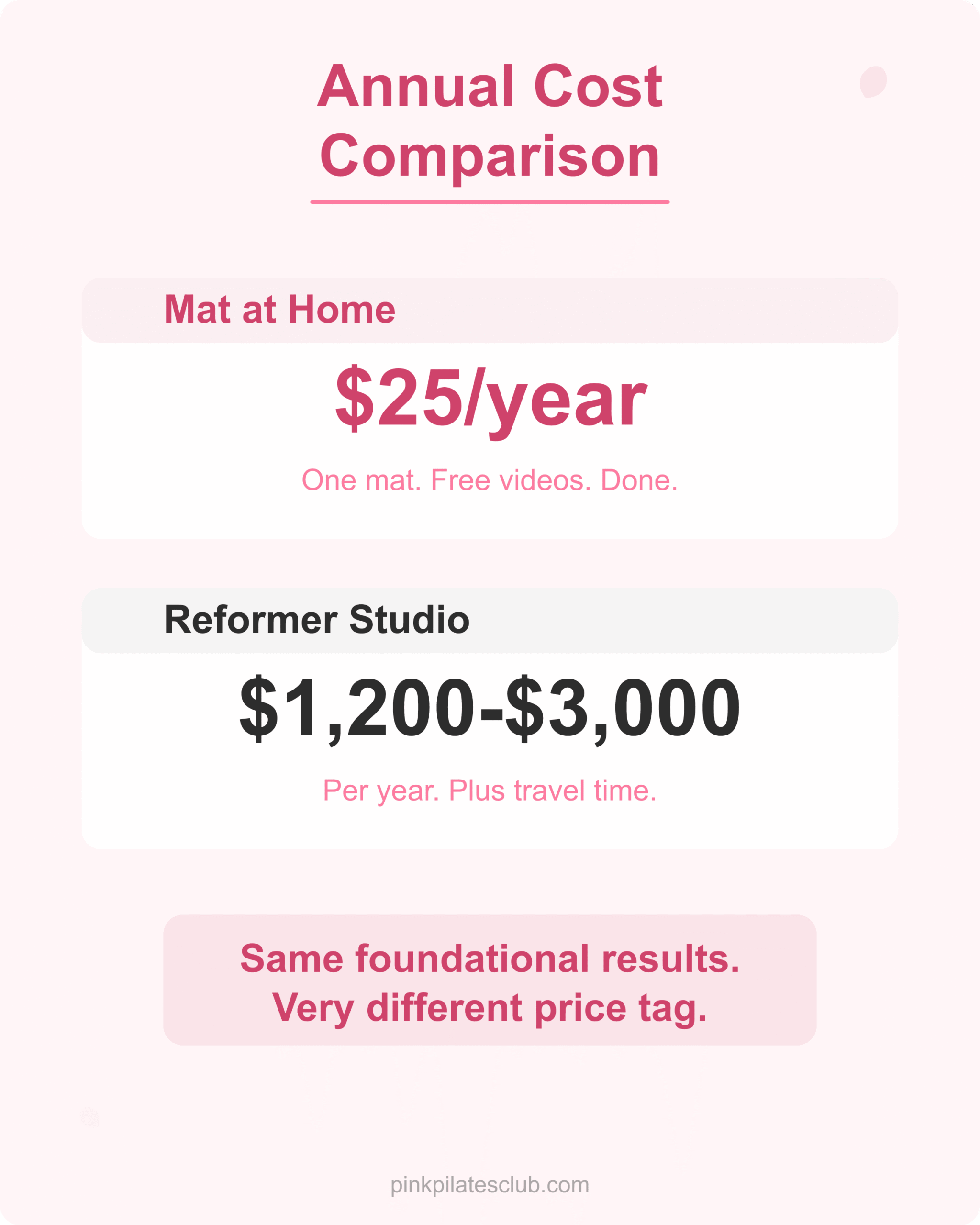
The financial difference between mat and reformer pilates is substantial. Here is what each path actually costs:
Mat Pilates at Home
- Yoga mat: $15 to $25 (one-time purchase)
- Workouts: $0 (free YouTube videos, or our free beginner guide)
- Monthly cost: $0
- Annual cost: $15 to $25 total
Reformer at a Studio
- Unlimited monthly membership: $100 to $250
- Drop-in class: $25 to $50 per session
- Annual cost: $1,200 to $3,000
- Plus travel time, scheduling constraints, and potential childcare costs
Home Reformer
- Machine: $300 to $3,000+ (one-time, but large)
- Space required: a dedicated area roughly 3m x 1m
- Maintenance and accessories: ongoing costs for spring replacements and add-ons
The mat pilates vs reformer results question takes on a different tone when you realise that a year of mat pilates costs less than a single month of studio reformer classes. And the results, as we have seen, are comparable for beginners.
For a full breakdown of budget-friendly pilates gear, read our guide to becoming a pink pilates princess on a budget.
Who Should Choose Mat Pilates
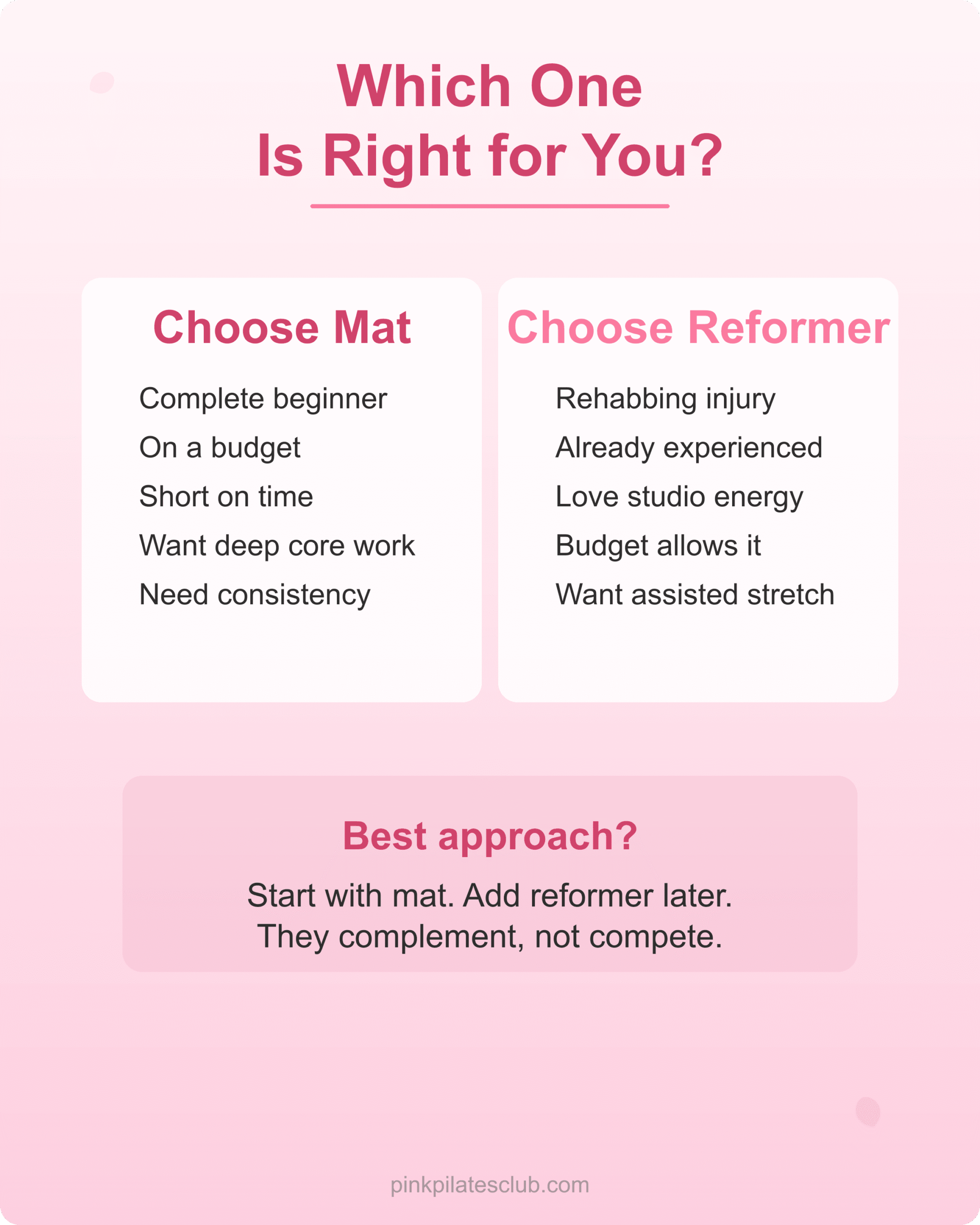
Mat pilates is the better choice if you are:
- A complete beginner who wants to build foundational strength before adding equipment
- On a budget and cannot afford studio memberships or a home reformer
- Short on time and need a workout that fits into 15 to 20 minutes at home
- Seeking deep core work as your primary goal, since mat work activates stabilising muscles more intensely
- Wanting consistency without scheduling, commuting, or financial barriers
Who Should Choose Reformer Pilates
Reformer pilates might be a better fit if you are:
- Rehabilitating a specific injury under professional guidance
- Already experienced with mat pilates and want more variety and challenge
- Motivated by the studio environment and group energy
- Budget is not a constraint and you enjoy the premium experience
- Looking for assisted stretching that the spring system provides
The best approach for many women is to start with mat, build a consistent home practice, and add reformer classes later as a supplement if budget and schedule allow. They are complementary, not competing. You do not have to choose one forever.
How to Get the Best Results from Mat Pilates at Home
If you are going the mat route (and we think most beginners should), here is how to maximise your results:
- Be consistent: three to five sessions per week beats one long session. Fifteen minutes daily is more effective than one 60-minute class on Saturday
- Focus on form: slow, controlled movements with proper alignment produce better results than rushing through reps. Quality over quantity, always
- Progress gradually: start with beginner moves for the first month. Add intermediate exercises in month two. Your body adapts, and your practice should evolve with it
- Build a routine: anchor your practice to a daily ritual. Our pink pilates princess morning routine shows you how to make mat pilates the centrepiece of a sustainable daily habit
One additional tip that most guides overlook: track your progress with a simple journal or notes app. Write down which moves felt easy, which felt challenging, and how your body felt afterwards. After four weeks, you will have concrete evidence of improvement that keeps you motivated far better than any before-and-after photo.
The women who get the best mat pilates vs reformer results at home are not the ones with the fanciest setup. They are the ones who show up consistently, move with intention, and trust the process. The results are coming. Your job is to keep showing up.
Frequently Asked Questions
Is mat pilates as effective as reformer pilates?
For core strength and overall toning, yes. Research shows comparable results between mat and reformer pilates for body composition and muscular endurance. Mat pilates actually activates deep core stabilising muscles more intensely because there is no machine assistance.
Can you get toned from mat pilates alone?
Absolutely. Consistent mat pilates three to five times per week produces visible toning within four to six weeks. The controlled, bodyweight-only movements build lean muscle definition, especially through the core, glutes, and legs.
Why is reformer pilates so much more expensive?
Reformer classes require specialised machines ($3,000 to $10,000 each), dedicated studio space, and trained instructors certified in equipment-based pilates. These overhead costs are passed to clients. Mat pilates requires only floor space and a mat, keeping costs minimal.
Should beginners start with mat or reformer?
Most pilates professionals recommend starting with mat. It builds foundational body awareness, core control, and proper breathing patterns without machine assistance. These fundamentals transfer directly to reformer work if you choose to try it later.
How long until you see results from mat pilates?
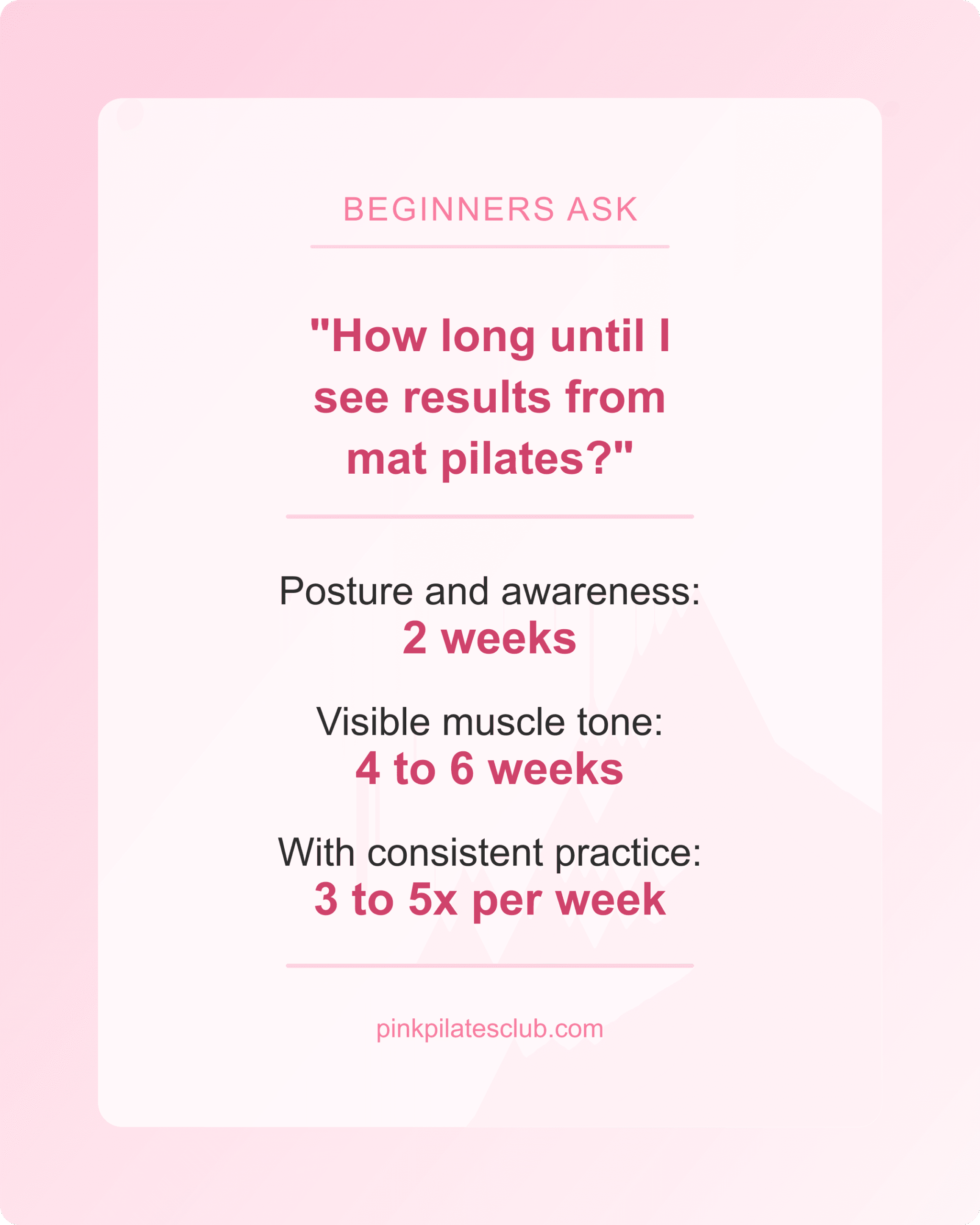
Most beginners notice improved posture and core awareness within two weeks. Visible muscle tone appears at four to six weeks with consistent practice. The famous Joseph Pilates quote applies: “In 10 sessions you will feel the difference, in 20 you will see the difference.”
Your Next Step
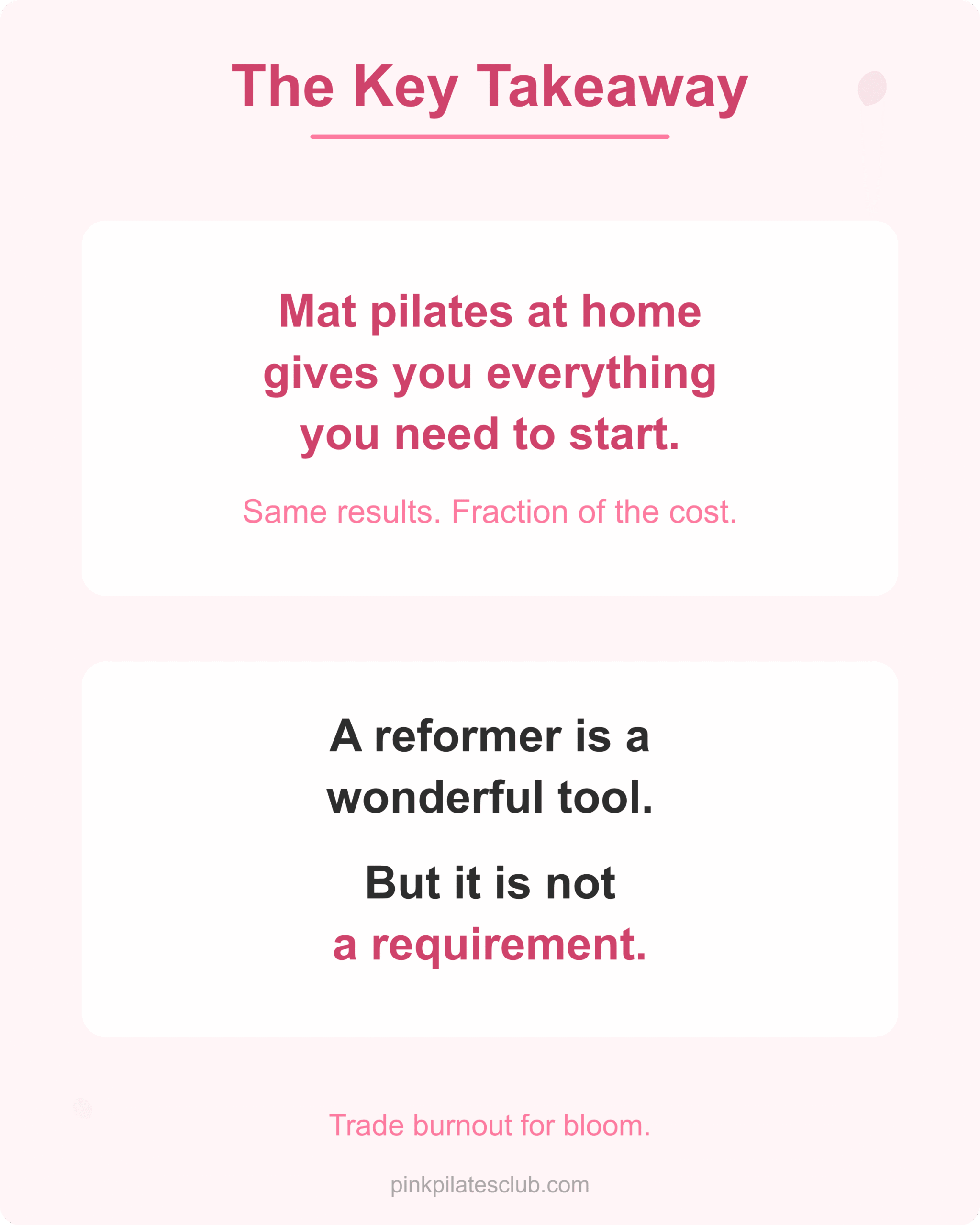
The mat pilates vs reformer results debate has a clear answer for most women: mat pilates at home gives you everything you need to build real strength, improve your posture, and create the toned, lean body you are after. And it does it for the price of a yoga mat, on your schedule, in your own space.
A reformer is a wonderful tool. But it is not a requirement. And waiting until you can afford one, or find a studio, or clear your schedule for a class, means waiting to start. Your body does not need you to wait. It needs you to move.
The truth about mat pilates vs reformer results comes down to this: the best equipment is the one that gets you moving consistently. For most women, that is a mat on the floor and 15 minutes of intentional movement.
Ready to start? Our beginner pink pilates princess workout gives you a complete 15-minute mat routine. Or explore what the pink pilates princess lifestyle is all about to understand the full philosophy behind the movement.
You do not need to be perfect. You just need to begin.