You have decided to start pilates at home. You have the routine, the motivation, and the living room floor space. But after one session on a thin yoga mat (or worse, bare carpet), your spine is bruised, your tailbone aches, and your knees are not speaking to you. A good mat is the one piece of equipment that genuinely makes a difference for home pilates, and choosing the wrong one can sabotage your practice before it starts.
The best pilates mat in 2026 is not the most expensive one. It is the one that matches your body, your floor surface, your exercises, and your budget. This guide explains exactly what to look for, what to avoid, and how to choose without overthinking it.
Why a Pilates Mat Is Different from a Yoga Mat
This is the first thing most women get wrong. They grab a yoga mat, try rolling exercises, and wonder why their spine feels like it is being ground into the floor.
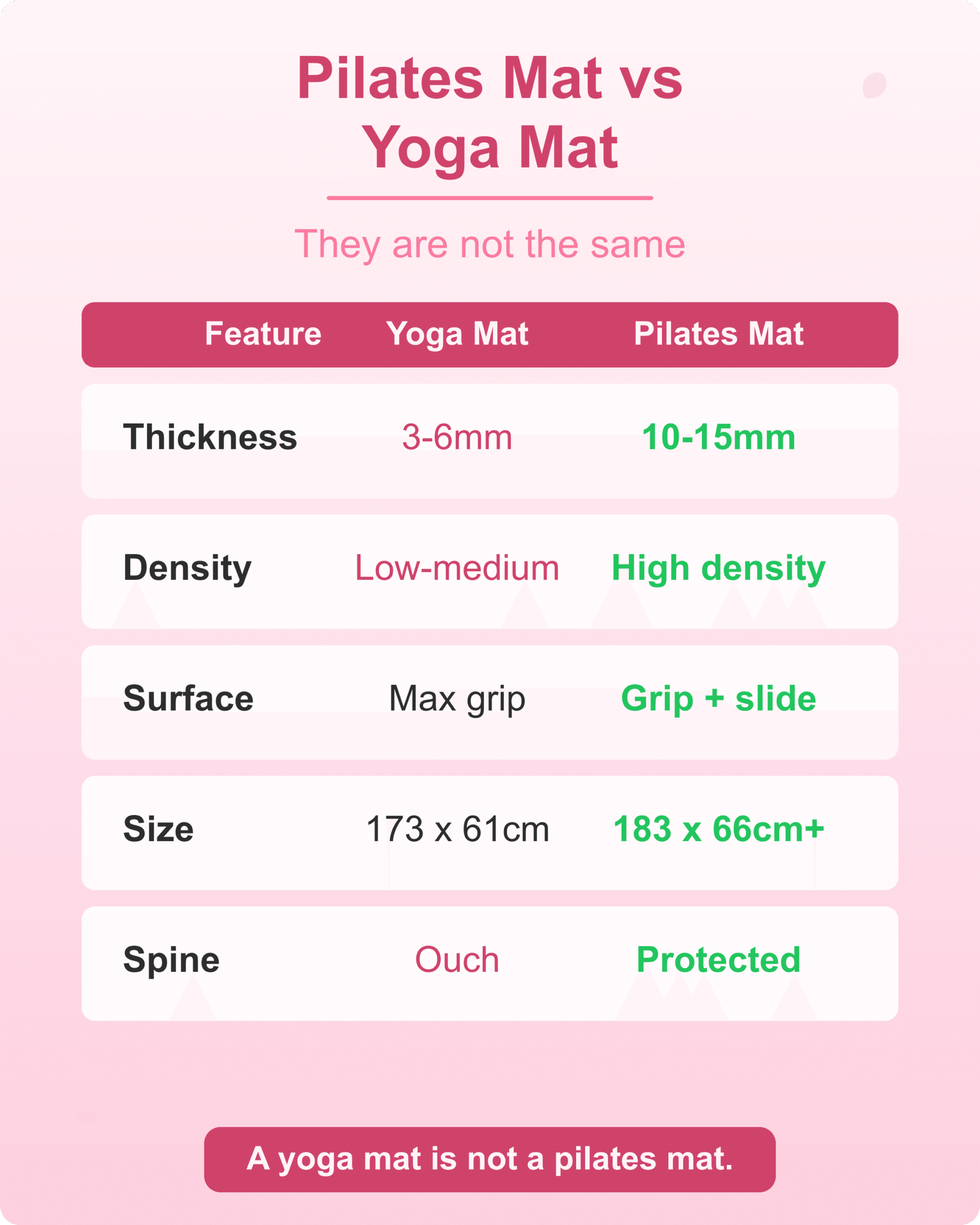
Thickness
A standard yoga mat is 3 to 6mm thick. A pilates mat is 10 to 15mm thick. That extra cushioning exists for a reason: pilates involves rolling on your spine, kneeling, lying on your side, and pressing your tailbone into the floor. Without adequate thickness, these exercises range from uncomfortable to painful.
Density
Thickness alone is not enough. A thick mat made from cheap foam compresses under your body weight, meaning your bones still hit the floor. A good pilates mat uses high-density foam that cushions without bottoming out. Think of it like a mattress: a thick mattress is useless if it sags. The same applies to mats.
Surface Texture
Yoga mats are designed for bare feet and grip. Pilates mats need a balance between grip (so you do not slide during planks) and smoothness (so you can slide your feet during certain exercises). The ideal surface has a subtle texture that grips when you press but allows controlled movement when you need it.
Size
Yoga mats are typically 173 x 61cm (68 x 24 inches). For pilates, you want at least 180 x 60cm, and ideally 183 x 66cm (72 x 26 inches) for comfortable arm and leg extensions. Taller women (over 170cm) should look for 190cm+ length mats.
The 5 Features That Actually Matter
When shopping for a pilates mat, these five features determine whether you will love it or return it.
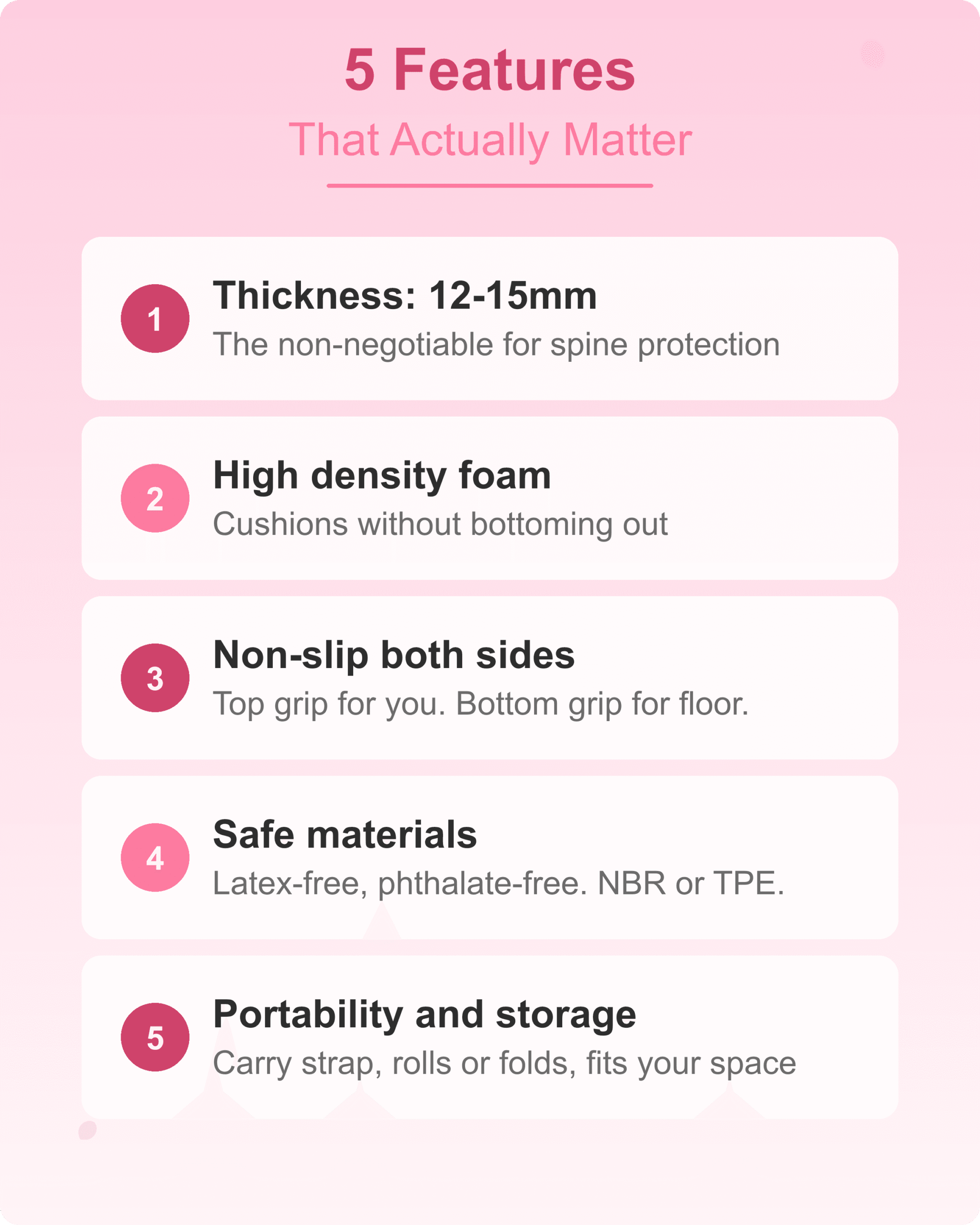
1. Thickness: The Non-Negotiable
For pilates at home, 12 to 15mm is the sweet spot.
- Under 10mm: Too thin for rolling exercises and kneeling. Your spine and tailbone will protest.
- 10 to 12mm: Adequate for most exercises. Works well for women under 65kg or on carpeted floors where the carpet provides additional cushioning.
- 12 to 15mm: Ideal for hard floors. Protects spine, knees, and tailbone during all pilates exercises including rolling like a ball, side-lying work, and kneeling exercises.
- Over 15mm: Can feel unstable during standing balance work. The extra cushioning makes your base less firm. Best reserved for women with specific joint pain concerns.
2. Density: What Stops You Bottoming Out
High-density NBR (nitrile butadiene rubber) or TPE (thermoplastic elastomer) foam holds its shape under body weight. Low-density foam compresses flat within weeks. You cannot always judge density from a product listing, but two indicators help:
- Weight: A quality 15mm pilates mat weighs 1.5 to 2.5kg. If a 15mm mat weighs under 1kg, the foam is too soft.
- Reviews mentioning “bottoming out”: This is the most common complaint with cheap mats. Check the one and two-star reviews specifically for this phrase.
3. Non-Slip Surface
You need grip on both sides: the top surface (where your body contacts) and the bottom surface (where the mat contacts the floor). A mat that slides across your hardwood floor during a plank is dangerous, not just annoying.
- Top surface: Look for textured or ribbed surfaces. Smooth mats become slippery with sweat.
- Bottom surface: Rubber dots, ridged patterns, or anti-slip coatings prevent floor movement. This matters most on hard floors.
4. Material Safety
You will have your face close to this mat during exercises. Material matters.
- NBR foam: The most common pilates mat material. Cushioning, durable, and affordable. Look for mats labelled “latex-free” and “phthalate-free.”
- TPE foam: More eco-friendly than NBR. Lightweight, good cushioning, recyclable. Slightly more expensive.
- Natural rubber: Excellent grip and durability but heavier. Avoid if you have a latex allergy.
- PVC: Common in budget mats. Durable but not eco-friendly and can have a strong chemical smell. Usually fine once aired out for a few days.
5. Portability and Storage
Thick pilates mats do not roll as tightly as thin yoga mats. Consider:
- Does it come with a carry strap? (Important if you take it to parks or studios)
- Does it fold or roll? (Some thick mats fold like a tri-fold, which stores more compactly)
- Where will you store it? (A 15mm mat rolled up has a diameter of roughly 20cm)
Best Pilates Mats by Budget
Here is what you can expect at each price tier, so you can match your investment to your needs.
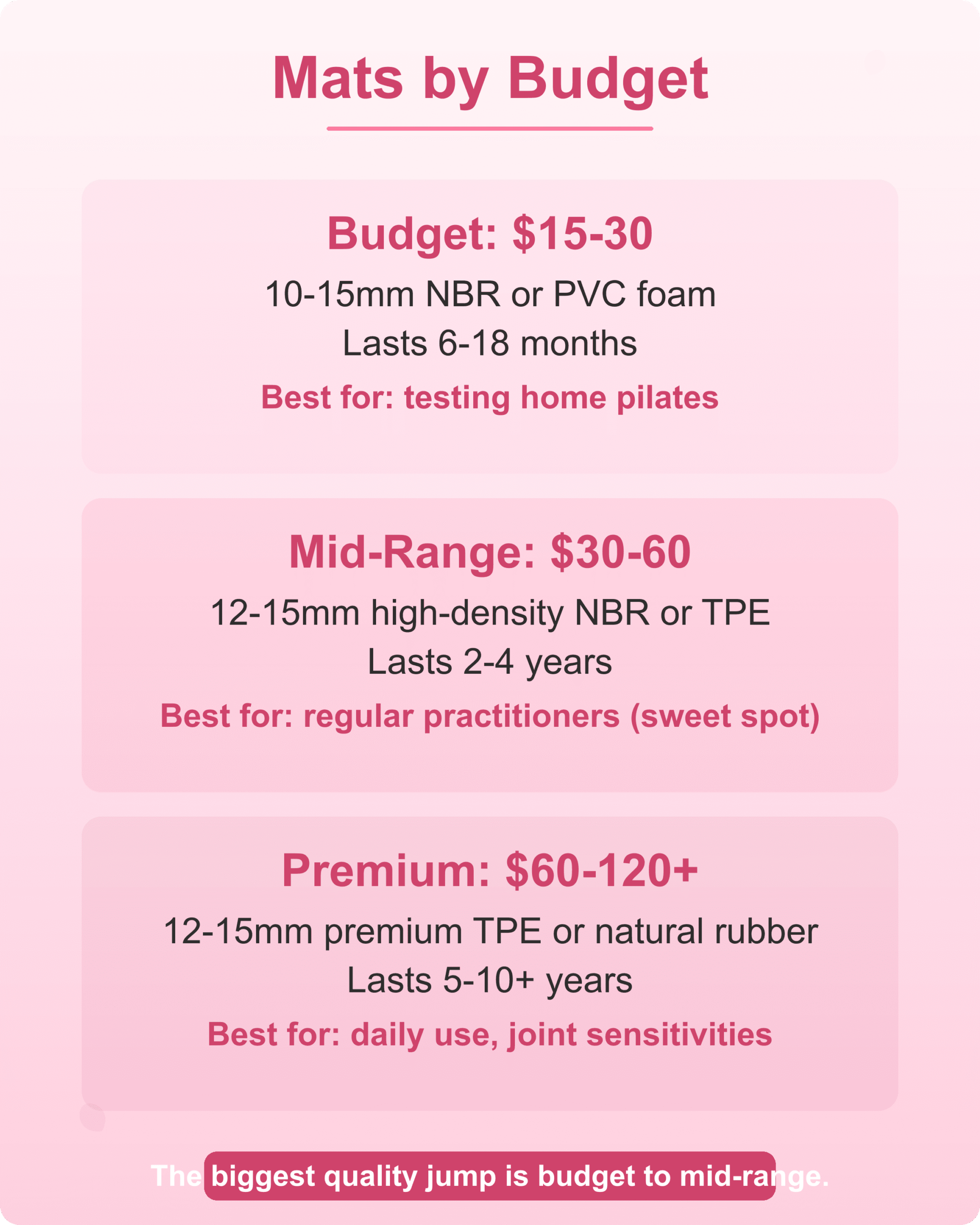
Budget Tier: $15 to $30
What you get: 10 to 15mm NBR or PVC foam. Basic non-slip surface. Usually comes with a carry strap. Adequate for beginners testing whether home pilates will become a regular practice.
What to expect: These mats work well for the first 6 to 12 months. The foam may start compressing in high-use areas (where your hips and shoulders press) after extended use. The non-slip coating may wear down over time. A slight chemical smell out of the box is common; air it out for 24 to 48 hours before use.
Best for: Women trying home pilates for the first time. If you are following our mat pilates beginner guide or wall pilates beginner guide and want to start without a big investment, this tier gets you going.
Where to look: Amazon (look for 4+ star ratings with 500+ reviews), Target, Decathlon.
Mid-Range Tier: $30 to $60
What you get: 12 to 15mm high-density NBR or TPE foam. Better non-slip surfaces on both sides. Often wider and longer than budget options. More consistent cushioning that holds up over time.
What to expect: These mats last 2 to 4 years of regular use (three to four sessions per week). The foam retains its shape and density. Non-slip coatings are more durable. Less chemical smell. This is the tier where comfort genuinely improves your practice.
Best for: Women committed to a regular home practice. If you are doing our 28-day wall pilates challenge or following any structured programme, this tier makes every session more comfortable.
Where to look: Gaiam, Manduka (their non-pro line), Liforme (their pilates mat), Amazon (filter by “pilates mat” specifically, not “yoga mat”).
Premium Tier: $60 to $120+
What you get: 12 to 15mm premium TPE or natural rubber. Exceptional density and cushioning. Superior non-slip performance on both sides. Often wider (66 to 70cm). Eco-friendly materials. Longer warranty.
What to expect: These mats last 5 to 10+ years. They feel noticeably different from the first session: the cushioning is supportive without being squishy, the grip is reliable even with sweat, and the materials feel premium against your skin. This is an investment piece, not a consumable.
Best for: Daily practitioners, pilates instructors, or women who simply want the best and plan to use their mat for years. Also worth considering if you have joint sensitivities or chronic back pain where cushioning quality directly affects comfort. Our pilates for lower back pain guide covers how proper support impacts pain relief.
Where to look: Manduka PRO series, Liforme, JadeYoga Harmony (thick version), B Mat.
Quick Decision Guide: Which Mat Is Right for You?
Use this framework to decide in 60 seconds.
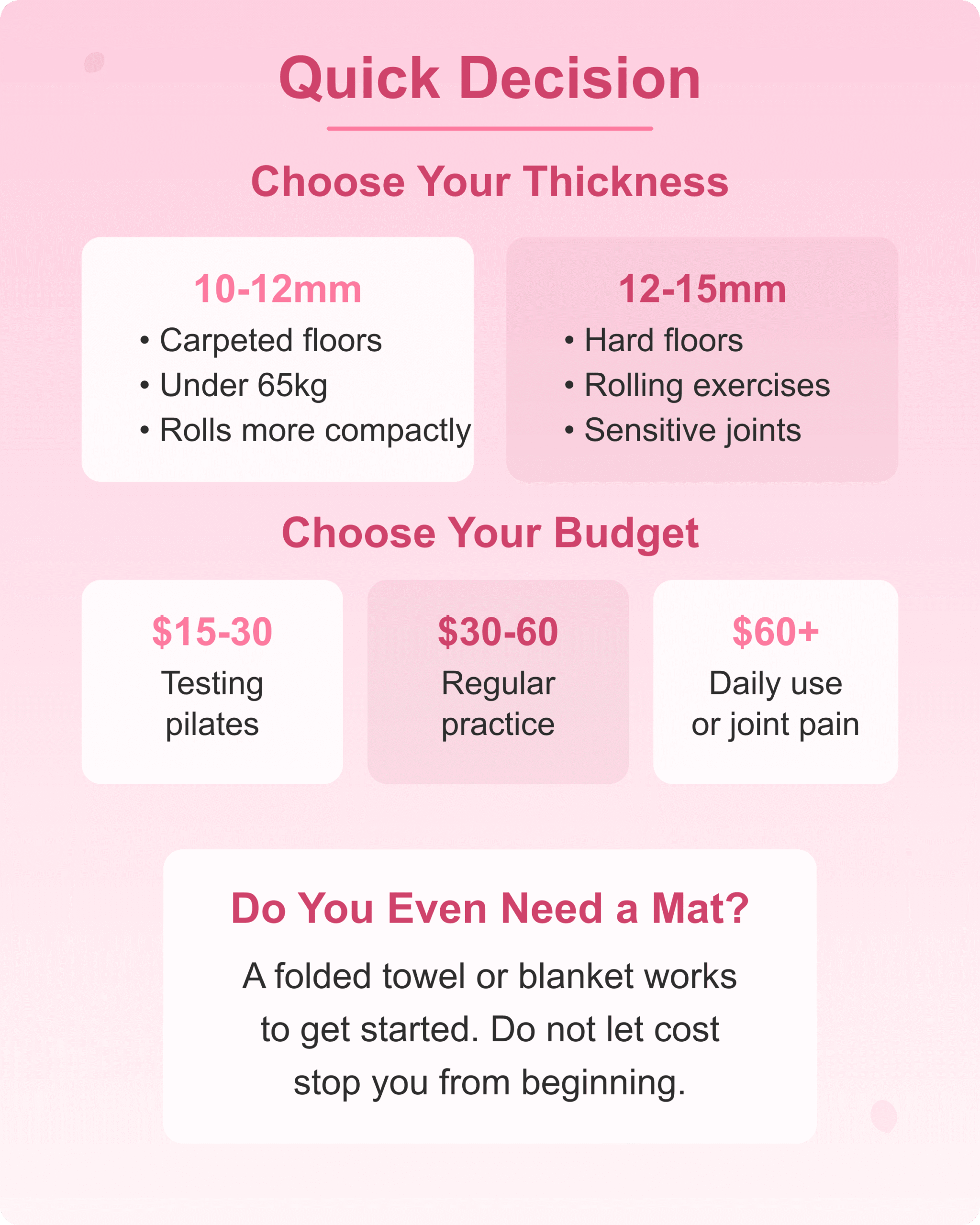
Choose 10-12mm Thickness If
- You practise on carpeted floors (carpet adds cushioning)
- You weigh under 65kg
- You mainly do standing and seated exercises
- You want a mat that rolls more compactly
Choose 12-15mm Thickness If
- You practise on hard floors (wood, tile, laminate)
- You do rolling exercises (roll-up, rolling like a ball)
- You have sensitive knees, hips, or tailbone
- You do side-lying exercises regularly
Choose Budget ($15-30) If
- You are testing whether home pilates will stick
- You plan to upgrade later if you love it
- You need a mat for occasional use (once or twice a week)
Choose Mid-Range ($30-60) If
- You practise three or more times per week
- You want comfort that lasts years, not months
- You are following a structured programme
Choose Premium ($60-120+) If
- You practise daily or near-daily
- You have joint sensitivities or back pain
- You want the best and plan to use it for 5+ years
How to Care for Your Pilates Mat
A well-maintained mat lasts significantly longer than a neglected one. These simple habits protect your investment.
After Every Session
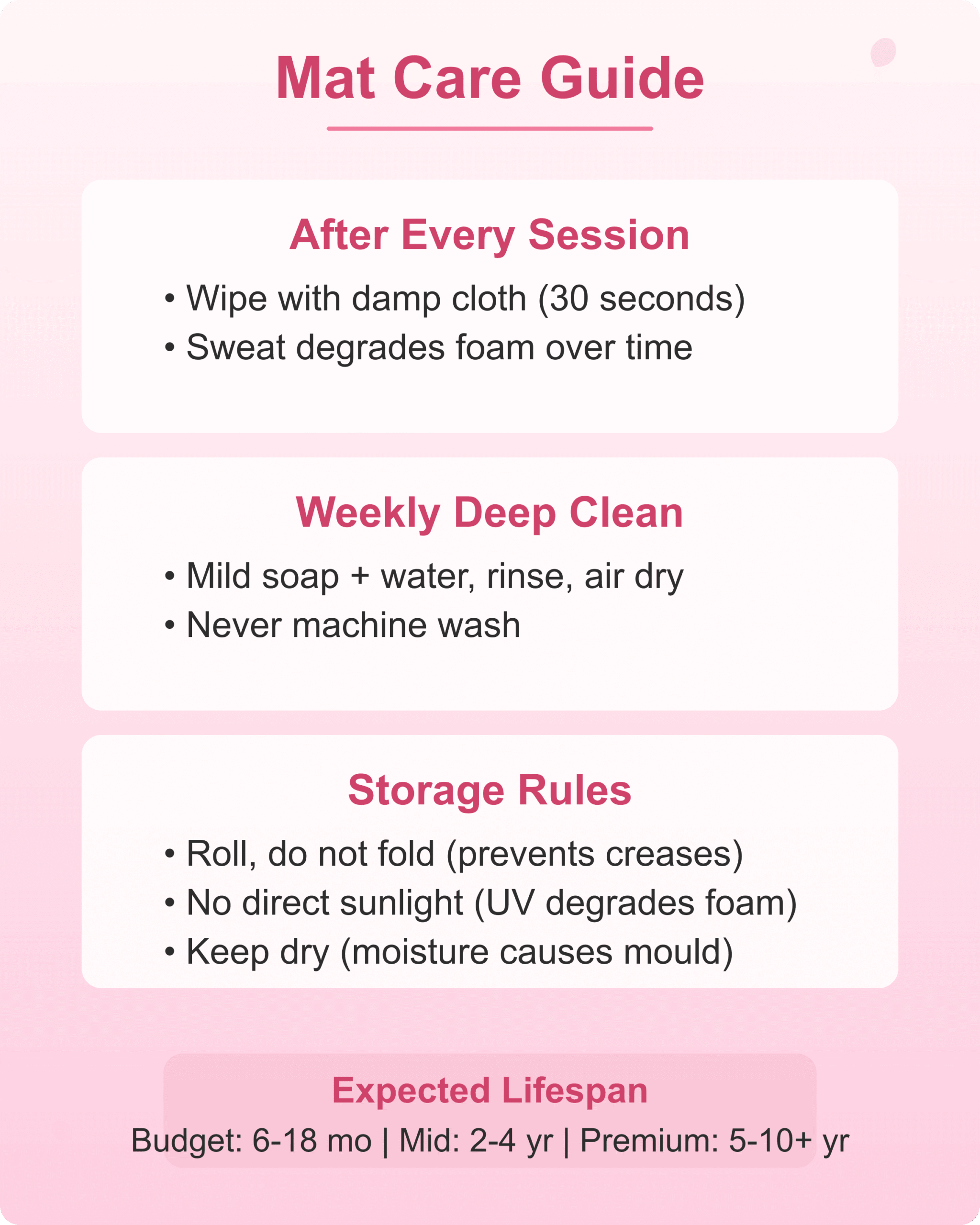
Wipe down your mat with a damp cloth or a gentle mat spray. Sweat degrades foam over time and creates bacteria. A quick 30-second wipe keeps your mat fresh and extends its lifespan.
Weekly
For a deeper clean, use a mixture of water and a few drops of mild dish soap. Wipe the entire surface, rinse with a clean damp cloth, and let it air dry completely before rolling up. Never put a pilates mat in a washing machine.
Storage
- Store rolled (not folded) to prevent permanent creases
- Keep out of direct sunlight (UV degrades foam)
- Store in a dry area (moisture encourages mould)
- Do not leave heavy objects on top of a rolled mat (compresses the foam)
When to Replace
Replace your mat when you notice:
- Permanent compression in areas where your hips and shoulders rest (you can feel the floor through the mat)
- Non-slip surface worn smooth
- Foam crumbling or flaking
- Persistent odour that cleaning does not remove
Budget mats typically last 6 to 18 months. Mid-range mats last 2 to 4 years. Premium mats last 5 to 10+ years. The cost per session of a premium mat is often lower than a budget mat over time.
Do You Even Need a Mat? (Honest Answer)
Here is what the pilates equipment guides will not tell you: you can start without a mat entirely. A folded towel, a thick blanket, or even carpet provides enough cushioning for foundational exercises. Many women complete our entire wall pilates beginner routine on a folded towel before deciding whether to invest in a mat.
A mat improves your experience, but it is not a prerequisite. If budget is the barrier keeping you from starting pilates, skip the mat, grab a towel, and begin. You can always add a mat later when you are sure pilates is part of your life.
Our pink pilates on a budget guide has more strategies for building your practice without spending money you do not have.
Frequently Asked Questions
What thickness is best for a pilates mat?
12 to 15mm is ideal for home pilates on hard floors. This thickness protects your spine, tailbone, and knees during rolling, kneeling, and side-lying exercises. 10mm works on carpeted floors where the carpet adds extra cushioning.
Can I use a yoga mat for pilates?
A standard yoga mat (3 to 6mm) is too thin for most pilates exercises. Rolling on your spine, kneeling, and side-lying work will be uncomfortable. If your yoga mat is your only option, fold a towel underneath for extra padding until you can invest in a proper pilates mat.
How much should I spend on a pilates mat?
$30 to $60 is the sweet spot for most home practitioners. This gets you a high-density mat with good grip that lasts 2 to 4 years. Budget mats ($15 to $30) work for beginners testing the practice. Premium mats ($60+) are worth it for daily practitioners or women with joint sensitivities.
What is the difference between NBR and TPE mats?
NBR (nitrile butadiene rubber) is the most common pilates mat material: affordable, good cushioning, durable. TPE (thermoplastic elastomer) is more eco-friendly, lighter, and slightly more expensive. Both work well. TPE is the better choice if environmental impact matters to you.
Do expensive pilates mats make a difference?
Yes, but the biggest jump in quality is from budget to mid-range, not from mid-range to premium. A $40 mat feels dramatically better than a $15 mat. A $100 mat feels slightly better than a $40 mat. If you are on a budget, a solid mid-range mat gives you 90% of the premium experience.
Your Next Step
The best pilates mat in 2026 is the one that gets you on the floor consistently. A $25 mat used four times a week will transform your body faster than a $120 mat used once a month. Choose based on your floor surface, your budget, and your commitment level, then stop researching and start practising.
Once you have your mat, the Mat Pilates at Home Playbook gives you progressive routines, exercise libraries, and a clear path from beginner to confident practitioner. Your mat is the foundation. Your practice is what builds on it.
You do not need the perfect mat. You just need a mat and the willingness to show up. The rest takes care of itself.