You’ve been exercising with pilates reformer machines and you’re in love with it. The classes feel incredible, your body is changing, and you are starting to think about what it would take to have a reformer at home. Then you search for one and immediately close the browser because the price range spans from $300 to $8,000 and you have no idea what the differences actually mean.
This guide is the resource you need before you spend a single penny. We break down the best home reformer pilates machines options in 2026 across every budget tier, explain what actually matters in a reformer (and what is just marketing), and help you choose the right machine for your space, your goals, and your wallet.
No sponsorships. No affiliate bias. Just honest comparisons based on what real women need from a home reformer.
What to Look for in a Home Pilates Reformer Machines
Before comparing specific machines, you need to understand the five factors that separate a great home reformer from an expensive regret.
1. Spring System: Springs vs Cords
This is the single most important difference between budget and premium machines.
Springs (coil springs, like in a studio reformer) provide smooth, progressive resistance that increases as you extend. They feel natural, predictable, and give you the same experience as a studio class. Every professional-grade reformer uses springs.
Cords (bungee cords or resistance bands) are used in most budget reformers to cut costs. They provide resistance differently: it can feel jerky at the start and inconsistent through the range of motion. Cords also wear out faster and need replacing every 6 to 12 months.
If you can afford springs, choose springs. If your budget limits you to cords, they still work, just know the movement will feel different from a studio reformer.
2. Frame Material: Metal vs Wood
Metal frames (aluminium or steel) are lighter, more affordable, and typically foldable. They are practical for smaller spaces. The trade-off is they can feel less stable at higher resistance levels and may produce more noise during use.
Wood frames (maple, beech, or bamboo) are heavier, more stable, and quieter. They look beautiful in your home and typically last decades. They are also significantly more expensive and rarely fold.
For most home users, a sturdy metal frame is perfectly fine. Wood frames become worth the investment if you plan to use your reformer daily for years and have dedicated space.
3. Carriage Length and Rail Quality
The carriage is the sliding platform you sit, lie, and kneel on. For comfortable use, you want:
- Carriage length: At least 90cm (35 inches) of padded surface. Taller women (over 5’8″) should look for 100cm+.
- Rail smoothness: Aluminium or steel rails with quality wheels. The carriage should glide silently without catching or jerking. Test this before buying if possible.
- Weight capacity: Most home reformers support 100 to 150kg (220 to 330lbs). Check this if it matters for your household.
4. Size and Storage
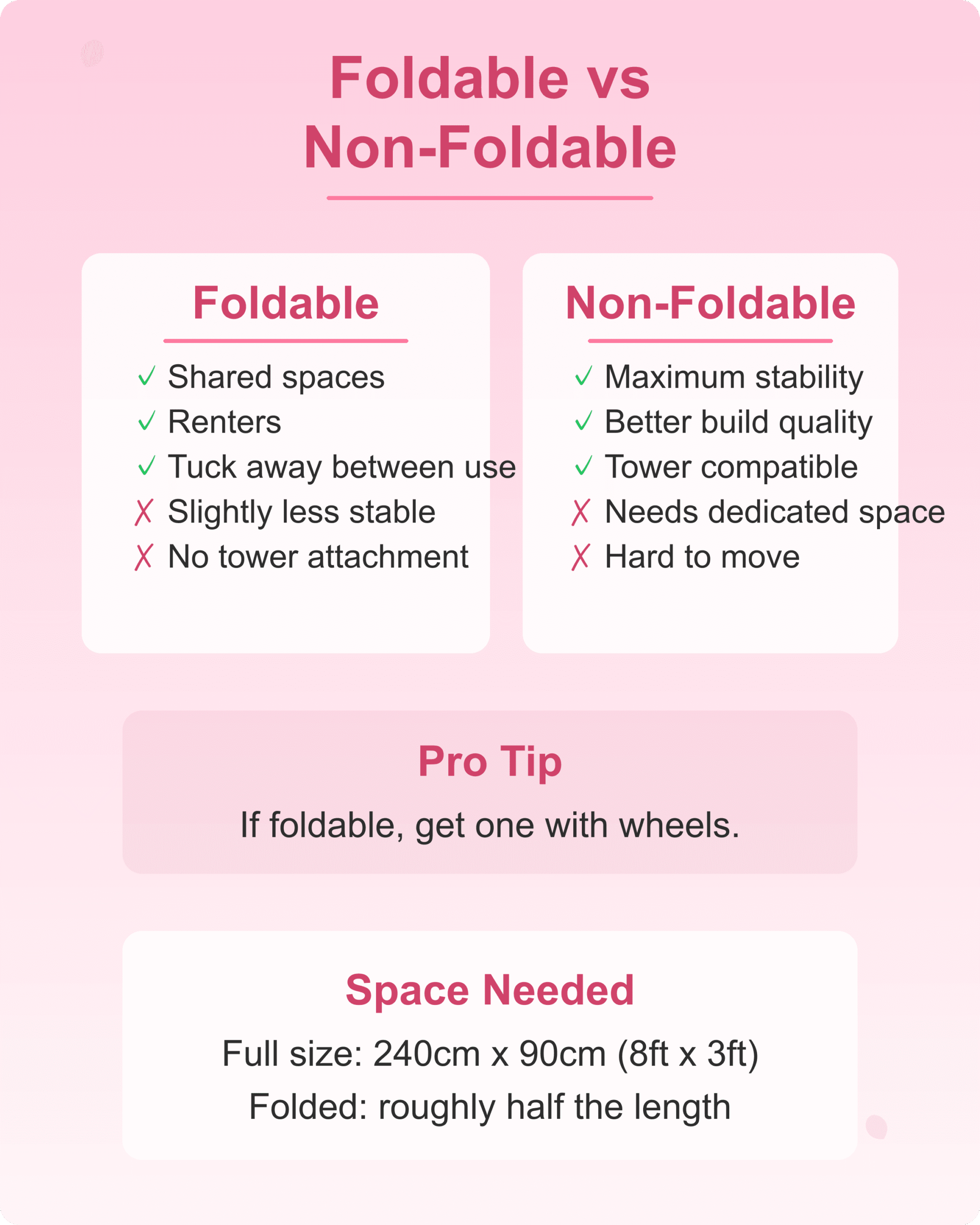
A full-size reformer is roughly 240cm long and 60cm wide (roughly 8 feet by 2 feet). That is significant floor space. Before buying, measure your intended space and decide whether you need a foldable model.
- Foldable reformers: Fold to roughly half their length. Ideal for living rooms, bedrooms, or shared spaces. Trade-off: slightly less stable than non-foldable models.
- Non-foldable reformers: More stable, often better build quality. Require a dedicated space like a spare room or garage.
5. Accessories Included
Some reformers come as a complete package; others require separate purchases. Check whether these are included:
- Foot straps (essential)
- Jump board (for cardio work)
- Box (for seated exercises)
- Foot bar adjustment options (multiple height settings)
- Headrest with adjustable positions
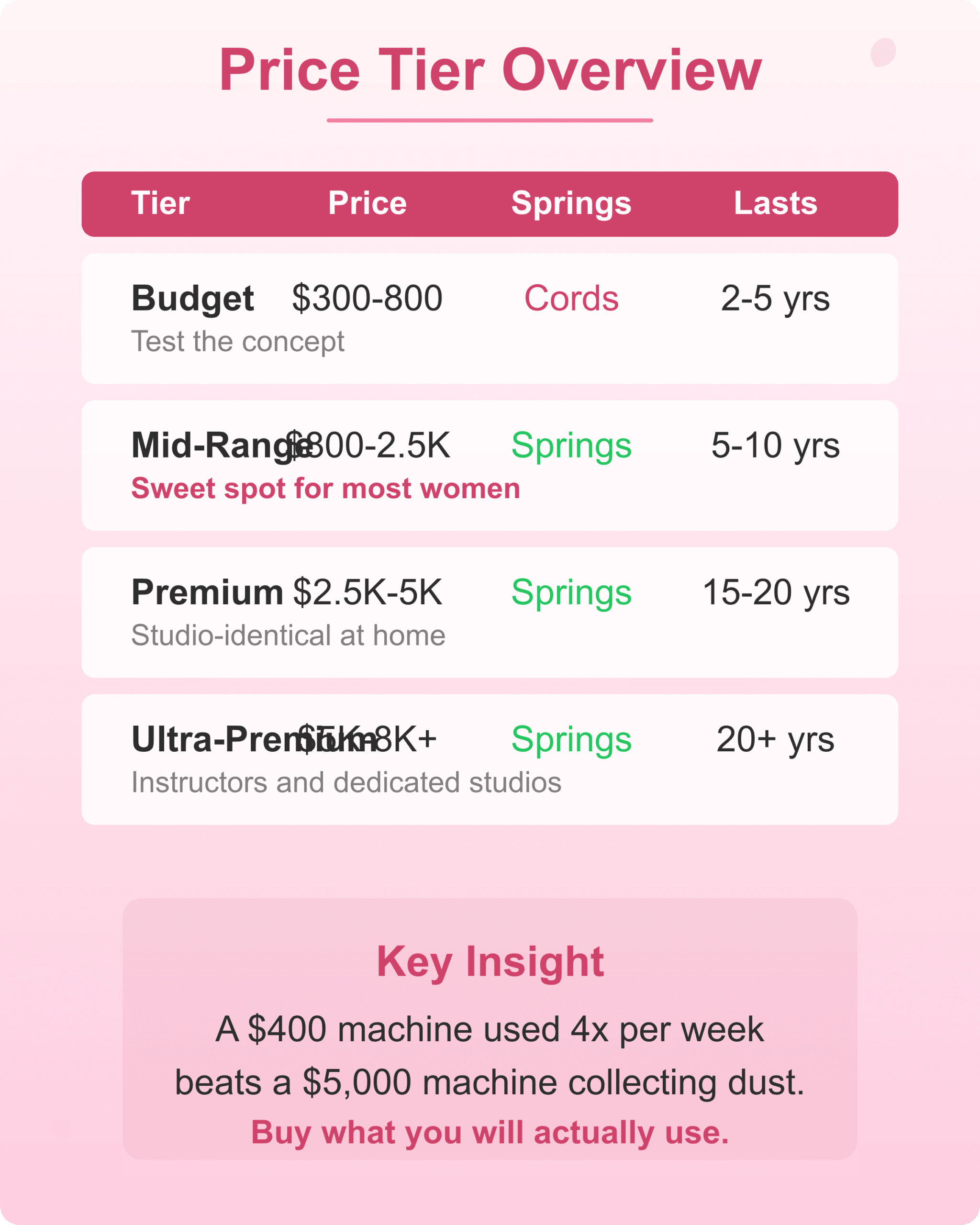
Budget Tier: $300 to $800
These entry-level reformers are designed for beginners who want to try reformer-style exercises at home without a major investment. They are a stepping stone, not a forever machine.
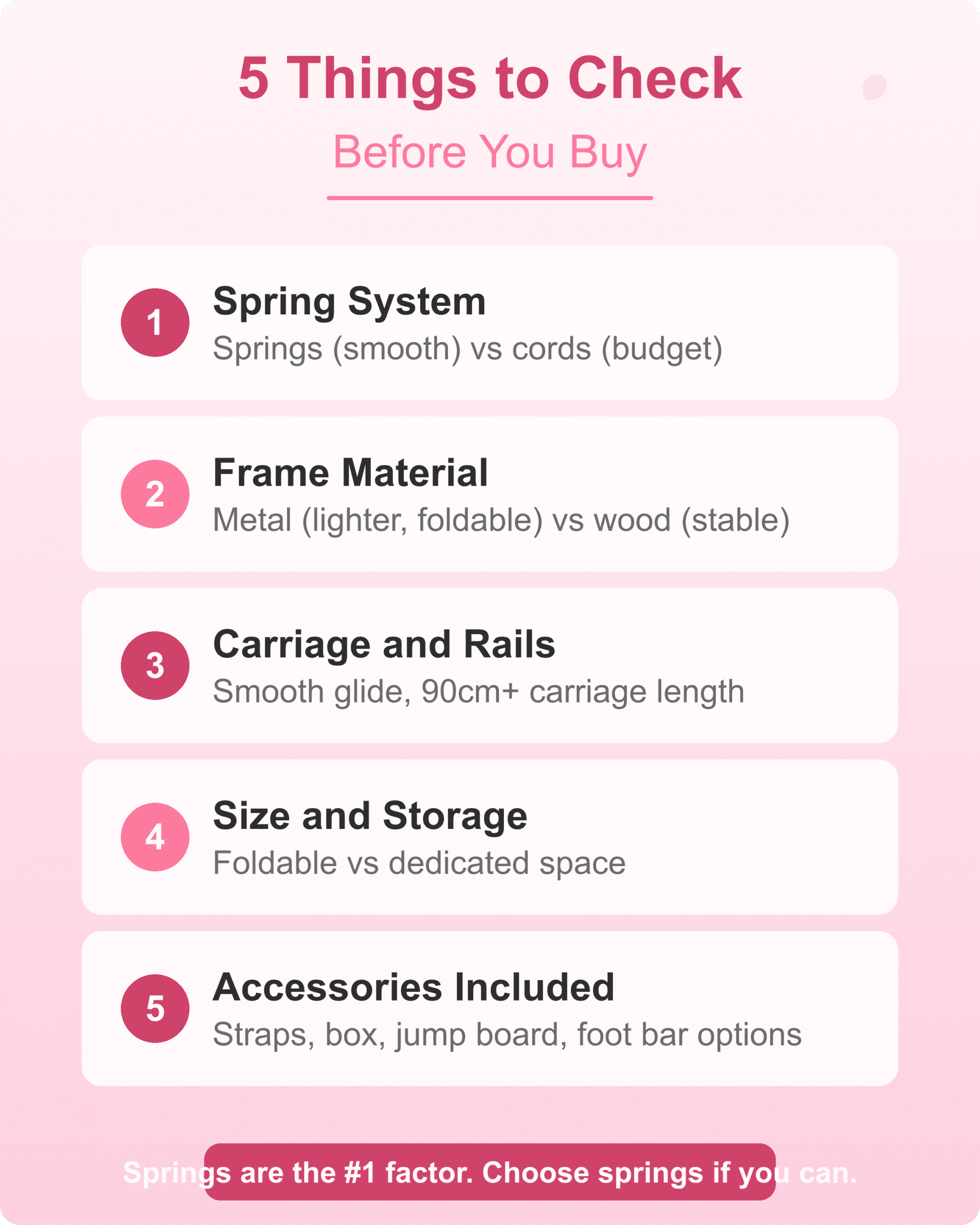
What You Get at This Price
- Bungee cord or light spring resistance (not studio-grade coil springs)
- Metal frame, typically foldable
- Basic foot bar with 1 to 2 height settings
- Lighter build weight (15 to 25kg)
- Limited resistance levels (3 to 5 settings)
Who This Tier Is For
Women who want to complement their mat or wall pilates practice with reformer-style movements at home. Also good for women who are not sure they will use a reformer long-term and want to test the concept before investing more.
What to Expect
These machines will give you the sliding carriage experience and allow you to perform most foundational reformer exercises. They will not feel like a studio reformer. The cord resistance is different from springs, the frame may wobble slightly during single-leg work, and the carriage glide is not as smooth. But for building strength and learning reformer movements, they do the job.
Brands to Research
Look at AeroPilates (their entry-level models), Stamina, and various well-reviewed options on Amazon. Read recent reviews specifically, as build quality can change between production runs. Check the return policy before ordering.
Honest Pros and Cons
- Pros: Affordable, foldable, low commitment, great for beginners exploring reformer work
- Cons: Cord resistance feels different from springs, lighter frame can wobble, cords wear out and need replacing, limited exercise variety compared to studio machines
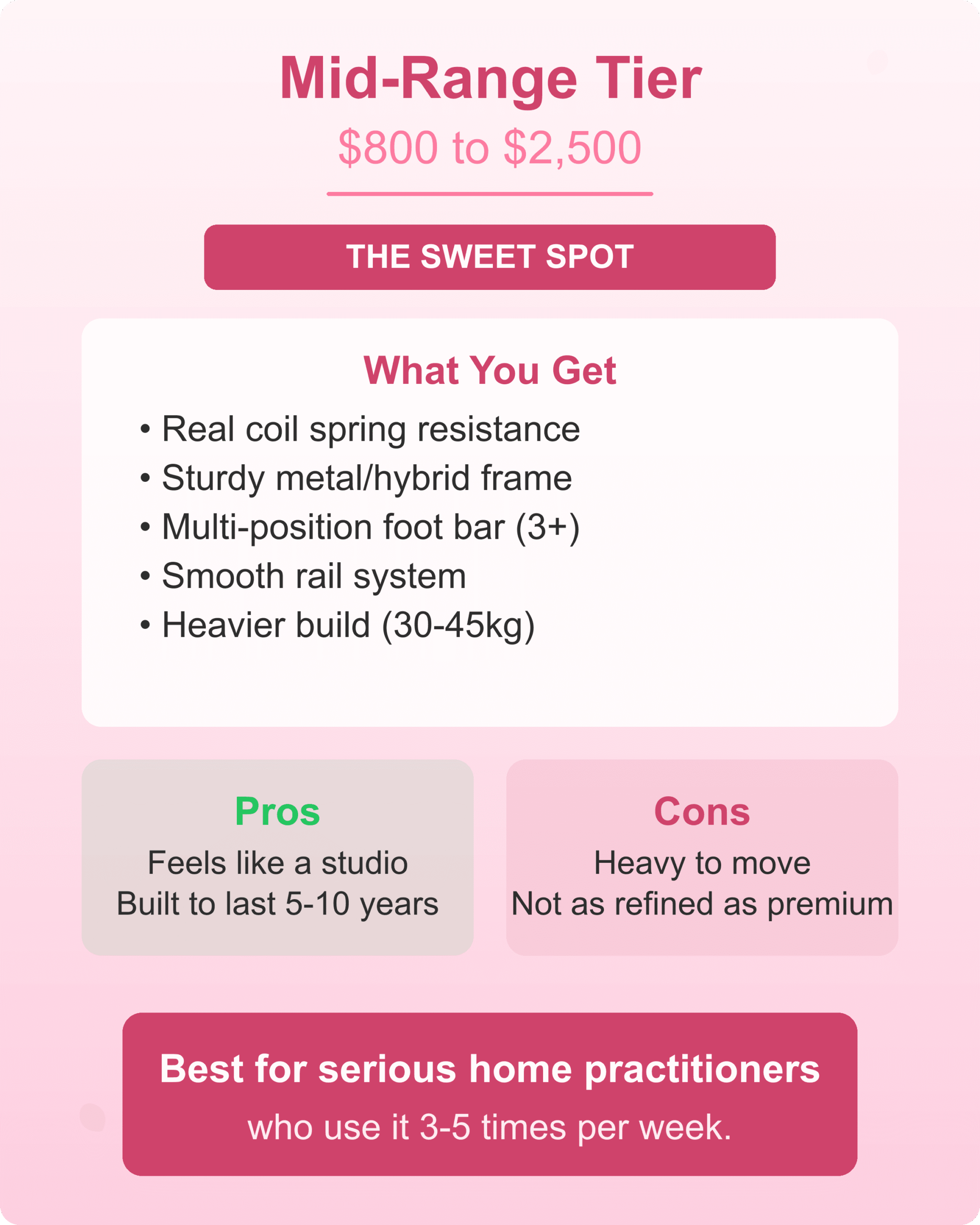
Mid-Range Tier: $800 to $2,500
This is the sweet spot for most serious home practitioners. You start getting real coil springs, sturdier frames, smoother carriage glide, and machines that feel genuinely close to a studio reformer.
What You Get at This Price
- Coil spring resistance (4 to 5 springs in most models)
- Sturdy metal or metal-wood hybrid frame
- Multi-position foot bar (3+ height settings)
- Heavier build weight (30 to 45kg), meaning better stability
- Smoother rail and carriage systems
- Some models include a box and jump board
Who This Tier Is For
Women who attend reformer classes regularly, love the workout, and want to practise at home between studio sessions. Also ideal for women who plan to make reformer pilates their primary workout and want a machine that lasts 5 to 10+ years.
What to Expect
These machines feel like a real reformer. The spring resistance is smooth and progressive. The carriage glides without catching. You can perform the full range of reformer exercises including footwork, straps, kneeling, and standing work. The main limitation compared to premium machines is usually fewer spring options and slightly less refined materials.
Brands to Research
Merrithew (their At-Home SPX line is widely respected), Elina Pilates, Align Pilates, and AeroPilates (their higher-end models with springs, not cords). Many boutique studios use machines in this price range, so you may recognise brands from your own classes.
Honest Pros and Cons
- Pros: Real spring resistance, feels like a studio reformer, built to last, full exercise range, good accessories available
- Cons: Not as refined as premium machines, some models are heavy and difficult to move, foldable options in this range can still wobble slightly
Premium Tier: $2,500 to $5,000
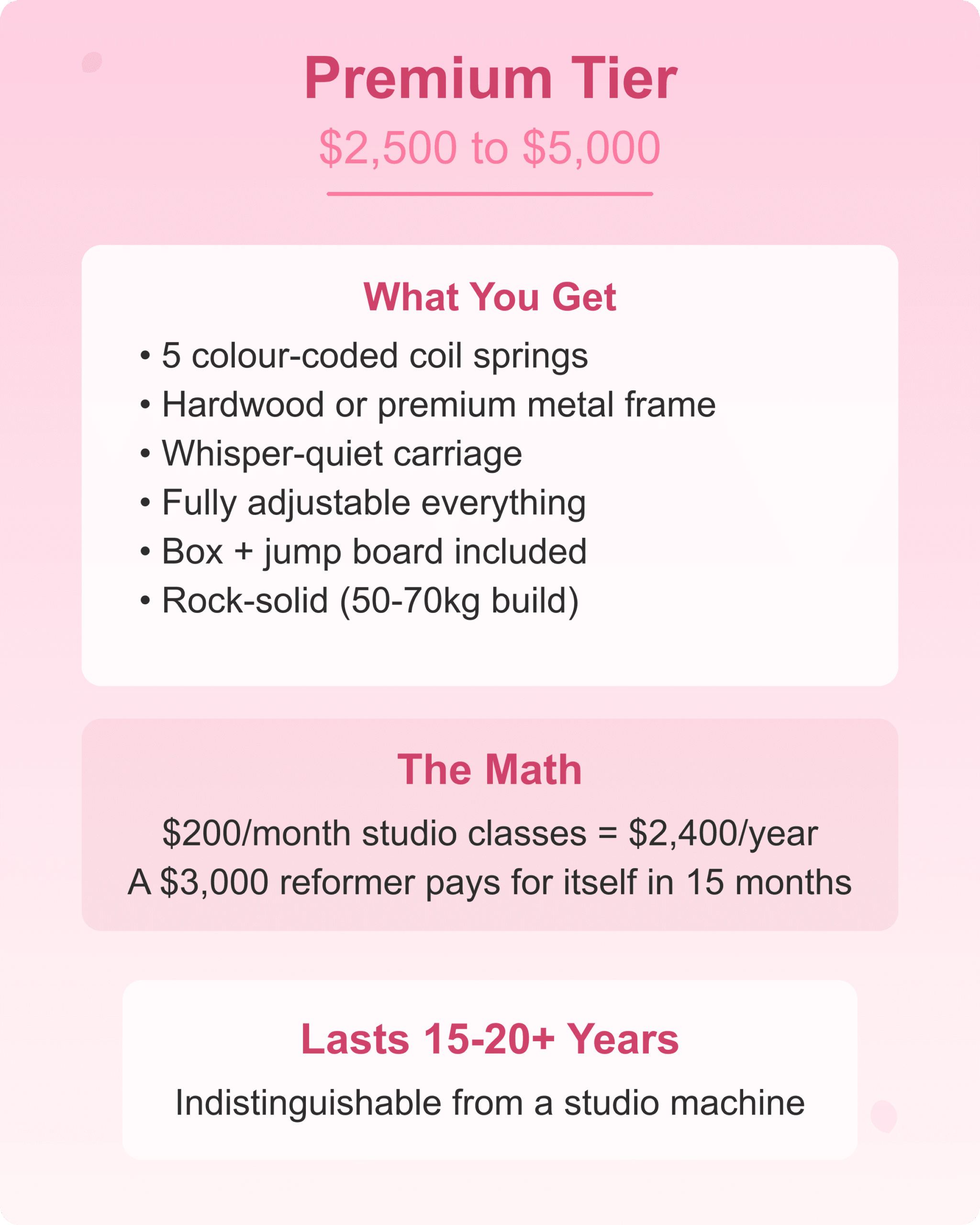
These are studio-quality machines designed for your home. If you are committed to reformer pilates as your primary workout and you have the space and budget, this tier is where long-term investment meets daily joy.
What You Get at This Price
- 5 colour-coded coil springs (identical to studio setups)
- Hardwood or premium metal frame with exceptional stability
- Precision-machined rails for whisper-quiet carriage movement
- Fully adjustable foot bar, headrest, and shoulder rests
- Heavy build weight (50 to 70kg), meaning rock-solid stability
- Included accessories: box, jump board, foot straps, and sometimes a tower attachment
Who This Tier Is For
Dedicated practitioners, pilates instructors teaching from home, or women who want the absolute best reformer experience in their own space. If you currently spend $200+ per month on studio classes and plan to reduce that to once or twice monthly while supplementing at home, this tier pays for itself within 1 to 2 years.
What to Expect
These machines are indistinguishable from what you use in a studio. The spring resistance is perfectly calibrated. The carriage movement is silent and fluid. Every adjustment point works smoothly. You will not outgrow this machine. It will serve you for 15 to 20+ years with minimal maintenance.
Brands to Research
Balanced Body (the industry standard, used in most major studios worldwide), Merrithew (their professional line), Gratz (the original Pilates reformer manufacturer), and Peak Pilates. These are the names you see in studios and teacher training programmes.
Honest Pros and Cons
- Pros: Studio-identical experience, exceptional build quality, lasts decades, full accessory ecosystem, holds resale value well
- Cons: Significant upfront investment, very heavy (difficult to move once placed), requires dedicated space, delivery and setup can be complex
Ultra-Premium Tier: $5,000 to $8,000+
This tier exists for completeness. These are professional studio machines, instructor-grade equipment, or reformers with integrated digital platforms.
What Sets This Tier Apart
- Custom wood finishes and artisan craftsmanship
- Integrated tower or Cadillac conversion kits (turning one machine into a full pilates studio)
- Digital screens with guided classes and real-time form feedback
- Professional-grade components rated for 8+ hours of daily use
Who This Tier Is For
Pilates instructors running a home studio, women building a dedicated wellness room, or serious enthusiasts who want the best money can buy. If you are reading this guide as a beginner, this tier is not for you yet, and there is zero shame in that.
Brands to Research
Balanced Body (their Allegro 2 and Centerline series), Gratz (handmade in the USA), and Frame Fitness (with integrated digital platform). These are heirloom-quality machines that you can pass down or resell at strong value.
Foldable vs Non-Foldable: The Space Question
For most women shopping for a home reformer, the foldable question is just as important as the budget question.
Choose Foldable If
- You are using a shared living space (living room, bedroom)
- Your dedicated workout area is also used for other things
- You rent and may need to move the machine
- You want the option to tuck it away between sessions
Choose Non-Foldable If
- You have a dedicated workout room, garage, or spare bedroom
- You plan to use the reformer daily (folding and unfolding gets tedious)
- You prioritise maximum stability and build quality
- You want to add a tower attachment (not compatible with most foldable models)
A Practical Tip
If you choose foldable, look for models with wheels. A 35kg foldable reformer without wheels is a frustrating experience to move daily. With wheels, you can roll it to a wall or closet in seconds.
Spring Systems Explained: What the Colours Mean
If you have taken reformer classes, you have heard your instructor call out spring settings. Home reformers use the same colour-coded system, though the exact colours vary by brand.
The Standard System (Balanced Body)
- Red: Full resistance. Used for legwork and heavy exercises.
- Blue: Medium resistance. Versatile for upper and lower body.
- Green: Light-medium. Good for arm work and moderate exercises.
- Yellow: Light. Used for stretching, delicate movements, and rehabilitation.
Budget reformers with cords typically offer 3 to 5 resistance levels controlled by adding or removing cords. Mid-range and premium machines use 4 to 5 individually selectable springs, giving you dozens of possible combinations.
For a more detailed breakdown of how springs work and what to expect as a beginner, our reformer pilates beginner guide covers it all.
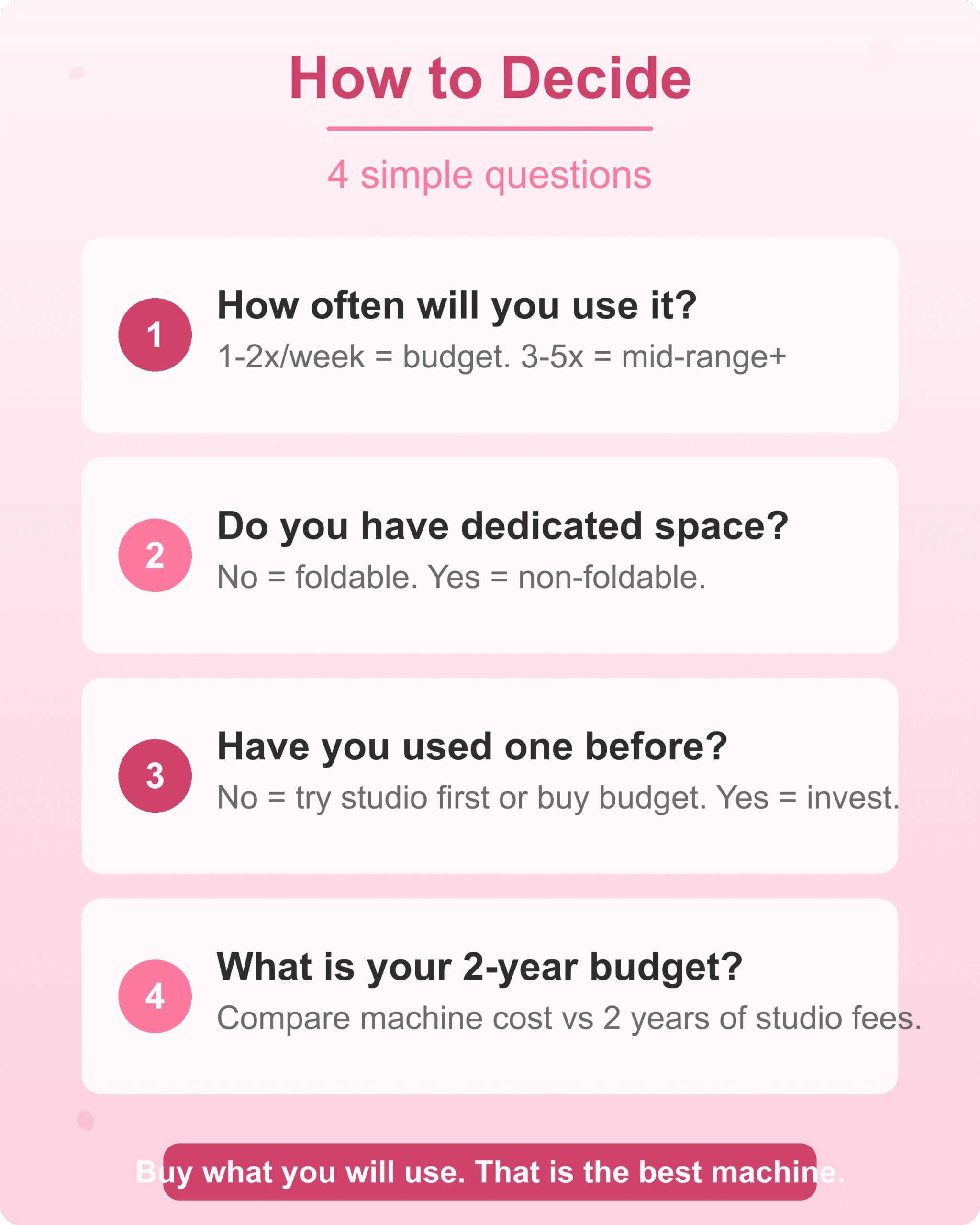
How to Decide: A Simple Framework
If the options feel overwhelming, use this framework:
- How often will you use it? Once or twice a week: budget tier is fine. Three to five times a week: invest in mid-range or premium.
- Do you have dedicated space? No: foldable, any tier. Yes: non-foldable opens up more options.
- Have you used a reformer before? No: start with budget to test the concept, or take a few studio classes first. Yes: you know what you want, invest accordingly.
- What is your 2-year budget? Compare the cost of your machine against 2 years of studio classes. A $2,000 reformer replaces $200/month of studio classes in 10 months.
If you are not ready for a reformer yet, you can get remarkable results with zero equipment. Our mat pilates at home guide and free 28-day wall pilates challenge prove that your body weight is all the resistance you need to build real strength.
Maintaining Your Home Reformer
A home reformer is an investment. Protect it with basic maintenance:
- Wipe down after every use: Sweat corrodes metal and degrades vinyl. A quick wipe with a damp cloth takes 30 seconds.
- Check springs monthly: Look for stretching, discolouration, or uneven tension. Replace springs every 2 to 3 years for safety (or sooner if they lose their snap).
- Lubricate rails quarterly: A silicone-based spray keeps the carriage gliding smoothly. Never use WD-40 or oil-based lubricants.
- Tighten bolts every 3 months: Vibration loosens hardware over time. A quick once-over with an Allen key prevents wobble.
- Store in a dry area: Humidity damages wood frames and can rust metal components. Avoid garages in humid climates unless the space is climate-controlled.
Frequently Asked Questions
Is a $300 reformer worth buying?
For a beginner testing whether they enjoy reformer-style workouts, yes. Budget reformers with cords are not studio-quality, but they let you practise foundational movements at home. Think of it as an entry point, not an endpoint. If you love it, upgrade to a spring-based machine later.
Can I get studio-quality results at home?
Yes, with a mid-range or premium machine and a structured programme. The reformer itself is the same tool whether it sits in a studio or your spare room. What you lose without a studio is instructor correction, which you can supplement with online classes and video tutorials.
How much space do I need for a home reformer?
A full-size reformer requires roughly 240cm by 90cm (8 feet by 3 feet) including clearance for exercises. Foldable models need about half that space when stored. You also need ceiling height clearance for standing exercises: at least 220cm (7.2 feet).
Should I buy new or second-hand?
Second-hand reformers can be excellent value, especially from premium brands like Balanced Body that hold up well. Check springs, rails, and vinyl condition before buying. Budget brands do not resell as well because they wear out faster. Facebook Marketplace and specialist pilates forums are the best places to find used machines.
Do I still need studio classes if I have a home reformer?
Not necessarily, but they complement each other well. Monthly or bi-monthly studio classes with an instructor help you refine form and learn new exercises you can then practise at home. Many women find the sweet spot is one studio class per week plus two to three home sessions.
Your Next Step
The best home pilates reformer in 2026 is the one that matches your budget, your space, and how often you will actually use it. A $400 foldable reformer used four times a week will give you dramatically better results than a $5,000 studio machine collecting dust in a spare room.
If you are ready to invest, use the framework above to narrow your options. If you are not ready yet, that is perfectly fine. A mat, a wall, and consistent practice will build the same foundational strength that a reformer builds, just through a different path.
For a structured home reformer programme once you have your machine, the Reformer Pilates at Home Starter Kit gives you progressive workouts, spring setting guides, and everything you need to train with confidence in your own space.
Whatever you choose, choose what you will actually use. That is the only machine that delivers results. Let your practice bloom on your own terms.