You have been thinking about starting pilates. Maybe for weeks, maybe for months. But every time you look into it, you hit the same wall: reformer classes are expensive, studios are intimidating, and you are not sure you are “fit enough” to walk into a room full of people who already know what they are doing. Here is what nobody tells you: mat pilates at home is where most pilates journeys begin, and it is every bit as effective as a studio class.
Mat pilates requires nothing but your body and a floor. No reformer, no springs, no $40-per-class membership. Just you, learning to move with control, breathe with intention, and build strength from the inside out. It is the original form of pilates, the way Joseph Pilates himself taught it, and it remains the foundation that every other style is built on.
This guide is your complete starting point. You will learn what mat pilates actually is, the six principles that make it work, 10 foundational exercises with full instructions, and a 20-minute routine you can follow today. No prior experience needed. No spending required. Just a willingness to begin.
What Is Mat Pilates (And Why Does It Work So Well)?
Mat pilates is a series of controlled exercises performed on the floor (usually on a mat, hence the name) that target your deep core muscles, improve flexibility, and build balanced strength throughout your entire body. Unlike weight training that isolates individual muscles, pilates trains your body as a connected system.
Joseph Pilates developed this method in the early 1900s, originally calling it “Contrology” because the entire practice revolves around conscious muscular control. Every movement is intentional. Nothing is rushed or thrown. That is what makes it so different from most workouts, and why it delivers results that other exercises miss.
Why Mat Pilates Is Perfect for Beginners
Mat pilates strips away every barrier between you and getting started:
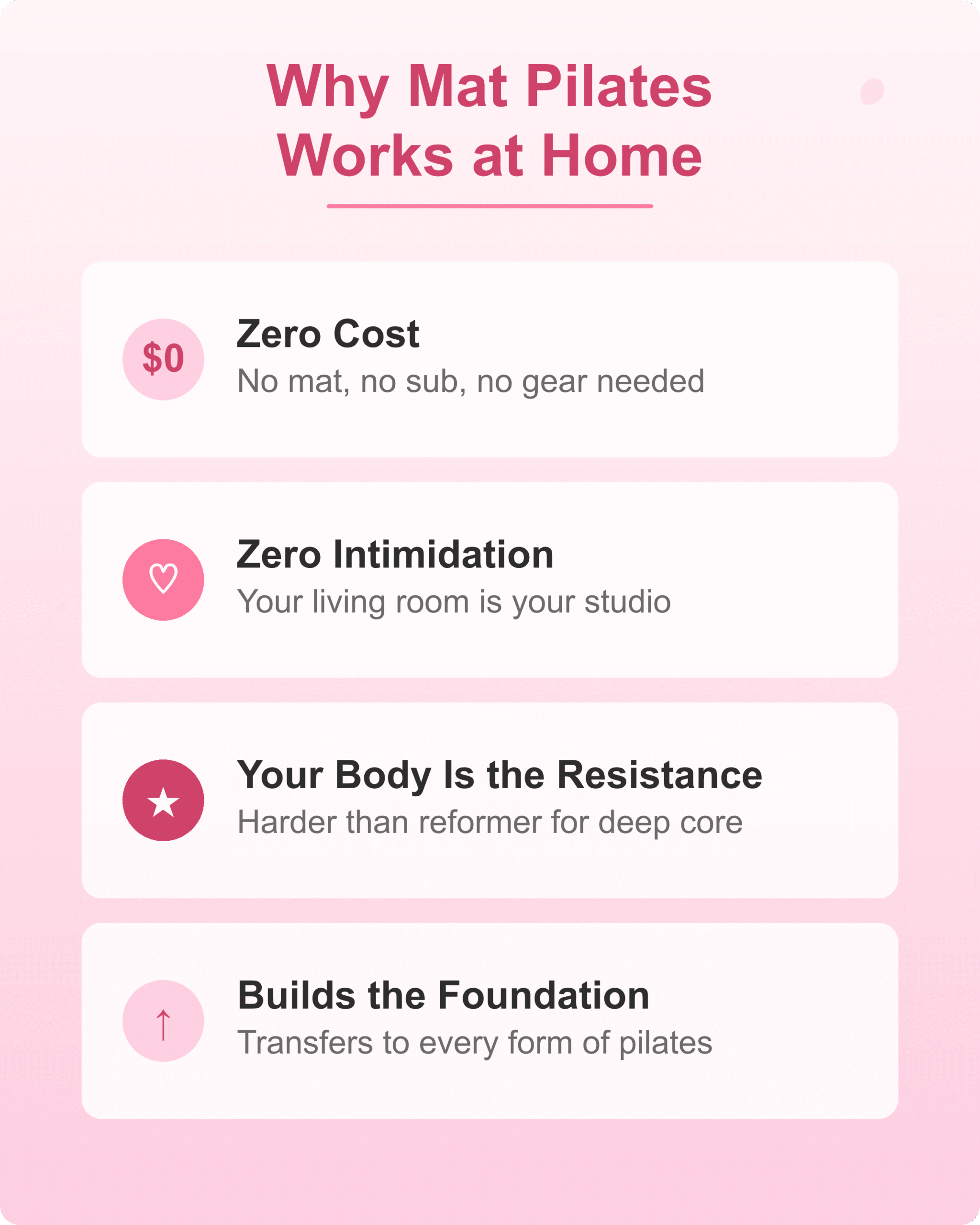
- Zero cost. You do not need a mat (a towel works), you do not need a subscription, and you do not need a single piece of equipment.
- Zero intimidation. Your living room is your studio. Nobody is watching. You can pause, rewind, and repeat as many times as you need.
- Your body is the resistance. On a reformer, springs provide the challenge. On a mat, gravity and your own body weight do the work. This actually demands more from your deep stabilising muscles.
- It builds the foundation for everything else. Whether you eventually try reformer classes, wall pilates, or stick with mat work forever, the principles and body awareness you build here transfer to every other form of movement.
If you have been wondering whether mat work can truly compete with reformer results, our mat pilates vs reformer comparison has the honest answer (spoiler: yes, it absolutely can).
The 6 Pilates Principles Every Beginner Should Understand
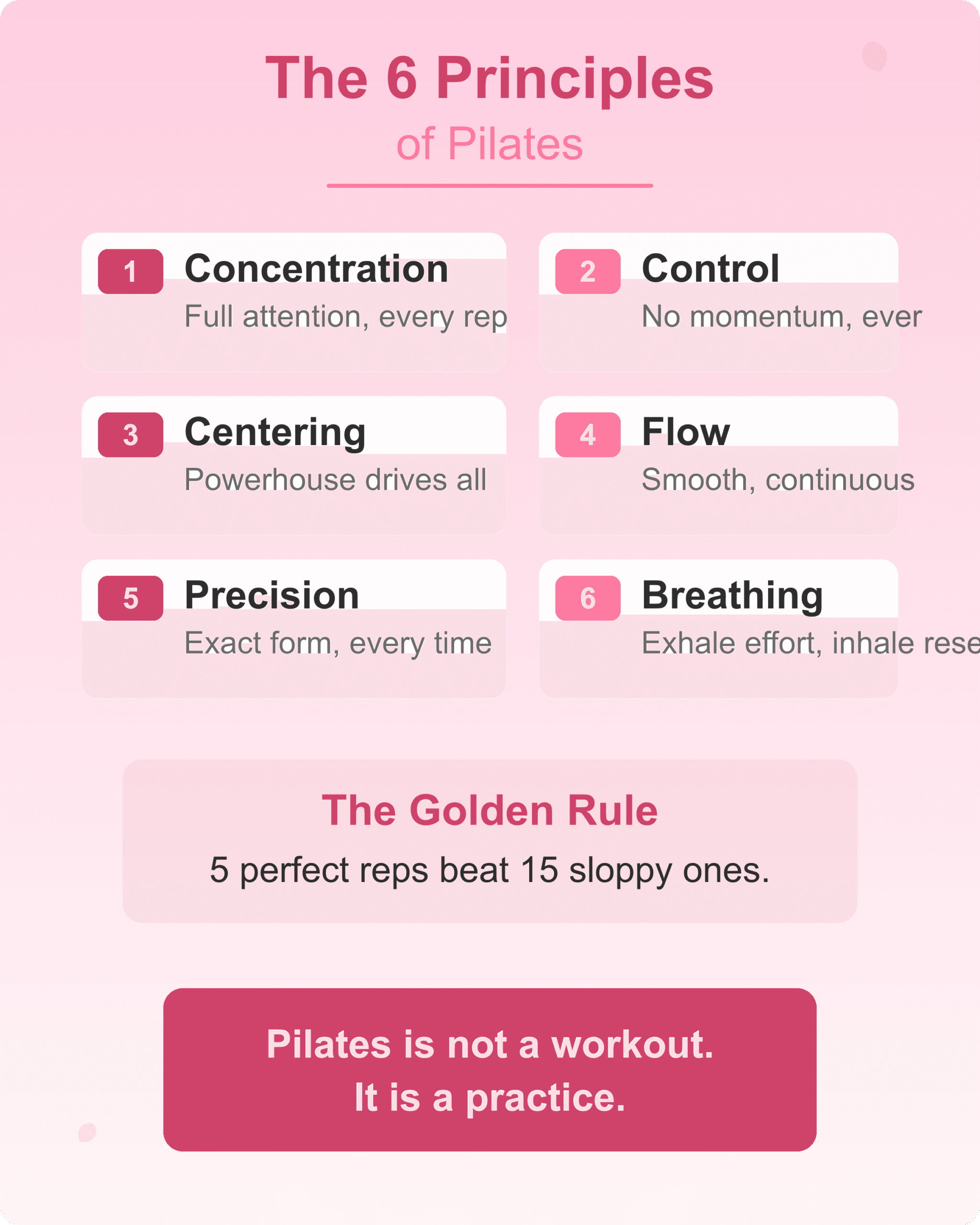
These six principles are not rules to memorise. They are the mindset behind every single pilates exercise. Understanding them transforms pilates from “lying on the floor doing crunches” into something far more powerful.
1. Concentration
Every exercise requires your full attention. This is not a workout you do while scrolling your phone. When you concentrate on the muscle you are working, you recruit more muscle fibres and get better results from fewer reps. Quality over quantity is the pilates way.
2. Control
No momentum, no swinging, no flopping. Every phase of every movement, the lift, the hold, and the return, is controlled by your muscles. This is why pilates movements look slow. Slow is the point. Slow means your muscles are doing the work, not gravity or momentum.
3. Centering
Joseph Pilates called the deep core muscles the “powerhouse”: the area from your lower ribs to your hips, wrapping all the way around your trunk. Every exercise begins with engaging this powerhouse. It is the engine that drives every movement, and it is the reason pilates is so effective for core strength and posture.
4. Flow
Pilates movements should feel smooth and continuous, not jerky or segmented. One exercise flows into the next, and within each exercise, the movement flows without pause. Think of it like a dance rather than a series of isolated reps.
5. Precision
Every exercise has a specific form, a specific alignment, and a specific path of movement. Precision means doing the exercise exactly right rather than doing more reps sloppily. Five perfect reps will always beat fifteen messy ones.
6. Breathing
Pilates uses lateral breathing: expanding your ribcage sideways and backward (rather than lifting your chest up) while keeping your core engaged. The general rule is exhale on the effort (the hardest part of the movement) and inhale to prepare. Do not overthink this at first. Just keep breathing, and the pattern will become natural.
What You Need to Get Started (Almost Nothing)
This is the shortest equipment list in fitness:
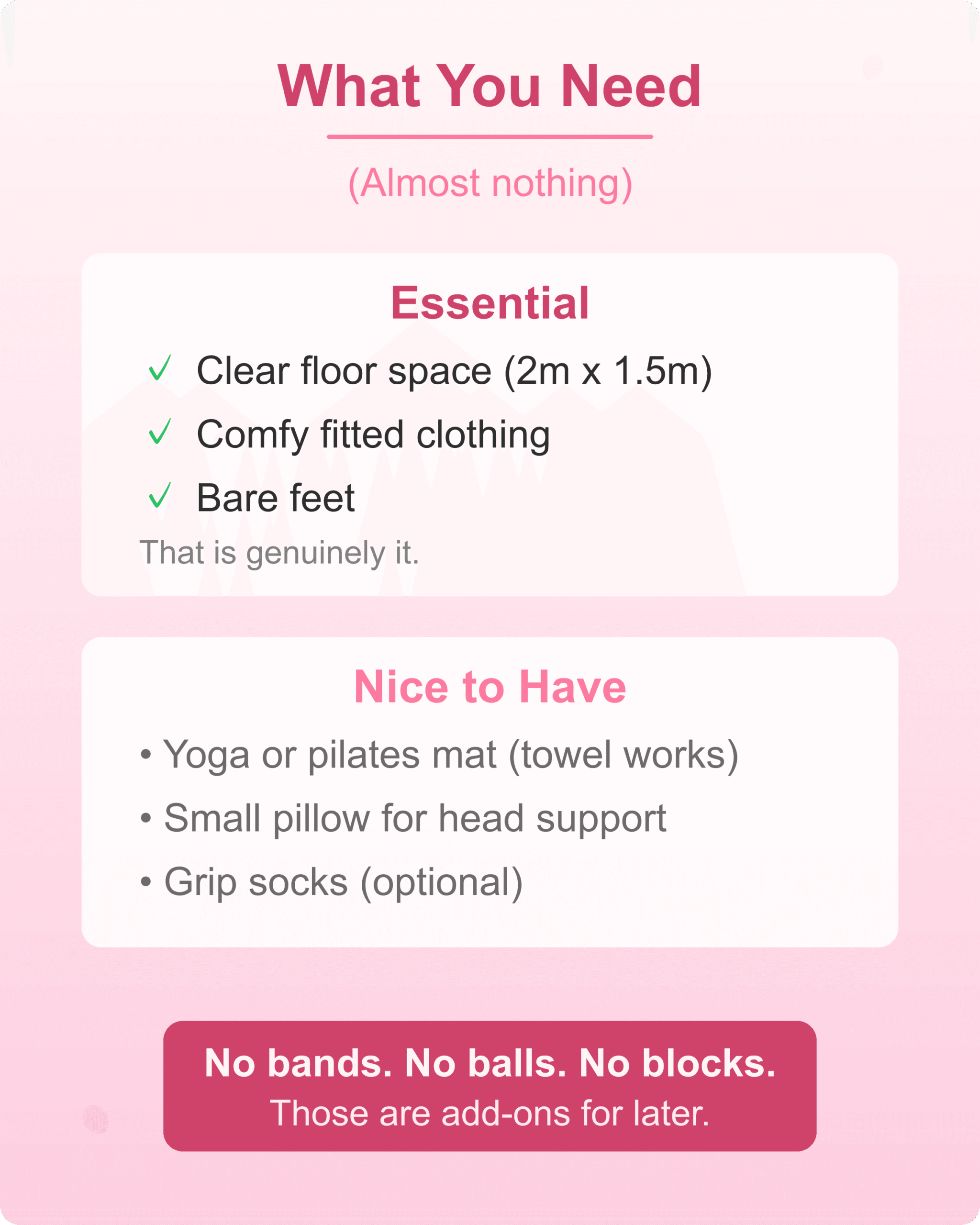
- A clear floor space: Enough room to lie down with your arms extended overhead and your legs stretched out. About 2 metres by 1.5 metres.
- Comfortable clothing: Fitted enough that you can see your body position, flexible enough to move freely. Leggings and a fitted top are ideal. If you want inspiration, our pink pilates outfit guide has affordable options.
Optional (But Nice to Have)
- A yoga or pilates mat: Adds cushioning for your spine and tailbone. A thick towel or blanket works as a substitute.
- A small pillow: Useful for head support if you have neck tension during core exercises.
- Bare feet or grip socks: Bare feet are standard for mat pilates at home. Grip socks are optional but help if your floor is slippery.
That is it. No bands, no balls, no blocks. Those are add-ons for later, not requirements for starting.
10 Foundational Mat Pilates Exercises for Beginners
These are the building blocks of every mat pilates practice. Master these 10 exercises, and you will have a strong foundation for any class, video, or programme you try in the future. Each includes the muscles targeted, step-by-step instructions, and breathing cues.
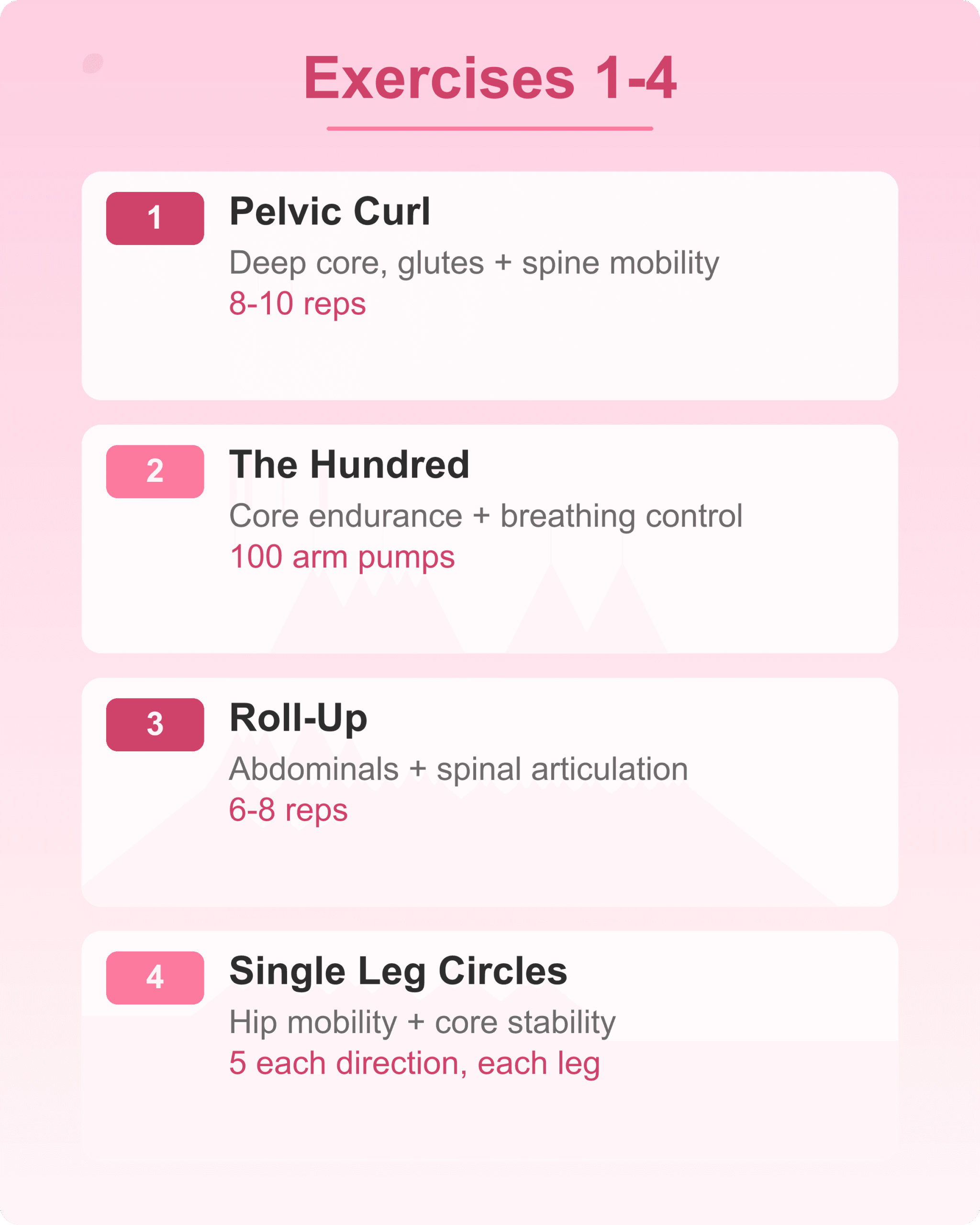
1. Pelvic Curl (The Foundation)
Targets: Deep core, glutes, spinal mobility
Lie on your back with knees bent, feet flat on the floor, hip-width apart. Arms rest by your sides. Inhale to prepare. Exhale and tilt your pelvis, pressing your lower back into the floor, then peel your spine off the mat one vertebra at a time until your hips are lifted and your body forms a straight line from shoulders to knees. Inhale at the top. Exhale and lower back down, placing each vertebra on the floor individually, tailbone touching last.
Reps: 8 to 10
2. The Hundred (The Classic)
Targets: Core endurance, breathing control, full-body coordination
Lie on your back and bring both knees to tabletop position (knees bent at 90 degrees, shins parallel to the ceiling). Lift your head, neck, and shoulders off the mat, reaching your arms long by your sides. Pump your arms up and down in small, controlled pulses: inhale for 5 pumps, exhale for 5 pumps. That is one cycle. Repeat for 10 cycles (100 pumps total). If this feels too intense, keep your feet on the floor with knees bent.
Reps: 10 breathing cycles (100 pumps)
3. Roll-Up
Targets: Abdominals, spinal articulation, hamstring flexibility
Lie flat on your back with legs extended and arms reaching overhead. Inhale and lift your arms toward the ceiling. Exhale and nod your chin, then peel your spine off the mat one vertebra at a time, reaching toward your toes. Inhale at the top. Exhale and reverse the movement, rolling back down with control. If you cannot roll up smoothly, bend your knees slightly or hold the backs of your thighs for assistance.
Reps: 6 to 8
4. Single Leg Circles
Targets: Hip mobility, core stability, inner and outer thighs
Lie on your back with one leg extended to the ceiling and the other flat on the floor. Circle the raised leg across your body, down, out, and back up to the start. Keep the circles small enough that your pelvis stays completely still. The challenge is keeping your hips stable, not making big circles. Circle five times in one direction, reverse for five, then switch legs.
Reps: 5 circles each direction, each leg
5. Rolling Like a Ball
Targets: Core control, spinal massage, balance
Sit at the front of your mat, knees bent, feet off the floor, hands holding your shins. Tuck your chin and curve your spine into a C-shape. Inhale and roll backward onto your shoulder blades (not your neck). Exhale and use your core to roll back to the starting position without letting your feet touch the floor. The roll should be smooth and controlled, not a floppy backward tumble.
Reps: 8 to 10
6. Single Leg Stretch
Targets: Lower abdominals, hip flexors, coordination
Lie on your back, head and shoulders lifted, one knee pulled toward your chest and the other leg extended at a 45-degree angle. Place the hand closest to the bent knee on that ankle, the other hand on the knee. Exhale and switch legs, drawing the other knee in while extending the first leg. The movement is smooth and rhythmic, like pedalling a bicycle in slow motion.
Reps: 8 to 10 per side (16 to 20 total)
7. Spine Stretch Forward
Targets: Hamstrings, lower back, spinal decompression
Sit tall with legs extended slightly wider than hip-width, feet flexed. Reach your arms forward at shoulder height. Inhale to sit taller. Exhale and round forward from the crown of your head, curling over an imaginary beach ball. Reach your fingers past your toes without collapsing your chest. Inhale at the deepest point. Exhale and restack your spine to sitting, building your posture from the base up.
Reps: 5 to 6
8. Swimming
Targets: Back extensors, glutes, shoulder stability
Lie face down with arms extended overhead and legs straight behind you. Lift your chest, arms, and legs slightly off the mat. Flutter your opposite arm and leg up and down in small, controlled alternations (right arm and left leg lift together, then switch). Keep your core engaged and your lower back long. Breathe in for 5 flutters, out for 5 flutters.
Reps: 20 to 30 seconds of continuous fluttering
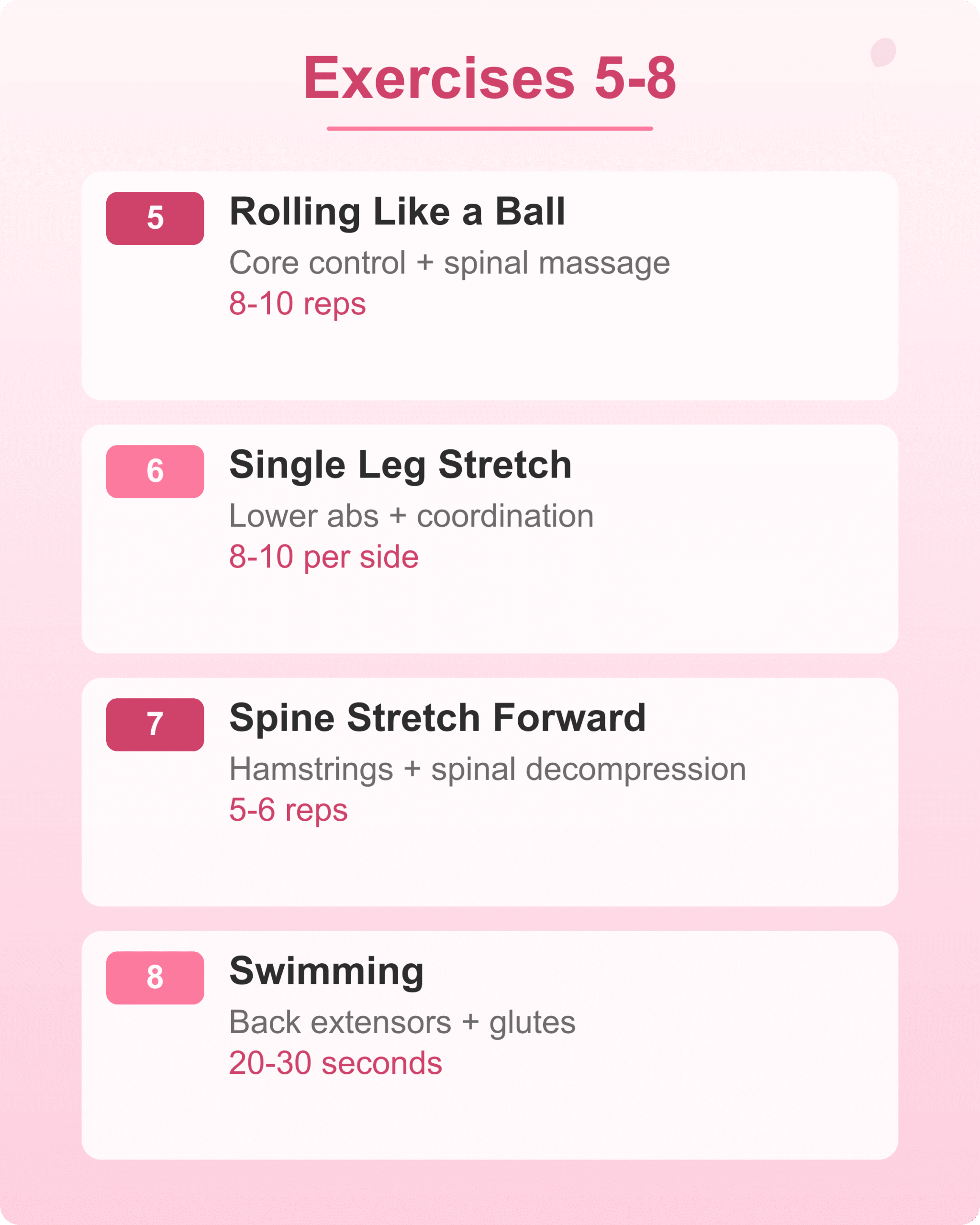
9. Side-Lying Leg Lift
Targets: Outer hip (gluteus medius), obliques, balance
Lie on your side in one long line: bottom arm extended under your head, top hand on the floor in front of your chest for support. Stack your hips. Exhale and lift your top leg to hip height, keeping it straight and slightly turned out from the hip. Inhale and lower with control. Do not let the leg swing or momentum take over. The lift is small and precise.
Reps: 10 to 12 per side
10. Child’s Pose with Side Reach (The Reset)
Targets: Lower back release, lat stretch, recovery
Kneel with your knees wide and toes together. Sit your hips back toward your heels and walk your arms forward on the floor. Rest your forehead down. Breathe deeply for three breaths. Then walk both hands to the right, feeling a stretch along your left side. Hold for three breaths. Walk your hands to the left for three breaths. Return to centre. This is your reset between exercises or at the end of your session.
Hold: 3 breaths centre, 3 breaths each side
Your Free 20-Minute Mat Pilates Routine
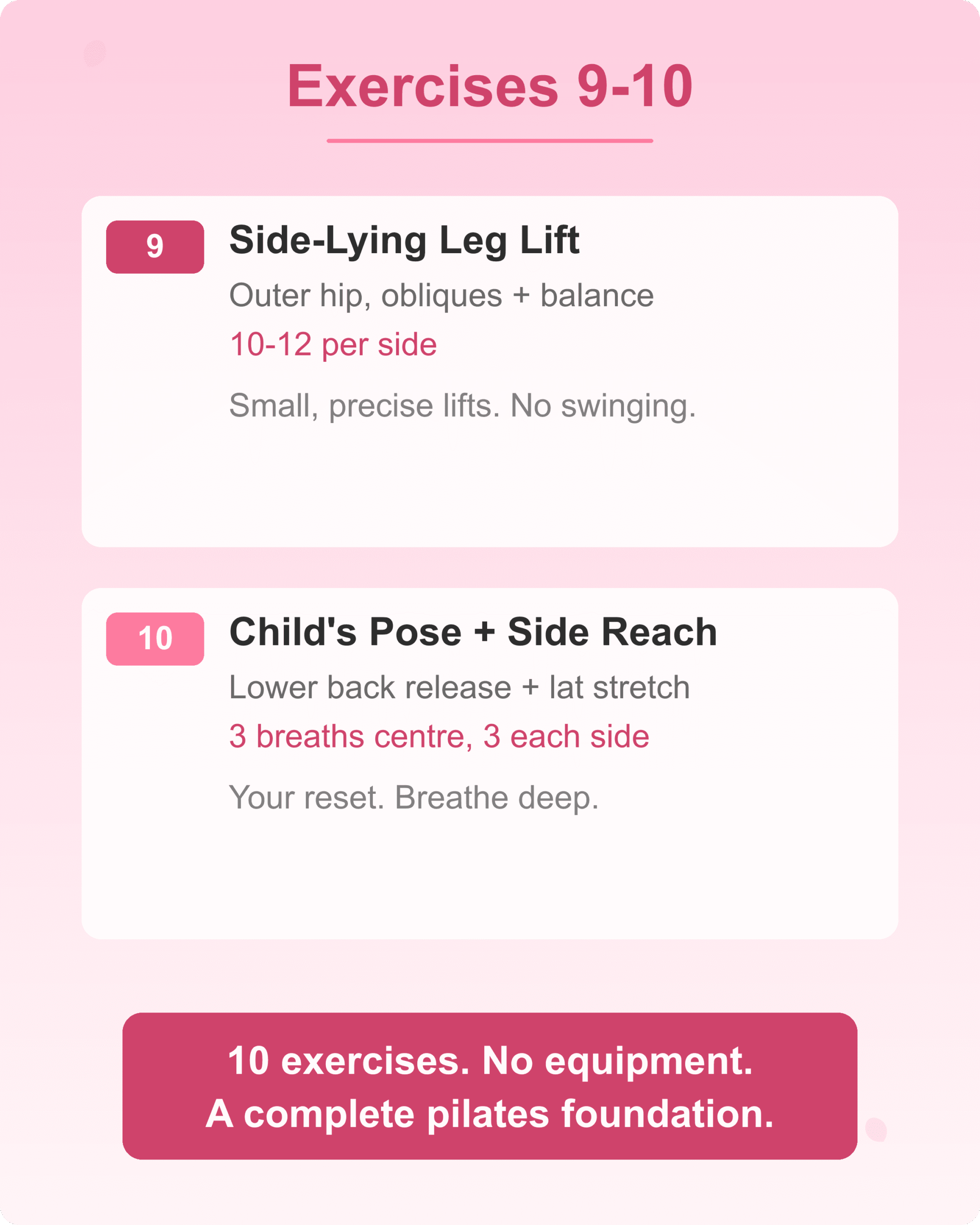
Now that you know the exercises, here is your complete mat pilates at home beginners routine. The sequence is ordered intentionally: it warms up your spine, progresses through core work, includes back strengthening, and finishes with a stretch.
- Pelvic Curl: 8 reps (2 minutes)
- The Hundred: 10 cycles (2.5 minutes)
- Roll-Up: 6 reps (2 minutes)
- Single Leg Circles: 5 each direction, each leg (2.5 minutes)
- Rolling Like a Ball: 8 reps (1.5 minutes)
- Single Leg Stretch: 8 per side (2 minutes)
- Spine Stretch Forward: 5 reps (1.5 minutes)
- Swimming: 30 seconds (1 minute)
- Side-Lying Leg Lift: 10 per side (2.5 minutes)
- Child’s Pose with Side Reach: Full sequence (2 minutes)
Total time: Approximately 20 minutes. Rest between exercises whenever you need to. The goal is control and connection, not speed.
If 20 minutes feels like too much at first, start with exercises 1, 2, 6, and 10 for a 10-minute version. Build up to the full routine over two to three weeks. Consistency matters more than duration, and our pilates consistency tips can help you stick with it.
Common Beginner Mistakes (And How to Fix Them)
These are the errors that trip up almost every beginner. Catching them early means faster results and zero wasted effort.
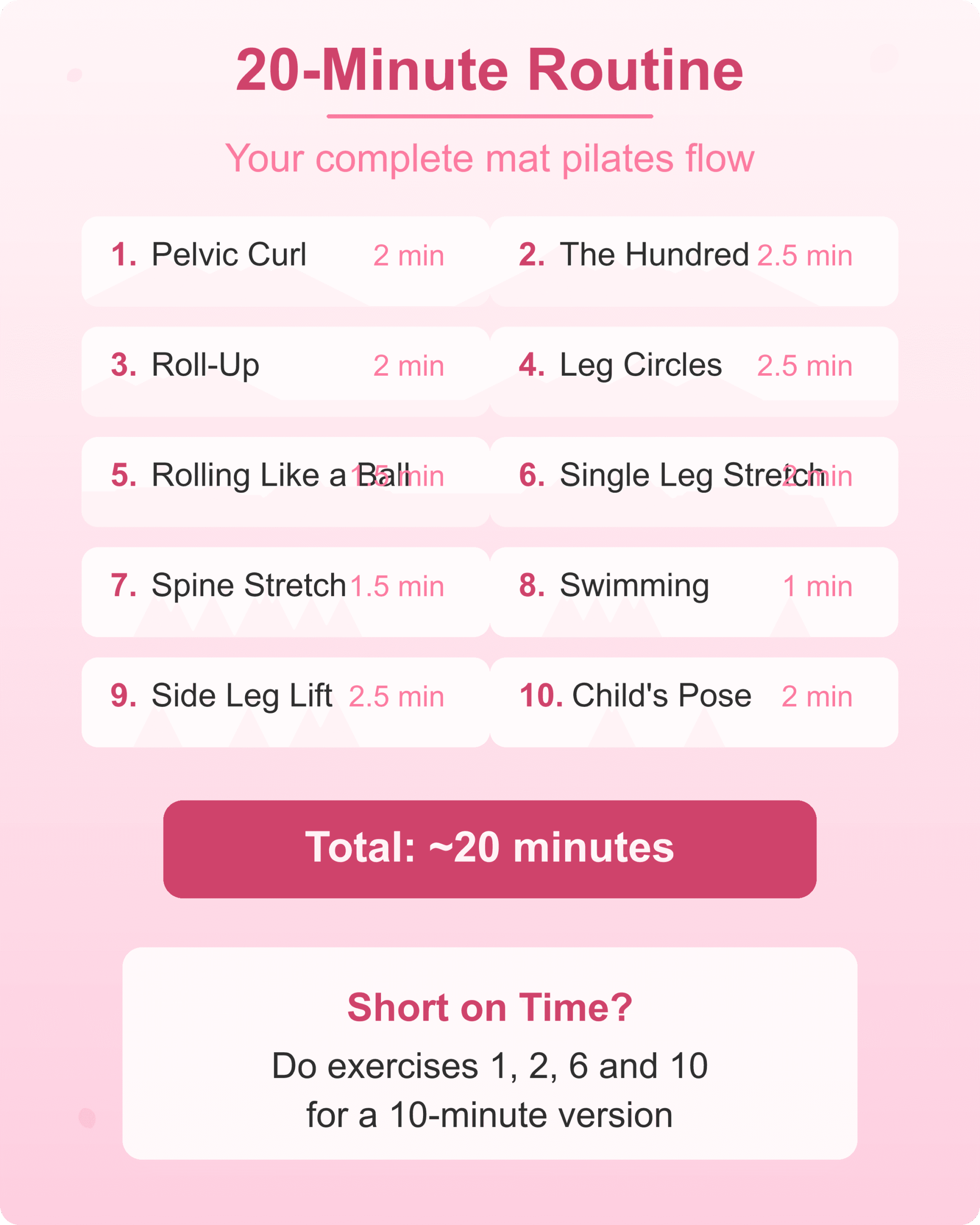
Using Your Neck Instead of Your Core
When lifting your head and shoulders in exercises like the Hundred or Single Leg Stretch, the temptation is to pull with your neck. Instead, think of your shoulder blades sliding down your back while your core lifts your upper body. If your neck hurts, place one hand behind your head for support. As your core gets stronger, the neck strain disappears.
Flaring Your Ribs
When your arms go overhead or you extend your legs, your lower ribs tend to pop up and your back arches. This means your core has disengaged. Fix it by imagining your ribcage knitting closed, keeping a connection between your front ribs and your pelvis throughout every exercise.
Holding Your Breath
The number one beginner mistake in pilates. Holding your breath increases tension and reduces core activation. Remember: exhale on the effort, inhale to prepare. If you lose the pattern, just breathe normally. Breathing imperfectly is always better than not breathing at all.
Going Too Fast
If you are finishing this 20-minute routine in 12 minutes, you are moving too quickly. Pilates works because of control. Each rep should take 3 to 5 seconds. Slow down, feel each muscle engage, and control the lowering phase of every exercise just as much as the lifting phase.
If you have been practising for a while and feel like you are not making progress, the issue may be deeper than form. Our article on why pilates is not working covers the hidden reasons results stall.
How Often Should You Do Mat Pilates at Home?
For meaningful results, three to four sessions per week is the sweet spot. This routine is gentle enough to do daily, but three to four sessions give your muscles recovery time while building strength consistently.
Here is a realistic schedule for your first month:
- Weeks 1-2: 3 times per week, 20 minutes per session. Focus on learning the exercises and breathing patterns.
- Weeks 3-4: 4 times per week. Add a second set of the exercises you find most challenging.
- Weeks 5+: 4 to 5 times per week. Increase reps, add holds, or introduce new exercises from online videos.
Most women notice improved posture and reduced stiffness within two weeks. Visible changes in core tone and body shape typically appear around weeks four to six. If you want a structured programme that builds on this foundation, the Mat Pilates at Home Playbook maps out a progressive plan so you never have to wonder what to do next.
Where Mat Pilates Fits in Your Pilates Journey
Mat pilates is not a stepping stone you leave behind. It is the foundation you keep coming back to. Even advanced pilates practitioners do mat work regularly because it demands the most from your core without any equipment assistance.
That said, adding variety keeps things interesting. Here is how mat pilates connects to other forms:
- Wall pilates: Uses the wall for support and feedback. Our wall pilates beginner guide pairs perfectly with mat work as an alternative on days when you want something different.
- Reformer pilates: Adds spring resistance and a sliding carriage. Our reformer pilates beginner guide covers everything for your first studio class.
Many women do mat pilates at home three times a week and add a reformer or wall session for variety. There is no rule that says you must choose one. The best approach is the one you actually stick with, and gentle movement always beats skipped workouts. Our gentle pilates vs HIIT guide has the science behind why.
Frequently Asked Questions
Is mat pilates enough to see real results?
Absolutely. Mat pilates builds deep core strength, improves posture, increases flexibility, and tones your entire body. Because your body is the only resistance, your stabilising muscles work harder than on a reformer. Three to four sessions per week produces visible results within four to six weeks.
Can I do mat pilates every day as a beginner?
Yes, this routine is gentle enough for daily practice. However, starting with three sessions per week gives your muscles time to adapt without soreness building up. Increase frequency gradually as your body gets stronger and the exercises feel more natural.
How is mat pilates different from yoga?
Both are floor-based and focus on controlled movement, but they differ in intention. Pilates emphasises core strength, muscular control, and spinal alignment. Yoga emphasises flexibility, balance, and mindfulness. Pilates movements are repetition-based while yoga holds poses. Many women combine both.
Do I need a thick mat for pilates?
A mat with 10 to 15mm thickness is ideal because it cushions your spine and tailbone during supine exercises. A standard yoga mat (5mm) works but may feel thin for exercises like rolling. A folded towel or blanket under your back is a perfectly good alternative if you do not want to buy a mat yet.
What if I cannot do an exercise properly?
Modify it. Bend your knees if straight legs feel too hard. Keep your head down if your neck hurts. Use a smaller range of motion. Pilates is about where you are today, not where you think you should be. Every modification is still working your muscles. Progress comes from consistency, not perfection.
Your Next Step
You have 10 exercises, a 20-minute routine, and zero reasons to wait. Mat pilates at home for beginners is not a compromise. It is the purest form of pilates there is: your body, your floor, and your intention to move with control. No equipment can replicate what that builds.
Do the routine once. Notice how your body feels afterward: taller, more open, more connected. Do it again in two days. By the end of your first month, you will understand why millions of women have made pilates the foundation of their wellness practice.
Ready for more structure? The Pink Pilates Starter Kit and Mat Pilates at Home Playbook give you progressive routines, printable guides, and a clear path from beginner to confident practitioner.
You do not need to be flexible. You do not need to be strong. You just need to start, and let your body bloom from there.