You do not need a reformer. You do not need a studio membership. You do not even need a mat. All you need is a wall and about fifteen minutes, and you can start building a stronger core, better posture, and the kind of full-body tone that makes you feel like a completely different person. That is the beauty of wall pilates for beginners at home.
Wall pilates has exploded across TikTok and YouTube because it solves the three biggest problems beginners face: cost, intimidation, and equipment. The wall acts as your partner, your prop, and your feedback system. It supports your back during core work, gives your feet something to press against (just like a reformer footbar), and tells your body exactly where it should be in space.
This guide covers everything you need to get started: what wall pilates actually is, why it works so well for beginners, 10 foundational exercises with step-by-step instructions, and a complete 15-minute routine you can do right now. No excuses. No spending. Just you and your wall.
What Is Wall Pilates (And Why Is Everyone Doing It)?
Wall pilates is exactly what it sounds like: traditional pilates exercises adapted to use a wall for support, resistance, and alignment. The concept is not new. Pilates instructors have used walls as teaching tools for decades. What is new is the viral attention it has received, particularly from women looking for effective at-home workouts that do not require expensive equipment.
The wall serves several functions depending on the exercise. It can act as a footbar (like on a reformer), a back support for core work, a stability aid for balance exercises, or simply a reference point to keep your spine aligned. The result is that exercises that might feel wobbly or confusing on a mat become structured and supported against the wall.
How the Wall Mimics a Reformer
If you have ever watched someone use a pilates reformer, you have seen them lying on their back and pressing their feet against a bar to slide a carriage. Wall pilates recreates this dynamic. When you lie on your back with your feet flat on the wall, pressing into the wall engages the same muscle chains as pressing against a reformer footbar: glutes, hamstrings, inner thighs, and deep core.
The key difference is that on a reformer, the carriage moves. With the wall, you move your body. This means your core has to work harder to stabilise, which is actually a benefit for building foundational strength. If you are curious about how mat and reformer workouts compare, our mat pilates vs reformer results guide has a detailed breakdown.
Why Wall Pilates Is Perfect for Beginners
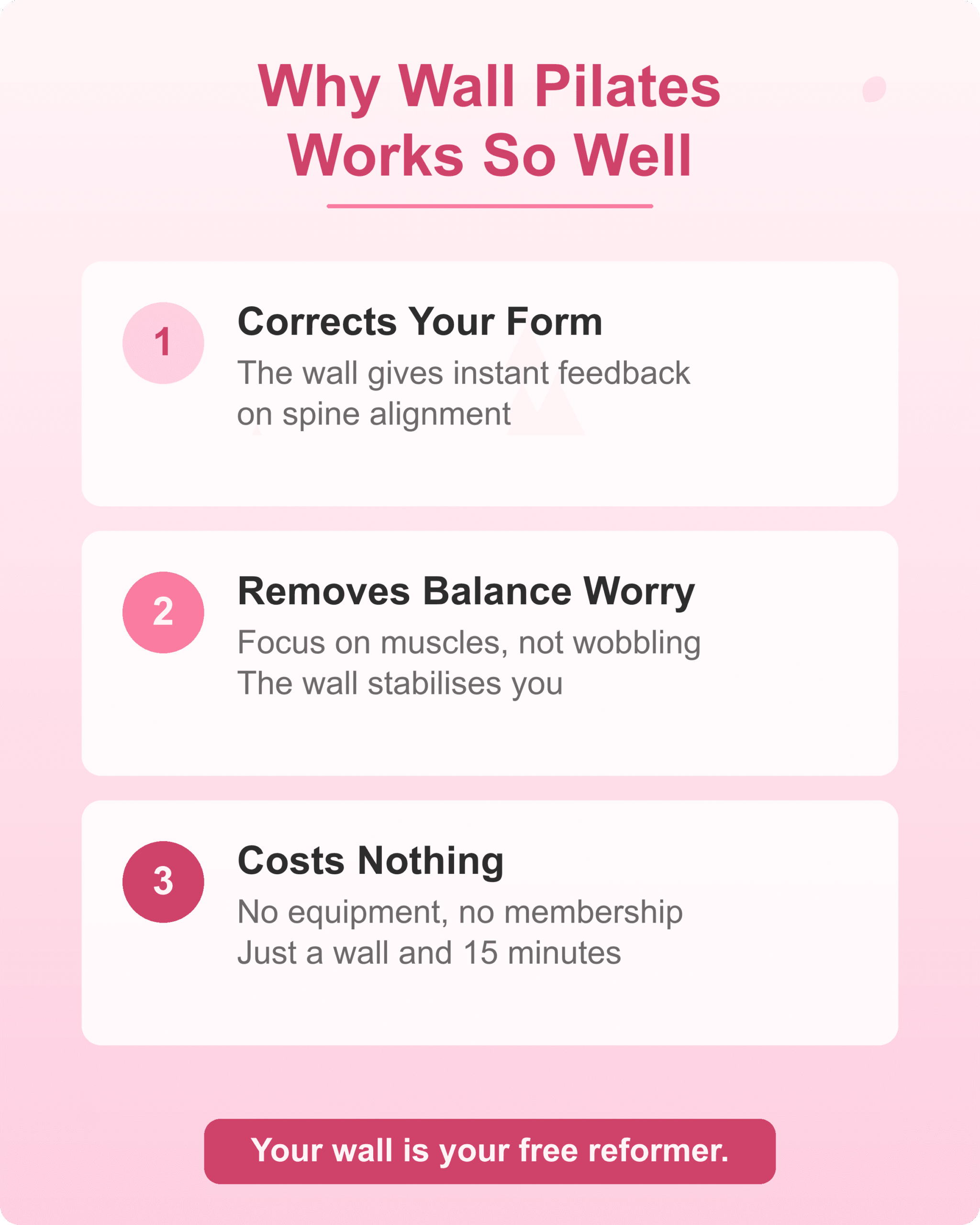
Three reasons wall pilates works so well for people who have never tried pilates before:
- The wall corrects your form. When your back is flat against a wall, you can feel whether your spine is neutral or arched. That physical feedback is something a mat cannot give you.
- It removes the balance challenge. Many beginner pilates exercises are hard not because the muscles are weak, but because the balance requirement is high. The wall removes that variable so you can focus on the muscles.
- It costs nothing. Zero equipment, zero subscription, zero gym membership. If you have a wall and a floor, you have everything you need.
Before You Start: Quick Setup Guide
Wall pilates requires almost no preparation, but these small details make a big difference in your comfort and results.
Choosing Your Wall
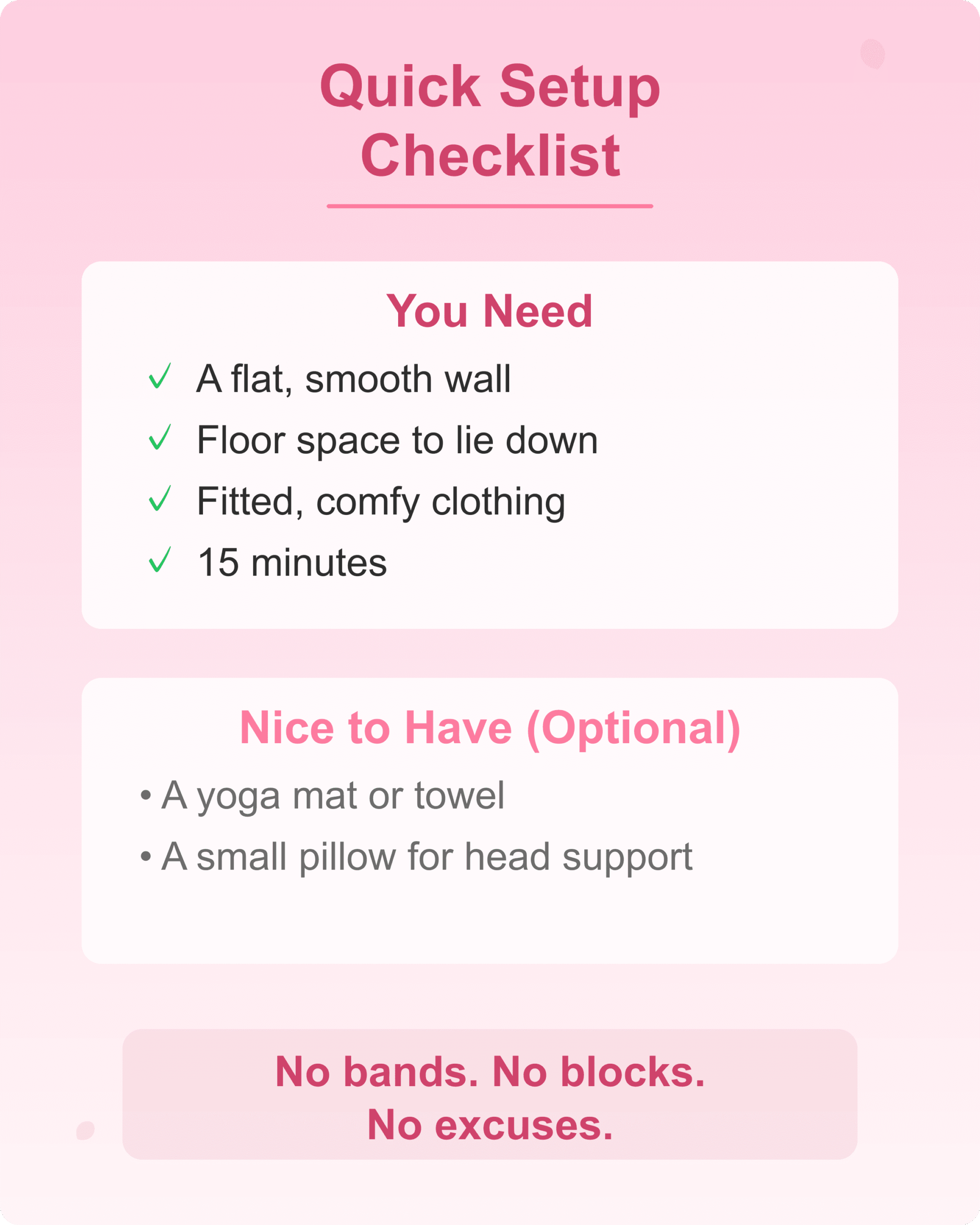
Pick a flat, smooth wall with enough floor space for you to lie down with your legs extended. Avoid walls with radiators, shelves, or artwork that could get knocked. A hallway wall or bedroom wall usually works perfectly.
What to Wear
Wear fitted clothing that lets you move freely. Socks can be helpful for exercises where your feet slide on the wall, or go barefoot for exercises where you need grip. A supportive sports bra and leggings are ideal. If you want to feel the part while you practise, our pink pilates outfit guide has budget-friendly options.
Optional Extras (Not Required)
- A yoga mat or towel: Adds cushioning for your spine when lying on the floor. Not essential, but more comfortable.
- A small pillow: Useful for head support during supine exercises if you have a stiff neck.
That is it. No bands, no blocks, no balls. Just you and the wall.
10 Foundational Wall Pilates Exercises for Beginners
These 10 exercises form the foundation of every wall pilates beginners at home routine. Master these, and you will have the strength and body awareness to progress to more advanced movements. Each exercise includes the target muscles, step-by-step instructions, and breathing cues.
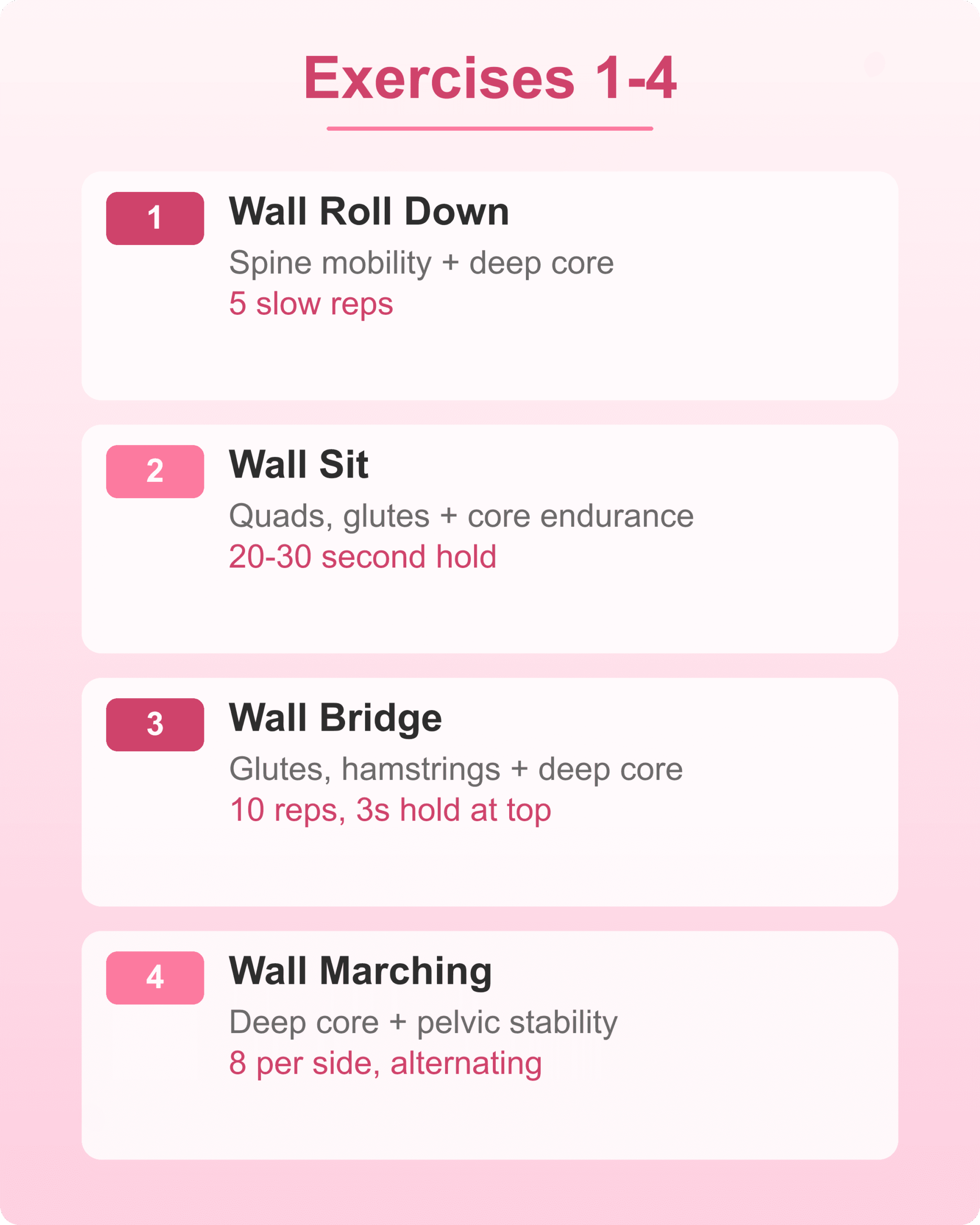
1. Wall Roll Down
Targets: Spine mobility, deep core, hamstrings
Stand with your back flat against the wall, feet hip-width apart and about a foot away from the base. Inhale to prepare. Exhale and nod your chin toward your chest, then slowly peel your spine away from the wall one vertebra at a time. Let your arms hang heavy. Roll down as far as is comfortable (your lower back may stay on the wall, and that is fine). Inhale at the bottom. Exhale and reverse the movement, restacking your spine against the wall from tailbone to head.
Reps: 5 slow roll downs
2. Wall Sit
Targets: Quadriceps, glutes, core endurance
Stand with your back against the wall and walk your feet forward about two feet. Slide your back down the wall until your thighs are roughly parallel to the floor (or as low as is comfortable). Keep your knees directly over your ankles, not past your toes. Press your lower back into the wall. Hold and breathe steadily.
Hold: 20 to 30 seconds, building to 60 seconds
3. Wall Bridge
Targets: Glutes, hamstrings, deep core
Lie on your back with your feet flat on the wall, knees bent at roughly 90 degrees. Arms rest by your sides, palms down. Exhale and press your feet into the wall as you peel your hips off the floor one vertebra at a time. Lift until your body forms a straight line from shoulders to knees. Inhale at the top. Exhale and lower back down slowly, placing each vertebra on the floor individually.
Reps: 10, with a 3-second hold at the top
4. Wall Marching
Targets: Deep core (transverse abdominis), hip flexors, pelvic stability
Start in the wall bridge position with hips lifted. Keeping your hips perfectly level (this is the challenge), exhale and lift one foot off the wall, bringing the knee toward your chest. Inhale and place it back. Exhale and lift the other foot. Your hips should not dip or tilt. If they do, lower your hips slightly.
Reps: 8 per side (16 total), alternating
5. Wall Toe Taps
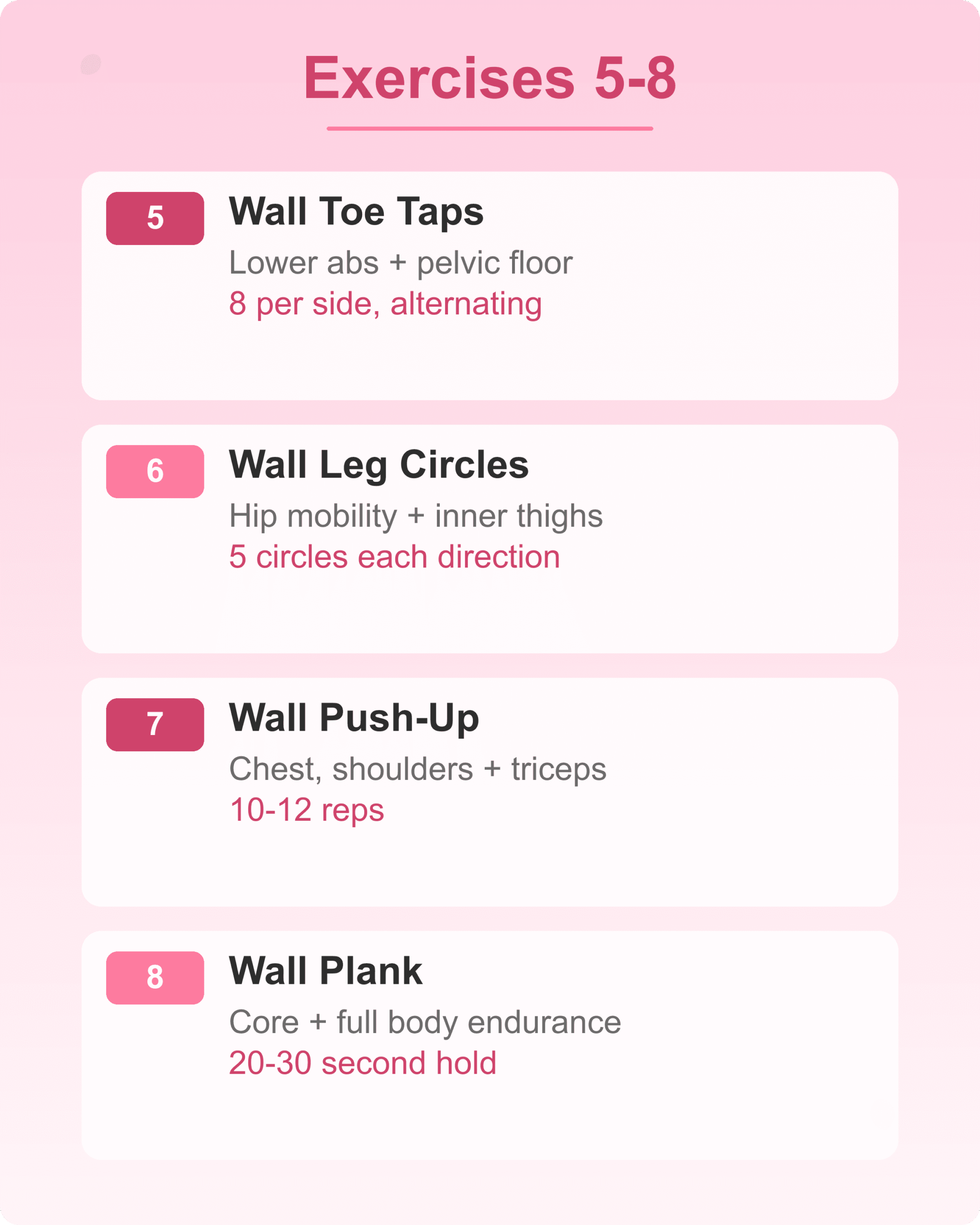
Targets: Lower abdominals, hip flexors, pelvic floor
Lie on your back with your legs up the wall, knees bent at 90 degrees so your shins are parallel to the ceiling. Press your lower back into the floor. Exhale and slowly lower one foot down the wall until the toe taps the base of the wall (or as low as you can go while keeping your back flat). Inhale and slide the foot back up. Repeat on the other side.
Reps: 8 per side (16 total), alternating
6. Wall Leg Circles
Targets: Hip mobility, inner thighs, core stability
Lie on your back with your hips close to the wall. Extend both legs straight up the wall. Slide one leg away from the wall and draw small circles in the air, keeping the other leg pressing gently into the wall for stability. Circle five times in one direction, then reverse. Switch legs.
Reps: 5 circles each direction, each leg
7. Wall Push-Up
Targets: Chest, shoulders, triceps, core
Stand facing the wall at arm’s length. Place your palms flat on the wall at shoulder height, slightly wider than shoulder width. Inhale and bend your elbows to bring your chest toward the wall, keeping your body in one straight line from head to heels. Exhale and press back to the start. The further your feet are from the wall, the harder it gets.
Reps: 10 to 12
8. Wall Plank
Targets: Core, shoulders, full body endurance
Stand facing the wall and place your forearms flat against it, elbows at shoulder height. Walk your feet back until your body forms a straight diagonal line. Engage your core and hold. This is a standing plank, gentler on the wrists and more accessible than a floor plank, but just as effective for building core endurance.
Hold: 20 to 30 seconds, building to 60 seconds
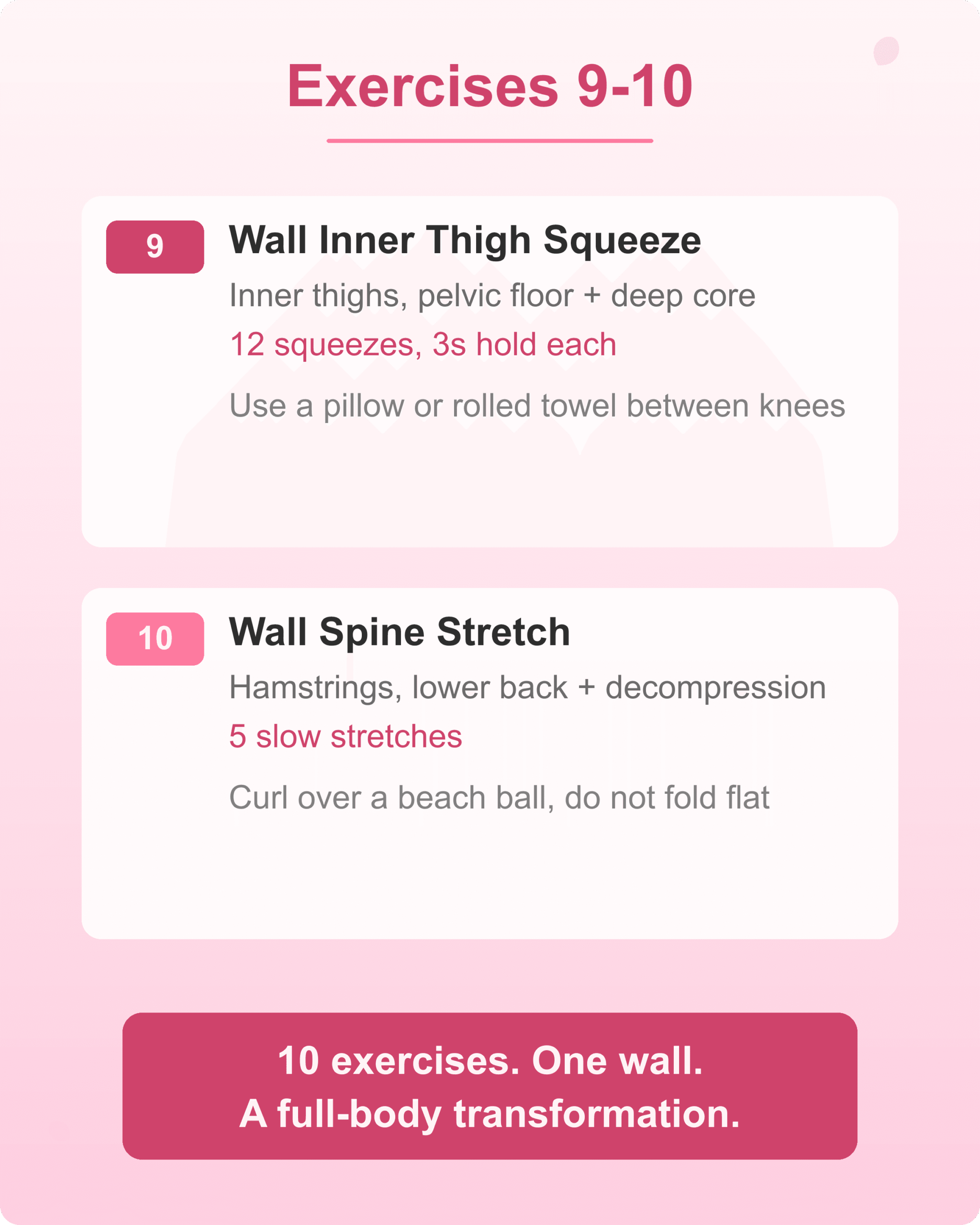
9. Wall Inner Thigh Squeeze
Targets: Inner thighs (adductors), pelvic floor, deep core
Lie on your back with your feet flat on the wall, knees bent at 90 degrees. Place a small pillow, folded towel, or even a rolled-up jumper between your knees. Exhale and squeeze your knees together firmly, holding for 3 seconds. Inhale and release slightly (do not drop the pillow). The squeeze activates the inner thigh and pelvic floor connection that is central to pilates.
Reps: 12 squeezes with a 3-second hold each
10. Wall Spine Stretch
Targets: Hamstrings, lower back, spine decompression
Sit on the floor facing the wall with your legs extended and feet flat against the wall, about hip-width apart. Sit tall with your back straight. Inhale and reach your arms up. Exhale and round forward over your legs, reaching your hands toward the wall. Think of curling over a beach ball rather than folding flat. Inhale at the deepest point. Exhale and restack your spine to sitting.
Reps: 5 slow stretches
Your Free 15-Minute Wall Pilates Routine
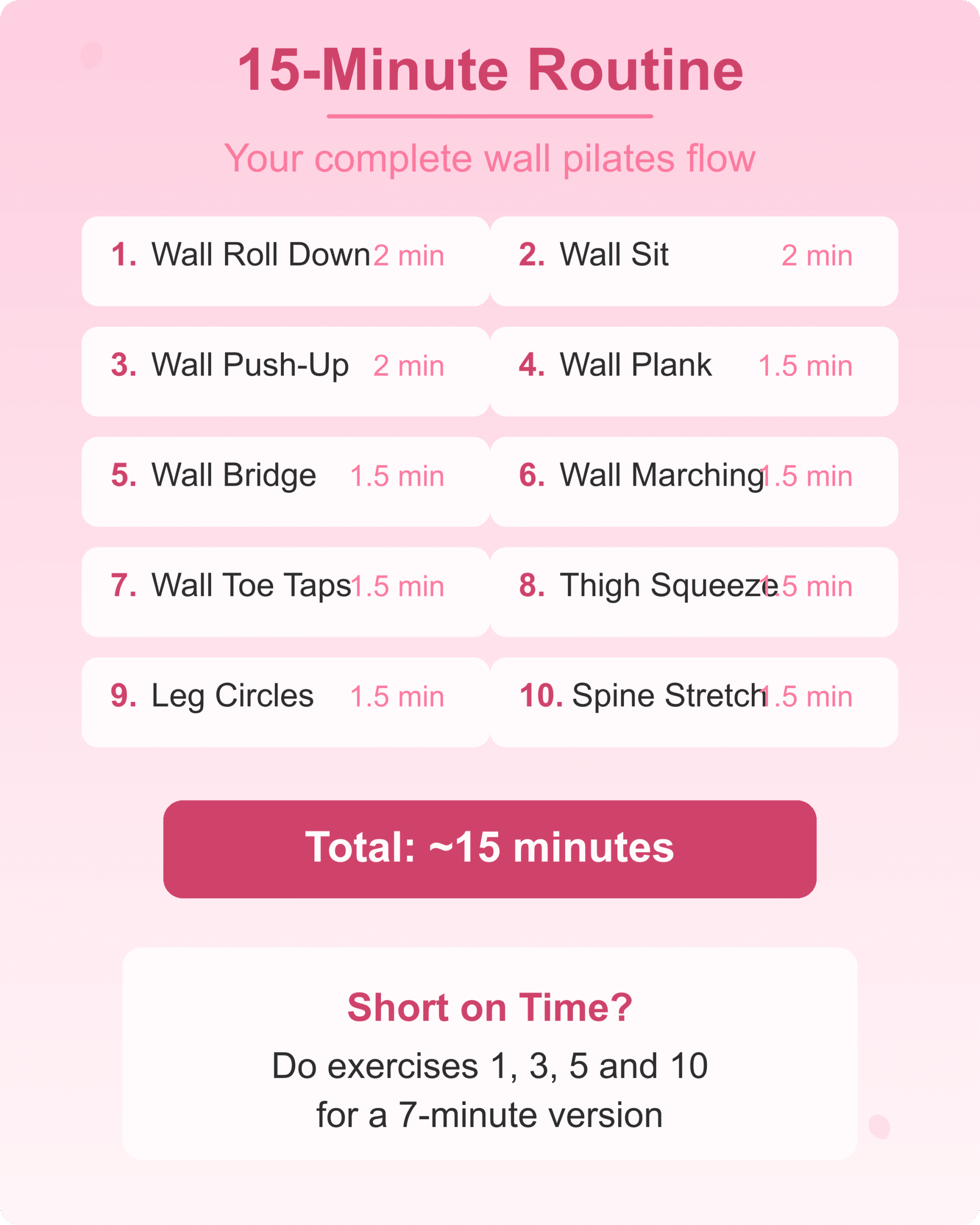
Now that you know the exercises, here is how to put them together into a complete wall pilates at home routine. This sequence flows from standing to supine, warming up your body progressively and finishing with a stretch.
- Wall Roll Down: 5 reps (2 minutes)
- Wall Sit: 30-second hold x 2 (2 minutes)
- Wall Push-Up: 10 reps x 2 sets (2 minutes)
- Wall Plank: 30-second hold x 2 (1.5 minutes)
- Wall Bridge: 10 reps (1.5 minutes)
- Wall Marching: 8 per side (1.5 minutes)
- Wall Toe Taps: 8 per side (1.5 minutes)
- Wall Inner Thigh Squeeze: 12 squeezes (1.5 minutes)
- Wall Leg Circles: 5 each direction, each leg (1.5 minutes)
- Wall Spine Stretch: 5 reps (1.5 minutes)
Total time: Approximately 15 minutes. Rest between exercises if needed. The goal is controlled movement, not speed.
If 15 minutes feels like a lot to commit to right now, that is okay. Start with exercises 1, 3, 5, and 10 for a quick 7-minute version. You can build up to the full routine over two to three weeks. If you struggle with staying on track, our pilates consistency tips can help you build a routine that sticks.
Common Mistakes to Avoid
Wall pilates is forgiving, but these errors can limit your results or cause discomfort. Watch for them from day one.
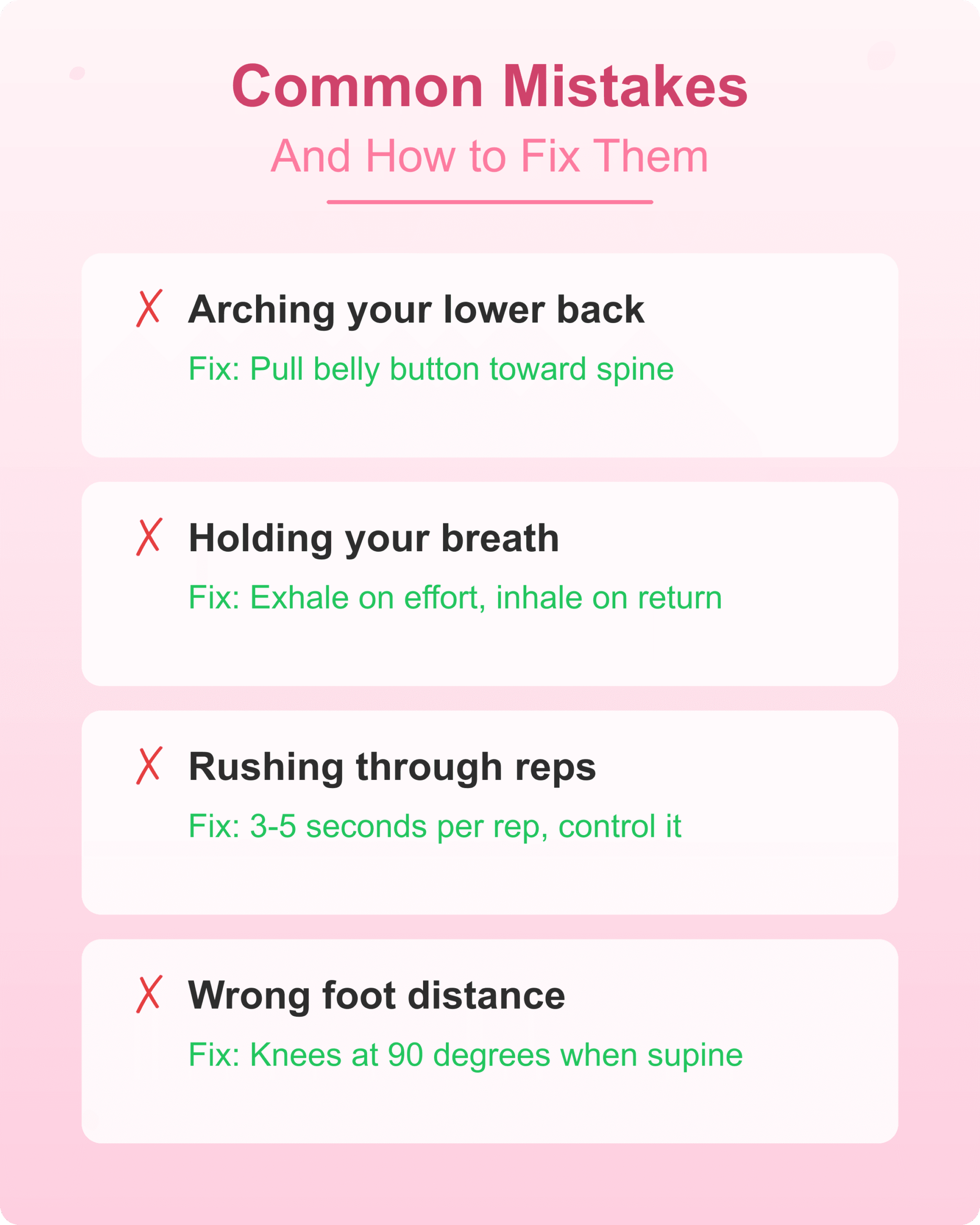
Arching Your Lower Back
During supine exercises (lying on your back), your lower back should stay pressed into the floor. If it arches, your deep core is not engaged and your hip flexors are taking over. Fix this by gently pulling your belly button toward your spine before starting each rep.
Holding Your Breath
The most common beginner mistake in any form of pilates. Holding your breath increases tension and reduces core activation. Exhale on the effort (the hard part) and inhale on the return. If you forget, just keep breathing. Imperfect breathing is better than no breathing.
Rushing Through Reps
Wall pilates works because of control, not speed. Each rep should take 3 to 5 seconds. If you are finishing the entire routine in 8 minutes, you are moving too fast. Slow down, feel the muscle working, and control the return phase of every exercise.
Placing Feet Too Close or Too Far from the Wall
For standing exercises like the wall sit, your feet should be about two feet from the wall. Too close and your knees will push past your toes. Too far and you will slide down. For supine exercises, your hips should be close enough that your knees bend to roughly 90 degrees when your feet are flat on the wall.
If you have been doing pilates for a while and not seeing results, the issue might not be the exercises themselves. Our guide on why pilates is not working covers the most common hidden reasons progress stalls.
How Often Should You Do Wall Pilates?
For visible results, aim for three to four sessions per week. This routine is gentle enough to do daily if you want, but three sessions give your muscles adequate recovery time while building strength consistently.
Here is a realistic beginner schedule:
- Weeks 1-2: 3 times per week, 15 minutes per session
- Weeks 3-4: 4 times per week, adding a second set of the exercises you find most challenging
- Weeks 5+: 4 to 5 times per week, increasing hold times and reps
Most women start noticing changes in how they feel (more energy, less stiffness, better posture) within two weeks. Visible changes in muscle tone and body shape typically show up around weeks four to six with consistent practice.
If you are looking for a more structured progression, our beginner pilates workout pairs perfectly with wall pilates for a well-rounded weekly routine.
Wall Pilates vs Other Forms of Pilates
Wall pilates is not a replacement for mat or reformer pilates. It is an entry point. Think of it as the first step in a journey that can go wherever you want it to go.
- Wall pilates: Best for absolute beginners, zero cost, builds foundational strength and body awareness.
- Mat pilates: The next step up. More challenging because you lose the wall’s support. Still free to do at home.
- Reformer pilates: Studio-based, spring-assisted, more variety of exercises. Our reformer pilates for beginners guide covers everything you need for your first class.
Many women combine wall pilates on busy days (when 15 minutes is all they have) with longer mat sessions or weekly studio classes. There is no rule that says you have to pick just one. The movement that works best is the one you actually do.
For a deeper look at how gentle movement outperforms intense workouts for lasting results, our gentle pilates vs HIIT guide has the science.
Frequently Asked Questions
Does wall pilates actually work for toning?
Yes. Wall pilates engages the same deep core muscles, glutes, and stabilisers as mat and reformer pilates. The wall adds feedback and support, making it easier to maintain correct form. With consistent practice (three to four times per week), most beginners see visible toning within four to six weeks.
Can wall pilates help with belly fat?
Wall pilates strengthens core muscles and improves posture, which can reduce the appearance of belly bloat. For actual fat loss, combine wall pilates with balanced nutrition. Pilates alone is excellent for muscle tone and body composition, but spot reduction of fat is a myth.
Is wall pilates safe for bad knees?
Wall pilates is one of the safest exercise options for people with knee concerns. The wall provides stability, reduces impact, and allows you to control your range of motion precisely. Exercises like the wall bridge and toe taps put zero stress on the knees. If you have a specific injury, consult your doctor first.
How long should a wall pilates session be for beginners?
Fifteen minutes is the sweet spot for beginners. It is long enough to work every major muscle group, short enough to fit into any schedule, and gentle enough to do without exhaustion. As you build strength, you can extend sessions to 20 or 30 minutes.
Do I need a mat for wall pilates?
No. A mat adds comfort for exercises where you lie on the floor, but it is not required. A folded towel or blanket works just as well. Some exercises (wall sit, wall push-up, wall plank) are done standing, so no floor cushioning is needed at all.
Your Next Step
You have a wall. You have 15 minutes. You now have 10 exercises and a complete routine. That is genuinely all it takes to begin. Wall pilates for beginners at home is not a watered-down version of the real thing. It is the real thing, simplified so you can start today without spending a single penny.
Try the 15-minute routine once. If it feels good (and it will), do it again in two days. By the end of your second week, you will feel stronger, taller, and more connected to your body than any high-intensity workout has ever made you feel.
Want to take your practice further? The Pink Pilates Starter Kit gives you structured progressions, printable routines, and everything you need to build on what you have started here.
You do not need to be perfect. You do not need equipment. You just need a wall and the willingness to bloom.