Your lower back aches. It aches when you sit at your desk, when you stand up from the couch, when you bend down to pick something up. You have tried stretching, painkillers, maybe even a physio appointment or two. But the pain keeps coming back. If this sounds familiar, pilates for lower back pain may be the approach your body has been waiting for.
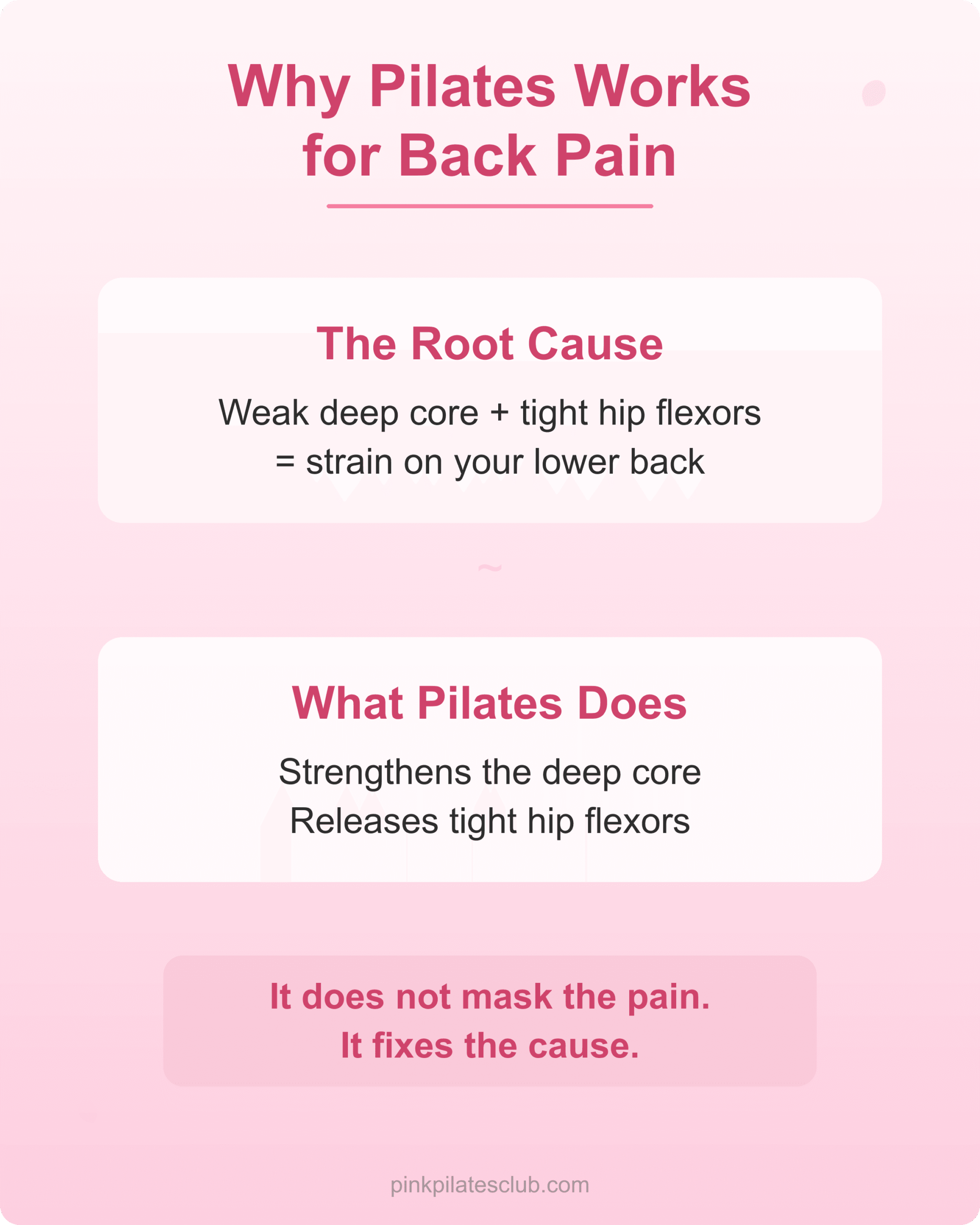
Unlike aggressive exercises that can make back pain worse, pilates works by strengthening the deep stabilising muscles that support your spine. It does not just mask the pain. It addresses the root cause: weak core muscles, tight hip flexors, and poor postural habits that put constant strain on your lower back.
This guide explains why pilates works for back pain, which specific exercises help the most, and gives you a gentle 15-minute routine you can do at home today. No equipment needed. No experience required. Just a mat and a willingness to move slowly.
Why Pilates for Lower Back Pain Works (The Science)
Lower back pain is the world’s leading cause of disability, affecting an estimated 619 million people globally according to the World Health Organization. Most cases are “non-specific,” meaning there is no single structural injury causing the pain. Instead, the pain comes from a combination of muscle weakness, postural imbalance, and nervous system sensitivity.
This is exactly where pilates excels. A 2023 systematic review published in the Journal of Clinical Medicine found that pilates significantly reduced pain intensity and improved functional disability in chronic lower back pain patients compared to other exercise interventions.
The Core Connection
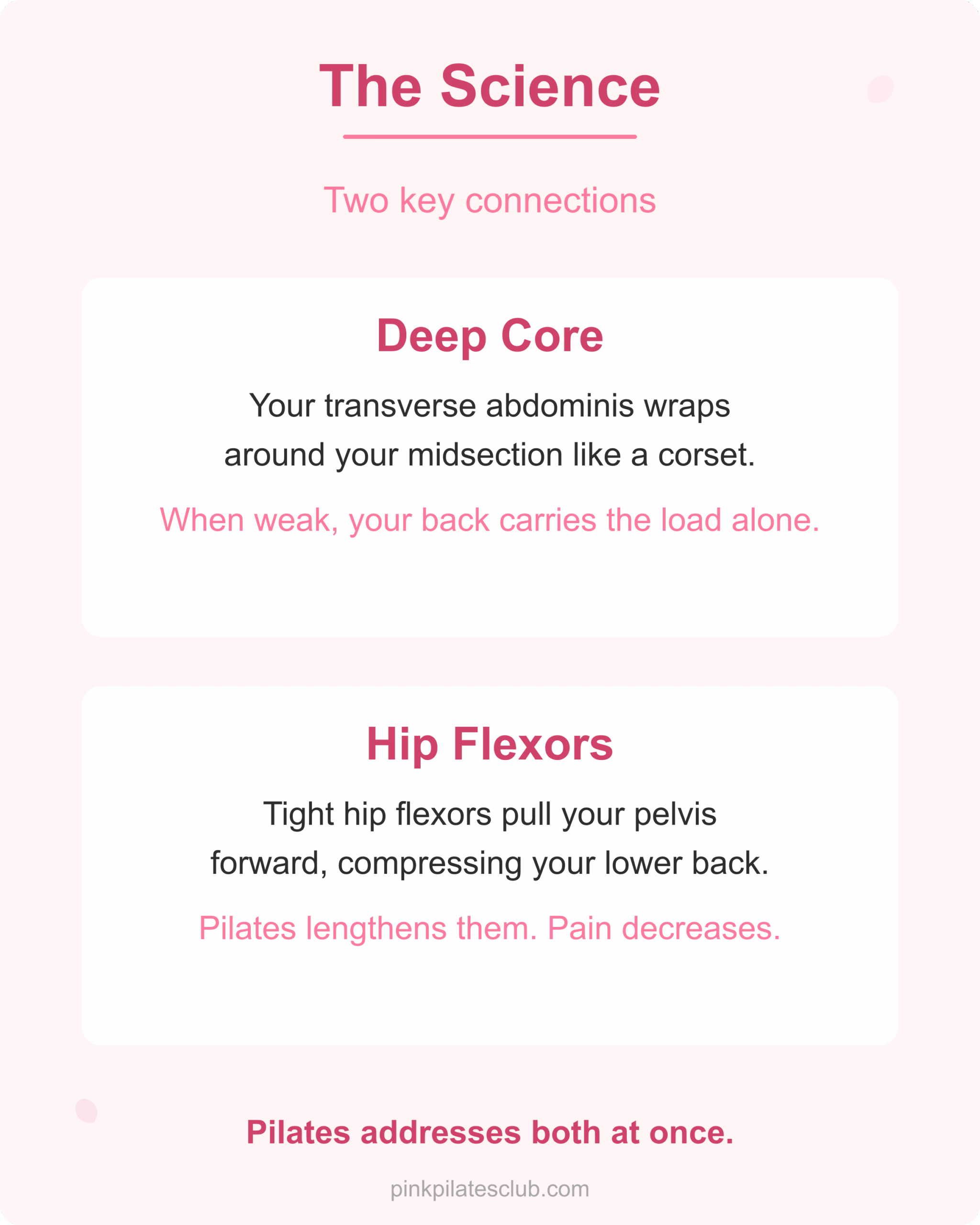
Your lower back is only as strong as the muscles that surround it. The transverse abdominis, your deepest core muscle, wraps around your midsection like a natural corset. When it is strong and active, it stabilises your spine and takes pressure off the small muscles and ligaments in your lower back that were never designed to carry the load alone.
Most people with lower back pain have a weak transverse abdominis. Their surface abs (the rectus abdominis) may be strong, but the deep stabiliser is dormant. Pilates is specifically designed to wake this muscle up and train it to fire automatically throughout your day. If you want to understand the difference between deep and surface core muscles, our guide on why pilates is not working has a detailed breakdown.
The Hip Flexor Connection
If you sit at a desk for most of the day, your hip flexors are almost certainly tight. Tight hip flexors pull on the front of your pelvis, tilting it forward and creating an exaggerated curve in your lower back. This anterior pelvic tilt compresses the lumbar vertebrae and causes pain.
Pilates addresses this directly through exercises that lengthen the hip flexors while strengthening the glutes and deep core. Over time, your pelvis returns to a more neutral position and the compression on your lower back decreases.
Before You Start: Important Safety Notes
While pilates for lower back pain is generally very safe, a few guidelines will keep your practice effective and pain-free:
- If you have a diagnosed spinal condition (herniated disc, spinal stenosis, spondylolisthesis), check with your doctor or physiotherapist before starting. These conditions may require specific modifications
- Pain is your signal. Mild discomfort during exercise is normal. Sharp, shooting, or radiating pain is not. If an exercise causes sharp pain, stop immediately and skip it
- Start gentler than you think you need to. Your lower back is sensitive. It responds better to less intensity done consistently than to occasional intense sessions
- Never force a range of motion. Go only as far as your body allows without pain. Your range will increase naturally over weeks of practice
The Gentle 15-Minute Pilates Routine for Lower Back Pain
This routine targets the four key areas that contribute to lower back pain: deep core weakness, hip flexor tightness, glute inactivation, and spinal mobility. Do it three to five times per week for best results.
Exercise 1: Pelvic Tilts (2 Minutes)
Lie on your back with your knees bent and feet flat on the floor, hip-width apart. Arms rest by your sides. Inhale to prepare. As you exhale, gently press your lower back into the mat by engaging your deep core (draw your belly button toward your spine). You will feel your pelvis tilt slightly. Hold for three seconds, then inhale and release back to neutral.
Repetitions: 10 slow, controlled reps. Focus on the quality of each tilt, not speed.
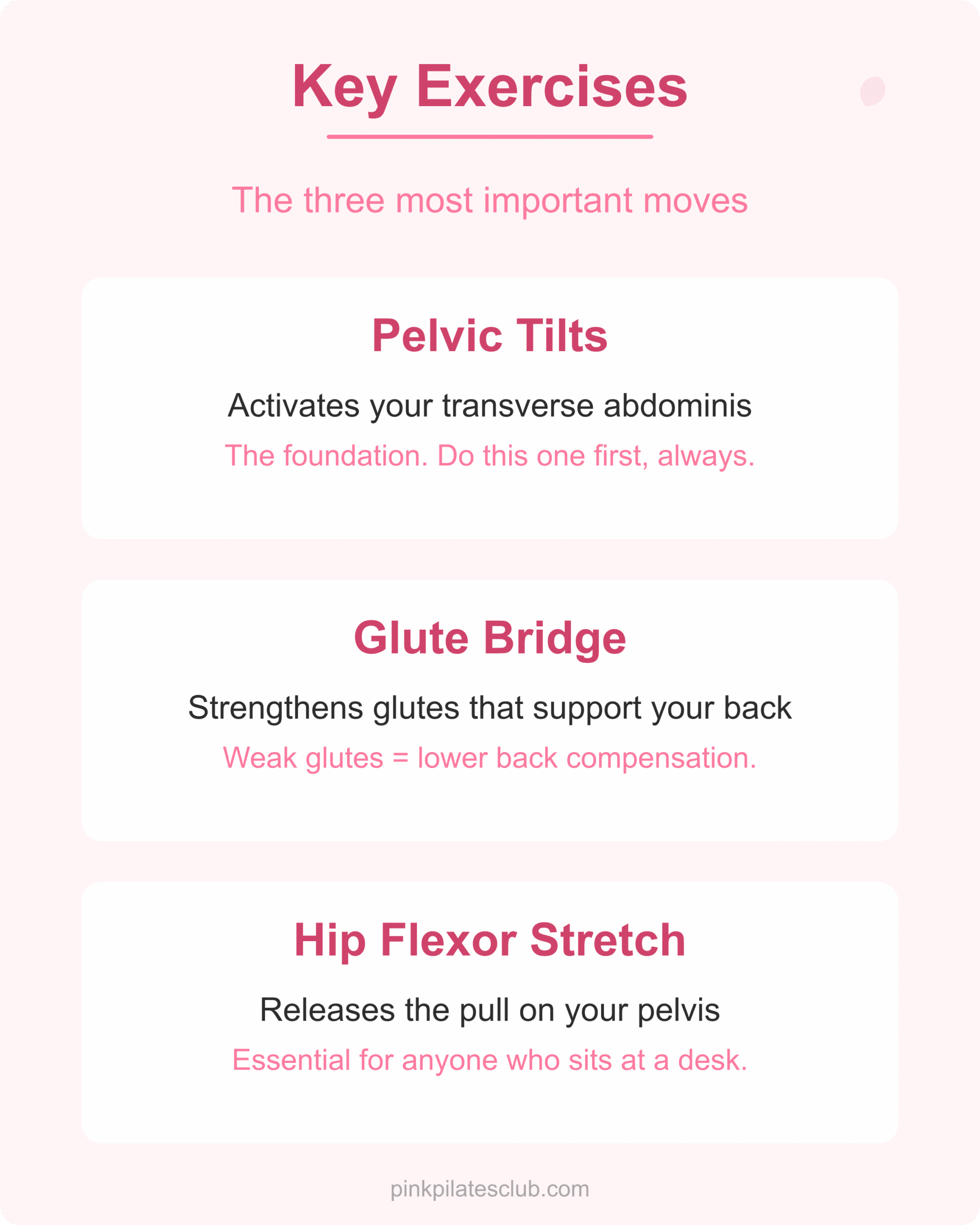
Why it helps: pelvic tilts teach your transverse abdominis to activate and gently mobilise the lumbar spine. This is the foundation exercise for all pilates for back pain routines.
Exercise 2: Dead Bug (2 Minutes)
Stay on your back. Lift both legs to tabletop position (knees directly above hips, shins parallel to the floor). Extend both arms straight up toward the ceiling. Inhale to prepare. As you exhale, slowly lower your right arm overhead and extend your left leg out straight, hovering it just above the mat. Inhale and return to the start. Repeat on the other side.
Repetitions: 8 reps total (4 per side), alternating.
Why it helps: the dead bug challenges your deep core to stabilise your spine while your limbs move. This mimics real-life demands on your back and trains the muscles that protect it.
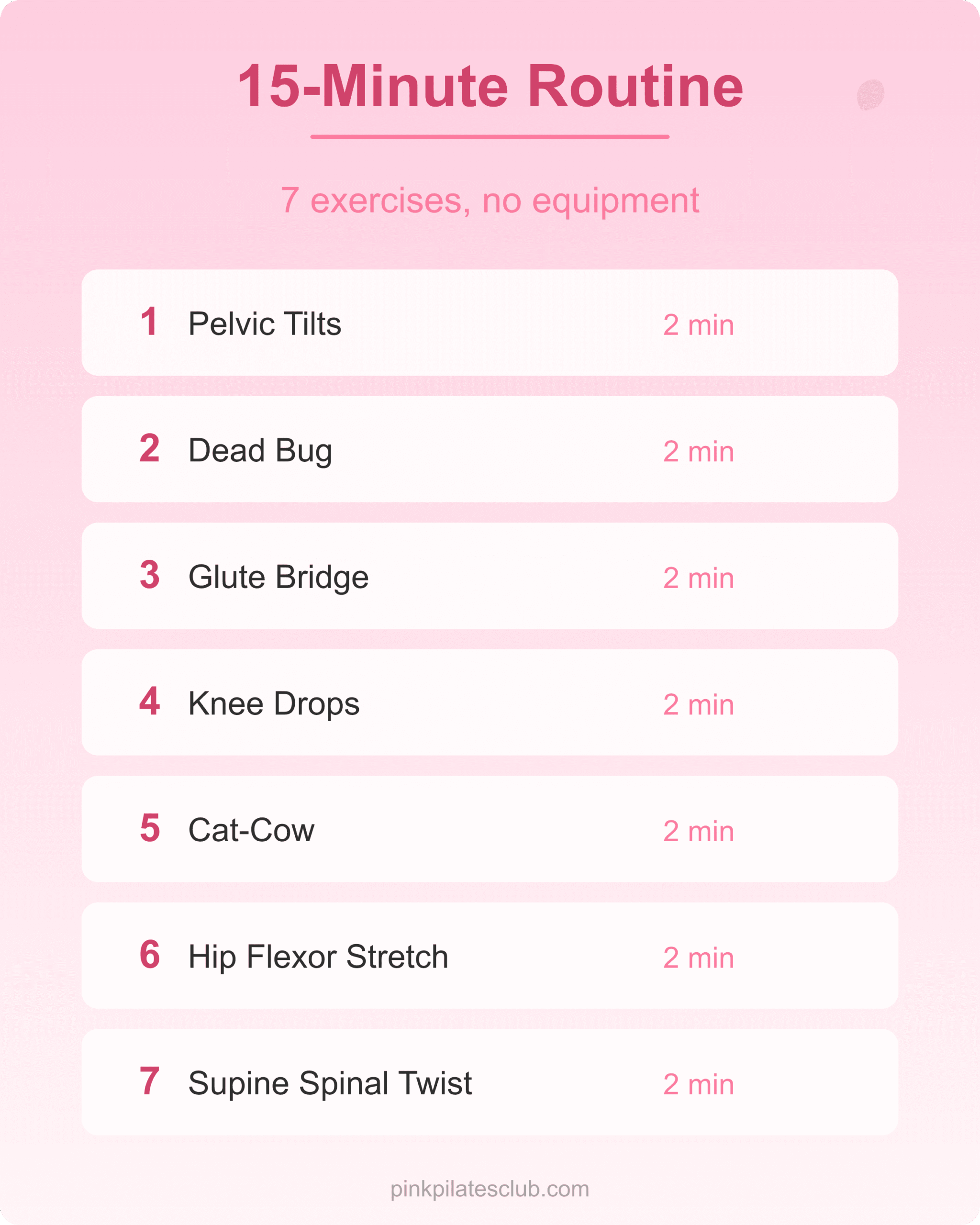
Exercise 3: Glute Bridge (2 Minutes)
Lie on your back with knees bent, feet flat, hip-width apart. Inhale to prepare. Exhale and press through your heels to lift your hips toward the ceiling, one vertebra at a time. Squeeze your glutes at the top. Hold for two seconds. Inhale and slowly lower back down, rolling through each vertebra.
Repetitions: 10 slow reps. Pause at the top of each one.
Why it helps: weak glutes are one of the primary causes of lower back pain. When your glutes do not fire properly, your lower back muscles compensate. Glute bridges activate and strengthen your glutes while gently mobilising your spine.
Exercise 4: Knee Drops (2 Minutes)
Stay on your back with knees bent and feet flat. Place your hands on your hip bones so you can feel if your pelvis moves. Inhale and slowly let both knees drop to the right, keeping your feet on the mat. Only go as far as you can without your left hip lifting off the mat. Exhale and use your core to bring your knees back to centre. Repeat to the left.
Repetitions: 6 reps per side, alternating.
Why it helps: knee drops build rotational stability in your core and gently stretch the muscles along the sides of your spine. They teach your obliques to work with your deep core as a team.
Exercise 5: Cat-Cow (2 Minutes)
Come to all fours with your wrists under your shoulders and knees under your hips. Inhale and let your belly drop toward the mat, lifting your chest and tailbone (cow). Exhale and round your spine toward the ceiling, tucking your chin and tailbone (cat). Move slowly and let each vertebra participate in the movement.
Repetitions: 8 slow reps. Let the breath guide the pace.
Why it helps: cat-cow mobilises every segment of your spine, increasing blood flow to the discs and releasing tension in the surrounding muscles. It is one of the most recommended spinal mobility exercises by physiotherapists worldwide.
Exercise 6: Hip Flexor Stretch (2 Minutes)
From all fours, step your right foot forward into a low lunge. Keep your left knee on the mat. Tuck your pelvis slightly (posterior tilt) and gently shift your weight forward until you feel a stretch in the front of your left hip. Hold for 30 seconds. Switch sides.
Repetitions: 2 holds per side, 30 seconds each.
Why it helps: this directly addresses the tight hip flexors that pull on your pelvis and compress your lower back. If you sit at a desk, this exercise is essential.
Exercise 7: Supine Spinal Twist (2 Minutes)
Lie on your back. Draw both knees to your chest. Extend your arms out to the sides in a T shape. Let both knees drop to the right as you look to the left. Hold for 30 seconds, breathing deeply. Switch sides.
Repetitions: 2 holds per side, 30 seconds each.
Why it helps: this gentle twist releases tension in the muscles along your spine (the paraspinals) and stretches your lower back in a position that is completely supported by the floor. It is a perfect closing exercise.
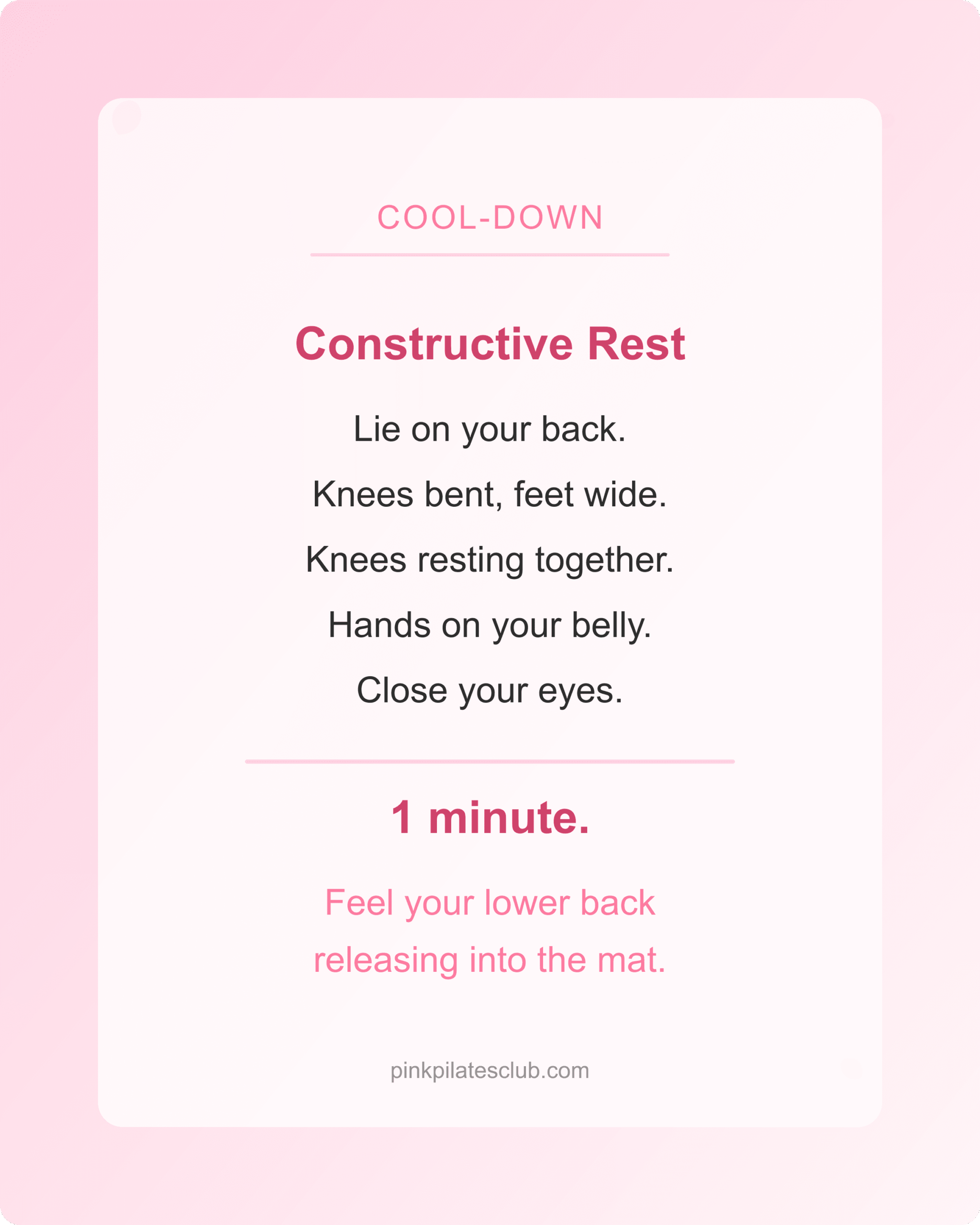
Cool-Down: Constructive Rest (1 Minute)
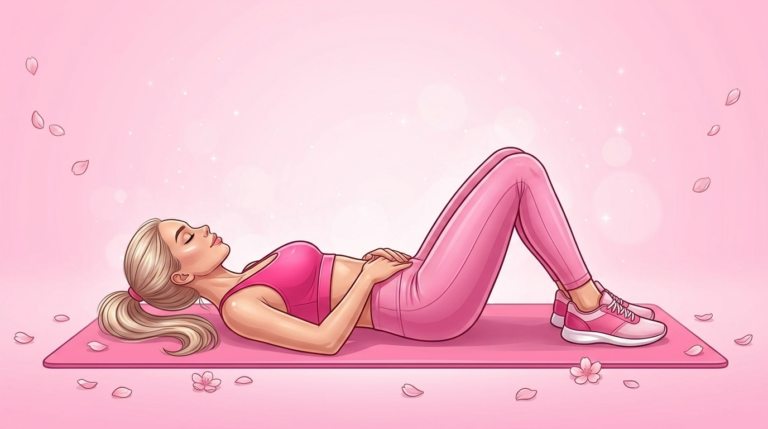
Stay on your back. Bend your knees and place your feet flat on the mat, slightly wider than hip-width. Let your knees rest against each other. Place your hands on your lower belly. Close your eyes. Breathe deeply for one minute. Feel your lower back releasing into the mat.
How Often Should You Do Pilates for Lower Back Pain?
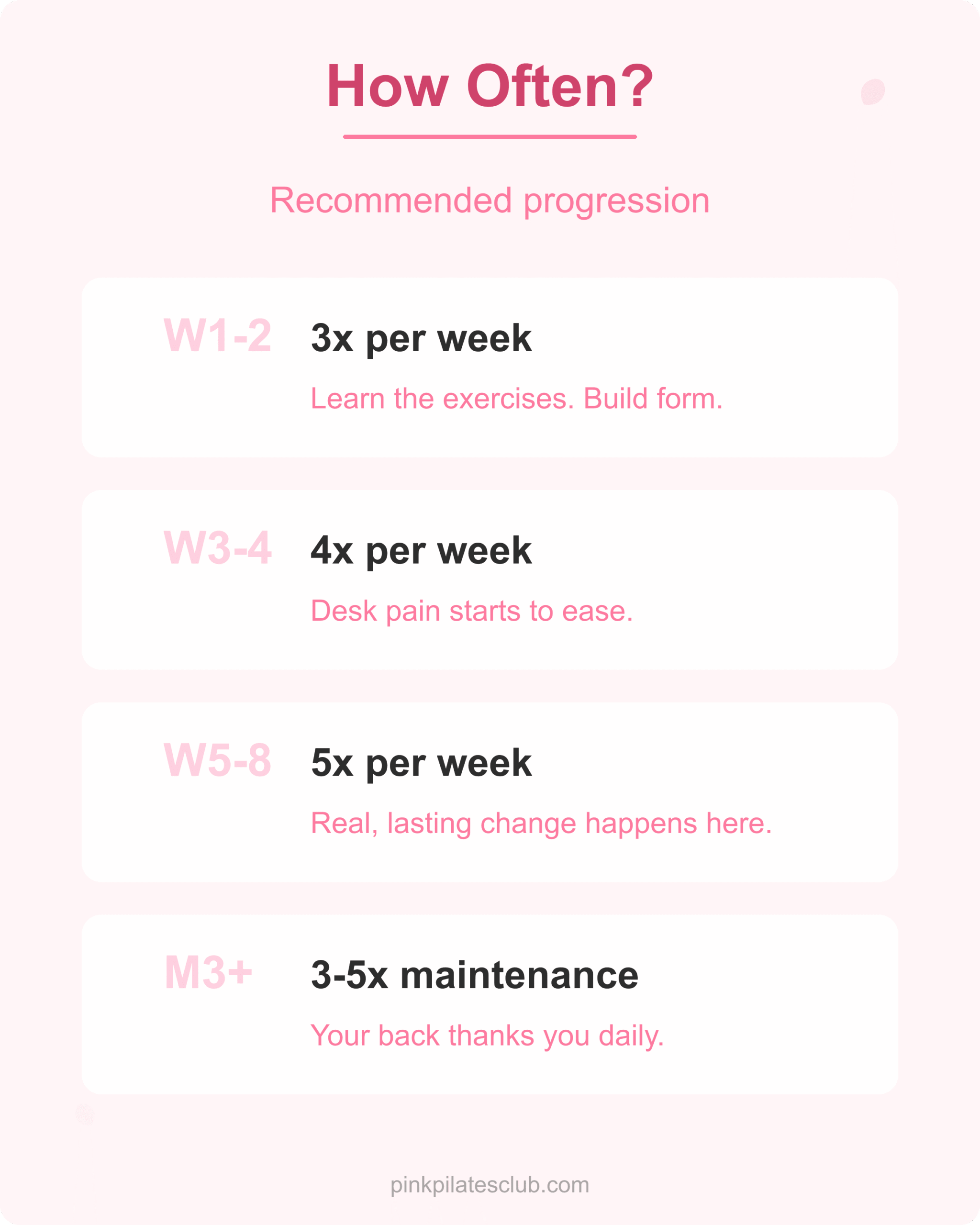
Consistency matters more than intensity. Here is the recommended progression:
- Weeks 1 to 2: three sessions per week. Focus on learning the exercises with proper form. Expect some mild muscle soreness (not back pain). Your body is learning new movement patterns
- Weeks 3 to 4: four sessions per week. The exercises will start to feel more natural. You may notice that your back aches less at your desk
- Weeks 5 to 8: five sessions per week. This is where meaningful change happens. Your core is consistently supporting your spine throughout the day
- Ongoing: maintain with three to five sessions per week. Many women continue this routine indefinitely because of how good it makes their back feel
If you struggle to stay consistent with any routine, our guide on pilates consistency tips has practical strategies for making pilates a daily habit.
What Results to Expect (Realistic Timeline)
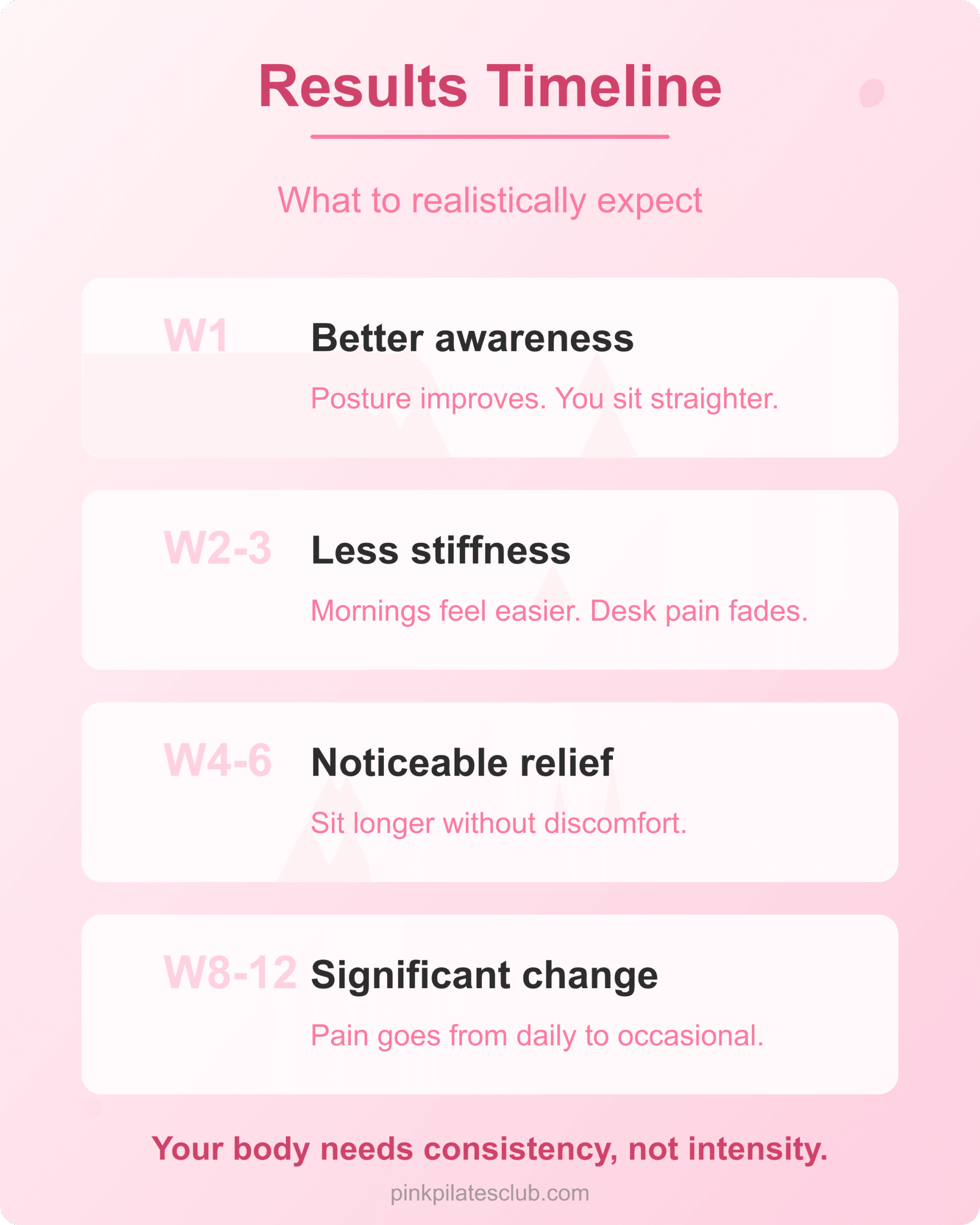
Do not expect instant relief. Pilates for lower back pain works by retraining your muscles and movement patterns, and that takes time. Here is what most women experience:
- After 1 week: improved awareness of your posture and core engagement. You may catch yourself sitting straighter
- After 2 to 3 weeks: reduced stiffness in the morning and after sitting. Pain episodes may be less frequent
- After 4 to 6 weeks: noticeable reduction in pain intensity. You can sit for longer without discomfort. Activities that used to trigger pain become easier
- After 8 to 12 weeks: significant improvement. Many women report their back pain going from a daily nuisance to an occasional reminder. Core strength is measurably better
These results assume three to five sessions per week with proper form. If you are not seeing results after six weeks, revisit the deep core activation technique in Exercise 1. The most common issue is engaging surface abs instead of the transverse abdominis.
Common Mistakes to Avoid
Even with a gentle routine like this, a few mistakes can slow your progress or aggravate your pain:
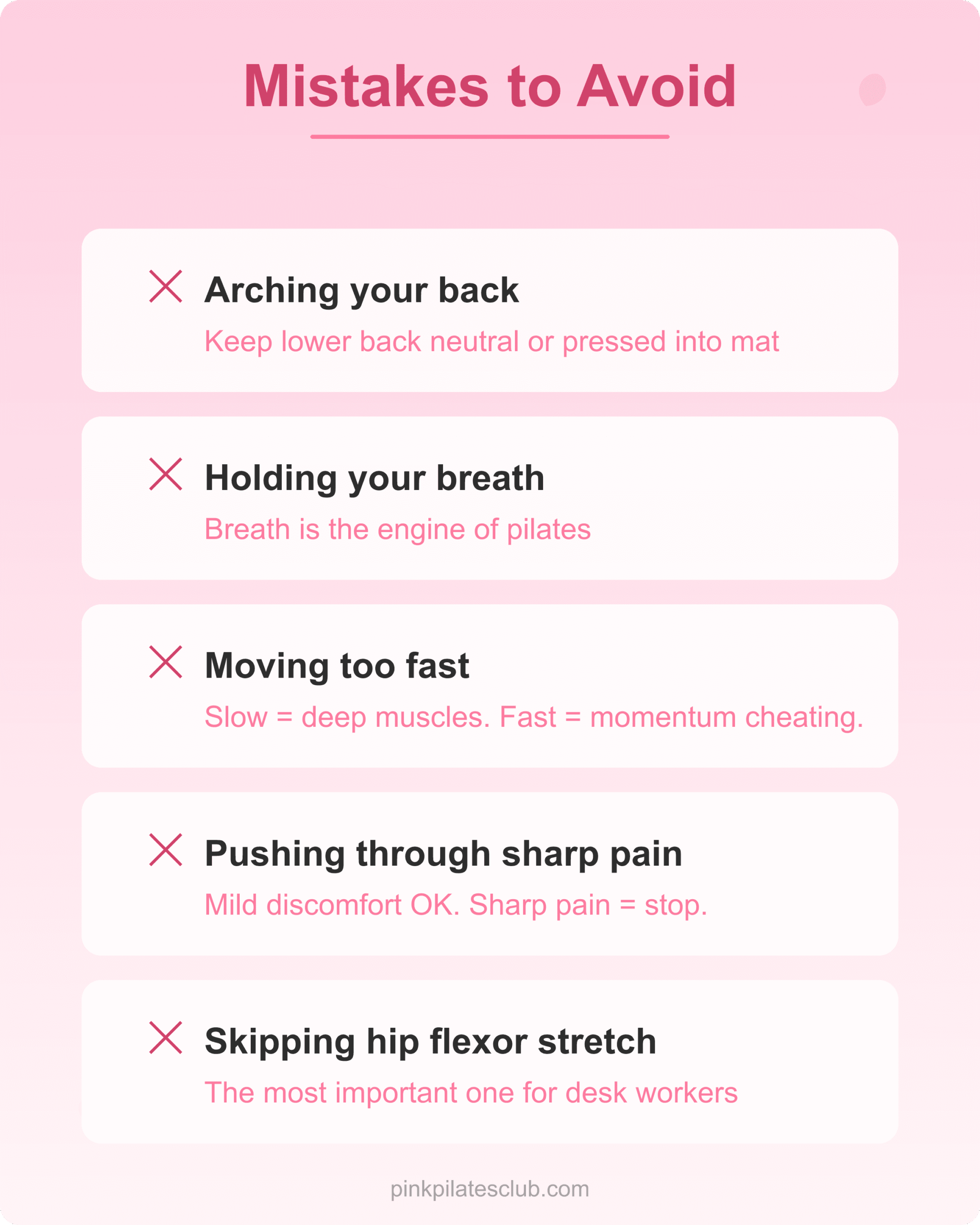
- Arching your back during exercises. Your lower back should stay neutral or gently pressed into the mat. If you feel your back arching, reduce the range of motion
- Holding your breath. Breath is the engine of pilates. When you hold your breath, your core cannot engage properly and your blood pressure spikes. Breathe continuously
- Moving too fast. Speed is the enemy of pilates for back pain. Slow, controlled movement is what builds the deep stabilising muscles. Momentum lets your body cheat
- Pushing through sharp pain. Mild discomfort is acceptable. Sharp or shooting pain means stop. Your body is telling you something is wrong
- Skipping the hip flexor stretch. This is the exercise most people skip because it does not feel like a “workout.” But for desk workers, it may be the single most important exercise in the routine
Pilates for Lower Back Pain: Desk Worker Edition
If your lower back pain is primarily caused by sitting at a desk all day, add these two habits alongside your pilates routine:
Micro-movement breaks: every 45 to 60 minutes, stand up and do 5 pelvic tilts and 5 cat-cow stretches. This takes 90 seconds and prevents the stiffness from building throughout the day.
Seated posture reset: while sitting, gently engage your deep core (draw belly button toward spine) and untuck your chin so your ears are over your shoulders. Hold this for 30 seconds. Repeat every time you notice yourself slumping. Over time, this becomes automatic.
These micro-habits complement your pilates routine by preventing the postural patterns that caused your back pain in the first place. If you want a complete daily routine that includes pilates, our morning routine guide shows you how to build a sustainable practice.
Frequently Asked Questions
Is pilates safe for lower back pain?
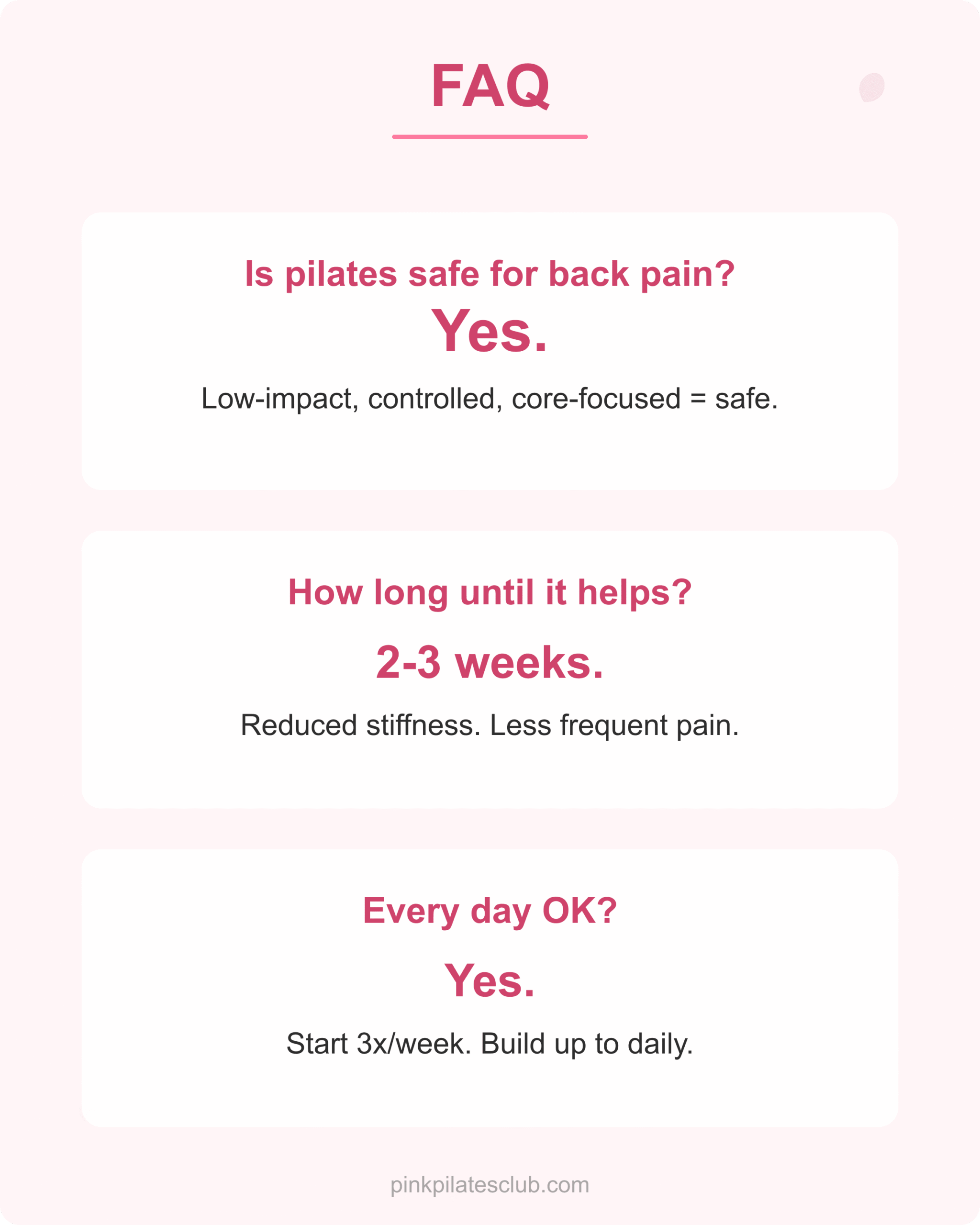
Yes. Pilates is one of the safest exercise approaches for lower back pain because it focuses on controlled, low-impact movement that strengthens the deep core muscles supporting your spine. Start gently and avoid any exercise that causes sharp pain.
How long does it take for pilates to help back pain?
Most people notice reduced stiffness within two to three weeks of consistent practice. Significant pain reduction typically occurs between weeks four and eight. Meaningful strength changes that prevent future pain episodes take eight to twelve weeks.
Can pilates make back pain worse?
If done incorrectly, yes. The most common mistakes are arching the back, moving too fast, and engaging surface abs instead of the deep core. Follow the form cues carefully and start with fewer reps than you think you need.
Should I do pilates or yoga for lower back pain?
Both can help, but pilates specifically targets deep core strength, which is the primary muscle group that supports your lower back. Yoga is excellent for flexibility and relaxation. Many women combine both, using pilates for strength and yoga for recovery.
Can I do this routine every day?
Yes, this routine is gentle enough for daily practice. However, start with three times per week for the first two weeks to allow your body to adapt. Then increase to four, five, or even daily if it feels good.
Your Next Step
If pilates for lower back pain is what brought you here, you now have everything you need to start. A 15-minute routine, seven targeted exercises, and a clear timeline for results. The only thing left is to begin.
Roll out your mat today. Start with the pelvic tilts. Move slowly. Breathe deeply. Give your body the gentle, consistent support it has been asking for. Your back will thank you.
If you are new to pilates entirely, our beginner pilates workout gives you a full introduction to the method with proper breathing cues and core activation prompts. And if you want to understand why gentle movement outperforms intense exercise for stressed bodies, our gentle pilates vs HIIT guide explains the science.
You do not need to push through the pain. You need to move gently around it.