You have been seeing little mat pilates results at home. Or thinking about starting. But a nagging voice keeps asking: is this actually enough? Can lying on the floor doing controlled movements really change your body the way a reformer class would? Is mat pilates just the “lite” version that people settle for when they cannot afford the real thing?
If you have ever felt like mat pilates results could not possibly match what you see from reformer classes, you are not alone. The fitness industry has done an excellent job of convincing women that more equipment equals more results. This article is here to set the record straight.
The short answer: yes, mat pilates can absolutely get you toned. The longer answer involves understanding what “toned” actually means, what the science says, and why mat pilates might actually demand more from your body than the reformer does.
What “Toned” Actually Means (It Is Not What You Think)
Before we can answer whether mat pilates gets you toned, we need to clarify what toning actually is, because the fitness industry uses this word in misleading ways.
The Science of Toning
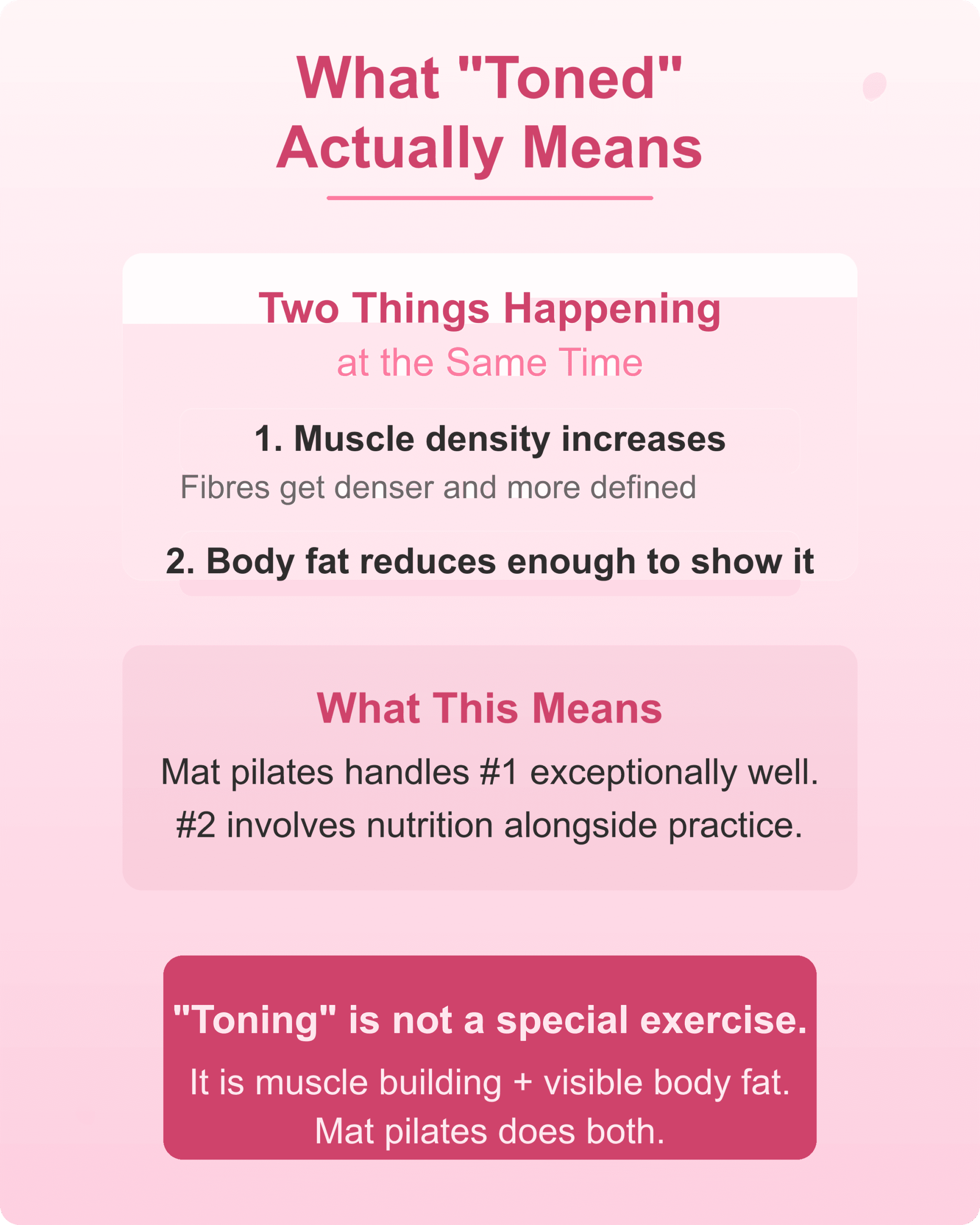
“Muscle tone” refers to the residual tension in a muscle at rest. When people say they want to look “toned,” what they actually mean is two things happening simultaneously:
- Increased muscle density: The muscle fibres become denser and more defined, creating visible shape under the skin.
- Reduced body fat covering the muscle: Even well-developed muscles are invisible if a layer of fat sits on top of them.
This is important because it means toning is not a special type of exercise. It is any exercise that builds muscle combined with a body fat level that lets that muscle show. Mat pilates handles the first part exceptionally well. The second part involves nutrition alongside your practice.
Why This Matters for Mat Pilates
Mat pilates builds long, lean, dense muscle. It does not create bulk (your body weight is the only resistance, which is not heavy enough for significant hypertrophy). But it absolutely creates the kind of defined, sculpted look that most women describe as “toned.” The research confirms this, and we will get to that next.
What the Research Says About Mat Pilates Results
The evidence base for mat pilates is robust. Here is what the studies actually found.
Core Strength
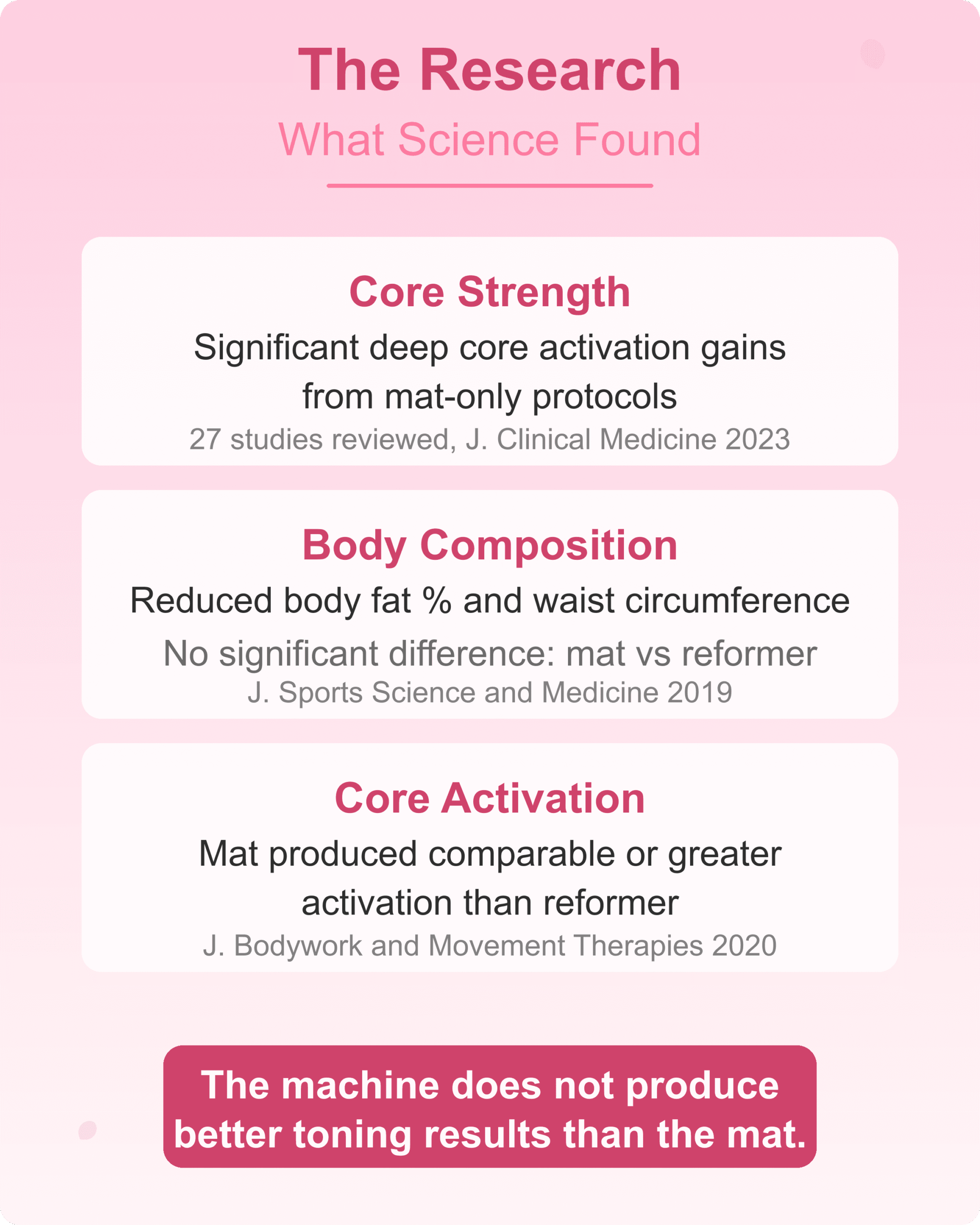
A 2023 systematic review in the Journal of Clinical Medicine analysing 27 studies found that pilates (including mat-only protocols) significantly improved deep core muscle activation. The transverse abdominis and multifidus (your deepest core stabilisers) showed measurable increases in both strength and endurance. This is the muscle group that creates a flat, pulled-in midsection.
Body Composition
A 2019 meta-analysis in the Journal of Sports Science and Medicine found that pilates practitioners (mat and reformer combined) experienced significant reductions in body fat percentage and waist circumference. Notably, the study found no statistically significant difference in outcomes between mat-only and reformer-based protocols for these measures.
Read that again: no significant difference between mat and reformer for body composition changes. The machine does not produce fundamentally better toning results than the mat.
Muscle Endurance and Definition
A 2020 study in BMC Musculoskeletal Disorders found that 8 weeks of mat pilates (three sessions per week) produced significant improvements in muscular endurance, flexibility, and functional movement. Participants showed measurable improvements in muscle definition, particularly in the core, glutes, and shoulders.
Mat vs Reformer: The Direct Comparison
A 2020 study in the Journal of Bodywork and Movement Therapies compared mat and reformer pilates head-to-head. The findings: mat pilates produced comparable or greater core muscle activation than reformer pilates for several foundational exercises. The reformer added variety and upper body options, but the core toning was equivalent.
For a full side-by-side comparison, our reformer vs mat pilates guide breaks down every factor.
Why Mat Pilates Is Actually Harder Than the Reformer (For Your Core)
This is the part that surprises most people. Mat pilates is not the easy version of reformer pilates. For your deep core, it is often harder.
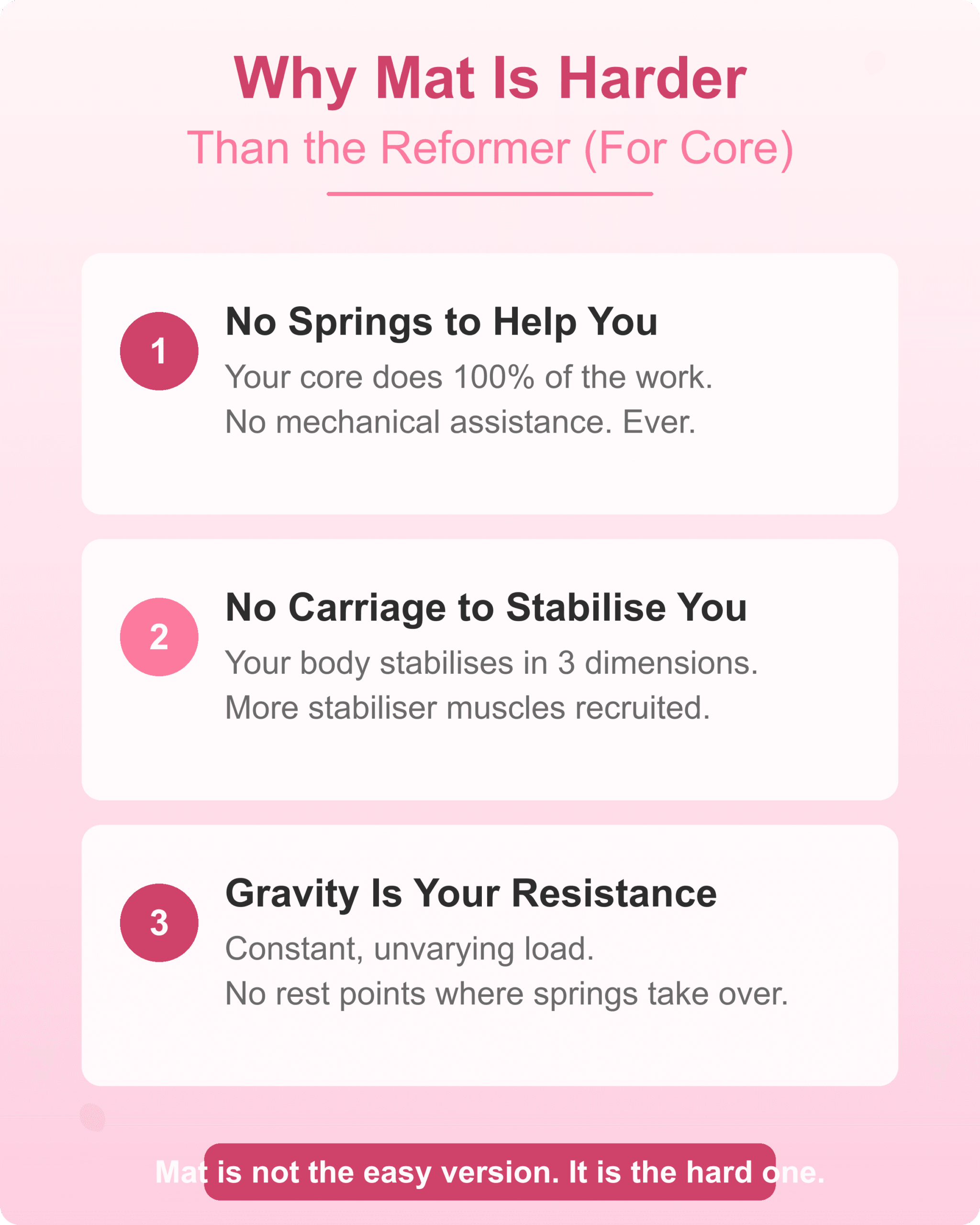
No Springs to Help You
On a reformer, springs assist certain movements. A roll-up that feels impossible on a mat becomes doable on a reformer because the springs help lift your torso. This is useful for beginners, but it also means your core is doing less work because the machine is sharing the load.
On a mat, your core does 100% of the work. Every lift, every hold, every controlled lowering is powered entirely by your own muscles. There is no mechanical assistance. This means fewer reps often produce greater muscle activation per rep.
No Carriage to Stabilise You
The reformer carriage slides on rails, which guides your movement along a fixed path. On a mat, there is no fixed path. Your body has to stabilise in three dimensions, recruiting more stabiliser muscles and demanding more from your proprioceptive system (your body’s awareness of where it is in space).
This three-dimensional stability demand is why mat pilates practitioners often have exceptional functional core strength: the kind that translates to real life, not just to looking good.
Gravity Is Your Resistance
On a mat, gravity is your only resistance. This sounds like a limitation, but it is actually an advantage for deep muscle activation. Gravity provides constant, unvarying resistance that your muscles must work against for the entire duration of each exercise. There is no rest point, no moment where the spring takes over.
What Mat Pilates Results Actually Look Like (Timeline)
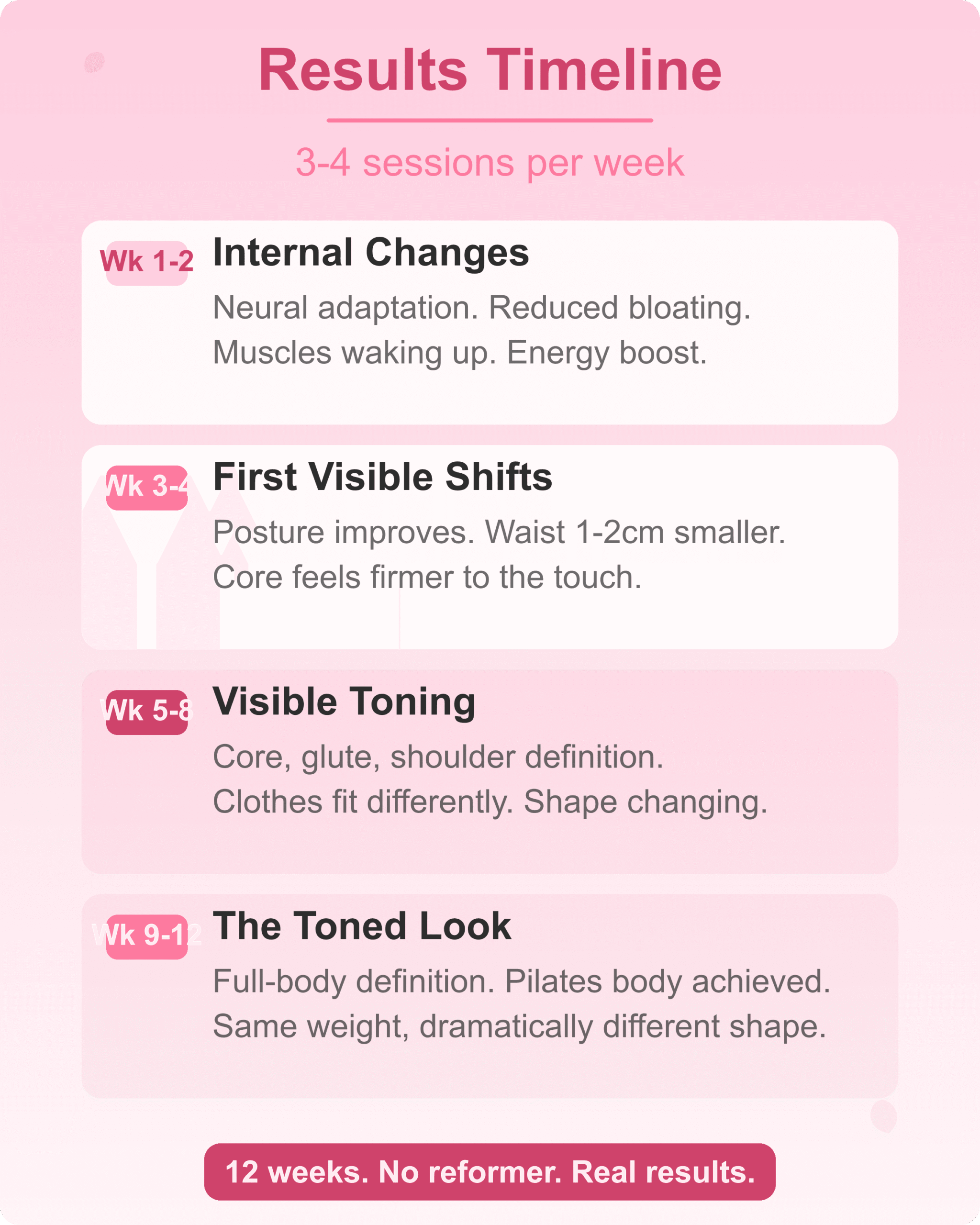
Here is a realistic timeline for mat pilates results when practising three to four sessions per week.
Weeks 1-2: Internal Changes
- Neuromuscular adaptation (brain learning to activate deep core)
- Reduced bloating from improved breathing and core engagement
- Slight energy boost and improved mood
- Muscles you did not know existed start to wake up
Weeks 3-4: First Visible Shifts
- Posture improvement (the first change people notice from the outside)
- Waist measurement may decrease 1 to 2cm (core toning, not fat loss)
- Core feels firmer to the touch
- Exercises that felt impossible are now manageable
Weeks 5-8: Visible Toning Begins
- Core definition emerging, especially obliques
- Glute and thigh shape changing (more sculpted, lifted)
- Shoulder and upper back definition from planks and push-up variations
- Clothes fitting differently (shape change, not necessarily size change)
Weeks 9-12: The Toned Look Arrives
- Full-body muscle definition visible: arms, core, legs, glutes
- Body composition shift (same weight, dramatically different shape)
- Posture transformation that makes you look taller and leaner
- The classic “pilates body”: long, lean, defined, not bulky
Our wall pilates before and after timeline shows similar week-by-week progression for wall-based home practice.
What Mat Pilates Cannot Do (The Honest Limitations)
Mat pilates is remarkably effective, but it has genuine limitations.
Limited Upper Body Resistance
Without straps or springs, mat pilates upper body work is restricted to push-up variations, planks, and exercises where your arms support your body weight. If upper body toning is a primary goal, adding a few sets of light dumbbell work or trying occasional reformer classes fills the gap. Our reformer beginner guide can help if you want to add studio sessions.
Cannot Spot-Reduce Fat
Mat pilates will strengthen and define the muscles in any area, but it cannot selectively burn fat from specific locations. If you want your abs to show, you need the muscle (which pilates builds) and a low enough body fat percentage (which nutrition manages). Both are required.
Progressive Overload Is Limited
Your body weight is your only resistance. Once your muscles adapt, you progress by increasing reps, hold times, tempo, and exercise complexity rather than adding weight. This means mat pilates will tone and define, but it will not build significant muscle mass. For most women, this is the exact result they want.
Requires Consistency to Work
One mat pilates session per week will not produce visible toning. The minimum effective dose is two to three sessions per week, every week, for at least six to eight weeks. If consistency is your challenge, our pilates consistency guide has science-backed strategies for making the habit stick.
How to Maximise Your Mat Pilates Results
If you want the fastest path to a toned body using only mat pilates, follow these principles.
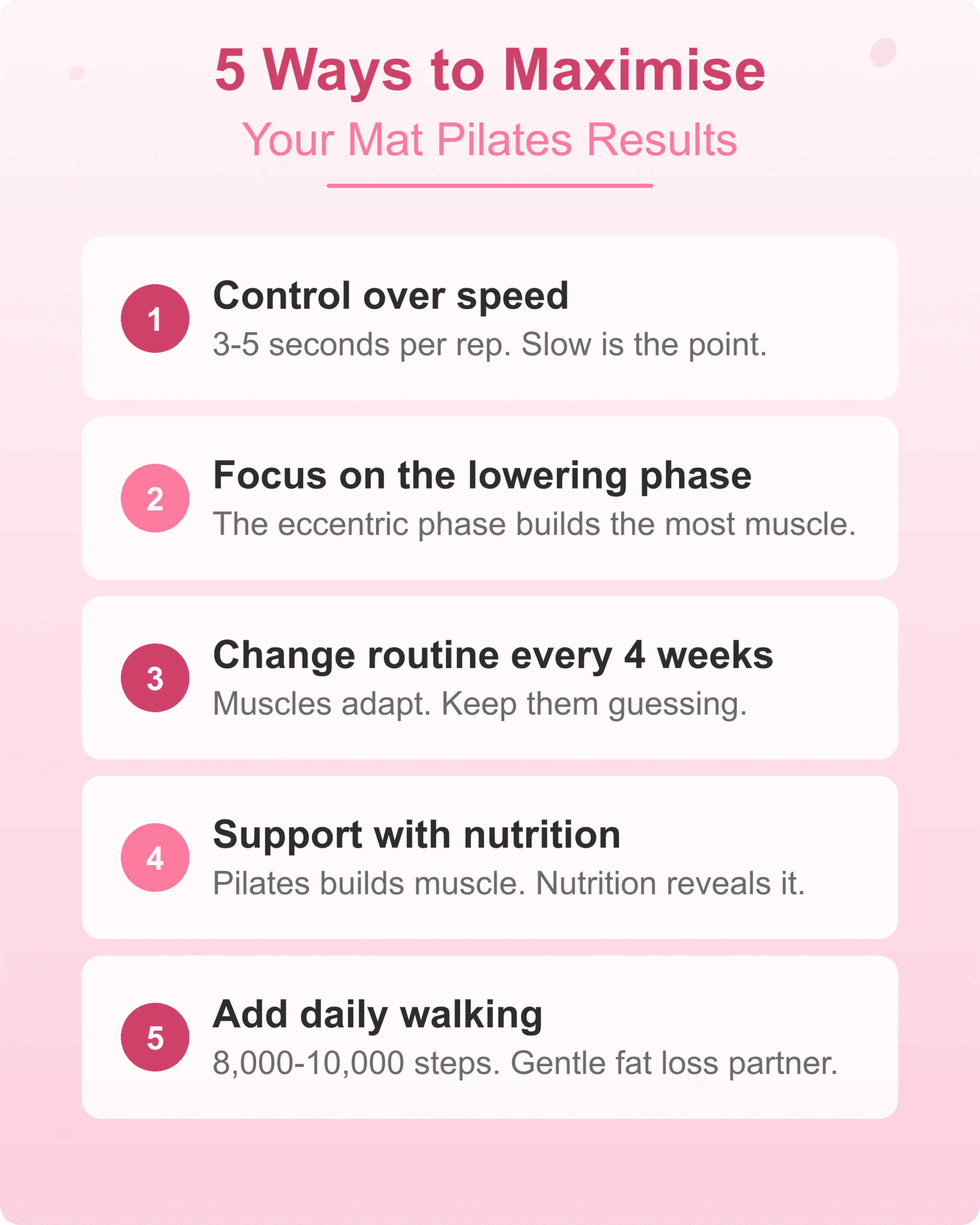
1. Prioritise Control Over Speed
Every rep should take 3 to 5 seconds. If you are rushing through exercises, you are using momentum instead of muscle. Slow, controlled movement recruits more muscle fibres and produces better toning results per rep.
2. Focus on the Eccentric Phase
The lowering portion of each exercise (called the eccentric phase) is where the most muscle damage and rebuilding happens. When lowering from a bridge, rolling down from a roll-up, or returning your leg from a circle, control the descent. Do not let gravity do the work. This single change can dramatically improve your results.
3. Add Variety Every 4 Weeks
Your muscles adapt to stimulus. After four weeks of the same routine, your body becomes efficient at those movements and the toning stimulus decreases. Switch exercises, change the order, add longer holds, or try a completely different routine. Our mat pilates beginner guide gives you a foundation, and our 28-day wall pilates challenge adds variety with wall-based exercises.
4. Support Your Practice with Nutrition
Toning requires visible muscles, which requires manageable body fat. You do not need a strict diet. Focus on adequate protein (1.2 to 1.6g per kg of body weight), plenty of vegetables, adequate hydration, and reasonable portions. The pilates builds the muscle; the nutrition reveals it.
5. Combine Mat Work with Walking
Adding 8,000 to 10,000 daily steps alongside your mat pilates practice supports cardiovascular health and gentle fat loss without competing with your pilates recovery. Walking and pilates together are one of the most effective, sustainable, and gentle body transformation combinations available. This aligns perfectly with the gentle movement philosophy that drives lasting results.
Frequently Asked Questions
Can mat pilates alone give you a toned body?
Yes. Mat pilates builds lean, dense muscle throughout your core, glutes, legs, and shoulders. Combined with consistent practice (three to four sessions per week) and balanced nutrition, mat pilates produces the sculpted, defined look most women describe as “toned” within 8 to 12 weeks.
Is mat pilates as effective as reformer pilates for toning?
For core toning, mat pilates is equally effective or even superior because your body does all the work without spring assistance. The reformer offers more upper body variety. For overall body composition, research shows no significant difference between the two.
How long does it take to see toning results from mat pilates?
Posture improvement shows within 3 to 4 weeks. Visible muscle definition typically appears between weeks 6 and 8. Full body toning with noticeable shape change arrives around weeks 10 to 12 with three to four sessions per week.
Why am I not getting toned from mat pilates?
The most common reasons: not practising frequently enough (minimum 2 to 3 times per week), moving too fast (rushing reduces muscle activation), not progressing exercises after the first month, or body fat covering the muscle you have built. Our why pilates is not working guide covers all the hidden barriers.
Do I need to add weights to mat pilates for toning?
No. Your body weight provides sufficient resistance for the lean, sculpted look most women want. Weights can be added for variety after 3 to 6 months of consistent practice, but they are not required for visible toning results. Focus on control, precision, and progressive exercise complexity instead.
Your Next Step
The question was never whether mat pilates can get you toned. The research is clear: it can. The real question is whether you will practise consistently enough, for long enough, to let the results show up.
Mat pilates is not the budget version of reformer pilates. It is the original, the foundation, and for many women, it is the only form they ever need. Your body weight is enough resistance. Your living room floor is enough space. Your willingness to show up is the only equipment that matters.
Ready to start? The 28-Day Flat Tummy Reset combines mat pilates with nutrition guidance for accelerated toning results. Or if building the daily habit is your biggest challenge, the Pilates Consistency Cheat Code gives you the framework to make showing up effortless.
You do not need a reformer to bloom. You just need a mat, 20 minutes, and the patience to trust the process.